


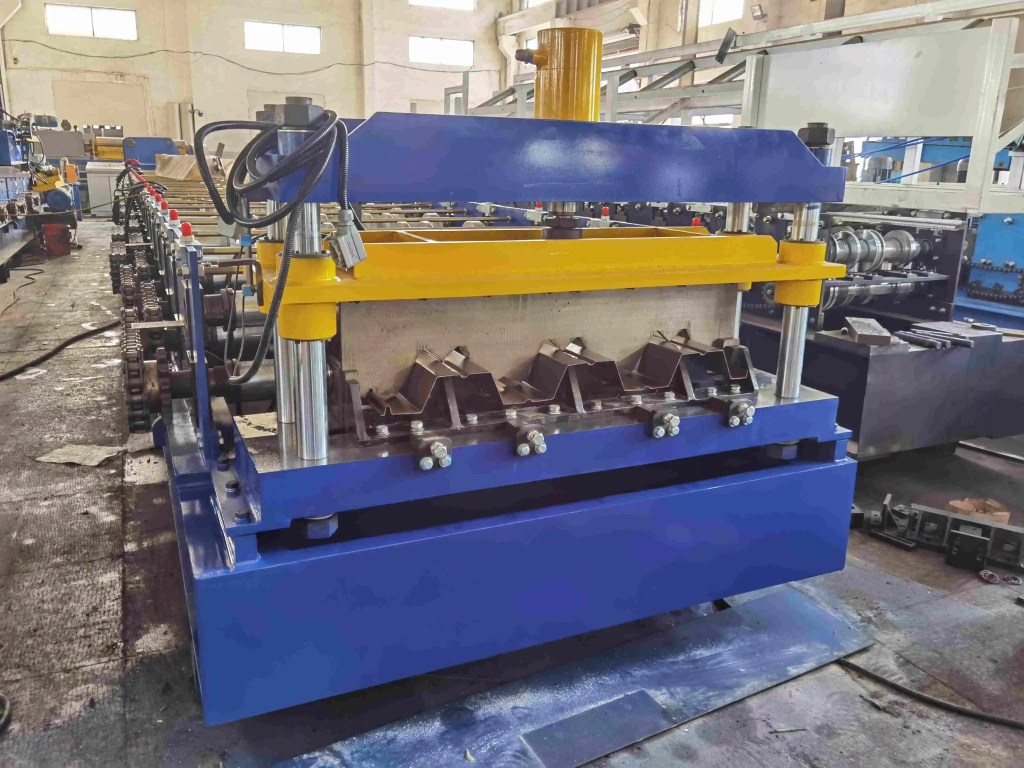
The global push for rapid infrastructure development has placed immense pressure on the manufacturing sector to produce high-strength, durable, and precise structural components. At the heart of this revolution is the bridge decking roll forming machine. These systems are no longer just metal benders; they are precision-engineered laboratories that transform high-yield galvanized steel into the backbone of modern transit.
4 Powerful 2026 Engineering Innovations
1. Engineering Precision in Bridge Decking Roll Forming Machine Design
Modern bridge decking requires a delicate balance between weight and structural integrity. A 2026-grade bridge decking roll forming machine must handle material thicknesses ranging from 1.2mm to 2.0mm, often with yield strengths exceeding 550 MPa. To achieve this, Believe Industry utilizes a heavy-duty rafted changeover system.
Engineering precision in a bridge decking roll forming machine is achieved through a multi-stage forming process that manages longitudinal strain and prevents “oil-canning” in wide-span profiles. High-torque AC variable frequency drives ensure constant speed, while D2 tool steel rollers maintain profile accuracy over millions of linear meters.
2. Overcoming Material Springback in High-Yield Structural Steel
One of the most significant challenges in bridge deck production is springback—the tendency of the metal to return to its original shape after bending. In structural decking, even a 1-degree deviation can compromise the interlocking of panels at the construction site.
To combat this, a high-end bridge decking roll forming machine incorporates over-bending technology in the final forming stations. By calculating the “Flower Pattern” (the step-by-step unfolding of the profile) using advanced FEA (Finite Element Analysis) software, we can predict exactly how much a specific gauge of steel will “kick back” and adjust the roller geometry accordingly. For a deeper look at these mechanics, read our comprehensive analysis of roll forming machine technology.
3. Custom Embossing Systems for Enhanced Concrete Bonding
Bridge decking serves two purposes: it acts as a permanent formwork during the pouring of concrete and as a composite reinforcement once the concrete cures. This “composite action” is only possible if the steel and concrete are mechanically locked together.
The integration of high-pressure embossing rollers within the bridge decking roll forming machine line creates specialized indentations (lugs) on the ribs of the deck. For 2026, we have introduced “Micro-Grip” embossing, which increases the surface contact area by 15%, significantly improving the shear bond between the steel and the concrete slab. This process is essential for meeting AISC (American Institute of Steel Construction) structural requirements.
4. Integrating the Machine into Automated Construction Workflows
Efficiency in 2026 is measured by the reduction of “human-in-the-loop” time. A modern bridge decking roll forming machine is now equipped with Smart-Cut Hydraulic Shear systems. These units are synchronized via fiber-optic encoders to the PLC, allowing for “fly-cutting” where the machine never stops, even while cutting panels to precise lengths.
Tolerance Control: ±1mm per 10 meters.
Production Speed: Optimized at 15-20m/min for heavy-gauge profiles.
Integration: Often paired with a heavy-duty slitting line to ensure raw material width precision.
6 High-Value FAQs
Most industrial lines handle 0.8mm to 1.5mm steel, but Beli’s heavy-duty bridge decking roll forming machine series processes up to 2.0mm structural galvanized steel.
Through an integrated embossing station that creates “lugs” on the profile’s side webs, providing a mechanical bond for composite action.
Standard runs are 10–12 meters per minute, while high-speed bridge decking roll forming machine lines reach 25 meters per minute.
Yes, by utilizing Rafted Sub-plates, the entire set of rollers can be swapped out in under 30 minutes.
We use advanced side-roll stands and over-bend calculations as detailed in the Steel Deck Institute (SDI) design manuals.
Daily lubrication of the drive chains and gearboxes is essential, similar to the maintenance of cut-to-length lines.
Conclusion: Dominating the 2026 Infrastructure Market
The evolution of the bridge decking roll forming machine represents a pivotal shift in industrial manufacturing. By 2026, the success of structural steel fabrication will no longer rely solely on output volume, but on the marriage of high-yield material handling and precision automation.
As we have explored, the integration of advanced FEA-backed flower patterns, high-pressure embossing for composite action, and smart hydraulic shear systems ensures that every panel produced meets the rigorous safety and durability standards required for modern bridge construction. For manufacturers, investing in a bridge decking roll forming machine that accounts for mechanical deflection and springback is not just a technical upgrade—it is a strategic necessity to secure high-value government and private infrastructure contracts.
Ready to revolutionize your structural steel production?
Don’t let outdated machinery bottleneck your infrastructure growth. Partner with Believe Industry Company to deploy a custom-engineered bridge decking roll forming machine designed for 2026 tolerances.
👉 Request a Technical Consultation & Quote Today
For a deeper dive into the mechanics of industrial fabrication, explore our comprehensive analysis of roll forming machine technology and discover how Beli Rollforming is shaping the future of global construction.


