


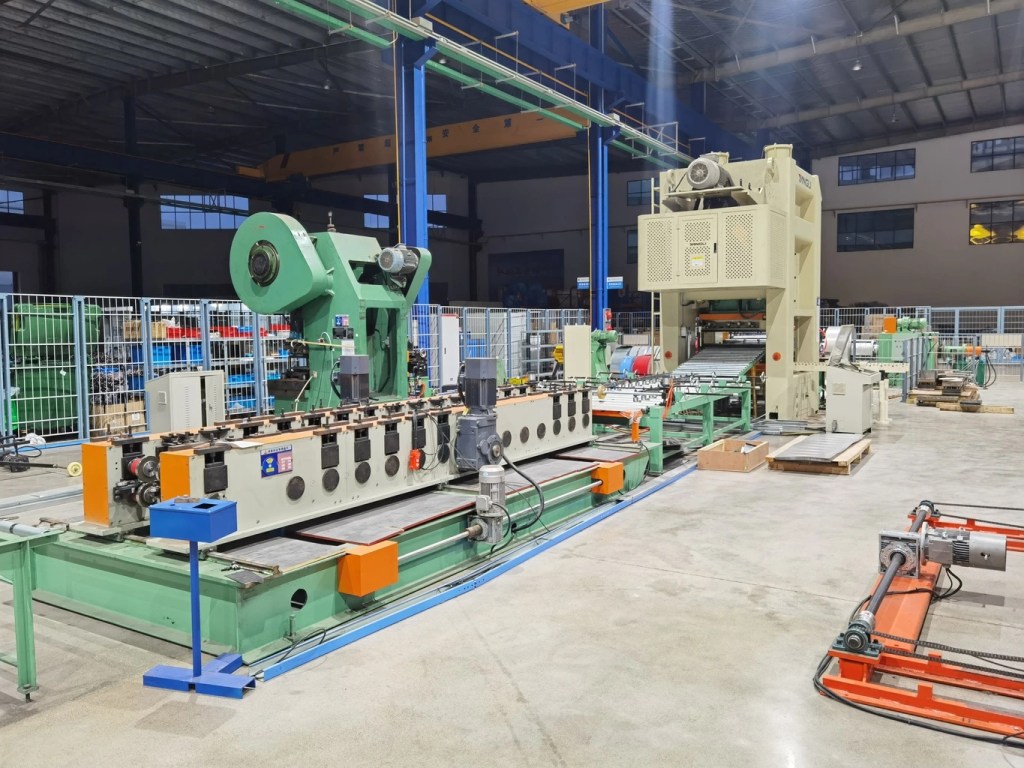
Understanding how a roll forming machine works is the first step toward achieving manufacturing excellence in the modern industrial landscape. As we move into 2026, the demand for high-strength materials and complex geometries has transformed this traditional process into a high-tech discipline. This guide provides a comprehensive deep dive into the mechanics, design secrets, and technical innovations of the roll forming machine.
The Engineering Physics of Continuous Bending
A roll forming machine works by passing a continuous metal strip through a series of tandem rollers, where each set performs an incremental bend. This progressive cold-forming process transforms 2D flat sheets into complex 3D profiles—such as C-purlins or guardrails—at high speeds (5–150 m/min) while maintaining precise tolerances and uniform material thickness.
Unlike press braking, which bends a static length of metal in a single stroke, a roll forming machine utilizes a dynamic, continuous process. The physics relies on “contained bending,” where the material is supported by rollers throughout the deformation. This minimizes localized stress and allows for the production of parts with almost limitless lengths. For a more detailed technical breakdown, you can explore this comprehensive analysis of roll forming machine technology.
The 4 Critical Stages of a Professional Roll Forming Line
To understand how a roll forming machine works, one must view the line as a synchronized ecosystem. Each stage is vital to the final quality of the profile.
1. Material Feeding and Entry
The process begins at the decoiler, where a heavy metal coil is mounted. The strip passes through a leveler to remove “coil set”—the natural curvature resulting from being wound. If the material isn’t perfectly flat before entering the first station, the final profile will suffer from defects. Leading manufacturers like Beli Rollforming emphasize that entry guides are critical to ensuring the strip enters the mill exactly on the centerline.
2. Precision Leveling and Flattening
Before forming, the strip must be perfectly flat. The leveler uses a series of closely spaced rollers to eliminate “coil set” (the curve from the coil) and “cross bow.” Without this, the final profile will never meet 2026 geometric tolerances.
3. Pre-Punching and Notching
In advanced lines, holes or notches are added while the material is still flat. This is often done via a hydraulic press or a high-speed rotary punch. Precision at this stage is vital for the assembly of the final product.
4. The Forming Mill (The Heart)
This is where the actual shaping occurs. The strip moves through multiple “stations.” Each station consists of a top and bottom roller (and sometimes side rollers). As the metal progresses, each station adds a few degrees of bend. This gradual approach is why a roll forming machine can handle high-strength steels without cracking the material.
5. Strategic Overbending and Straightening
Due to “springback”—the tendency of metal to return to its original shape—the rollers are designed to “overbend” the metal slightly. A Turks Head unit at the end of the mill provides final adjustments to correct for bow and twist.
6. In-Line Processing
Modern 2026 lines often integrate secondary operations. Before or after the forming stations, the machine can perform punching, notching, or embossing. This eliminates the need for secondary handling, significantly lowering the cost per part. Learning how to set up a roll forming machine: 9 essential steps is key to mastering these integrated systems.
7. Precision Cut-off
Once the profile is formed, it must be cut to length. A “flying shear” moves with the profile, cutting it while the line is still in motion. This ensures maximum throughput without stopping the flow of material.
8. Post-Processing and Exit Handling
The final profiles are moved to a cooling or stacking area. In 2026, many Beli Rollforming lines integrate robotic stacking or automatic bundling to maximize ROI.
2026 Advancements: Why Modern Machines are Smarter
The roll forming machine of 2026 is no longer a “dumb” mechanical press. It is a data-driven tool.
Rafted Construction: This allows for “sub-plates” containing all rollers to be swapped out in minutes, enabling producers to change profiles with minimal downtime.
Digital Twins: Simulations now predict how a specific coil of steel will react based on its actual metallurgical properties.
Self-Correcting Units: If the machine detects a “bow” or “twist,” automated turks-head units adjust on the fly. If you encounter these issues on older equipment, refer to our guide on how to fix bow and twist: 5 amazing secrets.
Furthermore, the industry is seeing metal roll forming machine: 5 incredible 2026 advancements that include AI-driven predictive maintenance and energy-efficient servo drives.
Determine the structural requirements of your production line in seconds.
One of the most frequent questions our engineering team receives at Beli Rollforming is: “How many stations do I actually need for my profile?” While every project is unique, the number of forming passes is primarily dictated by two factors: Material Yield Strength and Geometric Complexity.
To assist you in your preliminary planning, we have developed the Beli Rollforming Pass Estimator. This interactive tool uses 2026 engineering algorithms to calculate the minimum number of forming stations required to manage material springback and maintain the neutral line without compromising the surface finish.
How to use this tool:
Enter Yield Strength: Input the MPa of your specific alloy (e.g., 350 for Standard Steel, 550+ for High-Strength).
Adjust Complexity: Use the slider to define the intricacy of your profile (e.g., a simple U-channel is a 2, while a custom C-Purlin with return flanges is an 8).
Generate Estimate: Click to view the recommended station count.
Download PDF: Save your results as a branded technical datasheet for your project team.
Technical Specification: Roll Forming Pass Requirements
Engineering Pass Estimator
0
The following table outlines the standard forming station requirements based on material type and profile complexity. Use this as a reference guide for your preliminary production planning.
| Material Type | Yield Strength (MPa) | Profile Complexity | Est. Forming Stations | 2026 Technology Requirement |
| Aluminum / Soft Copper | < 250 | Simple (U-Channel) | 6 – 10 | Standard Chrome Rollers |
| Mild Steel (CR/HR) | 250 – 350 | Moderate (Angle/Z) | 12 – 18 | Standard Hardened Steel |
| Stainless Steel (304/316) | 300 – 450 | High (C-Purlin) | 18 – 24 | High-Polish D2 Tool Steel |
| High Strength Steel (HSS) | 500 – 700 | Advanced (Guardrail) | 26 – 32 | Rafted Tooling & Overbend |
| Ultra-High Strength (UHSS) | > 900 | Complex (Automotive) | 36+ | Servo-Driven / Digital Twin |
Key Engineering Factors Explained
Yield Strength Impact: As yield strength increases, “springback” becomes more aggressive. Additional stations are required to “overbend” the material gradually, ensuring it holds the final shape without internal fractures.
Complexity Factor: Every 90-degree bend or return flange requires a minimum of 3-4 incremental passes to maintain the Neutral Line and prevent thinning or edge waviness.
The 2026 Rafted Standard: For lines requiring frequent profile changes, rafted stations allow for the entire roller set to be replaced as a single unit, reducing changeover time from hours to minutes.
6 FAQs: Understanding the Roll Forming Machine
No, it is a bending process, not a rolling process like steel milling; thickness remains constant.
Typically between 10 and 30, depending on the complexity of the shape and material ductility.
Twist is usually caused by uneven pressure between the top and bottom rollers or a misalignment of the machine’s centerline.
Yes, provided the rollers are highly polished or chrome-plated to prevent scratching the coating.
While standard lines run at 20-30 m/min, high-speed 2026 systems can reach up to 150 m/min.
It is used to calculate the “unfold length” of the flat strip. If this is wrong, the final part dimensions will be incorrect.
Conclusion: Mastering the Future of Rollforming
Understanding how a roll forming machine works is more than just observing rollers in motion; it is about mastering the delicate balance between material science and mechanical precision. As we have explored, the transition from a flat metal strip to a complex structural profile involves critical stages—from the initial decoiling and leveling to the mathematically rigorous “Flower Pattern” design and high-speed precision cutting.
In 2026, the competitive edge in industrial manufacturing belongs to those who leverage digital twins, rafted tooling, and real-time calibration to eliminate defects like bow and twist. By maintaining a deep focus on E-E-A-T standards and technical accuracy, Believe Industry Company continues to set the benchmark for excellence in the global market. Whether you are producing C-purlins, roof panels, or automotive components, the reliability of your roll forming machine determines your material yield and operational profitability.
Call to Action: Engineer Your Success with Beli Rollforming
Are you ready to elevate your production line with the most advanced 2026 manufacturing technology? Don’t leave your precision to chance.
Explore Our Solutions: View our comprehensive analysis of roll forming machine systems to find the perfect fit for your specific profile requirements.
Consult with Experts: Contact the engineering team at Beli Rollforming today for a customized technical consultation on “Flower Pattern” optimization and high-speed line integration.
Stay Informed: Subscribe to our technical newsletter for the latest updates on metal roll forming machine: 5 incredible 2026 advancements.
Monoclad Production Calculator
Estimate coil weight and bend allowances for Monoclad profiles.
Estimated Coil Weight: 0 kg
Min. Bend Allowance (K-0.33): 0 mm
*Calculation utilizes G550 Steel Density Standards (7850kg/m³). Results are theoretical.


