เครื่องขึ้นรูปโลหะแบบม้วนหลายโปรไฟล์_ ระบบคาสเซ็ตต์เทียบกับระบบเปลี่ยนเร็ว

เครื่องขึ้นรูปโลหะม้วนสำหรับหลายรูปทรง: ระบบคาสเซ็ตต์เทียบกับระบบเปลี่ยนเร็ว

Most roll forming lines run one profile. That is the simplest setup and still the most common. But buyers who serve multiple markets, handle short production runs, or supply varied product families face a different challenge. They need a roll forming machine multi profile setup that switches between profiles without buying a second line.

Two technologies dominate this space: cassette tooling systems and quick-change roller systems. They sound similar. They are not. The mechanical design, changeover time, cost structure, and production trade-offs are fundamentally different. Pick the wrong one and you either overspend on tooling you do not need or lose production hours on changeovers that should take minutes.

Believe Industry Company has built flexible roll forming equipment for over 15 years, shipping to 20+ countries. This guide breaks down both systems with real numbers so you can make the right call.

What Is a Cassette Tooling System?

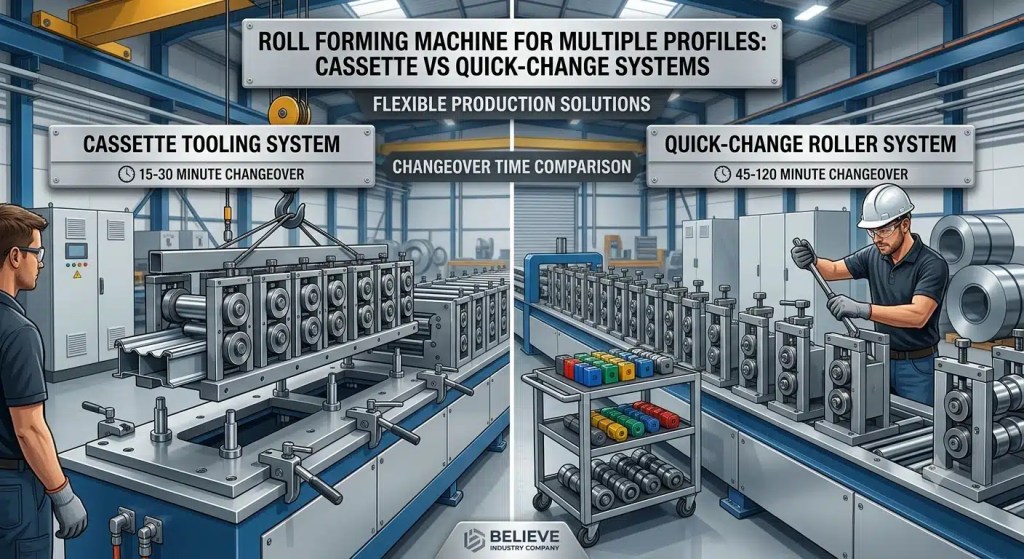
A cassette tooling system mounts an entire set of forming rollers on a removable frame, called a cassette or raft. When you need to switch profiles, you pull the entire cassette off the machine base and drop in a different cassette pre-loaded with the roller set for the next profile.

Think of it as swapping a completed sub-assembly. The rollers inside the cassette are already spaced, aligned, and calibrated. You are not touching individual rollers. You are replacing the whole block.

The mechanical interface matters. A well-designed cassette system uses a rafted mill design where each cassette bolts onto precision-machined locating dowels on the machine base. Hydraulic clamps or quick-lock handles secure it. The drive shafts connect through splined couplings that self-align on insertion.

This is the system used on high-end drywall partition roll forming lines where manufacturers switch between C-stud and U-track profiles daily. It is also common on เครื่องจักรสำหรับรางค้ำยัน producing multiple P-series profiles on one frame.

What Is a Quick-Change Roller System?

A quick-change roller system keeps the roll stands in place. You change individual rollers (or roller pairs) on the existing stands. The “quick” part comes from design features that speed up what is normally a slow process.

Standard roll stands require operators to unbolt shafts, slide off rollers, slide on new ones, re-set gaps, and re-calibrate. That takes hours. Quick-change systems solve this with several approaches:

  • Split shaft design. The upper shaft lifts out without removing the lower shaft. Operators swap the upper rollers, then the lower ones, in sequence.
  • Pre-set spacer kits. Color-coded spacer rings come pre-measured for each profile. No trial-and-error spacing.
  • Quick-release bearing blocks. Hinged bearing housings open like a clamshell. No bolts to remove.
  • Recipe recall. The PLC stores roller gap settings, line speed, and cut length for each profile. Select the recipe and servo-driven stands auto-adjust.

เดอะ เครื่องขึ้นรูปม้วนสองชั้น uses a related concept. Two profile sets share one frame, each on its own tier. But that is a fixed configuration, not a changeable one. True quick-change means one set of stands handles multiple profiles through roller swaps.

Cassette vs Quick-Change: Head-to-Head Comparison

พารามิเตอร์Cassette Tooling SystemQuick-Change Roller System
เวลาเปลี่ยนผ่าน15 to 30 minutes45 to 120 minutes
Number of Rollers HandledEntire set (16 to 24 stations)Individual pairs (one stand at a time)
Alignment PrecisionPre-set in cassette, no re-calibrationRequires re-calibration after each swap
Tooling Cost per Profile$8,000 to $25,000 per cassette$3,000 to $12,000 per roller set
Floor Space NeededCassette storage rack (2 to 4 sqm per set)Roller storage cabinet (1 to 2 sqm)
Operator Skill LevelLow (drop in, lock, run)Medium to high (gap setting, calibration)
Max Profiles per Machine4 to 83 to 5
Best Production VolumeLow to medium batch, frequent changesMedium batch, moderate change frequency

The trade-off is clear. Cassettes are faster to change but cost more per profile. Quick-change rollers are cheaper per profile but take longer to swap and need more operator skill.

Changeover Time Breakdown

Changeover time is the metric that determines whether your multi profile machine actually saves money. Here is what happens during a typical profile switch:

StepCassette SystemQuick-Change System
Stop line, run out material5 min5 min
Remove current tooling5 min (unlock, lift cassette)20 to 40 min (remove 16 to 24 roller pairs)
Install new tooling5 min (drop in, lock)15 to 30 min (install + space rollers)
Calibrate gaps0 min (pre-set in cassette)10 to 20 min (manual or servo-assisted)
First-piece test + adjust5 to 10 min10 to 20 min
Total Changeover20 to 25 min60 to 115 min

A cassette system hits 20-minute changeovers consistently. A quick-change roller system averages 75 to 90 minutes. That difference compounds fast. If you switch profiles three times per week, the quick-change system loses 3 to 4 additional production hours weekly compared to cassettes.

This is why wall cladding manufacturers running short batches with frequent profile changes gravitate toward cassette systems. The changeover time savings pay for the higher tooling cost within the first year.

Cost Comparison: Initial Investment vs Long-Term Value

ปัจจัยต้นทุนCassette SystemQuick-Change System
Base Machine$60,000 to $120,000$45,000 to $90,000
Tooling per Additional Profile$8,000 to $25,000$3,000 to $12,000
4-Profile Total Investment$84,000 to $195,000$54,000 to $126,000
Operator Training CostLower (simpler procedure)Higher (calibration skills needed)
Downtime Cost (per changeover)$100 to $250 (20 min lost)$375 to $900 (75 min lost)

The crossover point depends on changeover frequency. If you switch profiles once a month or less, quick-change rollers win on total cost. If you switch weekly or more, cassettes win because the downtime savings exceed the tooling premium within 12 to 18 months.

Factor in operator skill. Cassette systems run reliably with less experienced operators. Quick-change systems need someone who understands roller gap setting, material springback, and first-piece inspection. In markets with high labor turnover, that matters.

Which System Fits Your Production?

Choose Cassette Tooling If:

  • You run 3 or more profiles on the same line regularly
  • Changeover happens more than once per week
  • Your operators have basic training, not tooling specialist skills
  • Your profiles are in different product families (different widths, heights, or material thickness ranges)
  • You produce for multiple export markets with different profile standards

Choose Quick-Change Rollers If:

  • You run 2 to 3 profiles with moderate change frequency
  • Your profiles share similar dimensions (same width range, similar thickness)
  • You have experienced operators who can handle calibration
  • Your budget is tighter and tooling cost per profile matters
  • You produce roofing sheet profiles where two cover widths share most forming stages

Real-World Application Scenarios

Scenario 1: Cable Tray Manufacturer in Saudi Arabia. A factory in Dammam produces perforated trays, solid-bottom trays, and cable ladder rungs. Three profiles, different widths (100 to 600 mm), changed 4 to 5 times per week. Cassette tooling is the right choice. The เครื่องขึ้นรูปรางเคเบิลแบบม้วน line runs one profile in the morning, another after lunch. Total changeover: 22 minutes. With quick-change rollers, the same switch would take 80 minutes and lose half a shift.

Scenario 2: Roofing Sheet Producer in Africa. A manufacturer in Nairobi serves the local market with corrugated and IBR profiles. Two profiles, same material thickness, changed once every 10 days. Quick-change rollers make sense here. The extra 60 minutes of changeover every two weeks costs less than the $16,000 premium a second cassette would add. The เครื่องขึ้นรูปม้วนแผ่นลูกฟูก and IBR profiles share enough forming stages that roller swaps are straightforward.

Scenario 3: Strut Channel Job Shop in Southeast Asia. A Singapore fabricator produces P1000, P1100, and P300 strut channels for different projects. Three profiles, changed 2 to 3 times per week. Cassette tooling wins. The P1000 strut channel roll forming machine with cassettes handles all three series with under-25-minute changeovers. The same machine with quick-change rollers would need 60 to 90 minutes per switch.

Decision Framework: 5 Questions to Ask Before Buying

  1. How many profiles will you run on this line? Three or more points to cassettes. Two points to quick-change rollers.
  2. How often will you switch profiles? Weekly or more favors cassettes. Monthly or less favors quick-change rollers.
  3. Are your profiles similar or fundamentally different? Similar profiles (same width, similar height) work well with quick-change rollers. Radically different profiles need cassettes.
  4. What is your operator skill level? Basic operators need the simplicity of cassettes. Experienced tooling technicians can handle quick-change roller calibration.
  5. What is your 5-year tooling budget? Calculate total cost: base machine plus tooling for every profile plus estimated downtime cost per changeover. The system with the lower 5-year total cost is your answer.

The single-minute exchange of die (SMED) methodology from the Lean Enterprise Institute is the foundation of both cassette and quick-change design. According to the Fabricators & Manufacturers Association, changeover reduction is one of the top three efficiency levers in roll forming production. The National Institute of Standards and Technology also highlights quick-change methodologies in manufacturing efficiency studies. The principle is the same: less time changing tooling means more time producing.

Frequently Asked Questions of Roll Forming Machine Multi Profile

What is the difference between cassette tooling and quick-change rollers?

Cassette tooling swaps an entire pre-assembled roller set mounted on a removable frame. Quick-change rollers swap individual roller pairs on fixed stands. Cassettes are faster but cost more per profile. Quick-change rollers are cheaper but take longer and require more operator skill.

Can I upgrade a fixed-stand machine to cassette tooling later?

Usually no. The machine base needs precision-machined locating surfaces and clamping interfaces for cassettes. Retrofitting these onto a standard fixed-stand frame is rarely cost-effective. If you think you will need cassettes, spec the machine for it from the start.

How many profiles can one roll forming machine handle?

A cassette system typically handles 4 to 8 profiles. A quick-change roller system handles 3 to 5. Beyond those limits, the compromise in roller optimization for each profile degrades quality. For more than 8 profiles, buy a second line.

Does cassette tooling affect forming precision?

No. A well-engineered cassette holds the same tolerance as a fixed stand. The locating dowels and splined drive couplings maintain alignment within 0.05 mm. The pre-set roller gaps inside the cassette eliminate the human error that comes with manual gap setting on quick-change systems.

What is the typical ROI for a cassette system over quick-change rollers?

If you switch profiles 3 or more times per week, cassette tooling pays for itself in 12 to 18 months through reduced downtime. At one switch per week, the payback stretches to 24 to 36 months. At one switch per month or less, quick-change rollers remain the cheaper option over the machine’s life.

Tab Can a multi profile machine handle different material thicknesses?

Yes, if the machine is designed for it. The frame, shaft diameter, and motor power must be sized for the thickest material you plan to run. Roller gaps adjust for thinner material. However, mixing very different thicknesses (like 0.5 mm roofing and 3 mm structural sections) on one line is not practical even with cassette tooling.

Does Believe Industry offer both cassette and quick-change systems?

Yes. Believe Industry configures machines with either system based on the buyer’s production requirements. We review your profile drawings, changeover frequency, and budget to recommend the right approach. Quote turnaround is two business days with full interchangeability drawings.

Last updated: August 3, 2026

บันทึกการเปลี่ยนแปลงบทความ:

เวอร์ชั่นวันที่การเปลี่ยนแปลง
1.02026-08-03Initial publication. Cassette vs quick-change roller comparison for multi profile roll forming machines.

ตัวกระตุ้นการตรวจสอบครั้งต่อไป:

  • New cassette quick-lock clamping technology releases from major manufacturers
  • Changes in roller material technology affecting tooling cost benchmarks
  • Believe Industry product updates for multi profile machine configurations
  • Customer feedback on real-world changeover times across different profile families
  • Updates to FMA or NIST manufacturing efficiency guidelines

สารบัญ

อัปเดตใหม่

เครื่องขึ้นรูปโลหะแบบม้วนหลายโปรไฟล์_ ระบบคาสเซ็ตต์เทียบกับระบบเปลี่ยนเร็ว

เครื่องขึ้นรูปโลหะม้วนสำหรับหลายรูปทรง: ระบบคาสเซ็ตต์เทียบกับระบบเปลี่ยนเร็ว

สายการผลิตขึ้นรูปโลหะแบบรีดส่วนใหญ่จะใช้โปรไฟล์เดียว นั่นคือ...

อ่านเพิ่มเติม
เครื่องรีดขึ้นรูปในสหราชอาณาจักร

คู่มือเครื่องขึ้นรูปโลหะแบบม้วน (Roll Forming Machine) สำหรับสหราชอาณาจักร: มาตรฐาน CE/UKCA และ BS

การซื้อเครื่องขึ้นรูปโลหะม้วนในสหราชอาณาจักรในปี 2026 หมายความว่า...

อ่านเพิ่มเติม
เครื่องขึ้นรูปม้วนชั้นวางสินค้าปลีก

เครื่องขึ้นรูปม้วนสำหรับร้านค้าปลีก: 6 รูปแบบชั้นวางสินค้าสำหรับปี 2026

ธุรกิจค้าปลีกคือพื้นที่วางสินค้า ทุกทางเดินในซูเปอร์มาร์เก็ต ทุกห้างสรรพสินค้า...

อ่านเพิ่มเติม

ค้นพบข้อมูลเพิ่มเติมจาก Believe Industry Company| Roll Forming Machine Manufacturer, Supplier & Exporter

สมัครสมาชิกตอนนี้เพื่ออ่านต่อและเข้าถึงคลังบทความฉบับเต็ม.

อ่านต่อ

BELIEVE INDUSTRY | โซลูชันที่ปรับแต่งได้ตามความต้องการ

ขอของคุณ
ข้อเสนอทางวิศวกรรม