ที่อยู่
No 1, Yd Road, Huishan District, Wuxi City, Jiangsu. 214183
เวลาทำการ
จันทร์ถึงศุกร์: 9AM - 5PM
เสาร์: 9AM - 4PM
ที่อยู่
No 1, Yd Road, Huishan District, Wuxi City, Jiangsu. 214183
เวลาทำการ
จันทร์ถึงศุกร์: 9AM - 5PM
เสาร์: 9AM - 4PM
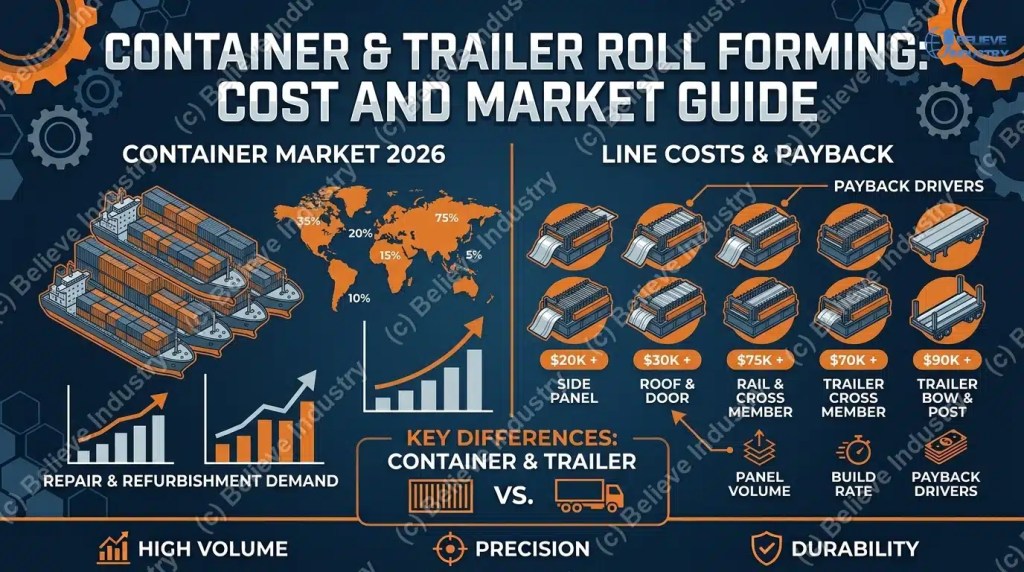
งานเครื่องขึ้นรูปตู้คอนเทนเนอร์เริ่มจากคอยล์เหล็กทนการกัดกร่อนหนา 1.6 มม. และจบที่แผ่นลายลูกฟ้าที่ต้องทนอากาศเกลือ 20 ปีและการซ้อนสูงเก้าชั้น นั่นคือใจความของงานทั้งหมด ไม่มีอะไรในหมวดนี้ที่เป็นเพียงการตกแต่ง ทุกโปรไฟล์รับแรงเชิงโครงสร้าง
คำนิยามเครื่องขึ้นรูปคอนเทนเนอร์: a continuous cold forming line that turns Corten or high-strength steel coil into the corrugated panels, cross members, and rails used in ISO shipping containers and road trailers, with in-line cutting to a fixed panel or member length.
The category splits into two sub-markets. Container lines run wide corrugated panels for box manufacturing and depot repair. Trailer lines run narrower structural sections for dry vans, flatbeds, and container chassis. Same machine family, different tooling, different tolerances. You can see how forming stations are arranged on a สายเครื่องมืดแผ่นโลหะ before you read the profile detail below.
เราสร้างและส่งมอบสายขึ้นรูปในกว่า 20 ประเทศเป็นเวลา 15 ปี งานตู้คอนเทนเนอร์และรถลากคือหมวดที่ผู้ซื้อพลาดทำสูญเสียบ่อยที่สุด คอยล์ไม่ใช่เกรดเหล็กหลังคามาตรฐาน และความคลาดเคลื่อนที่สำคัญไม่ใช่ความกว้างของโปรไฟล์ แต่คือความลึกของลาย ถ้าคลาดไป 3 มม. แผ่นจะไม่ผ่านการทดสอบแรงกดในแนวดิ่ง ซึ่งเป็นสิ่งที่การออกแบบตู้ทั้งหมดพึ่งพา
เส้นผลิตหลังคาและผนังอาคารขึ้นรูปเหล็กหนา 0.4 ถึง 0.6mm งานตู้คอนเทนเนอร์ใช้ความหนาเป็นสองเท่า และเปลี่ยนกลุ่มเหล็กทั้งหมด
สามปัจจัยที่ทำให้โปรไฟล์งานขนส่งยากกว่าโปรไฟล์งานอาคาร
Corten ผุกร่อนได้ แต่ก็แข็งตัวขึ้นจากการขึ้นรูป SPA-H and Corten A carry a minimum yield of 345 MPa, roughly 40% above a standard galvanized roofing grade. Deep corrugation on that steel springs back harder, so the forming schedule needs more passes and tighter roll gaps than a roofing line of the same gauge. Our การขึ้นรูปเย็น breakdown covers springback control in detail.
Corrugation is load bearing. The 36mm ribs on a container side panel are what let a stack of nine containers push 192,000 kg through the corner posts without the walls buckling. Depth tolerance on a container rib is typically plus or minus 1.5mm. Miss it and the wall loses stiffness in the direction that matters.
Panel edges are weld prep. Every side panel carries a flat edge, about 37mm wide, that gets welded to the next panel. Edge straightness and edge camber decide how fast the welding head can run. A panel with 2mm of edge wave costs more in welding rework than it saved in steel.
The governing documents are public. ISO 1496-1 sets the specification for series 1 freight containers, and ASTM A606 Type 4 defines the weathering steel most plants form. Read both before you finalize a tooling order.
| โปรไฟล์ | วัสดุและความหนา | Key dimension | ความเร็วสายผลิต | จำนวนสถานที่ |
|---|---|---|---|---|
| Container corrugated side panel | Corten A / SPA-H, 1.6 to 2.0mm | 36mm depth, 208mm wave width | 12 to 20 m/min | 22 ถึง 30 |
| Container roof and door panel | SPA-H or Q235, 1.6 to 2.5mm | 20mm depth, 210mm pitch, 5 wave | 15 ถึง 25 m/min | 18 ถึง 24 ปี |
| คานข้างใต้พื้นคอนเทนเนอร์และคานขวางพื้น | SPA-H, ประมาณ 4.5mm | หน้าตัด C หรือ Z ระยะ 25 ถึง 30 ซม. | 8 to 14 m/min | 16 ถึง 22 ปี |
| คานขวางพื้นรถตู้และคานข้างโชสซี | Q345 / A572 Gr.50, 3.0 to 4.6mm | ช่องขนาด 3 ถึง 4 นิ้ว ระยะ 12 ถึง 16 นิ้ว | 10 ถึง 18 m/min | 14 ถึง 20 |
| โค้งหลังคารถตู้และเสาผนังข้าง | Galvalume หรือเหล็กพ่นสีล่วงหน้า หนา 0.8 ถึง 1.6 มม. | ช่องโค้ง ระยะ 16 ถึง 24 นิ้ว | 20 ถึง 35 m/min | 12 to 18 |
ความเร็วเส้นผลิตคำนวณจากการผลิตต่อเนื่องด้วยการตัดแบบเคลื่อนที่ จำนวนสถานที่คำนวณจากการตัดตามความยาวแบบตั้งเดี่ยว ไม่ใช่เส้นผลิตแบบรวมตั้งแต่คอยล์จนได้ตู้สำเร็จ
แผงด้านข้างตู้คอนเทนเนอร์คือตัวขับปริมาณ ตู้คอนเทนเนอร์แห้งขนาด 20 ฟุตใช้แผงห้าแผงต่อผนังด้านข้างหนึ่ง เชื่อมต่อขอบเข้าหากัน จึงเป็นสิบแผงต่อหนึ่งตู้ เมื่อคูณกับตู้ขนาด 40 ฟุตและปริมาณตู้ต่อปี ตัวเลขจะโตขึ้นอย่างรวดเร็ว
เรขาคณิตถูกกำหนดโดยอุตสาหกรรม ความลึกของลูกฟูก 36mm ความกว้างคลื่นประมาณ 208mm แบ่งเป็นผิวบน 72mm ผิวล่าง 70mm และส่วนลาด 68mm รัศมีรอยดัดที่รอยพับอยู่ที่ R5 แต่ละแผงมีขอบเรียบ 37mm ทั้งสองด้านเพื่อรอการเชื่อม
Material is Corten A to ASTM A606 Type 4 or SPA-H to JIS G3114, at 1.6mm for general purpose containers and 2.0mm for high cube and heavy duty units. Copper runs 0.25 to 0.55%, and that copper content is what gives the steel its atmospheric corrosion resistance. It is also what narrows the forming window. Corten work hardens faster than plain carbon steel, so the flower pattern needs more intermediate bends to keep the R5 outer radius from cracking.
Finished panel dimensions land near 1,116mm by 2,323mm for a 20 ft side wall. Note that 1,116mm sits well inside a normal uncoiler’s range, so a container panel line is not a wide-line special case. Our เครื่องคลายม้วน guide covers the payoff end for this width class.
ตัวเลขเครื่อง:
การควบคุมความลึกคือการทดสอบตอนส่งมอบงานที่สำคัญ เราตรวจด้วยแม่แบบโปรไฟล์และเลเซอร์ที่สามจุดข้ามแผง แล้วบันทึกค่าที่วัดได้ลงในรายงาน FAT

Roof panels use a different corrugation, so most plants buy a second container roll forming machine tooling set rather than trying to share one. Five rounded waves, 20mm deep, on a 210mm pitch, with panel size near 1,045mm by 2,356mm. A 20 ft container roof takes ten panels. A 40 ft roof takes about twenty. Gauge runs 1.6 to 2.0mm in SPA-H or, on cheaper units, plain Q235.
The rounded wave is shallower than the side wall rib, and that changes the forming problem. Shallow waves on thin gauge are more prone to oil canning, so roof lines carry more stations at smaller bend increments and often add a tension leveler ahead of the mill. Surface finish matters too. Containers get shot blasted and painted, and a panel with roll marks telegraphs straight through the topcoat. Our high speed roof panel line uses the same approach of adding stations rather than adding roll pressure.
แผ่นประตูใช้ความหนามากที่สุดในตู้ ที่ 2.0 ถึง 2.5 มม. ผลิตด้วยตระกูลสายเดียวกันแต่ใช้เครื่องมือต่างกัน ตู้หนึ่งใบมีบานประตูสองบาน ปริมาณจึงต่ำกว่าผนังข้าง แต่ต้นทุนเครื่องมือสูงกว่าเพราะความหนาและเพราะลายต้องเคลียร์ให้ได้กับรูปทรงของแท่งล็อกประตู

รางข้างล่างและขาตั้งพื้นเป็นหน้าตัดที่ผู้ซื้อเครื่องขึ้นรูปตู้คอนเทนเนอร์ยังซื้อจากภายนอกมากที่สุด การขึ้นรูปเองในโรงงานคือการลงทุนที่ให้กำไรสูงสุดที่กิจการตู้คอนเทนเนอร์หรือลานจอดทำได้ เพราะชิ้นส่วนเหล่านี้สึกก่อนแผ่นอย่างมาก
รางข้างล่างเป็นรูปตัวเย็นหนา SPA-H ราว 4.5 มม. วิ่งยาวเต็มความยาวตู้ มันคือส่วนที่ขาตั้งพื้นเชื่อมเข้าไป แต่ขาตั้งพื้นเป็นหน้าตัดรูป C หรือ Z หนาราว 4.5 มม. เช่นกัน วางห่างกัน 25 ถึง 30 ซม. ตู้ 20 ฟุตมี 24 ชิ้น ถ้าขาตั้งพื้นที่อยู่ติดกันสองชิ้นผุกร่อนเป็นรู พื้นไพร์วูดหนา 28 มม. จะแอ่นเป็นรูปตัววีภายใต้น้ำหนักกระจาย 20,000 กก.
That spacing sets the production rate. Cutting 24 members per container at 10 m/min is a continuous job, which is why these lines run with an automatic stacker and rarely stop between coils. Closed structural sections follow the same forming logic as our เครื่องมืดแผ่นโลหะสำหรับถาดสายเคเบิล platform, where the section closes over the last four or five stations and springback control decides whether the seam lines up.

งานตู้ส่งสินแบ่งออกเป็นส่วนที่คุณขึ้นรูปและส่วนที่คุณเชื่อม การแยกส่วนนี้ช่วยประหยัดเงินผู้ซื้อได้มาก และเป็นสิ่งแรกที่ต้องกำหนดในข้อกำหนดการผลิต
Roll formed trailer parts:
สิ่งที่ยังคงเป็นแผ่นเหล็กเชื่อมคือแบบหลัก H ลึก 500 มม. บนรถลากผนังข้างความยาว 13 ม. คานหลักนี้ใช้ปีกบนหนา 14 มม. หน้ากลางหนา 8 มม. และปีกล่างหนา 16 มม. ไม่มีเครื่องขึ้นรูปใดผลิตหน้าตัดนี้ได้อย่างคุ้มค่า เสามุมตู้คอนเทนเนอร์เป็นอีกกรณีหนึ่ง เพราะขึ้นรูปเย็นที่ความหนาราว 6 มม. และผ่านเครื่องขึ้นรูปจริง แต่คานหลักของรถลากไม่ จงระวังประมาณใด ๆ ที่อ้างว่าเป็นจริง
Trailer builders push the same engineering argument every year. Take weight out of the cross members without losing stiffness. Roll forming answers it, because a formed high-strength section at 3.5mm Q345 carries the same load as a 4.5mm hot-rolled channel. Fifty kilos off the trailer is fuel and payload money for the fleet that buys it. That is the same lightweighting logic behind automotive roll forming, applied at a much larger scale and with looser tolerance. The Truck Trailer Manufacturers Association publishes the recommended practices that most North American specs reference.
จำนวนเครื่องสำหรับสายผลิตคานขวางและคานข้างแบบรวม:

โค้งหลังคาคือชิ้นส่วนของตู้ส่งสินที่มีปริมาณมากที่สุดแต่ไม่ค่อมีใครสนใจ ตู้กระบอกแห้งขนาด 53 ฟุตมีโค้งหลังคาทุกระยะ 16 ถึง 24 นิ้วตามความยาวหลังคา จึงอยู่ระหว่าง 27 ถึง 40 โค้งต่อหนึ่งตู้ เมื่อใช้เหล็กเคลือบหนา 0.8 ถึง 1.2mm ขึ้นรูปได้เร็ว
ขั้นตอนการขึ้นรูปไม่ซับซ้อน รางรูปตัวตื้นหรือรูปหมวกจากเหล็กแข็งแรงสูงชนิดโลว์อัลลอยหรือกัลวาไลว์ ขึ้นรูปผ่าน 12 ถึง 18 ชุด จากนั้นมาถึงส่วนที่กำหนดว่าหลังคาจะรั่วหรือไม่ โค้งหลังคาถูกดัดตามรัศมียอดหลังคาหลังขึ้นรูป และเท้าโค้งต้องวางตัวภายในราว 3 มม. จากรางบน เพื่อให้ผิวหลังคาวางราบ บนสายที่มีชุดดัดโค้งในตัว ขั้นตอนขึ้นรูป ดัดโค้ง วัด และตัดจะเกิดขึ้นโดยไม่ต้องจับชิ้นงานซ้ำ
เสาผนังข้างของตู้คอนเทนเนอร์แบบครอบสินค้ามีระยะในแนวศูนย์ 12 ถึง 16 นิ้ว และรับแผ่นตัวบรรทุก มีโครงสร้างสองแบบที่แข่งกัน แบบเก่าคือเสารูปตัวหรือรูปหมวกที่ยึดด้วยหมุดยึตหรือเชื่อมไว้หลังผิวแผ่นเรียบ แบบใหม่ที่พบมากในตู้ข้างของยุโรปและจีน คือหน้าตัดกล่องหลายซี่ที่ขึ้นรูปเย็น ซึ่งทดแทนชุดแผ่นเรียบและเสาทั้งหมด โครงสร้างแบบนี้ต้องใช้เครื่องขึ้นรูปที่กว้างกว่า มี 20 ถึง 26 ชุด และตัดขั้นตอนการยึดหมุดยึตออกไปหนึ่งขั้นตอน
Specs:

| Part | วิธีการผลิต | เหตุผล |
|---|---|---|
| Container side, roof, door panel | ผลิตด้วยการขึ้นรูป | ลูกฟ้าลึกต่อเนื่อง ปริมาณสูง ควบคุมขอบรอยเชื่อม |
| คานข้างใต้พื้นคอนเทนเนอร์ คานขวางพื้น | ผลิตด้วยการขึ้นรูป | หน้าตัดคงที่ 24 ชิ้นงานต่อหนึ่งตู้คอนเทนเนอร์ |
| Container corner post | Cold formed, then welded | หน้าตัดปิดลึกที่ 6 มม. ปริมาณต่ำต่อหน่วย |
| Container corner casting | Cast steel | Load path part, fixed ISO 1161 geometry |
| คานขวางรถตู้ คานข้าง และรางกันชน | ผลิตด้วยการขึ้นรูป | ความยาวมาก หน้าตัดคงที่ น้ำหนักตามเป้าหมาย |
| Trailer main beam, H section | Welded plate | 500mm deep, 8 to 16mm flange, low volume per length |
| เพลา ระบบแขวน หมุดลาก และขาตั้งรถ | Bought in | ไม่ใช่ชิ้นส่วนที่ขึ้นรูป |
พิมพ์ตารางนี้ไว้ น้ำหนักเหล็กประมาณ 60% ในตู้คอนเทนเนอร์หรือตู้ส่งสินสามารถถูกขึ้นรูปด้วยเครื่องขึ้นรูป ส่วนที่เหลือคือชิ้นที่เชื่อม หล่อ หรือซื้อมา ไม่มีผู้ขายรายใดเปลี่ยนแปลงได้
| เมตริก | Figure | แหล่งที่มา |
|---|---|---|
| China new container output, 2025 | about 6.45 million TEU | สมาคมอุตสาหกรรมตู้คอนเทนเนอร์จีน 2026 |
| Change versus 2024 | down 20.4% | same |
| China 2026 forecast | 4.5 to 5.0 million TEU | same |
| China global market share | above 96% | same |
| China installed capacity | 12.5 million TEU per year | same |
| Global container fleet | 33.69 million TEU, 7,497 vessels | fleet data, end 2025 |
| Container service life | 15 ถึง 25 ปี | แนวปฏิบัติของอุตสาหกรรม |
อ่านตัวเลขเหล่านี้อย่างระมัดระวัง ผลผลิตลดลง 20.4% ในปี 2025 และคาดว่าจะลดลงอีกในปี 2026 ขณะที่กำลังการผลิตที่ติดตั้งอยู่ที่ 12.5 ล้าน TEU อัตราการใช้งานเพียงสูงกว่าครึ่งเพียงเล็กน้อย นี่คือตลาดที่โหดหลายสำหรับผู้ที่ซื้อเส้นผลิตแผงใหม่เพื่อไล่ตามปริมาณตู้คอนเทนเนอร์
The money is not in new box production. It is in repair and refurbishment. A fleet of 33.69 million TEU with a 15 to 25 year service life generates a permanent stream of replacement panels, and depot repair shops buy smaller lines than box plants do. The Institute of International Container Lessors sets the inspection and repair standards that depots work to. If you are evaluating a container roll forming machine in 2026, the repair channel is where demand is less contested.
| ประเภทสายการผลิต | ช่วงราคาทั่วไป | Payback driver |
|---|---|---|
| Container side panel line | $180,000 to $420,000 | ปริมาณแผง สัญญาจัดหาวัสดุให้โรงงานตู้ |
| สายผลิตแผงหลังคาและประตูของตู้คอนเทนเนอร์ | $120,000 to $260,000 | Bundled with a side panel line |
| สายผลิตคานข้างและคานขวางคอนเทนเนอร์ | $90,000 to $200,000 | Depot repair volume |
| สายผลิตคานขวางและคานข้างรถตู้ | $110,000 to $240,000 | จำนวนชิ้นต่อสัปดาห์ ข้อกำหนดน้ำหนัก |
| สายผลิตโค้งหลังคารถตู้และเสาผนัง | $70,000 to $180,000 | Trailer build rate |
กรณีกำไรชัดเจนเมื่อพิจารณาที่ชิ้นส่วน แผ่น Corten หนา 1.6 มม. ขนาด 1,116 มม. คูณ 2,400 มม. หนักราว 35.7 กก. คอยล์ที่ราคาวัสดุ Corten ทำให้วัสดุอยู่ที่ราว $28 ถึง $34 แผ่นสำเร็จรูปขายในราคา $39 ถึง $45 เมื่อซื้อเป็นจำนวนมาก และราคาสูงกว่าเมื่อสั่งซ่อมเฉพาะแผ่น นั่นคือกำไรบางมากเมื่อพิจารณาจากเหล็กเพียงอย่างเดียว
กำไรอยู่ที่ความหนาและความลึก แผ่นคอนเทนเนอร์แบบไฮคับหนา 2.0 มม. ใช้เหล็กมากกว่าและราคาสูงกว่า สายผลิตแผ่นที่ทำงาน 18 m/min ผลิตได้ราว 7 แผ่นต่อนาทีเมื่อตัดยาว 2.4 ม. ดังนั้นปริมาณผลผลิตไม่ใช่ข้อจำกัด ข้อจำกัดคือใครเป็นผู้ซื้อแผ่น ศูนย์ซ่อมที่มีสัญญาต่อเนื่องทำได้ดีกว่าจากชุดหลังคาและแผ่นข้างราคา $200,000 มากกว่าโรงผลิตตู้ที่ได้จากสายแผ่นข้างเฉพาะราคา $400,000
A container roll forming machine sits in a different cost bracket from commodity roofing equipment. A roofing sheet line trades on price per meter. A container panel line trades on corrugation depth accuracy, weld edge quality, and Corten forming behavior. Line speed sells commodity equipment. Tolerance sells transport equipment.
If your product mix spans both containers and trailers, a เครื่องขึ้นรูปสองชั้น can carry two shallow profiles on one base, but do not expect it to handle container ribs on one deck and trailer rails on the other. The gauge gap is too wide. A เครื่องขึ้นรูปม้วนแบบกำหนดเอง built around your actual panel schedule usually beats a catalogue line, and the price drivers are station count, cutoff type, and whether you need an in-line curver.


เครื่องรีดขึ้นรูป Strut Channel 3 เครื่อง พร้อมจัดส่งไปยัง...
อ่านเพิ่มเติม

เครื่องขึ้นรูปแผ่นนั่งร้านพร้อมจัดส่งให้ผู้ซื้อในสหรัฐอเมริกา...
อ่านเพิ่มเติม
เครื่อง roll forming งานเรือ: โปรไฟล์ต่อเรือ 5 ชนิด เครื่อง roll forming งานเรือ...
อ่านเพิ่มเติม
เครื่องม้วนเข้ารูปสำหรับรางรถไฟ: โปรไฟล์โครงสร้างพื้นฐาน 5 แบบ รางรถไฟ...
อ่านเพิ่มเติม English English
  Español
 Português
 Русский
 العربية
 Bahasa Melayu
 Türkçe
 ไทย
ไทย
 Bahasa Indonesia