Endereço
Nº 1, Yd Road, distrito de Huishan, cidade de Wuxi, Jiangsu. 214183
Horário de trabalho
De segunda a sexta-feira: das 9h às 17h
Sábado: 9h - 16h
Endereço
Nº 1, Yd Road, distrito de Huishan, cidade de Wuxi, Jiangsu. 214183
Horário de trabalho
De segunda a sexta-feira: das 9h às 17h
Sábado: 9h - 16h

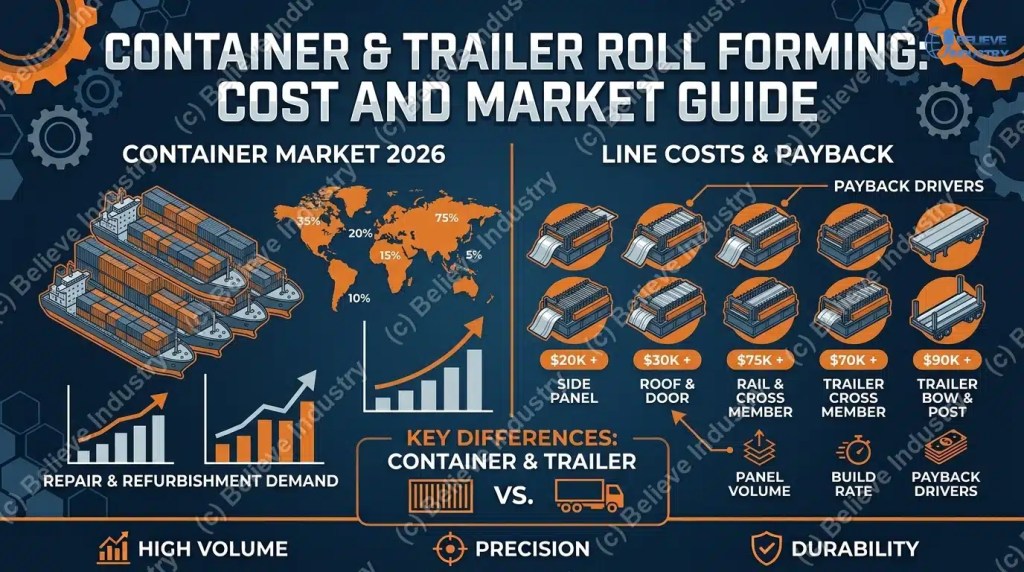
Container roll forming machines work starts with a coil of 1.6mm weathering steel and ends with a corrugated panel that has to survive twenty years of salt air and nine-high stacking. That is the whole job description. Nothing in this category is decorative. Every profile carries structural load.
Container roll forming machines definition: a continuous cold forming line that turns Corten or high-strength steel coil into the corrugated panels, cross members, and rails used in ISO shipping containers and road trailers, with in-line cutting to a fixed panel or member length.
The category splits into two sub-markets. Container lines run wide corrugated panels for box manufacturing and depot repair. Trailer lines run narrower structural sections for dry vans, flatbeds, and container chassis. Same machine family, different tooling, different tolerances. You can see how forming stations are arranged on a linha de máquinas de perfilagem de rolos before you read the profile detail below.
We have built and commissioned roll forming lines in more than 20 countries over 15 years. Container and trailer work is the category where buyers get burned most often. The coil is not a standard roofing grade, and the tolerance that matters is not profile width. It is corrugation depth. Get that wrong by 3mm and the panel fails the vertical load test that the whole container design depends on.
Roofing and cladding lines form 0.4 to 0.6mm steel. Container work doubles that gauge and swaps the steel family entirely.
Three things make transport profiles harder than building profiles.
Corten weathers, but it also work hardens. SPA-H and Corten A carry a minimum yield of 345 MPa, roughly 40% above a standard galvanized roofing grade. Deep corrugation on that steel springs back harder, so the forming schedule needs more passes and tighter roll gaps than a roofing line of the same gauge. Our conformação a frio por laminação breakdown covers springback control in detail.
Corrugation is load bearing. The 36mm ribs on a container side panel are what let a stack of nine containers push 192,000 kg through the corner posts without the walls buckling. Depth tolerance on a container rib is typically plus or minus 1.5mm. Miss it and the wall loses stiffness in the direction that matters.
Panel edges are weld prep. Every side panel carries a flat edge, about 37mm wide, that gets welded to the next panel. Edge straightness and edge camber decide how fast the welding head can run. A panel with 2mm of edge wave costs more in welding rework than it saved in steel.
The governing documents are public. ISO 1496-1 sets the specification for series 1 freight containers, and ASTM A606 Type 4 defines the weathering steel most plants form. Read both before you finalize a tooling order.
| Perfil | Material and gauge | Key dimension | Velocidade da linha | Estações |
|---|---|---|---|---|
| Container corrugated side panel | Corten A / SPA-H, 1.6 to 2.0mm | 36mm depth, 208mm wave width | 12 to 20 m/min | 22 a 30 |
| Container roof and door panel | SPA-H or Q235, 1.6 to 2.5mm | 20mm depth, 210mm pitch, 5 wave | 15 a 25 m/min | 18 a 24 |
| Container bottom side rail and floor cross member | SPA-H, about 4.5mm | C or Z section, 25 to 30cm centers | 8 to 14 m/min | 16 a 22 |
| Trailer floor cross member and chassis side rail | Q345 / A572 Gr.50, 3.0 to 4.6mm | 3 to 4 inch channel, 12 to 16 inch centers | 10 to 18 m/min | 14 to 20 |
| Trailer roof bow and side wall post | Galvalume or pre-painted, 0.8 to 1.6mm | Bowed channel, 16 to 24 inch centers | 20 to 35 m/min | 12 to 18 |
Line speeds assume continuous production with a flying cutoff. Station counts assume a standalone cut to length arrangement, not a coil-to-box integrated line.
The container side panel is the volume driver. A 20 ft dry container uses five panels per side wall, welded edge to edge, so ten panels per box. Multiply that across 40 ft units and annual box output and the numbers get large fast.
Geometry is fixed by the industry. Corrugation depth is 36mm. Wave width runs about 208mm, split into a 72mm top face, a 70mm bottom face, and 68mm slopes. Bend radius at the folds sits at R5. Each panel keeps a 37mm flat edge on both sides for welding.
Material is Corten A to ASTM A606 Type 4 or SPA-H to JIS G3114, at 1.6mm for general purpose containers and 2.0mm for high cube and heavy duty units. Copper runs 0.25 to 0.55%, and that copper content is what gives the steel its atmospheric corrosion resistance. It is also what narrows the forming window. Corten work hardens faster than plain carbon steel, so the flower pattern needs more intermediate bends to keep the R5 outer radius from cracking.
Finished panel dimensions land near 1,116mm by 2,323mm for a 20 ft side wall. Note that 1,116mm sits well inside a normal uncoiler’s range, so a container panel line is not a wide-line special case. Our desenrolador guide covers the payoff end for this width class.
Machine numbers:
Depth control is the commissioning test that matters. We check it with a profile gauge and a laser at three points across the panel and log the readings in the FAT report.

Roof panels use a different corrugation, so most plants buy a second container roll forming machine tooling set rather than trying to share one. Five rounded waves, 20mm deep, on a 210mm pitch, with panel size near 1,045mm by 2,356mm. A 20 ft container roof takes ten panels. A 40 ft roof takes about twenty. Gauge runs 1.6 to 2.0mm in SPA-H or, on cheaper units, plain Q235.
The rounded wave is shallower than the side wall rib, and that changes the forming problem. Shallow waves on thin gauge are more prone to oil canning, so roof lines carry more stations at smaller bend increments and often add a tension leveler ahead of the mill. Surface finish matters too. Containers get shot blasted and painted, and a panel with roll marks telegraphs straight through the topcoat. Our high speed roof panel line uses the same approach of adding stations rather than adding roll pressure.
Door panels carry the heaviest gauge in the container at 2.0 to 2.5mm. They run on the same line family with different tooling. Two leaves per container means volume is lower than side walls, but tooling costs more because of the gauge and because the corrugation must clear the locking bar geometry.

The bottom side rail and the floor cross members are the sections most container roll forming machine buyers still source outside. Forming them in house is the highest-margin move a container or depot operation can make, because these parts wear out long before the panels do.
The bottom side rail is a cold-formed channel at about 4.5mm SPA-H that runs the full container length. It is what the floor cross members weld into. The floor cross member is a C or Z section, also about 4.5mm, spaced at 25 to 30cm. A 20 ft container carries 24 of them. If two adjacent members corrode through, the 28mm plywood floor sags into a V shape under a 20,000 kg uniform load.
That spacing sets the production rate. Cutting 24 members per container at 10 m/min is a continuous job, which is why these lines run with an automatic stacker and rarely stop between coils. Closed structural sections follow the same forming logic as our máquina de perfilagem de bandejas de cabos platform, where the section closes over the last four or five stations and springback control decides whether the seam lines up.

Trailer work splits into what you roll form and what you weld. That distinction saves buyers a lot of money, and it is the first thing to nail down in a specification.
Roll formed trailer parts:
What stays welded plate: the 500mm deep H main beam. On a 13m side board trailer that beam runs a 14mm top flange, an 8mm web, and a 16mm bottom flange. No roll former makes that section economically. Container corner posts are a different case, since they are cold formed at about 6mm and do go through a mill, but the trailer main beam does not. Be suspicious of any quote that claims otherwise.
Trailer builders push the same engineering argument every year. Take weight out of the cross members without losing stiffness. Roll forming answers it, because a formed high-strength section at 3.5mm Q345 carries the same load as a 4.5mm hot-rolled channel. Fifty kilos off the trailer is fuel and payload money for the fleet that buys it. That is the same lightweighting logic behind automotive roll forming, applied at a much larger scale and with looser tolerance. The Truck Trailer Manufacturers Association publishes the recommended practices that most North American specs reference.
Machine numbers for a combined cross member and rail line:

Roof bows are the highest-volume trailer part nobody thinks about. A 53 ft dry van carries a bow every 16 to 24 inches along the roof, which lands between 27 and 40 bows per trailer. At 0.8 to 1.2mm coated steel, they form fast.
The forming step is simple. A shallow channel or hat section in high strength low alloy or Galvalume, formed over 12 to 18 stations. Then comes the part that decides whether the roof leaks. The bow gets bent to the roof crown radius after forming, and the bow feet must land within about 3mm of the top rail so the roof skin sits flat. On a line with an in-line curving station, the bow is formed, curved, measured, and cut without a second handling step.
Side wall posts on a dry van run at 12 to 16 inch centers and carry the panel. Two constructions compete. The older way is a Z or hat post riveted or bonded behind a flat skin. The newer way, common on European and Chinese side board trailers, is a multi-rib cold-rolled box section that replaces the flat sheet and post assembly entirely. That construction needs a wider roll former with 20 to 26 stations and it removes one riveting operation from the build.
Specs:

| Part | Método de produção | Why |
|---|---|---|
| Container side, roof, door panel | Roll formed | Continuous deep corrugation, high volume, weld edge control |
| Container bottom side rail, floor cross member | Roll formed | Constant section, 24 members per container |
| Container corner post | Cold formed, then welded | Deep closed section at 6mm, low volume per unit |
| Container corner casting | Cast steel | Load path part, fixed ISO 1161 geometry |
| Trailer cross member, side rail, rub rail | Roll formed | Long length, constant section, weight targets |
| Trailer main beam, H section | Welded plate | 500mm deep, 8 to 16mm flange, low volume per length |
| Axle, suspension, kingpin, landing gear | Bought in | Not a forming part |
Print this table. Roughly 60% of the steel weight in a container or trailer can come off a roll former. The rest is welded, cast, or bought, and no vendor can change that.
| Métrica | Figure | Fonte |
|---|---|---|
| China new container output, 2025 | about 6.45 million TEU | China Container Industry Association, 2026 |
| Change versus 2024 | down 20.4% | same |
| China 2026 forecast | 4.5 to 5.0 million TEU | same |
| China global market share | above 96% | same |
| China installed capacity | 12.5 million TEU per year | same |
| Global container fleet | 33.69 million TEU, 7,497 vessels | fleet data, end 2025 |
| Container service life | 15 to 25 years | industry practice |
Read those numbers carefully. Output fell 20.4% in 2025 and is forecast lower again in 2026, while installed capacity sits at 12.5 million TEU. Utilization is barely above half. That is a brutal market for anyone buying a new panel line to chase box volume.
The money is not in new box production. It is in repair and refurbishment. A fleet of 33.69 million TEU with a 15 to 25 year service life generates a permanent stream of replacement panels, and depot repair shops buy smaller lines than box plants do. The Institute of International Container Lessors sets the inspection and repair standards that depots work to. If you are evaluating a container roll forming machine in 2026, the repair channel is where demand is less contested.
| Line type | Typical price band | Payback driver |
|---|---|---|
| Container side panel line | $180,000 to $420,000 | Panel volume, box plant supply contracts |
| Container roof and door panel line | $120,000 to $260,000 | Bundled with a side panel line |
| Container rail and cross member line | $90,000 to $200,000 | Depot repair volume |
| Trailer cross member and rail line | $110,000 to $240,000 | Units per week, weight specification |
| Trailer roof bow and wall post line | $70,000 to $180,000 | Trailer build rate |
The margin case is straightforward on the parts. A 1.6mm Corten side panel at 1,116mm by 2,400mm weighs about 35.7 kg. Coil at Corten prices puts material around $28 to $34. Finished panels sell in the $39 to $45 band in volume and higher on single-panel repair orders. That is a thin margin on steel alone.
The margin lives in the gauge and the depth. A 2.0mm high cube panel carries more steel and more price. A panel line running 18 m/min makes roughly 7 panels a minute at a 2.4m cut length, so throughput is not the constraint. The constraint is who buys the panels. Repair depots with steady contracts do better on a $200,000 roof and side panel combination than a box plant does on a $400,000 dedicated side line.
A container roll forming machine sits in a different cost bracket from commodity roofing equipment. A roofing sheet line trades on price per meter. A container panel line trades on corrugation depth accuracy, weld edge quality, and Corten forming behavior. Line speed sells commodity equipment. Tolerance sells transport equipment.
If your product mix spans both containers and trailers, a máquina de perfilagem de rolos de dupla camada can carry two shallow profiles on one base, but do not expect it to handle container ribs on one deck and trailer rails on the other. The gauge gap is too wide. A máquina de perfilagem personalizada built around your actual panel schedule usually beats a catalogue line, and the price drivers are station count, cutoff type, and whether you need an in-line curver.


A mining roll forming machine is a heavy duty roll...
Leia mais

Upright roll forming machine speed is the finished-column line speed...
Leia mais
An electrical roll forming machine turns steel coil into the...
Leia mais
Agricultural roll forming machines turn steel coils into the gutters,...
Leia mais English English
  Español
 Português
 Русский
 العربية
 Bahasa Melayu
 Türkçe
 ไทย
ไทย
 Bahasa Indonesia