สารบัญ

เครื่องขึ้นรูปแผ่นหลังคาความเร็วสูง

เครื่องขึ้นรูปแผ่นหลังคาความเร็วสูง: คู่มือฉบับสมบูรณ์สำหรับผู้ซื้อ (2026)

เครื่องขึ้นรูปแผ่นหลังคาความเร็วสูง runs at up to 60 m/min — roughly three to four times faster than a standard roofing line. That speed matters when a roofing contractor needs 5,000 linear meters per shift, or when a steel building factory runs three profile sizes back to back.

Believe Industry Company has supplied high speed roof panel roll formers to customers in 10+ countries. This guide covers what the machine consists of, how to compare specs, what buyers get wrong, and the frequency asked questions.

What Is a High Speed Roof Panel Roll Forming Machine?

A high speed roof panel roll forming machine is a continuous cold-bending line that shapes flat metal coil into finished roof panel profiles at speeds above 30 m/min — with the fastest models reaching 60 m/min.

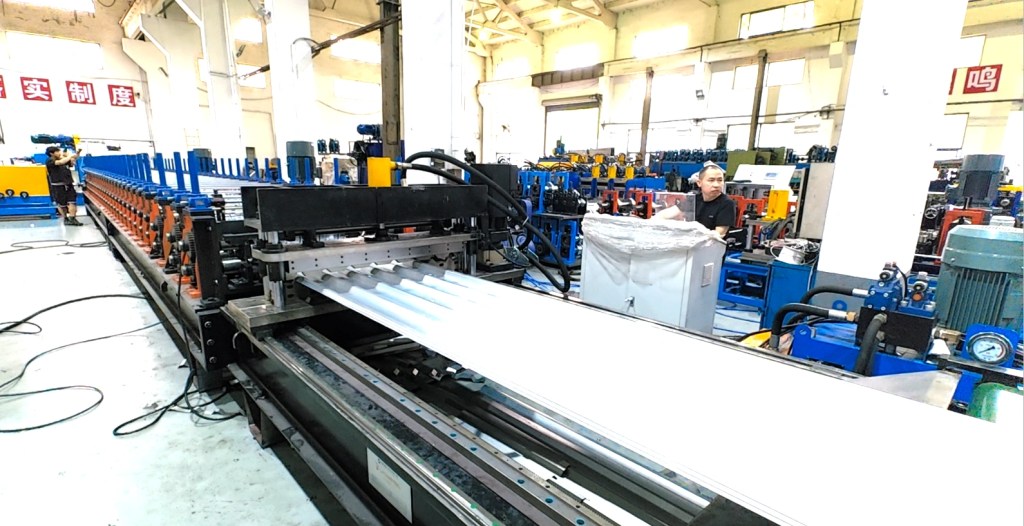
The speed advantage comes from three engineering choices: a high-torque gearbox transmission, a flying hydraulic cutting unit (which cuts without stopping the strip), and an auto-stacking system that handles panels without bottlenecking the output.

Standard machines for corrugated or IBR sheets run at 15–25 m/min. A high speed line at 60 m/min doubles or triples daily output from the same floor space.

The 4 Core Components

Every high speed roof panel roll former from Believe Industry uses the same four-unit layout.

1. High Speed Hydraulic Uncoiler with Coil Car (10–20 Ton)

The uncoiler holds the steel coil and feeds it into the forming section at a controlled tension. For high speed lines, the standard capacity is 10 to 20 tons.

A coil car is included. It lifts the coil from the floor and loads it onto the uncoiler mandrel without crane involvement — critical when coil changes happen every 20–30 minutes on a fast line.

Hydraulic expansion locks the coil in place. A friction brake system maintains consistent back-tension as the strip accelerates to 60 m/min.

2. High Speed Gearbox Transmission Roll Forming Section

This is the core of the machine. The forming section uses a gearbox transmission — not chain drive — specifically because chains stretch and lose synchronization above 25 m/min.

The gearbox distributes torque evenly across all forming stands. Each stand uses hardened alloy steel rolls (typically GCr15 or Cr12MoV) precision-ground to H7 tolerance. Stands are mounted on a cast-iron or welded steel mill base.

The number of forming stands varies by profile. A simple corrugated panel may use 16 stands. A deep-rib IBR or standing seam profile may use 22–28 stands.

3. Flying Hydraulic Cutting Device with High-Duty Hydraulic System

A flying cutter is what separates a high speed line from a standard one. On a standard machine, the strip stops, the blade cuts, the strip restarts. This stop-start cycle limits speed to around 15–20 m/min.

A flying cutter travels with the strip at line speed, cuts the panel to length, then returns to its start position — all while the forming section keeps running. The result: no speed interruption, no panel waviness at cut ends.

The hydraulic system driving the cutter is rated for high duty cycle — typically 10–15 MPa working pressure with a separate cooling circuit. Blade material is Cr12MoV or D2 tool steel.

Cut length accuracy on a flying hydraulic system: ±1 mm at 60 m/min.

4. Auto Stacking System

At 60 m/min, a finished 2-meter panel exits every two seconds. Without an automatic stacker, two workers cannot handle that rate. The auto stacker uses a belt conveyor plus pneumatic or servo-driven stacking arms to count, layer, and bundle panels into stacks of preset quantity.

Most buyers specify stacking height up to 800 mm with automatic count alarm. The stacker adds roughly 10-16 meters to the total line length.

High Speed vs Standard Speed: Side-by-Side Comparison

คุณสมบัติStandard Roof Panel MachineHigh Speed Roof Panel Roll Former
ความเร็วในการขึ้นรูป15–25 m/min40–60 m/min
Drive systemChain driveGearbox transmission
วิธีการตัดStop-cut (hydraulic or pneumatic)Flying hydraulic cut
Cut length accuracy±2–3 mm±1 mm
ความจุของเครื่องคลายขดลวด3–8 ton10–20 ton
เครื่องเรียงซ้อนอัตโนมัติไม่จำเป็นมาตรฐาน
Shift output (8 hr, 2m panels)~3,000–5,000 pcs~8,000–14,000 pcs
Floor space15–20 m25–35 m
Suitable material thickness0.3–0.8 มม.0.3–0.8 มม.
Price range (USD)55,000140,000

A standard machine makes sense for custom-length or small-batch orders. A high speed line pays off when daily volume exceeds 8,000 linear meters.

Compatible Roof Panel Profiles

A high speed gearbox line is not profile-specific. Believe Industry builds high speed variants for all major roofing profiles:

เดอะ เครื่องขึ้นรูปม้วนสองชั้น can also be built in high speed configuration — two profile tooling sets on one machine, with gearbox drive on both decks.

Material Specifications

พารามิเตอร์ข้อกำหนด
วัสดุGalvanized steel (GI), Galvalume (GL), color-coated steel (PPGI)
ความแข็งแรงของผลผลิตสูงสุด 550 MPa
ความหนา0.3–0.8 mm (standard); 0.3–1.2 mm (heavy-duty option)
ความกว้างของขดลวด600–1,250 mm depending on profile
น้ำหนักขดลวดUp to 20 ton per coil
Finished panel width600–1,000 mm (net coverage, profile-dependent)

High Speed Gearbox vs Chain Drive vs Servo Motor: Full Comparison

This is the question buyers ask most often. Here is the honest comparison.

Drive Typeความเร็วสูงสุดความแม่นยำการซ่อมบำรุงค่าใช้จ่ายเหมาะสำหรับ
Chain drive20–25 m/min±2–3 mmChain stretch, lubrication every 500 hrต่ำสุดLow-volume, budget lines
Gearbox (helical gear)40–60 m/min±1–1.5 mmOil change every 2,000 hrMedium-highHigh volume, consistent profile
Servo motor (individual axis)15–30 m/min±0.5 มม.Low mechanical, high electricalสูงสุดFrequent profile changes, R&D

For bulk roof panel production — the same profile every shift — the gearbox wins. Servo motors add cost without adding speed. Chain drive cannot keep up.

How to Specify a High Speed Roof Panel Roll Former: Checklist

Before requesting a quote, confirm these parameters:

  • ภาพวาดโปรไฟล์ — CAD or sample panel preferred
  • Material thickness range — e.g., 0.4–0.7 mm
  • ความกว้างของขดลวด — determines machine width and roll pass design
  • Required forming speed — 40, 50, or 60 m/min
  • Cut length range — minimum and maximum panel length
  • Cut accuracy requirement — ±1 mm or ±2 mm
  • น้ำหนักขดลวด — determines uncoiler tonnage
  • เครื่องเรียงซ้อนอัตโนมัติ — required or optional
  • Electrical standard — voltage, frequency, and PLC brand (Siemens, Delta, Mitsubishi)
  • Local safety codes — CE, OSHA, or national standard

Believe Industry handles custom roll design in-house. Send the profile drawing and material spec — the engineering team sizes the forming stands, gearbox, and hydraulic system accordingly.

เครื่องคำนวณผลผลิต

Use this reference to estimate daily output before buying.

ความเร็วสายการผลิตOperating EfficiencyPanel LengthPanels per HourPanels per 8-hr Shift
40 m/min80%2 m960 pcs7,680 pcs
50 m/min80%2 m1,200 pcs9,600 pcs
60 m/min80%2 m1,440 pcs11,520 pcs
60 m/min80%3 m960 pcs7,680 pcs
60 m/min80%6 m480 pcs3,840 pcs

80% efficiency accounts for coil change, shift breaks, and occasional length adjustment.

คำถามที่พบบ่อย

What is a high speed roof panel roll forming machine?

A high speed roof panel roll forming machine is a cold roll forming line that produces metal roofing panels at speeds of 40–60 m/min. It uses a gearbox transmission (not chain drive) and a flying hydraulic cutter to maintain continuous motion at high output rates without stopping for each cut. Believe Industry’s standard high speed lines are rated to 60 m/min.

How fast is a high speed roof panel roll former?

A high speed roof panel roll former from Believe Industry runs at up to 60 meters per minute. That compares to 15–25 m/min for chain-drive standard machines. At 60 m/min, a line with a 2-meter panel setting produces approximately 1,440 panels per hour before accounting for efficiency losses.

What is the difference between a flying cut and a stop-cut on a roof panel machine?

A stop-cut machine halts the material strip before cutting, then restarts it. This limits speed to roughly 20 m/min and creates a micro-deceleration zone that can cause panel waviness near the cut end. A flying hydraulic cut travels with the moving strip at full line speed, cuts while moving, and returns to home position — the strip never slows down. Flying cut is required for any machine above 30 m/min.

Can a high speed machine handle color-coated (PPGI) steel without scratching?

Yes. The forming rolls are polished and optionally coated with hard chrome. PVC spacers or coated contact surfaces are used at the output section. The critical area is the stacker — Believe Industry uses felt-lined stacking arms and non-abrasive conveyor belts as standard on high speed lines for color-coated material.

What profiles can run on a high speed roof panel roll former?

Any trapezoidal or sinusoidal (corrugated) roofing profile can be configured for high speed production, including corrugated 686/762, IBR, T18/T25/T35 trapezoidal, Klip-Lok, and Widespan. Standing seam profiles are feasible but typically limited to 40 m/min due to the seam-forming geometry.

How long does it take to change a coil on a 20-ton uncoiler?

With a coil car included in the line, a trained two-person crew can complete a coil change in 8–12 minutes. Without a coil car, the same change takes 20–30 minutes with crane assistance. On a 60 m/min line with 20-ton coils, a coil change happens approximately every 40–60 minutes depending on profile weight per meter.

What maintenance does a high speed gearbox line require?

The gearbox oil should be changed at 2,000 operating hours or annually, whichever comes first. Hydraulic oil and filter should be replaced every 1,000 hours. Forming rolls should be inspected for wear every 3–6 months. The flying cutter blade requires inspection after 50,000 cuts and replacement when burr height exceeds 0.3 mm. Compared to chain-drive machines, gearbox lines have significantly lower routine maintenance requirements.

What electrical standard does Believe Industry use for high speed lines?

Believe Industry configures each machine to the customer’s local standard. Common specs: 380V/50Hz/3-phase (most of Asia, Middle East, Africa), 400V/50Hz/3-phase (Europe), 220V/60Hz (North America), 440V/60Hz (some industrial US sites). PLC brand options include Siemens, Delta, Mitsubishi, and Schneider. Specify your requirement at order stage.

Why Believe Industry for a High Speed Roof Panel Roll Former?

Believe Industry Company has designed and manufactured roll forming equipment over 15 years. The engineering team has built high speed gearbox roof panel lines for customers across 10+ countries — from Southeast Asian roofing factories running three-shift operations to Australian steel building suppliers requiring CE-compliant lines.

Every high speed line goes through a full-speed run test at the factory before shipping. Test reports, video documentation, and operator training materials ship with each machine.

Working Machine in Action

External References

เครื่องรีดขึ้นรูปที่ดีที่สุดสำหรับชั้นวางสินค้าในคลังสินค้า

เครื่องขึ้นรูปโลหะม้วนที่ดีที่สุดสำหรับชั้นวางสินค้าในคลังสินค้า: คู่มือการเลือกซื้อที่ตรงไปตรงมา (2026)

ถ้าคุณผลิตชั้นวางสินค้าในคลังสินค้า คุณก็คงรู้เรื่องนี้อยู่แล้ว: ...

อ่านเพิ่มเติม
วิธีเลือกบริษัทผลิตเครื่องรีดขึ้นรูปที่เหมาะสมสำหรับสายการผลิตของคุณ

วิธีเลือกบริษัทผลิตเครื่องรีดขึ้นรูปที่เหมาะสมสำหรับสายการผลิตของคุณ

บริษัทผลิตชิ้นส่วนขึ้นรูปโลหะด้วยกระบวนการรีดขึ้นรูป (Roll Forming Corporation) ทำอะไรบ้าง? กระบวนการรีดขึ้นรูป...

อ่านเพิ่มเติม

ค้นพบข้อมูลเพิ่มเติมจาก Believe Industry Company| Roll Forming Machine Manufacturer, Supplier & Exporter

สมัครสมาชิกตอนนี้เพื่ออ่านต่อและเข้าถึงคลังบทความฉบับเต็ม.

อ่านต่อ

BELIEVE INDUSTRY | โซลูชันที่ปรับแต่งได้ตามความต้องการ

ขอของคุณ
ข้อเสนอทางวิศวกรรม