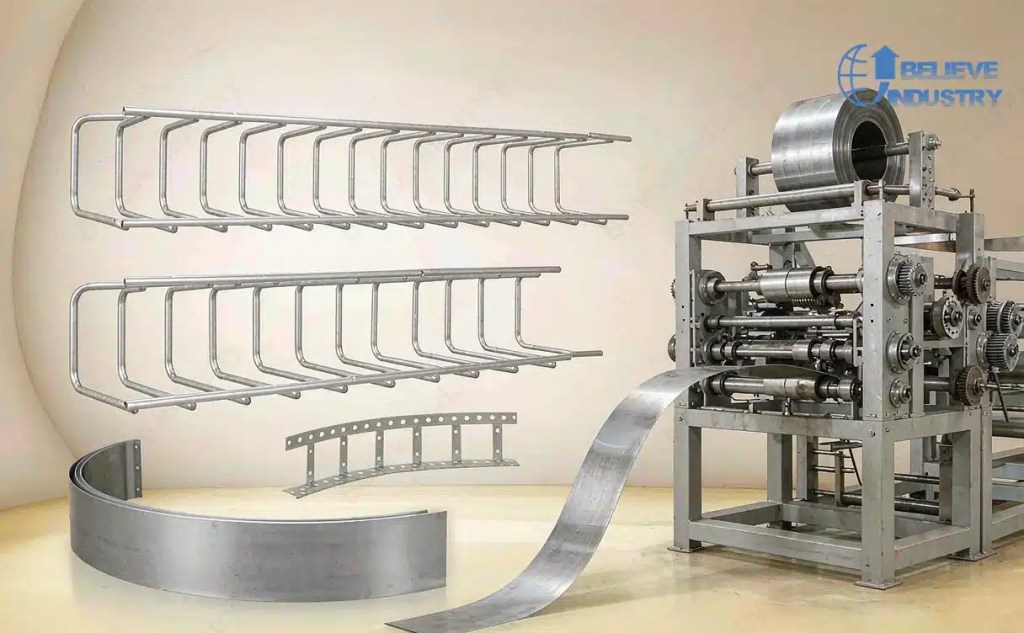
รางสายเคเบิล

What Is a Cable Tray? 6 NEMA Type Facts Explained 2026

Need a Roll Forming Machine for Your Project?
Get a free quote from Believe Industry — 15+ years of custom roll forming manufacturing.
ขอใบเสนอราคา Download Catalogue

What Is a Cable Tray? 6 NEMA Type Facts Explained 2026

A cable tray is a rigid, open support system that holds and routes electrical cables in industrial and commercial buildings. It carries power, control, and data cables in a continuous run instead of pulling each wire through conduit. This guide explains what a cable tray is, the six NEMA types, how load classes work, and how roll forming produces most steel trays.
Short answer: A cable tray is a rigid support system that holds power, control, and data cables in a continuous run. NEMA VE 1 defines six tray types and a load/span class system. Roll forming shapes most steel trays from a coil in one pass, which keeps cost and tolerance tight. Pick the tray type by cable weight, fill, and the standard your project cites.

What a Cable Tray Does

A cable tray is a structural pathway, not a closed pipe. It lets crews lay many cables side by side, add or remove them later, and keep airflow around the conductors. That airflow matters because heat shortens cable life.
Most trays use steel, aluminum, or stainless steel. Steel trays dominate heavy industrial work. Aluminum fits corrosive or weight-sensitive sites. Stainless suits coastal and chemical plants.
Crews route a cable tray once, then fill it as the plant grows. That beats conduit, where every added circuit means new pipe and fittings. You can read more about the electrical and power industry roll forming line that builds these profiles.

The Six NEMA VE 1 Tray Types

NEMA VE 1 (current edition VE 1-2017, harmonized with CSA C22.2 No. 126.1) defines six basic cable tray types. Each type fits a different cable mix and load.
NEMA typeชื่อการใช้งานที่ดีที่สุด
1ALadderHeavy power feeders on long spans
1BVentilated troughMixed power and control cables
1CSolid bottomDirty or drip-prone areas
1DChannelShort branch runs and walls
1EWire meshData and fiber, fast pulls
1FSingle railLight, flexible routing
A รางเคเบิลแบบบันได uses two side rails and open rungs. It carries the heaviest loads at the widest support spacing. A solid bottom tray shields cables from falling debris but traps more heat, so fill rules are tighter.

How NEMA Load and Span Classes Work

A cable tray is rated by a load/span class, not by sheet thickness. The number is the support span in feet. The letter is the working load per linear foot.
ClassSpanWorking load
A8 to 20 ft50 lb/ft (75 kg/m)
B8 to 20 ft75 lb/ft (112 kg/m)
C8 to 20 ft100 lb/ft (149 kg/m)
A 20C cable tray carries 100 lb per linear foot when supported every 20 feet. NEMA requires a 1.5 safety factor at failure and a separate 200 lb (90 kg) concentrated load at mid-span. Because the standard is performance based, two makers can hit 20C with different sections, as long as they pass the test.

NEC Article 392 and IEC 61537

In the United States, NEC Article 392 (NFPA 70) governs cable tray installation. It caps fill at 50 percent of usable area for ladder and ventilated trays, and 40 percent for solid bottom trays. Overfill does not break the tray, but it derates the cables. NEMA widths run 6, 9, 12, 18, 24, 30, 36, 42, and 48 inches, while IEC widths run 50 to 1000 mm. Quote in the unit system your project uses.
A metal cable tray can act as the equipment grounding conductor when the run is bonded continuously and sized to NEC Table 392.60(A). Steel trays cannot be the sole ground for ground-fault protection above 600 A.
For international work, อีซีอี 61537 sets the safe working load at the load that produces mid-span deflection of 1/100 of the span, with a 1.7 safety factor. Europe uses the harmonized EN 61537. เนมา publishes VE 1 for North America. The two systems are not interchangeable, so cite the standard your project names.

How Roll Forming Makes a Cable Tray

Roll forming turns a flat coil into a finished cable tray in one continuous line. The process is leveling, punching, roll forming, and cut to length. A เครื่องจักรผลิตรางสายเคเบิล forms the side rails and base in matched passes.
Most holes are punched inline before forming. Our punching die installation guide covers hole drift and tooling setup. An เครื่องเปลี่ยนขนาดรางสายเคเบิลอัตโนมัติ swaps width without hand change, which suits mixed orders. Believe Industry has built roll forming lines since 2005, with 80+ engineers and 500+ projects shipped to 50+ countries, all made to ISO 9001 and CE.
Output depends on the punch method. Hydraulic punch runs 3 to 4 m/min. Press punch runs 10 to 15 m/min. Rotary punch exceeds 30 m/min. Roll formed rails hold tight, repeatable dimensions, so fittings and splice plates line up across a long run. See our cable tray roll forming line cost guide for a full spec and price range.

Materials and Finishes

Pick the material by site, not by habit. Hot dip galvanized steel fits most plants. Stainless 316L fits coastal and chemical sites. Aluminum fits weight-limited roofs.
Finish choice follows the corrosion class in the standard you cite. Outdoor trays need thicker zinc. Food and pharma sites need smooth, cleanable surfaces. A cable tray roll forming machine for the Middle East is often specified for heat, dust, and SASO marking.

Choosing the Right Cable Tray

Start with cable weight and fill, then confirm the standard. A ladder tray wins for heavy feeders on long spans. A ventilated trough wins for mixed runs. A solid bottom tray wins where debris is the risk.
Match the load class to the real support spacing, not the catalogue maximum. Closer supports raise the safe load. Ask each supplier for the test report, not just a certificate, and check the exact width and finish on the report. A wider tray costs more in steel but saves support points, so balance the two before you fix the width. Believe Industry supplies cable tray lines to 50+ countries and supports layout, tooling, and commissioning from first sample to final run.

Frequently Asked Questions of Cable Tray

Q: What is a cable tray used for?

A cable tray supports and routes power, control, and data cables in a building. It replaces conduit runs where many cables run together and need airflow, future access, and fast installation.

Q: What are the six NEMA VE 1 cable tray types?

NEMA VE 1 defines ladder (1A), ventilated trough (1B), solid bottom (1C), channel (1D), wire mesh (1E), and single rail (1F). Ladder trays carry the heaviest loads; wire mesh suits data and fiber.

Q: How do NEMA load classes work?

The number is the support span in feet. The letter is working load per foot: A is 50 lb/ft, B is 75 lb/ft, C is 100 lb/ft. A 20C tray holds 100 lb/ft at 20 ft spans, with a 1.5 safety factor.

Q: Is a cable tray the same as conduit?

No. Conduit encloses each cable in a tube. A cable tray is an open support where cables lay in a run. Trays cost less to install and let crews add cables later, but they expose cables to the environment.

Q: Can a metal cable tray be the ground?

Yes, under NEC 392.60(A), if the tray is bonded continuously and sized to the table. Steel trays cannot be the sole ground above 600 A ground-fault protection, and aluminum not above 2000 A.

Q: How is a steel cable tray made?

Roll forming shapes the side rails and base from a coil in one line: level, punch, form, cut. Inline punching places holes before forming. Speed ranges from 3 to 4 m/min (hydraulic) to over 30 m/min (rotary).

บันทึกการเปลี่ยนแปลงบทความ

อัปเดตล่าสุด: 2026-09-25
  • 2026-09-25: Initial publish. Covers NEMA VE 1 six types, A/B/C load classes, NEC 392 fill and grounding, IEC 61537, and roll forming production.

ตัวกระตุ้นการตรวจสอบครั้งต่อไป

  • NEMA releases a new VE 1 edition beyond VE 1-2017.
  • CSA C22.2 No. 126.1 updates the harmonized North American class rules.
  • A major NEC revision changes Article 392 fill or grounding limits.
  • Cable tray roll forming speed or inline punching specs change in our line data.

สารบัญ

อัปเดตใหม่

ค้นพบข้อมูลเพิ่มเติมจาก Believe Industry Company| Roll Forming Machine Manufacturer, Supplier & Exporter

สมัครสมาชิกตอนนี้เพื่ออ่านต่อและเข้าถึงคลังบทความฉบับเต็ม.

อ่านต่อ