عنوان
رقم 1، طريق Yd، منطقة هويشان، مدينة ووشى، جيانغسو. 214183
ساعات العمل
من الإثنين إلى الجمعة: 9 صباحًا - 5 مساءً
السبت: 9 صباحًا - 4 مساءً
عنوان
رقم 1، طريق Yd، منطقة هويشان، مدينة ووشى، جيانغسو. 214183
ساعات العمل
من الإثنين إلى الجمعة: 9 صباحًا - 5 مساءً
السبت: 9 صباحًا - 4 مساءً

Drainage roll forming machine lines turn steel coil into the gutters and downspouts that move rain off the roof and away from the building. The six profiles in this guide cover residential, commercial, and industrial buildings. One well-chosen line can supply gutter and downspout products to a whole region.
These machines get less attention than roofing lines, and that is a mistake. The ultimate guide to roll forming machine lines explains the full lineup, station by station. Roof panels only work when the drainage behind them works, and gutters and downspouts are manufactured steel parts like everything else on the building.
Do the math before dismissing the category. One millimeter of rain on one square meter of roof equals one liter of water. A 200 square meter roof in a 50 mm storm sheds 10,000 liters in a few hours. If the gutter overflows, that water ends up against the foundation. Roof drainage is a system, and the machine that forms the profiles decides how well that system works.
Cities tighten stormwater runoff rules every year, and property owners face penalties for dumping roof runoff onto streets. Rainwater harvesting pushes the same demand from the other side. Households and farms treat the roof as a catchment and store the water, which turns a simple gutter into the intake of a water supply system. Roofing contractors also want gutters that match new metal roofs, and that means factory-made lengths with clean painted edges, which is exactly what a drainage roll forming machine produces.
Standards back this up. The SMACNA architectural sheet metal manual is the reference installers still use for gutter sizing and formed details. The المجلس الدولي لأكواد البرمجة plumbing code now includes rainwater catchment rules that more jurisdictions adopt each year, and Europe follows EN 12056-3 for gravity roof drainage. A drainage roll forming machine that only makes pretty profiles is not enough. The profiles must meet published capacity and material rules.
A drainage roll forming machine is a compact cold forming line built around narrow coil. Typical gutter stock runs 0.40 to 0.60 mm pre-painted steel or aluminum in coil widths from 200 to 500 mm. The line uncoils, straightens, forms the profile through 12 to 20 roll stations, punches outlet holes where required, and cuts to length. The عملية تشكيل اللفة is the same physics used on roofing lines, scaled to thin gauge and light profiles.
Three drainage roll forming machine families cover the market. A stationary gutter machine makes K-style, half-round, or box gutter in fixed lengths. A downspout machine forms seamed rectangular or round tubes and cuts them square. A portable seamless gutter machine rides to the jobsite and pulls continuous gutter from coil, removing the joints that cause most leaks. New buyers should read كيف تعمل آلة تشكيل اللفائف before comparing suppliers, because the tolerance rules that govern drainage roll forming machine quality apply at every scale.
| المعلمة | Stationary gutter machine | Downspout machine | Portable seamless gutter machine |
|---|---|---|---|
| السرعة النموذجية | من 15 إلى 25 متر/دقيقة | 15 to 30 m/min | 10 to 20 m/min |
| Material gauge | 0.40 to 0.70 mm | 0.40 to 0.60 mm | 0.40 to 0.55 mm |
| محطات التشكيل | 12 to 20 | من 12 إلى 16 | 10 to 14 |
| عرض الملف | 200 to 500 mm | 100 to 400 mm | 250 to 380 mm |
| الناتج | Fixed lengths, stacked | Tubes cut to length | Continuous lengths on site |
Cutting and punching matter more on a drainage roll forming machine than on heavy lines. Outlet holes, crimped ends, and square cuts decide whether the product fits on site, and servo-driven cutoff holds length tolerance at speed. A punch station inside the line removes a whole manual step.
The K-style gutter is the default rain gutter in North America. The name comes from the front face, which looks like a K from the side. Standard widths are 5 inch (127 mm) and 6 inch (152 mm), and buyers choose the wider size in heavy rainfall regions. The tall back carries more water than a half-round of the same top width, and for most drainage roll forming machine sales in North America, K-style is the whole story.
K-style machines run 15 to 25 m/min through 12 to 16 stations. The front edge gets a hem that removes the sharp edge and stiffens the face, and the back edge gets the fold that hooks into hangers. Drainage roll forming machine buyers in North America rarely need more than this profile plus rectangular downspout. The آلة تصريف مياه الأمطار page shows typical tooling and output for the family.

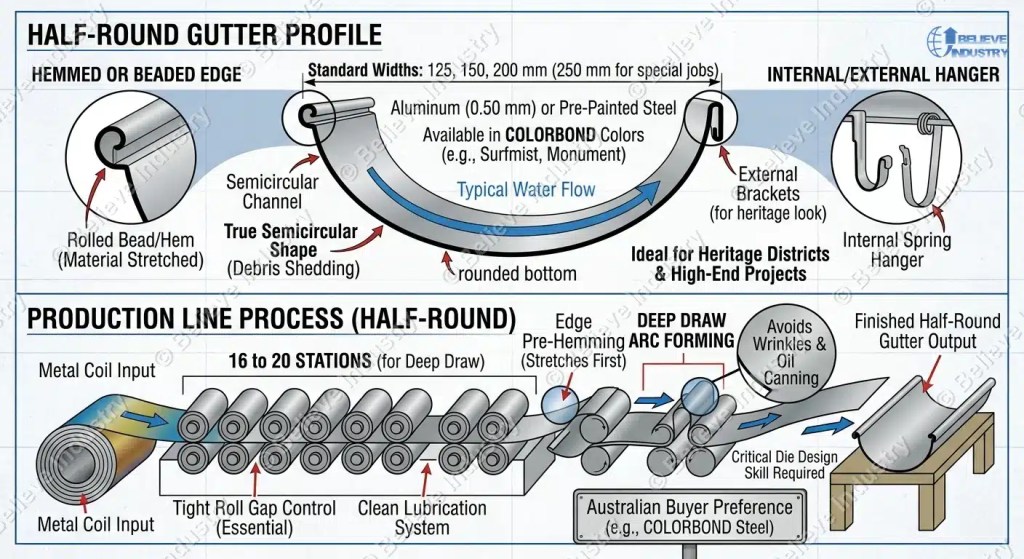
Half-round gutters are the traditional profile, a true semicircular channel made in metal for over a century. Sizes run 125 to 200 mm, with 250 mm available for special jobs. The rounded bottom flows smoothly and sheds debris, which keeps heritage districts, coastal homes, and high-end residential projects loyal to it.
Forming a half-round is harder than forming a K-style. The deep draw stretches the strip edge, and poor roll setup shows as wrinkles or oil canning on the visible face. Expect 16 to 20 stations, tight roll gap control, and clean lubrication. Aluminum at 0.50 mm and pre-painted steel both work, and Australian buyers commonly order it in COLORBOND colors. Demand is smaller and regional, so most plants order half-round tooling as a آلة تشكيل اللفة المخصصة option, and this profile is where a drainage roll forming machine supplier proves its die design skill.
Box gutters sit inside the roof, behind parapets or in the valley between roof sections, invisible from the street. They carry the concentrated runoff of large roof areas, and some also take the discharge of internal drains. Bottom widths run 200 to 400 mm with tall legs, and the gauge is heavier because a box gutter holds standing water after every storm.
Box gutter needs deep, square bends, which is where تصميم آلة تشكيل اللفة separates good tooling from bad. A drainage roll forming machine that runs box gutter needs 16 to 20 stations to hold leg angles square, because a twisted leg means a leaking joint. Codes in several countries require overflow provisions on concealed gutters, so dies must reproduce notches or lowered edges consistently. Long lengths up to 6 m reduce joints, and fewer joints mean fewer leaks.

Valley gutters collect runoff where two roof slopes meet. Industrial valley gutters run 300 to 600 mm wide in 0.70 to 1.20 mm galvanized or Zincalume steel. Profiles form a shallow V or a flat bottom with stiffening ribs. This is the heaviest work a drainage roll forming machine does, with the thickest gauge and the widest strip.
The valley sits between roof panels, so its edge geometry must match the panels it drains. It has to line up cleanly with standing seam roof panels and with sheets from a آلة ألواح السقف المعدنية. Most metal building leaks start at this joint, not in the roof field. Roll formed valley in continuous lengths up to 9 m removes the seams that brake-formed sections need, and the رابطة الإنشاءات المعدنية publishes solid drainage detailing guidance for these assemblies.

The rectangular downspout is the workhorse of roof drainage. Residential sizes are 2×3 and 3×4 inch, roughly 50×75 mm and 75×100 mm, with corrugated or smooth faces. Rectangular tubes move high volume for their visual size and stack tightly for shipping. Elbows, shoes, and brackets come from the same stock.
A downspout machine forms the tube, closes a seam along one corner, and cuts square lengths. Square cuts matter, because a crushed end will not fit the elbow. Speeds run 15 to 30 m/min, so output is rarely the bottleneck; tooling changeover and material handling decide the daily number. This is the line most drainage roll forming machine plants add second, after the gutter machine.
Round downspouts run 75 mm and 100 mm for buildings, with 150 mm and larger for industrial roofs. The smooth circular bore moves water with less friction than a rectangular tube, and round profiles clog less at joints. They are also the standard connection to rainwater tanks, which makes them the profile of choice for harvesting systems.
Round tube forming needs careful seam control, because the lock must hold under internal water pressure and freeze-thaw cycles. Many drainage roll forming machine buyers pair a round downspout line with a K-style or half-round gutter line, since both sell to the same customers. Large industrial runs are where this machine earns its keep in a single season.

| حساب تعريفي | Typical size | Common gauge | Machine notes | Main markets |
|---|---|---|---|---|
| K-style gutter | 127 to 152 mm top width | 0.45 to 0.60 mm | 12 to 16 stations, hemmed front edge | North America, residential and light commercial |
| Half-round gutter | 125 to 250 mm | 0.50 to 0.70 mm | 16 to 20 stations, deep draw control | Heritage, coastal, high-end residential |
| Box gutter | 200 to 400 mm bottom | 0.60 to 1.00 mm | 16 to 20 stations, square legs | Commercial and concealed drainage |
| Industrial valley gutter | 300 to 600 mm | 0.70 to 1.20 mm | Ribbed sections, long runs | Metal buildings, agricultural sheds |
| Rectangular downspout | 50×75 to 75×100 mm | 0.40 to 0.60 mm | Seamed corner, square cutoff | Residential and commercial worldwide |
| Round downspout | 75 to 150 mm | 0.40 to 0.60 mm | Seam and lock control | Rainwater harvesting, industrial roofs |
These six profiles cover most of the orders that reach drainage roll forming machine builders. The mix shifts by region, but the machine requirements stay the same: the right gauge range, enough stations, and clean cutoff and punching.
Rainwater harvesting treats the roof as a catchment and the gutter as the intake. The arithmetic is simple. A 200 square meter roof in a temperate climate with 700 mm of annual rain receives about 140,000 liters a year. After first-flush diverters, filtration, and tank losses, a well-built system recovers 60 to 80 percent. A 5,000 square meter commercial roof turns even 200 mm of annual rain into roughly a million liters, and at that scale gutter and downspout sizes are flow ratings, not decoration. Drainage roll forming machine buyers in dry regions report that harvesting orders now justify the larger tooling on its own.
Harvesting buyers ask for bigger gutters, mesh screens, and round downspouts that feed tank inlets without air locks. Seamless gutters remove the joints where collected water leaks. Stormwater rules also reward keeping water on site, and the آلة تشكيل السقف المعدني provides the catchment panels that the drainage equipment must match. الرابطة الوطنية لمقاولي الاتصالات guidance treats drainage capacity as part of the roof system, not an add-on.
Start with the profiles you will actually sell, not the ones in the brochure. A drainage roll forming machine built for K-style only is cheaper, simpler, and the right buy for a regional gutter shop. A manufacturer serving contractors and metal building erectors needs valley and downspout capability as well.
Work through this checklist before requesting quotes:
Real pricing depends on tooling count and options, and our سعر ماكينة تشكيل اللفائف guide explains what drives the cost. Two dedicated machines often beat one fancy line. A K-style gutter machine plus a downspout line covers the products that sell every week, and custom profile work can wait for changeover.


A mining roll forming machine is a heavy duty roll...
اقرأ المزيد

Upright roll forming machine speed is the finished-column line speed...
اقرأ المزيد
An electrical roll forming machine turns steel coil into the...
اقرأ المزيد
Agricultural roll forming machines turn steel coils into the gutters,...
اقرأ المزيد English English
  Español
 Português
 Русский
 العربية
 Bahasa Melayu
 Türkçe
 ไทย
ไทย
 Bahasa Indonesia