Alamat
No. 1 Yudong Road, Huishan District, Wuxi City, Jiangsu. 214103
Jam Kerja
Senin hingga Jumat: 9AM - 5PM
Sabtu: 9AM - 4PM
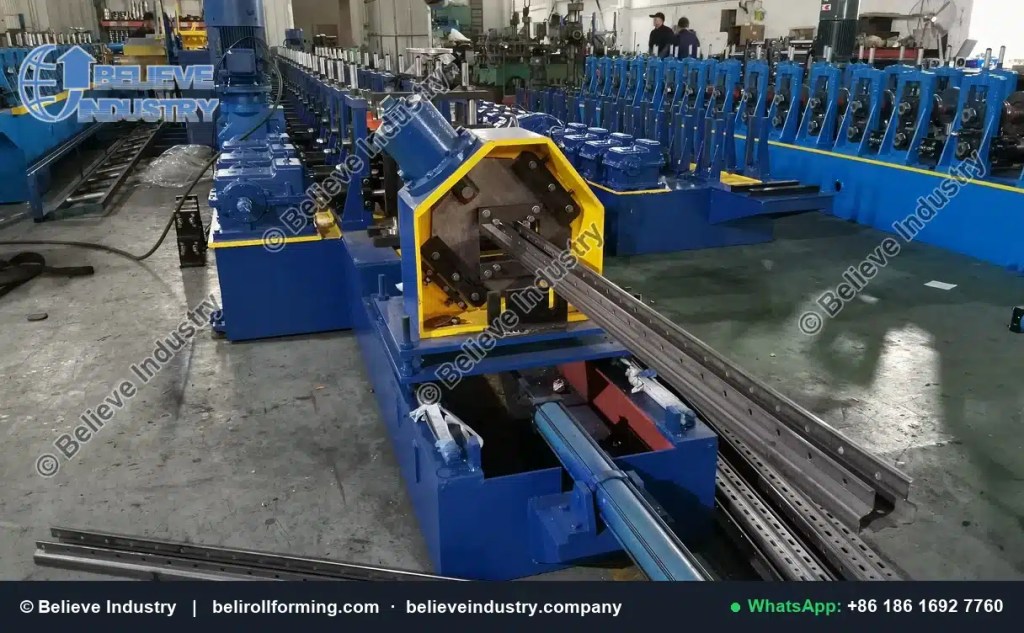
Upright column roll tooling is the set of forming rolls, the pass sequence and the punch dies that turn flat strip into a pallet rack upright. For 2.5 to 4.0 mm steel the working range is 14 to 24 passes, one punch station ahead of forming, and roll hardness at HRC 58 to 62. Get the pass count and the angle split right and the column leaves the line straight. Get them wrong and the operator spends the shift chasing twist.
This guide covers what changes between 2.5 mm and 4.0 mm, how to split the bend angle across the stands, which roll steel survives four millimetre strip, and where each common defect is born. The numbers come from lines we build and from tooling we have rebuilt after someone else got it wrong.
An upright column looks simple at a glance. A web, two flanges, a return lip on each side, and a row of teardrop or keyhole holes down the middle. That shape hides three problems.
The first is the return lip. A 15 to 20 mm lip folded back on itself needs a roll that reaches in without touching the flange face. As thickness climbs past 3 mm, that roll gets thin and the load on it climbs.
The second is the hole pattern. Upright holes sit close to the centre line in most teardrop systems, so the punch station has to work on a web that will later be formed. Hole position tolerates little drift, because a rack beam connector either engages or it does not.
The third is straightness. MHI racking guidance is the reference most North American buyers work to for upright capacity. A column is a long part, often 2 to 12 m, and any small twist per metre multiplies over the length. A 0.5 degree error at the last stand is a visible bow at the end of an 8 m column.
Good upright column roll tooling solves all three at the design stage. Bad upright column roll tooling solves them by adding straightening passes after the fact.
Pass count in upright column roll tooling follows thickness and section depth, not catalogue habit. The table below is the range we design to for a standard teardrop column with a 50 to 100 mm web and 40 to 60 mm flanges.
| Ketebalan strip baja | Passes, minimum | Passes, typical | Catatan |
|---|---|---|---|
| 2,5 mm | 14 | 14 sampai 16 | Light racking, single shift duty |
| 3,0 mm | 16 | 16 to 18 | The most common upright thickness |
| 3,5 mm | 18 | 18 to 20 | Heavier duty, deeper flange |
| 4,0 mm | 20 | 20 sampai 24 | High bay racking, springback is the enemy |
Two rules sit behind the table. First, no single pass should turn a bend more than 10 to 12 degrees on 3 mm strip, and no more than 8 degrees on 4 mm. Second, the last 15 to 20 percent of passes exist to correct, not to form. Plants that cut the pass count to save tooling money usually pay it back in scrap and rework inside a year.
For context on how the finished column is used, the guide to upright rack column roll forming machines covers the teardrop and keyhole systems and the section sizes behind them.
Angle split in upright column roll tooling is where most arguments start. Ours is blunt. Form hard early, correct late, and never let the last three passes carry real work.
| Pass group | Share of passes | Bend angle per pass | Fungsi |
|---|---|---|---|
| Entry, passes 1 to 4 | About 25 percent | 6 to 8 degrees | Start the flange, set the line |
| Main forming, middle | About 50 percent | 8 to 10 degrees | Bring the flange to final angle |
| Correction, passes 15 to 18 | About 20 percent | 2 to 4 degrees | Recover springback, true the web |
| Final, last 2 passes | About 5 percent | 0 to 1 degree | Size the section, set the lip |
The return lip gets its own schedule. Fold it in the middle of the run, not at the end, because a lip formed late has no pass left to correct the flange it sits on. On 4 mm strip we often give the lip two passes of its own.
Springback is the number that drives the correction group. Cold rolled steel at 3 mm springs back 1 to 2 degrees after the roll releases, and cold formed steel design guidance treats that springback as a design input rather than a surprise. High strength low alloy at 4 mm can spring 3 degrees. Upright column roll tooling that ignores this lands every column slightly open, and the punch then fights a flange that is not where the die expects it.
In upright column roll tooling the flower pattern is the drawing of the strip at every pass. Four rules keep it honest.
Rule one, hold the web flat. The web is the datum. If the web bows in the middle passes, the flanges climb and twist follows. Support the web with a flat roll top and bottom through the forming group.
Rule two, form both flanges together. Symmetry cancels side thrust. A line that forms one flange first and the other later pulls the strip sideways on every pass, and the edge guide works overtime.
Rule three, keep the roll gap at 1.05 to 1.15 times strip thickness. Too tight and the roll marks the surface. Too loose and the strip wanders.
Rule four, never form and punch in the same pass. Punch loads are impact loads. Forming loads are steady. Mixing them in one station shortens die life and blurs the hole edge.
If the profile family is still open, pallet rack upright profile names explains how teardrop, keyhole and Sammons sections differ before tooling is cut.
Roll steel in upright column roll tooling is a cost decision that shows up as downtime two years later. For upright column roll tooling at 2.5 to 3.5 mm, Cr12MoV at HRC 58 to 62 is the workhorse. At 4 mm, move to D2 with a deep cryogenic treatment, or accept that the lip rolls will need replacing early.
| Material rol | Hardness | Best thickness | Life, indicative |
|---|---|---|---|
| Baja bantalan GCr15 | HRC 60 to 64 | 2.5 mm and lighter | Long on light strip, chips on heavy |
| Cr12MoV | HRC 58 to 62 | 2.5 to 3.5 mm | The standard choice for racking |
| D2 with cryogenic treatment | HRC 60 to 62 | 3.5 to 4.0 mm | Best wear resistance at 4 mm |
| Surface chrome plated | 0.02 to 0.03 mm layer | Any, on galvanized | Reduces pickup and marking |
Shaft diameter matters as much as roll steel. A 4 mm line needs shafts of 90 to 120 mm to hold deflection under load. Undersized shafts flex, the roll gap opens under pressure, and the column comes out with a wave nobody can trace.
Heat treatment is not a detail, and roll forming tooling practice shows how often it is the root cause of early roll failure. A roll hardened to HRC 55 because the supplier skipped a temper step will mushroom at the keyway within months. Ask for the hardness certificate with the tooling, not after the first failure.
The related question of how fast the line can run is covered in upright roll forming machine speed. Most upright lines run 15 to 25 m per minute, and pass count in upright column roll tooling sets the ceiling.
For upright column roll tooling, punch first. The reason is support. A flat strip at the punch station sits on a solid die block with full backing. A formed column at the same station has two flanges in the way and a web that flexes under the punch load.
Pre-punch also keeps hole position tight. The strip is flat and the pilot can register on a fixed edge. Once the section is formed, the same hole has to be located against a flange that carries springback.
There is one exception. If the hole pattern changes often and the volumes are low, a post-form punch unit can be cheaper than a dedicated pre-punch die per pattern. The changeover guide for upright punch tooling and hole patterns covers the trade-off in time and cost.
Three punch rules apply at any thickness. Keep the hole edge at least 1.5 times thickness away from a bend line. Keep punch clearance at 8 to 12 percent of thickness per side. And never punch a hole that a later pass will bend through, because the hole distorts and the edge cracks.
Most defects in upright column roll tooling trace to a specific pass group. The table below is the one we use on commissioning.
| Cacat | Penyebab umum | Where it starts | Fix |
|---|---|---|---|
| Twist along the length | Asymmetric forming or a bowed web | Entry to middle passes | Form both flanges together, flatten the web rolls |
| Flange wave | Roll gap too tight or shaft deflection | Main forming group | Open the gap to 1.1 times thickness, check shaft size |
| Web bow | Too much angle in one pass | Middle passes | Spread the angle, add a correction pass |
| Open flange after exit | Springback not compensated | Correction group | Add 1 to 3 degrees of overbend |
| Hole position drift | Punch after forming, or loose pilot | Punch station | Move to pre-punch, tighten the pilot |
The pattern is consistent. Defects that look like a tooling quality problem are usually a pass design problem. Before anyone re-cuts a roll on upright column roll tooling, check the angle schedule and the roll gap.
A wider view of setup and fault finding sits in the upright rack machine setup guide, which walks the first article in 12 steps.
A 16 pass upright column roll tooling set with one pre-punch station lands between 35,000 and 70,000 USD, depending on section size, roll steel and whether the punch die is included. A 24 pass upright column roll tooling set for 4 mm high bay work sits at the top of that band.
Lead time runs 45 to 70 days from approved flower pattern. The flower pattern approval is the real gate. If the buyer signs the drawing late, the rolls are cut late, and no amount of shop pressure recovers the schedule.
Cost per pass in upright column roll tooling is a poor way to compare quotes. Two suppliers can both quote 16 passes of upright column roll tooling, and one can put 60 percent of the angle in the first six passes while the other spreads it evenly. The second column will be straighter, and the quote will look 10 percent higher for a reason.
Shared tooling is the other lever in upright column roll tooling. A roll set built for a 100 mm web can often run an 80 mm web with a shim change, if the flange geometry matches. That is worth designing in from the start. The steel grade guide for upright columns explains which grades you are likely to run and how each one springs back.
If the choice is still between roll forming and bending, roll formed upright column versus press brake puts the tooling cost against the labour cost with real numbers.
Q: How many passes does upright column roll tooling need for 3 mm steel?
Q: Is pre-punch always better than post-punch for upright columns?
Q: What roll hardness should upright column roll tooling use?
Q: Why does my upright column twist even with new rolls?
Q: Can one upright column roll tooling set run several section sizes?
Q: How long does it take to get upright column roll tooling made?
Panduan upright rack roll forming machine overview shows how tooling sits inside the full line, from uncoiler to stacker. For a pass design review, send the column drawing, the steel grade, the thickness range and the hole pattern. We return a pass count, an angle schedule and a roll material recommendation for your thickness band.
Upright column roll tooling is not a commodity. It is the one part of the line that decides whether the column is straight before the straightener ever touches it.
Last updated: 2026-11-20
Riwayat Perubahan Artikel
2026-11-20: Initial publication. Pass count table for 2.5 to 4.0 mm, angle split by pass group, flower pattern rules, roll material table, punch sequence and five defect fixes.
Pemicu Tinjauan Berikutnya
A new upright section standard or teardrop pitch change; roll steel prices move more than 15 percent; a shipped 4 mm line adds new springback data; quarterly SERP check for the focus term.
Cable Tray Production Cost per Meter: 6 Levers That Cut...
Baca selengkapnyaUpright Column Roll Tooling: Pass Design for 2.5 to 4.0...
Baca selengkapnya3 in 1 Roll Forming Machine Passes Testing, Ready to...
Baca selengkapnyaCable Tray Coil Width and Scrap: Yield From Coil to...
Baca selengkapnya