Alamat
No. 1 Yudong Road, Huishan District, Wuxi City, Jiangsu. 214103
Waktu Kerja
Isnin hingga Jumaat: 9AM - 5PM
Sabtu: 9AM - 4PM
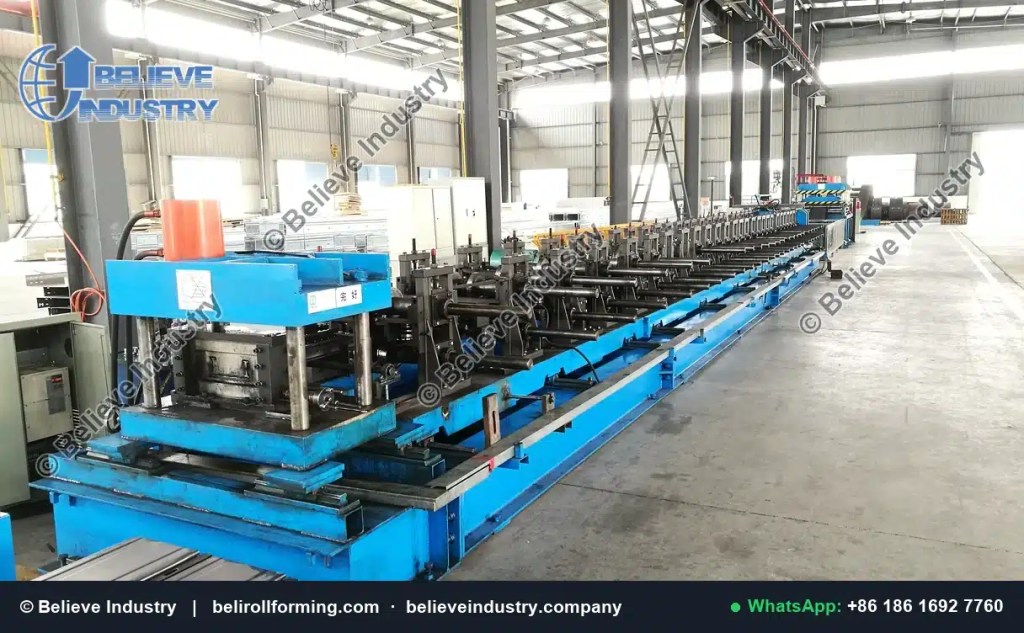
Cable tray production cost per meter is the sum of six lines: material, labour, energy, die amortisation, maintenance and scrap credit. Material takes 65 to 75 percent of the total on a normal perforated tray line. That is why most plants attack the wrong lever. They chase labour, which is 8 to 12 percent, while a 15 mm coil width error quietly costs more than every operator on the floor.
The six levers below are ordered by how much money they return, not by how easy they are to talk about. Two of them are fixed at the quoting stage and cannot be recovered later. The other four run on the line every shift.
Start with a real number. Take a 300 by 100 mm perforated trough in 1.5 mm pre galvanized steel, running 585 mm strip, at a coil price of 780 USD per tonne. The table below is the cost stack per finished meter.
| Cost line | Share of total | USD per meter | Fixed or controllable |
|---|---|---|---|
| Material, after scrap credit | 65 to 75 percent | 5.20 to 5.80 | Fixed at coil width |
| Labour, direct and indirect | 8 to 12 percent | 0.70 to 0.95 | Controllable |
| Energy, electric and air | 3 to 5 percent | 0.25 to 0.35 | Controllable |
| Die and roll amortisation | 3 to 6 percent | 0.20 to 0.40 | Fixed at tooling order |
| Maintenance and consumables | 2 hingga 4 peratus | 0.15 to 0.30 | Controllable |
| Scrap recovery credit | minus 2 to 5 percent | minus 0.15 to minus 0.30 | Controllable |
Add the middle of each band and the cable tray production cost per meter lands near 7.10 USD. Two plants with the same machine, the same steel and the same wage bill can sit 0.80 USD apart in cable tray production cost per meter. The gap is not luck. It is the six levers.
Coil yield is the largest lever in cable tray production cost per meter, and the least exciting, which is why it gets skipped.
Coil width is set from the developed width of the section plus a margin of 8 to 15 mm, and it is the first input in cable tray production cost per meter. Every millimetre above that margin is bought, slit, shipped and then trimmed off as scrap on every meter you run. On a 585 mm strip, 15 mm of fat is 2.6 percent of the coil. At 300,000 meters a year, that is roughly 60,000 USD gone with no offsetting benefit.
The discipline is boring and it works. Fix the margin in writing per tooling set. Hold the slitter to plus or minus 0.5 mm. Measure incoming coils, because slitters drift as blades wear. Then leave it alone.
For the calculation itself, cable tray coil width and scrap walks the developed width method and the reverse quote from yield. The coil width calculation guide covers the same margin logic for other profile families.
Scrap is not one material in cable tray production cost per meter. It is three, and they do not sell for the same price.
Clean edge trim off pre galvanized coil is a known grade and sells near mill scrap price, and galvanizing guidance explains why a cut edge sells differently from a coated one. Punched slugs with oil on them sell lower. Mixed shop scrap, the pile where everything lands, sells lowest of all. A plant that tips all three into one bin is handing away 60 to 90 USD per tonne for no reason.
| Scrap stream | Typical recovery, USD per tonne | What raises the price |
|---|---|---|
| Clean edge trim, single grade | 280 to 340 | Baled, dry, no mixed alloys |
| Punch slugs, oiled | 230 to 290 | Drained, kept separate from trim |
| Mixed shop scrap | 180 to 240 | Nothing, this is the floor |
| Rework and rejects | Sold as scrap only | Prevention beats recovery |
Segregation is a two-bin change and a short talk with the operators. On a line producing 1,200 tonnes of coil a year, moving a third of the scrap from mixed to clean grade is worth 8,000 to 15,000 USD. It also makes the monthly scrap report readable, which is worth more than the cash.
Do not confuse recovery with prevention. A higher scrap price never beats not making the scrap. Recovery only softens the loss.
In cable tray production cost per meter, labour is a per-hour cost and material is a per-meter cost. That difference is the whole lever.
A cable tray line running 12 m per minute with four people on the shift carries a different labour cost per meter than the same line at 18 m per minute. At 12 m per minute, a 480 minute shift makes about 5,760 meters. At 18, it makes about 8,640. The crew cost does not move. Labour per meter drops by a third.
| Kelajuan talian | Meters per shift | Labour USD per meter at 620 USD per shift |
|---|---|---|
| 12 m per minute | 5,760 | 0.108 |
| 15 m per minute | 7,200 | 0.086 |
| 18 m per minute | 8,640 | 0.072 |
| 24 m per minute | 11,520 | 0.054 |
Speed has a ceiling inside cable tray production cost per meter. Run too fast and the punch misses, the cut length drifts and the rejects eat the gain. The honest target is the fastest speed at which the first article still passes at the end of the shift, not the speed on the brochure.
Where speed is limited by the punch, a servo upgrade is the usual fix. The servo punching upgrade guide covers what changes and what it returns.
Every width or pattern change adds to cable tray production cost per meter through setup time and setup scrap. The scrap part is the one nobody counts.
| Changes per shift | Setup scrap, percent of coil | Setup time, minutes |
|---|---|---|
| One change | 0.4 to 0.8 | 20 to 35 |
| Two changes | 0.8 to 1.4 | 40 to 70 |
| Three changes | 1.2 to 2.0 | 60 to 105 |
Setup scrap comes from the first articles, the thread up and the tail out. It is pure loss, and it repeats every time the line changes. Batching by width and by pattern is the cheapest fix available, because it costs nothing but a production plan.
The next step up is stored recipes. A line with motorised width adjustment and recipe storage cuts the changeover itself, not just the planning around it. The automatic size change guide shows what a recipe driven change looks like in minutes.
A dull punch raises cable tray production cost per meter in three ways. It raises the burr, it raises the punch load, and it slowly shifts the hole edge. All three end as rejects, and rejects are the most expensive scrap because they already carry labour and energy.
| Maintenance item | Selang masa | Cost if ignored |
|---|---|---|
| Punch tip inspection | Every 20,000 hits | Burr, then cracking at the hole edge |
| Die clearance check | Bulanan | Slugs stick, punch load climbs |
| Stripper and spring check | Bulanan | Sheet marks, misfeeds |
| Roll surface clean and check | Mingguan | Marking on galvanized surface |
The cheapest habit is a first article check at the start of every shift, not every week, and roll forming practice treats that check as the core of die life control. One 300 mm sample against the drawing catches a drifting punch before it becomes a pallet of rejects.
Punch and die cost inside cable tray production cost per meter is also a design decision. A die that punches only the holes the pattern needs, instead of a full grid everywhere, cuts both punch waste and cycle time. The cable tray machine types guide explains how ladder, trough and cover sections change the punch load.
Energy is 3 to 5 percent of cable tray production cost per meter, and most of it is not the main motor.
Compressed air is the hidden line. A single 6 mm leak at 7 bar costs roughly 1,000 USD a year in electricity at continuous duty, and most plants have several. Punches, strippers and air cylinders all run on that air. A leak walk once a quarter pays for itself before lunch.
| Energy item | Typical share of energy cost | Quick win |
|---|---|---|
| Main drive motors | 45 to 55 percent | Variable frequency drive, soft start |
| Hydraulic power unit | 15 to 25 percent | Idle unloading, oil temperature control |
| Compressed air | 12 to 20 percent | Leak walk, solenoid shutoff at breaks |
| Lighting and auxiliaries | 5 to 10 percent | LED, motion sensors |
A variable frequency drive on the main motor is the single biggest energy item, and it also softens the start, which helps the gearbox. On a line running two shifts, the payback is usually under two years.
Here is the whole cable tray production cost per meter chain in one number, for the 300 by 100 mm trough at 585 mm strip.
Strip mass per meter is 0.585 by 0.0015 by 1 m, times 7,850 kg per cubic meter, which is 6.89 kg. One tonne of coil therefore holds about 145 raw meters. At 4 percent total scrap, sellable output is about 139 meters.
Material cost is 780 USD per tonne divided by 139 meters, which is 5.61 USD per meter. Add labour at 0.85, energy at 0.30, die amortisation at 0.25 and maintenance at 0.20, then subtract a scrap credit of 0.20. The cable tray production cost per meter is about 7.01 USD.
Now run the levers against that cable tray production cost per meter. Tighten the width margin and recover 2 percent of material, worth 0.11 USD. Segregate scrap and recover 0.06 USD. Lift speed from 12 to 18 m per minute and save 0.036 USD of labour. Cut changeovers from three to one and save 0.05 USD of setup scrap. Fix air leaks and save 0.03 USD. The total is about 0.29 USD per meter, or 87,000 USD a year at 300,000 meters.
That is the distance cable tray production cost per meter puts between a plant that wins a 9.50 USD quote and one that loses it.
Cable tray production cost per meter belongs on the quote sheet as a build up, not as a single number. Buyers who see the six lines understand where the price comes from, and they stop shopping on the total alone.
A quote that shows cable tray production cost per meter as six separate lines also protects the seller. When the coil price moves, the material line moves and the reason is visible. A single price that jumps 6 percent overnight reads as gouging, even when it is honest.
Two checks belong on every cable tray production cost per meter quote. First, state the coil width and the margin, because that is the assumption behind the material line. Second, state the batch size, because the setup scrap assumption depends on it. Quotes that hide both assumptions get compared against quotes built on different ones, and the comparison is meaningless.
Panduan kos talian dulang kabel covers the capital side of the same question, and the four tray types compared explains why a ladder rail and a perforated trough of the same nominal size cost different amounts to make.
Q: What is a normal cable tray production cost per meter?
Q: Which cost lever saves the most money?
Q: Does running the line faster always cut cost per meter?
Q: How much does scrap segregation actually return?
Q: Should I add a servo punch to cut cable tray production cost per meter?
Q: How often should the cost per meter be recalculated?
Panduan cable tray roll forming machine overview covers line configuration from uncoiler to stacker, and the penjelas jenis NEMA maps which tray classes carry which load ratings in North America. Load class and section thickness are linked, and NEMA VE 1 sets the load classes, so the cost per meter of a tray always starts with the duty it has to carry. Buyers in Europe work to IEC 61537 instead, and the cost structure is the same.
For a cost review, send one month of production data, the coil price, the current strip widths and one scrap report. We return the six line build up, the lever order by saving and the two assumptions your quote sheet is missing.
Cable tray production cost per meter is not a mystery. It is six lines, two fixed at the start, and four waiting on the next shift.
Last updated: 2026-11-20
Log Perubahan Artikel
2026-11-20: Initial publication. Six line cost stack, six levers with savings by lever, line speed table, changeover scrap table, worked example to 0.29 USD per meter and 6 FAQ.
Pencetus Semakan Seterusnya
Coil or scrap prices move more than 10 percent; a shipped line adds new throughput data; NEMA VE 1 or IEC 61537 revision; quarterly SERP check for the focus term.
Cable Tray Production Cost per Meter: 6 Levers That Cut...
Baca lagiUpright Column Roll Tooling: Pass Design for 2.5 to 4.0...
Baca lagi3 in 1 Roll Forming Machine Passes Testing, Ready to...
Baca lagiCable Tray Coil Width and Scrap: Yield From Coil to...
Baca lagi