Especificações do perfil IBR e normas sul-africanas

O que é telha IBR? Especificações do perfil e normas sul-africanas.

What is IBR roof sheeting?

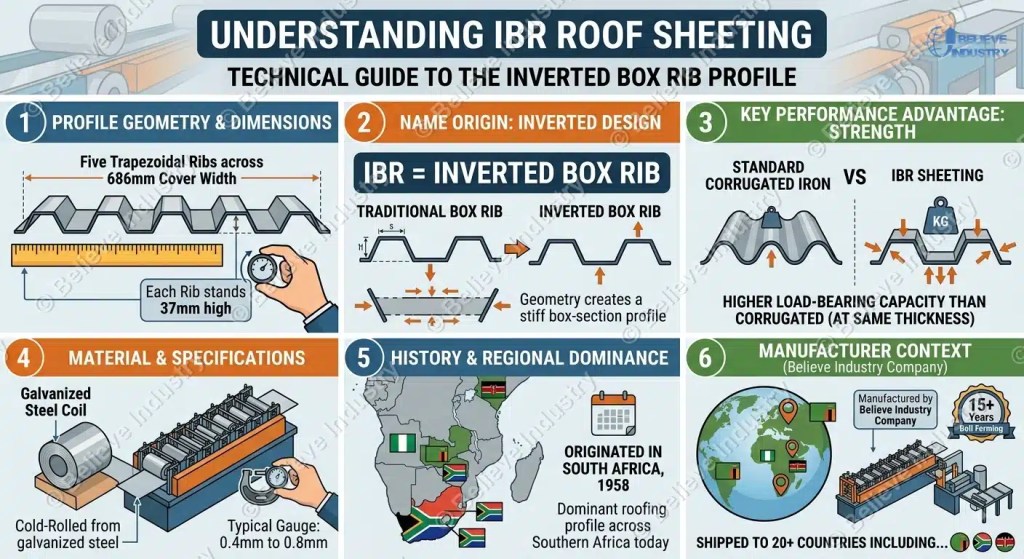
IBR roof sheeting is a profiled metal roofing sheet with five trapezoidal ribs rolled across a 686mm cover width. Each rib stands 37mm high. The profile is cold-rolled from galvanized steel coil, typically 0.4mm to 0.8mm thick. IBR originated in South Africa in 1958 and remains the dominant roofing profile across Southern Africa today.

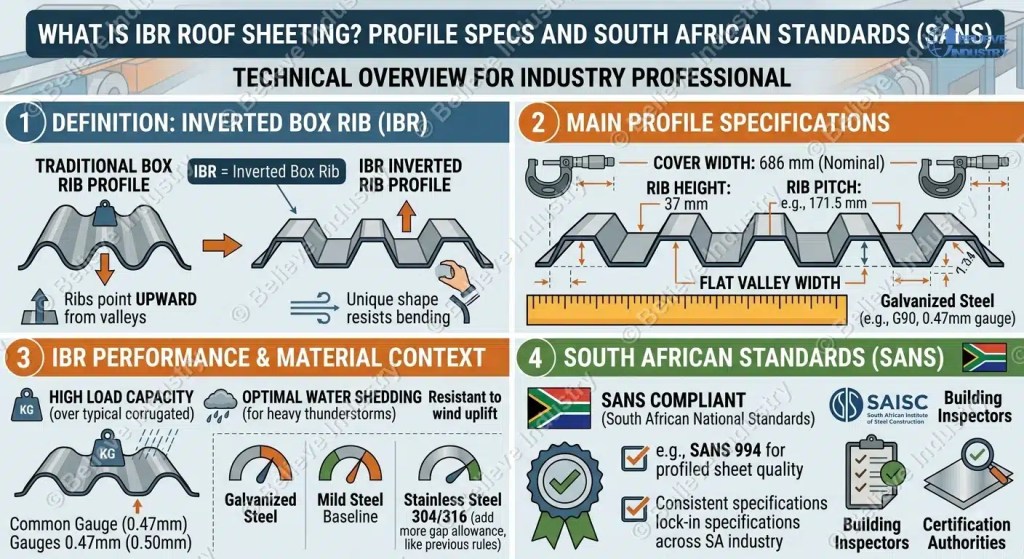
The name IBR stands for Inverted Box Rib. The “inverted” refers to the trapezoidal ribs pointing upward from the flat valley, creating a stiff box-section profile when viewed in cross-section. This geometry gives IBR sheets higher load-bearing capacity than standard corrugated iron at the same material thickness.

Acredite na Empresa do Setor has manufactured IBR roll forming machines for over 15 years, shipping to 20+ countries including South Africa, Kenya, Nigeria, and Zambia.

What is IBR roof sheeting

IBR 686 profile: technical specifications

The IBR 686 profile is the standard IBR sheet used across South Africa and neighboring markets. The “686” refers to the effective cover width after side laps are engaged. The total coil input width is 925mm to 940mm, depending on the lap design.

ParâmetroEspecificação
Largura da capa686 mm
Altura da costela37 mm
Rib Count5 trapezoidal ribs
Espaçamento entre as costelas171.5 mm (center to center)
Valley Stiffener1 stiffener rib per valley
Espessura do material0.4 mm to 0.8 mm
Input Coil Width925-940 mm
Minimum Roof Slope (span up to 30 m)5 degrees
Minimum Roof Slope (span over 30 m)7.5 degrees
Fixing Method (Roofing)Screw through narrow flute
Fixing Method (Wall Cladding)Screw through wide flute

The profile works for both roofing and wall cladding applications. On roofs, fasteners go through the narrow flute. On walls, the wide flute faces outward and fasteners go through it. For every 100 square meters of roof area, IBR 686 uses roughly 10% fewer sheets than standard corrugated profile with the same lap pattern. Fewer sheets means fewer fasteners, less labor, and faster installation.

IBR rib geometry explained

The defining feature of IBR roof sheeting is its trapezoidal rib design. Five ribs run the full length of the sheet, each measuring 37mm in height. The ribs are trapezoidal rather than rounded, which increases the section modulus and improves spanning capability.

Each valley between the main ribs contains a secondary stiffener rib. This stiffener is smaller, typically 2mm to 3mm high, but it prevents oil-canning under wind load and thermal cycling. Without the valley stiffener, wide flat areas between main ribs would flex and cause visible waviness on the finished roof.

The 171.5mm center-to-center rib spacing creates a balanced load distribution. Compare this to standard corrugated profile, which uses narrower corrugations at 76mm pitch with only 17mm height. The IBR profile geometry delivers roughly 2.2 times the section modulus per square meter of sheet area.

South African standards: SANS 994, SANS 121, and SANS 10400

IBR roof sheeting sold in South Africa must comply with three key standards administered by the South African Bureau of Standards (SABS). O National Regulator for Compulsory Specifications (NRCS) enforces compulsory specifications for building materials in the SA market.

SANS 994 is the primary specification for profiled steel sheeting. It defines dimensional tolerances, coating requirements, and mechanical properties. Under SANS 994, IBR 686 profile dimensions must fall within plus or minus 2mm for cover width and plus or minus 1mm for rib height. Material grade must meet ISQ 550, which is equivalent to S350GD under EN 10346.

SANS 121 governs hot-dip galvanized coatings. For IBR sheets, the minimum zinc coating is Z180 for inland applications and Z275 for coastal areas within 10km of the shoreline. Z275 means 275 grams of zinc per square meter of sheet, total both sides.

SANS 10400 Part L covers the National Building Regulations for roofs. This standard specifies structural requirements including wind uplift resistance, water proofing, and drainage. IBR roof sheeting must withstand wind uplift forces calculated based on the building location and roof geometry.

PadrãoEscopoRequisito fundamental
SANS 994Profiled steel sheetingDimensional tolerances, material grade ISQ 550
SANS 121Hot-dip galvanizingZ180 inland, Z275 coastal
SANS 10400-LNational Building RegulationsWind uplift, structural, drainage

IBR roof sheeting roll forming machine must be configured to produce profiles within these tolerances. Coil feed width, roller station count, and cutting accuracy all affect compliance.

IBR vs corrugated vs Widespan: profile comparison

Three profiles dominate the Southern African roofing market. Each serves different applications based on span requirements, budget, and aesthetic preferences.

ParâmetroIBR 686Corrugated 762Widespan 700
Largura da capa686 mm762 mm700 mm
Altura da costela37 mm17 mm34 mm
Rib TypeTrapezoidalSinusoidal (wave)Trapezoidal
Rib Count510.5 (8.5 pitch)4
Max Purlin Spacing (0.5mm)1.8 m1.2 m1.6 m
Market Share (SA)60%+20%10%
Uso típicoResidential, commercial, industrialAgricultural, low-cost housingIndustrial warehouses

IBR leads the market because it balances strength, coverage efficiency, and cost. Folha ondulada is cheaper per linear meter but requires closer purlin spacing and more fasteners. Ampla extensão competes with IBR in industrial applications but holds a smaller market share.

686 IBR sheet roll forming machine is the most commonly ordered profile machine for customers targeting the South African and broader African markets.

IBR vs corrugated vs Widespan profile comparison

Material specifications and coil requirements

IBR roof sheeting is produced from three primary material types. Galvanized steel (GI) is the baseline, with zinc coating per SANS 121. Galvalume (GL) adds an aluminum-zinc alloy coating for improved corrosion resistance. Pre-painted galvanized (PPGI) applies a color coating on top of the galvanized base for aesthetic finish.

Tipo de materialRevestimentoEspessura típicaIdeal para
Galvanized (GI)Z180-Z275 zinc0.4-0.8 mmStandard roofing, inland
Galvalume (GL)AZ150 aluminum-zinc0,4-0,6 mmCoastal, industrial
Pre-painted (PPGI)Z180 + polyester paint0,4-0,6 mmResidential, commercial

For the South African market, coil input width must be 925mm to 940mm. European standard coil at 1000mm or 1250mm will not produce correct IBR 686 profile dimensions without slitting first. The máquina de perfilagem de chapas de cobertura uncoiler and feed guide must accept SA-spec widths.

Material grade ISQ 550 (yield strength 550 MPa) is the South African standard for profiled sheeting. This is equivalent to S350GD under EN 10346 or ASTM A653 Grade 50. Lower grades will not meet SANS 994 mechanical property requirements.

IBR 686 vs IBR 890

Two IBR variants exist in the market. IBR 686 is the standard profile. IBR 890 offers a wider cover width with the same rib height and geometry.

ParâmetroIBR 686IBR 890
Largura da capa686 mm890 mm
Altura da costela37 mm37 mm
Rib Count55
Input Coil Width925-940 mm1150-1200 mm
Market AdoptionDominant (60%+)Niche (under 5%)
Ideal paraStandard SA roofingWider coverage, fewer sheets

IBR 890 covers 30% more area per sheet than IBR 686. This means fewer sheets, fewer fasteners, and faster installation for large roof areas. The trade-off is higher coil cost per linear meter and fewer suppliers stocking 1150mm+ width coil in Africa.

890 IBR sheet roll forming machine is less commonly ordered than the 686 variant. Most African buyers stick with IBR 686 because coil availability and contractor familiarity favor the standard profile.

Why IBR dominates African roofing markets

IBR holds over 60% of the South African profiled steel roofing market. Several factors explain this dominance.

First, IBR was developed specifically for African conditions. The 37mm rib height provides excellent water shedding during heavy summer thunderstorms common in the Highveld. The trapezoidal geometry resists wind uplift better than corrugated profile, which matters in coastal areas like Cape Town and Durban where wind speeds exceed 120 km/h during storms.

Second, SANS 994 standardization means every contractor, supplier, and building inspector in South Africa recognizes IBR 686. Building material chains like Cashbuild, Build It, and Builders Warehouse stock IBR sheets in standard lengths. The South African Institute of Steel Construction (SAISC) publishes design tables and load data for IBR profiles, reinforcing specification consistency across the industry. This ecosystem effect locks in the profile specification.

Third, IBR offers the best cost-to-strength ratio for African construction budgets. At 0.47mm thickness, an IBR sheet spans 1.5 meters between purlins. A corrugated sheet at the same thickness spans only 1.0 meter. Less steel structure, lower total project cost.

Fourth, IBR works for both roofing and wall cladding. Builders use the same profile for the entire building envelope, simplifying procurement and reducing waste. The IBR roofing sheet making machine produces both roofing and wall sheets from the same roll set.

Why IBR dominates African roofing markets

How IBR sheets are produced

IBR roof sheeting is manufactured through cold roll forming. Flat galvanized coil feeds into a linha de máquinas de perfilagem de rolos with 18 to 22 progressive roller stations. Each station bends the metal slightly until the final IBR profile emerges. No heat, no welding, no cutting of the cross-section.

processo de conformação de rolos runs continuously. Coil feeds in one end, finished IBR sheets exit the other. A hydraulic flying shear cuts sheets to length while the line keeps running. Standard production speeds range from 10 to 12 meters per minute, producing roughly 3,000 linear meters per 8-hour shift.

For manufacturers producing both IBR and corrugated profiles, a máquina de perfilagem de rolos de dupla camada stacks two roll sets on one frame. Profile changeover takes 5 to 15 minutes. This setup suits suppliers serving hardware chains that stock multiple profiles.

If you are evaluating equipment for IBR production, our IBR sheet roll forming machine buy guide covers machine specs, output rates, and supplier comparison in detail.

How IBR sheets are produced

Frequently Asked Questions of IBR Roof Sheeting

What does IBR stand for in roof sheeting?

IBR stands for Inverted Box Rib. The name refers to the five trapezoidal ribs that point upward from the flat sheet valley, creating an inverted box shape in cross-section. The profile was introduced in South Africa in 1958.

What is the cover width of IBR 686 roof sheeting?

IBR 686 has an effective cover width of 686mm after side laps are engaged. The input coil width is 925mm to 940mm. The difference between coil width and cover width accounts for the material formed into the ribs and the overlapping side laps.

Título da aba de acordeão 3

IBR roof sheeting requires a minimum slope of 5 degrees for roof spans up to 30 meters. For spans exceeding 30 meters, the minimum slope increases to 7.5 degrees. These requirements are specified under SANS 10400 Part L.

What is the difference between IBR and corrugated roof sheeting?

IBR has five trapezoidal ribs at 37mm height on a 686mm cover width. Corrugated profile uses sinusoidal waves at 17mm height on a 762mm cover width. IBR spans 1.5 meters between purlins at 0.47mm thickness versus 1.0 meter for corrugated at the same gauge. IBR costs more per sheet but reduces total structure cost through wider purlin spacing.

What SANS standards apply to IBR roof sheeting?

Three standards apply. SANS 994 covers profiled steel sheeting specifications including dimensions and material grade. SANS 121 governs hot-dip galvanized coatings, requiring Z180 for inland and Z275 for coastal areas. SANS 10400 Part L addresses structural requirements for roofs under the National Building Regulations.

What material thickness is used for IBR roof sheeting?

IBR roof sheeting is produced in thicknesses from 0.4mm to 0.8mm. The most common thicknesses are 0.47mm for residential roofing and 0.5mm for commercial and industrial applications. Material grade must be ISQ 550 (yield strength 550 MPa) to meet SANS 994 requirements.

Can IBR sheeting be used for wall cladding?

Yes. IBR profile works for both roofing and wall cladding. For wall applications, the wide flute faces outward and fasteners go through the wide flute. Using the same profile for roof and walls simplifies procurement and reduces material waste on construction projects.

What coil width is needed to produce IBR 686 profile?

The input coil width must be 925mm to 940mm to produce IBR 686 profile to SANS 994 dimensional tolerances. Standard European coil at 1000mm or 1250mm requires slitting before roll forming. Verify that the uncoiler and feed guide on your roll forming machine accept SA-spec coil widths.

Last updated: August 13, 2026

Registro de alterações do artigo:

  • 2026-08-13: Initial publication. Covered IBR profile definition, 686 specifications, SANS standards, profile comparison, material specs, and FAQ.

Próximos gatilhos de revisão:

  • SANS 994 standard revision or amendment publication
  • New IBR profile variant entering the African market
  • Significant change in South African coil width supply chain
  • Update to SANS 10400 Part L wind load requirements
  • New competitor profile gaining market share over IBR 686

Believe Industry Company has manufactured roll forming machines for over 15 years, serving 20+ countries across Africa, Europe, the Americas, and Asia.

Índice

Novas atualizações

Descubra mais sobre Believe Industry Company| Roll Forming Machine Manufacturer, Supplier & Exporter

Assine agora para continuar lendo e ter acesso ao arquivo completo.

Continue lendo