


Standing seam roll former machines produce standing seam roofing panels with interlocking raised seams. Unlike snap-lock or screw-down panels, standing seam systems use concealed fasteners where seams are mechanically or manually folded on site. A standing seam roll former automates this process at scale, feeding coiled metal through successive roller stations to form precise seam profiles at speeds ranging from 10 to 40 meters per minute.
The technology started in industrial roofing and expanded into solar panel mounting, building envelopes, and architectural cladding. According to the Metal Construction Association, standing seam metal roofing accounts for a growing share of the commercial low-slope segment in North America. Believe Industry (Beli Rollforming) has supplied standing seam roll formers across 40+ countries since 2005, including a production partnership with GameChange Solar for solar mounting structure manufacturing since 2019.
This guide covers machine types, technical specs, selection criteria, and supplier comparison. For broader roll forming equipment pricing context, see our roll forming machine price overview.
Standing Seam Roll Former by the Numbers
- Seam height range: 38 mm to 76 mm (1.5″ to 3″)
- Panel width: 300 mm to 600 mm per station (custom widths available)
- Line speed: 10-40 m/min depending on material thickness,machine design and profile complexity
- Material thickness: 0.4 mm to 1.2 mm for galvanized steel; 0.5 mm to 1.0 mm for aluminum
- Typical coil width: 600 mm to 1,250 mm
- Machine footprint: 6 m x 1.5 m for basic models; 15 m+ for fully automated lines
- Power consumption: 7.5 kW to 25 kW for main drive motors
- Lead time from order to shipment: 25 to 60 days depending on configuration
- Average service life: 15-25 years with regular maintenance
What Is a Standing Seam Roll Former?
A standing seam roll former is a continuous metal forming machine that converts flat coil stock into profiled roofing or cladding panels with raised interlocking seams. Metal strip passes through a series of forming rollers that gradually shape the blank into a specific cross-section profile. Each roller station makes incremental bends until the final standing seam geometry emerges at the exit.
The defining feature of a standing seam profile is the vertical leg that interlocks with an adjacent panel, creating a weather-tight seal without exposed fasteners. According to SMACNA’s sheet metal and air conditioning design guidelines, the interlocking seam geometry must maintain consistent tolerances throughout the panel length to ensure proper weather resistance. This matters in commercial and industrial roofing where water penetration and wind uplift resistance are primary concerns. Seams are typically seamed together using a manual or electric seaming tool after panels are installed on the roof deck.
Standing seam roll formers fall into two broad categories: fixed-geometry machines that produce one seam type per die set, and quick-change machines that accept interchangeable roller cassettes for different profiles without full retooling.
Types of Standing Seam Profiles
Seam geometry matters when specifying a roll former. Profile choice determines compatibility with the building design, climate, and local codes. The Wikipedia article on standing seam roofs provides a useful overview of how different seam types evolved historically across regional markets.
1. Single Lock (Single Rib) Seam
The single lock standing seam has one vertical leg folded over a complementary hook leg on the adjacent panel. This profile is common in residential and light commercial applications. Seam height typically ranges from 38 mm to 50 mm. Single lock seams offer moderate wind uplift resistance and are easy to hand-seam in the field.
2. Double Lock (Double Rib) Seam
Double lock standing seams fold both sides of the seam into a 180-degree hem, creating a tighter mechanical interlock. Seam heights of 50 mm to 76 mm provide superior wind uplift ratings, making this profile the standard for hurricane-prone regions and high-wind commercial zones. The International Code Council references double lock geometry in their metal roofing wind load provisions for high-velocity hurricane zones. Double lock machines need more roller stations and typically run slower than single lock lines.
3. Snap-Lock / Mechanical Seam
Snap-lock profiles let panels be installed without seaming tools, as the female rib snaps over the male rib during installation. These are popular in retrofit and re-roofing projects where speed matters. They generally offer lower wind uplift performance than mechanically seamed double lock systems.
4. Tee-Peak and Field-Lok Profiles
Tee-peak systems use a T-shaped rib that interlocks with a receiving channel, eliminating the traditional hook-and-bend seaming process. Field-Lok profiles use a specialized clip and interlocking rib design that installs faster but requires specific panel geometry tolerances.


How Standing Seam Roll Formers Work
The standing seam roll forming process goes from coil loading to finished panel stacking in four stages. Understanding this workflow helps when specifying a machine alongside other roll forming equipment families like strut channel roll forming machines, which share similar entry-feeding and progressive-forming principles but target different profile geometries.
Step 1: Decoiling and Entry Feeding
A decoiler — manual or servo-controlled — holds the coil. A pinch roller section feeds the strip into the first station under controlled tension. Entry guides keep the strip tracking straight to prevent edgewave or camber.
Step 2: Progressive Forming
The strip moves through roller stations, each making an incremental bend. Single lock lines typically use 8-12 stations. Double lock machines need 14-18 stations to form the tighter hem geometry. Rollers are precision-ground from tool steel or carbide, holding tolerances within ±0.2 mm.
Step 3: Seaming Rib Formation
Exit stations form the male and female rib geometry. The male rib hooks into the female rib’s receiving channel. Some machines include an integrated seaming head that completes the first fold on the line, cutting field seaming labor by about 60%.
Step 4: Cutting and Panel Handling
Continuous panels are cut to length by a flying cutoff shear or hydraulic chopper without stopping the line. Panels then go to a stacking table or bundling station. Automated packaging is an optional add-on for high-volume facilities.


Key Technical Specifications
These specifications determine production capacity, finished product quality, and site compatibility when evaluating a standing seam roll former. AISI material standards define the minimum mechanical properties that coil stock must meet for roll forming, particularly yield strength and tensile elongation, which directly affect how the metal bends without cracking at each station.
| Parameter | Standard Range | Notes |
|---|---|---|
| Seam height | 38-76 mm | Determined by roller die geometry |
| Panel coverage width | 300-600 mm | Adjustable with cassette systems |
| Material | Galvanized steel (per AISI specs), Galvalume, aluminum (per Aluminum Association alloy standards) | Verify coil width compatibility |
| Thickness range | 0.4-1.2 mm | Thicker = slower speeds, higher power |
| Line speed | 10-40 m/min | Varies by profile and material |
| Motor power | 7.5-25 kW | Main drive motors only |
| Machine length | 6-18 m | Increases with automation level |
| Roller stations | 14-28 | Double lock needs more stations |
| Cutting tolerance | ±1.0 mm | Flying shear vs. chopper shear |
| Control system | PLC + HMI | Some machines offer remote diagnostics |
Standing Seam Roll Former vs. Traditional Roll Forming Machines
Standing seam machines differ from general-purpose roll formers in several ways. These differences matter when deciding whether equipment can actually meet standing seam tolerances. The critical distinction is that a standing seam roll former must hold roller-to-roller parallelism within ±0.1 mm, compared to ±0.3 mm typical for standard C/Z purlin roll forming machines, because any deviation in the interlocking rib geometry creates seam gaps that compromise weather resistance.
| Feature | Standing Seam Roll Former | Standard Roll Former |
|---|---|---|
| Seam geometry | Precise vertical interlocking ribs | Flanging, channel, or generic profiles |
| Roller precision | ±0.1 mm tolerance, hardened surfaces | ±0.3 mm typical |
| Station count | 16-28 stations for proper seam formation | 10-14 stations typical |
| Seaming capability | Often has integrated seaming station | Not included |
| Panel compatibility | Designed for interlocking roof systems | Broad panel type compatibility |
| Speed vs. accuracy | Accuracy prioritized over speed | Speed often prioritized |
| Material handling | Sensitive to coil camber and flatness | More tolerant of coil variations |
| Price range | 25,000−150,000 | 10,000−80,000 |
The tighter tolerances required for standing seam interlocking mean that a standard roll former cannot simply be refitted with standing seam dies and produce acceptable results. Machine frame rigidity, roller mounting, and entry guides must all be designed for seam-grade accuracy.
Top Standing Seam Roll Former Manufacturers in 2026
The standing seam market mixes specialized manufacturers with general roll forming suppliers. This comparison focuses on companies with documented standing seam production experience.
| Manufacturer | Country | Specialty | Typical Lead Time | Price Segment |
|---|---|---|---|---|
| Believe Industry | China | Solar mounting + architectural, quick-change cassettes | 45-60days | Mid-range |
| MASC Systems | USA | High-speed industrial lines, double lock specialists | 90-120 days | Premium |
| Formtek Group | USA | Architectural metals, custom profile capability | 60-90 days | Mid-premium |
| Dallan | Italy | European standards compliance, automation options | 60-90 days | Premium |
| Brite | Germany | Precision engineering, narrow panel specialists | 90-150 days | Premium |
| Samco | India | Cost-competitive basic lines, local service | 30-60 days | Economy |
Applications of Standing Seam Roll Formers
Solar Panel Mounting Structures
Standing seam clamp systems are the fastest-growing application for this equipment. Solar installers use clips that grip the seam without penetrating the roof panel, making standing seam roofing a preferred substrate for rooftop solar. Believe Industry’s 2019 partnership with GameChange Solar illustrates this convergence: their joint production line uses standing seam roll formers to manufacture solar strut channel mounting rails compatible with standing seam clamp technology.
This cross-application means solar mounting manufacturers increasingly invest in standing seam roll formers as primary production equipment, since the same machine can produce roofing panels and solar structural components with relatively short changeover times.

Commercial and Industrial Roofing
Standing seam metal roofing dominates low-slope commercial roofing in North America and Australia. The NRCA publishes detailed installation guidelines and wind uplift test standards that define minimum seam geometry requirements for commercial applications. The concealed fastener design eliminates the most common metal roofing failure points: exposed screws that rust, leak, or back out. Steel and aluminum standing seam roofs commonly last 40-60 years with minimal maintenance, making them cost-competitive with single-ply membranes despite higher upfront material costs.

Architectural Cladding and Facades
Standing seam profiles are used increasingly on walls and facades for their aesthetic appeal, especially in commercial and institutional buildings. Vertical standing seam cladding creates a modern look while providing weather-resistant envelope performance, much like the principles applied in architectural metal wall cladding systems that share overlapping design and fabrication considerations with standing seam roofing. Some manufacturers offer horizontal seaming configurations for wall applications with geometry that differs from vertical roof seams.

Agricultural and Pre-Engineered Buildings
Barn roofs, warehouse roofing, and pre-engineered metal building systems frequently use standing seam profiles. Weather resistance, installation speed, and material cost make this segment price-sensitive. Producers here prioritize machine throughput and material efficiency over premium seam geometry.
How to Choose the Right Standing Seam Roll Former
Choosing a standing seam roll former means matching machine capabilities to your production requirements and market focus. The ICC’s International Building Code establishes minimum wind load requirements by climate zone, which directly determines whether single lock or double lock seam geometry is appropriate for your target market.
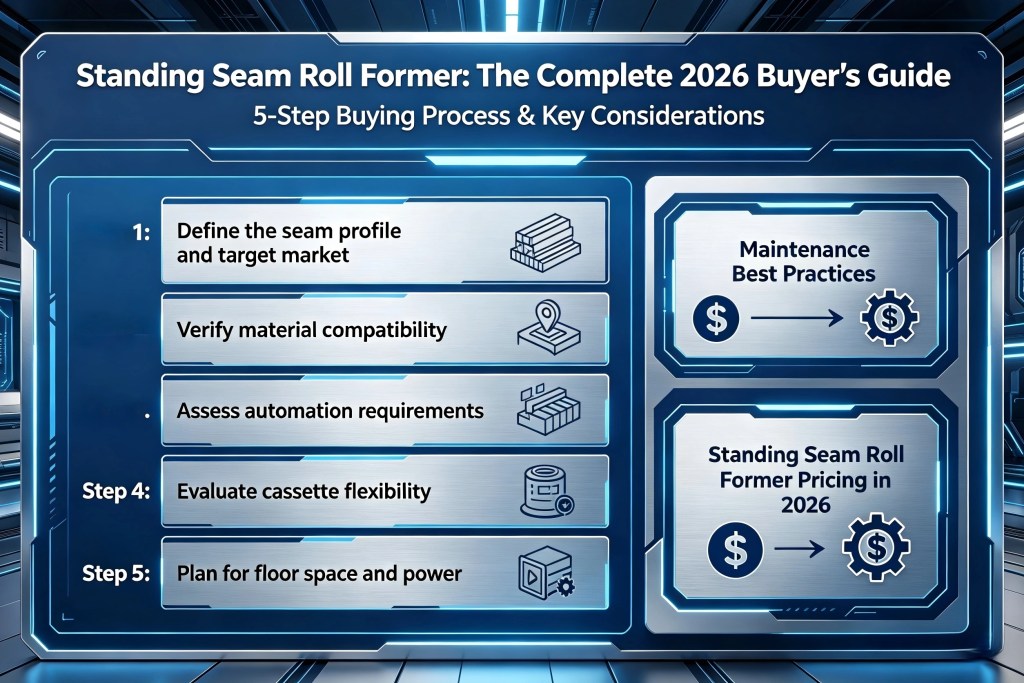
Step 1: Define the seam profile and target market
The first decision is whether you need single lock, double lock, or snap-lock, and whether the machine serves roofing, solar mounting, or architectural applications. Double lock machines cost more and run slower but access higher-margin commercial projects. Single lock and snap-lock machines are faster and serve larger-volume residential and light commercial markets.
Step 2: Verify material compatibility
Confirm the machine handles the specific metals and thicknesses you plan to use. Aluminum standing seam (typically 0.5-0.9 mm, per Aluminum Association alloy standards) needs different roller pressures and clearances than steel (0.4-1.2 mm, per AISI specifications). If you plan to run both, look for adjustable roller pressure or quick-change cassette systems that handle both material windows.
Step 3: Assess automation requirements
Manual decoiling and offloading works fine for small-volume or job-shop operations producing 200-500 panels per day. Above 800 panels per day, consider a servo-controlled decoiler, automatic panel stacker, and PLC control system that maintains consistent quality over long runs. Cable management systems like cable tray roll forming machines often share similar decoiling and stacking automation components, so suppliers with broad roll forming portfolios may offer better integration options.
Step 4: Evaluate cassette flexibility
Quick-change cassette systems let a single machine base produce multiple seam profiles without full retooling. This matters for contractors serving diverse markets or manufacturers running seasonal product mixes. The added cost of a cassette system typically pays back within 6-12 months through reduced machine downtime during changeovers.
Step 5: Plan for floor space and power
Standing seam lines range from 6 meters (basic single-lock) to over 18 meters (fully automated lines with entry/outfeed equipment). Check your facility has adequate floor space, crane access for coil handling, and electrical supply matching the machine’s requirements. Refer to our roll forming machine price guide for typical facility setup costs alongside equipment pricing.
Maintenance Best Practices
Regular maintenance extends machine life and keeps panel quality consistent. A well-maintained standing seam roll former can stay productive for 20+ years. OSHA guidelines for machine guarding and lockout/tagout procedures apply to roll forming equipment during maintenance operations, particularly when working near the entry pinch rollers and cutting station.
Daily checks:
- Roller surfaces for wear, scoring, or chip contamination
- Coil tension and entry guide alignment before each run
- Material shavings cleaned from roller flanges and side plates
- Hydraulic fluid levels if the machine has hydraulic components
Weekly maintenance:
- Lubricate all bearing points per manufacturer specs
- Roller mounting bolts and retaining screws for tightness
- Cutting station blade sharpness and guide alignment
- Emergency stop circuits tested for proper function
Quarterly service:
- Full dimensional check of produced panels against spec
- Gearboxes and chain drives for wear and proper lubrication
- PLC and HMI calibration if quality deviations appear
- Worn roller bearings replaced before they cause profile drift
Common issues and remedies:
- Edgewave in finished panels: Usually excessive entry tension or misaligned entry guides. Adjust pinch roller pressure and check guide alignment.
- Dimensional drift over long runs: Roller wear or thermal expansion. Check roller temperatures during extended runs and replace worn rollers.
- Intermittent cutting errors: Dull blade or incorrect clearance. Replace or re-grind the blade and verify clearance per manufacturer specs.
Standing Seam Roll Former Pricing in 2026
Pricing varies based on machine complexity, automation level, and origin. These ranges reflect current market conditions. A full cost analysis should account for tooling, installation, operator training, and facility preparation — not just the machine base price, as detailed in our roll forming machine pricing guide.
| Machine Category | Price Range (USD) | Typical Features |
|---|---|---|
| Basic single-lock, manual decoiler | 18,000−28,000 | Fixed geometry, 10-15 m/min, hydraulic cut |
| Mid-range single/snap-lock, semi-auto | 28,000−55,000 | Quick-change capable, 15-25 m/min, |
| Double-lock industrial line | 55,000−95,000 | Integrated seaming, 20-35 m/min, PLC control |
| Premium fully automated line | 95,000−180,000 | Auto stacking, cassette system, remote diagnostics |
| Custom/architectural specialist | 80,000−250,000+ | Bespoke profiles, narrow widths, exotic materials |
Price is not the only factor: machine uptime, spare parts availability, and technical support responsiveness often matter more over the machine’s 15-25 year lifespan than the initial purchase price.
Frequently Asked Questions
A standing seam roll former produces interlocking rib profiles with tight tolerances for weather-tight roof connections. Standard roll formers make generic open profiles (channels, C-sections, angles) without interlocking geometry or the precision that standing seam systems require. Using a standard roll former for standing seam panels usually results in poor interlocking fit, seam gaps, and failed weather resistance.
Most stand seam roll formers handle galvanized steel (Z275, Z450 coatings), Galvalume, aluminum (3003, 3105, 5005 alloys per the Aluminum Association material standards), and zinc. Aluminum needs wider clearances due to its softer surface and higher thermal expansion. Copper and titanium-zinc are specialty materials that some manufacturers support with hardened tooling.
Line speeds typically range from 10 to 40 meters per minute. Double lock profiles run slower (10-25 m/min) due to their complexity. Single lock and snap-lock profiles can reach 20-40 m/min. Actual speed also depends on material thickness, coil quality, and whether the machine is running integrated seaming or producing panels for manual field seaming.
Yes, with a quick-change cassette system. Operators can swap from single-lock to double-lock (or different coverage widths) within 30-90 minutes without disassembling the core machine. Fixed-geometry machines need full die replacement and re-setup, which takes 4-8 hours. Cassette systems add 8,000−25,000 but dramatically improve flexibility for mixed-product manufacturers.
Lead times range from 45-75 days for basic models from Chinese manufacturers with available inventory to 90-150 days for custom-configured machines from European or American builders. Believe Industry typically ships within 60 days for standard configurations and 45-60 days for custom profile development. Always confirm lead time before finalizing project timelines, as site preparation, electrical installation, and operator training follow machine delivery.
Most machines operate on 380-415V three-phase power at 50 or 60 Hz. Some smaller or entry-level models accept 220-240V single-phase power but with reduced capacity. Always verify your facility’s electrical supply matches the machine specs before ordering. Some manufacturers offer dual-voltage configurations for international shipments, but this must be specified at order time.
Single lock seams fold one side of the connection at 90 degrees, creating a basic interlock with moderate wind uplift resistance. Per NRCA wind load guidelines, double lock seams fold both sides at 180 degrees, creating a tighter bond that resists separation under significant wind loads. Double lock is required by building codes in high-wind and hurricane-prone regions and is the preferred profile for commercial roofing in most of North America and Australia.
Monitor three key variables during production runs: coil flatness (edgewave or centerbow indicates coil stress), roller cleanliness (contamination causes surface scratches and dimensional errors), and cut accuracy (verify panel length every 10 panels with a calibrated tape). Most quality issues originate in the entry section rather than the forming stations, so regular entry guide inspection is the single most effective quality control practice.
Conclusion
A standing seam roll former is precision equipment serving a demanding market where panel geometry directly affects weather resistance and building performance. The choice between single lock and double lock, manual and automated, basic and premium configurations should be driven by your target market’s specifications and volume requirements rather than price alone.
For manufacturers entering the solar mounting or commercial roofing market, a quick-change mid-range machine offers the best balance of capability and flexibility. Established commercial roofing contractors benefit more from an integrated seaming line with automated panel handling to maximize throughput and reduce per-panel labor costs.
Believe Industry’s standing seam roll former line combines proven mechanical design with cassette-based flexibility, supporting single lock, double lock, and solar strut channel profiles from a single machine base. With over 20 years of roll forming experience and 40+ country export capability, our team can help configure a machine that matches your production goals.
Ready to discuss your standing seam roll former requirements? Contact Believe Industry for a technical consultation and production feasibility assessment.
Changelog
| Date | Version | Changes |
|---|---|---|
| 2026-05-06 | 1.0 | Initial publication |
| Next review | – | November 2026 |


