Table of Contents

solar strut channel roll forming machine

SEO Title Solar Strut Channel Roll Forming Machine: 5 Punch Solutions & Complete Guide 2026

What Is a Solar Strut Channel Roll Forming Machine?

solar strut channel roll forming machine is a production line that takes steel coil and forms it into slotted U-channels. These channels are the main structural part of solar panel mounting systems.

Key facts:

  • Input: galvanized or pre-painted steel coil, 1.5–3.0 mm thick
  • Output: slotted strut channel profiles (commonly 41×41 mm or 1⅝×1⅝ inch)
  • Speed: 10–20 metres per minute
  • Process: fully automated, from coil to cut-length channel

Why these machines matter for solar: According to SEIA data, each megawatt of utility-scale solar needs 2.5–4.5 tonnes of strut channel. That makes production speed and hole accuracy critical cost factors for solar contractors.

Believe Industry has built solar-specific strut channel lines since 2019, when the company partnered with GameChange Solar (USA) to develop roll-formed profiles for large ground-mount solar farms. That project set the benchmark for hole-pattern accuracy and surface protection that all Believe solar lines follow today.

Why Solar Projects Need a Dedicated Machine

A standard Solar Strut Channel Roll Forming Machine works for HVAC or cable tray jobs. But solar projects have tighter requirements.

What makes solar different

RequirementWhy it matters
Hole accuracy ±0.5 mm or betterSolar clamps and rail connectors won’t fit if holes are off
Speed 12–20 m/minLarge projects need 800–2,000 tonnes in 90 days
Burr height < 0.15 mmAluminium sub-frames scratch easily
Consistent slot pattern9/16-inch slots must accept standard hardware with no modification

A dedicated solar strut channel roll forming machine solves all of these with:

  • Servo-controlled feeders
  • High-speed hydraulic or rotary punching
  • Real-time encoder feedback

Main Components

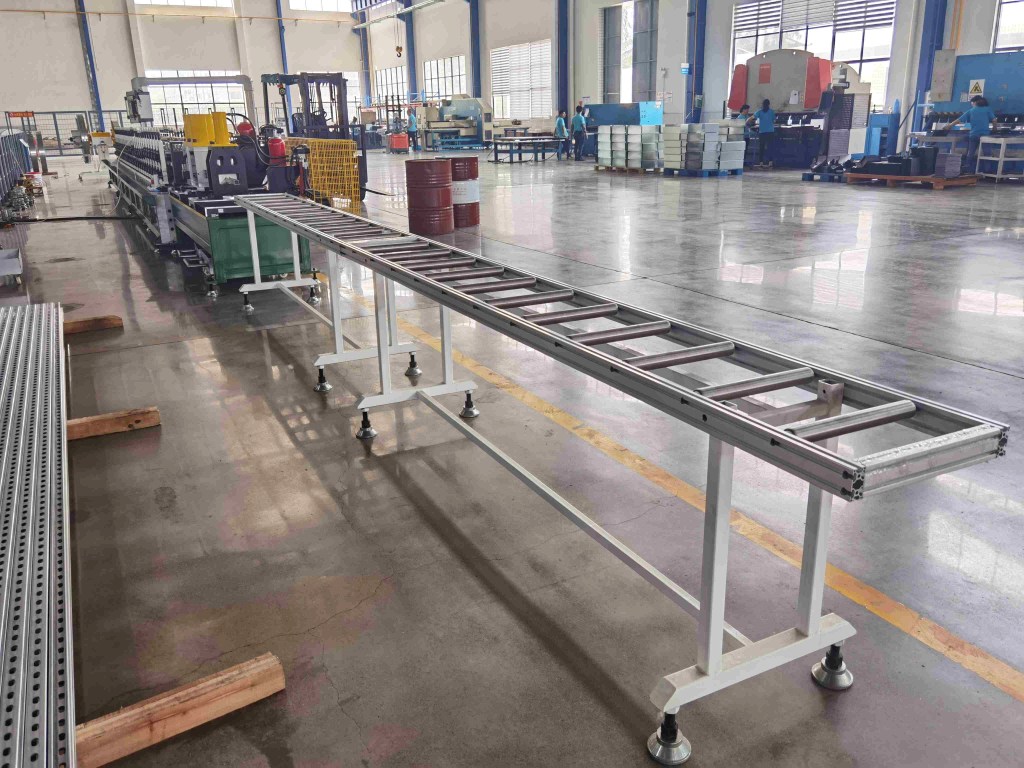
Every Believe Industry solar strut channel roll former is a complete turnkey line.

① Uncoiler

  • Handles coil weight: 3–5 tonnes
  • Hydraulic mandrel accepts 508–610 mm ID coils
  • Induction brake prevents material sag

② Servo Feeder & Leveller

  • 7- or 9-roller straightener removes coil curvature
  • Keeps hole-pattern accuracy before punching
  • Entry guider aligns strip to the forming mill centreline

③ Punch System

  • Applied before or during forming
  • D2 tool steel punches, hardened to HRC 58–62
  • Five punch types available (see comparison table below)

④ Roll Forming Mill

  • 20-28 forming stations for standard 41×41 mm profile
  • Hardened alloy-steel rolls on chrome-plated shafts
  • Chain or gearbox drive keeps all stations in sync

⑤ Guider System

  • Entry guide, side rails, and inter-station guides
  • Keeps strip aligned through every forming stage
  • See the Guider section for full details

⑥ Flying Cut-Off

  • Cuts to length without stopping the line
  • Tolerance: ±1 mm over 6 metres
  • Hydraulic flying die or servo-tracking saw

⑦ PLC Control Panel

  • Siemens or Mitsubishi PLC
  • Touch-screen HMI with up to 50 saved profiles
  • Auto length counting and batch tracking

⑧ Run-out Table

  • Motorised conveyor to stacking area
  • Optional auto-stacker for high-volume lines

Punch Solution Comparison

Picking the right punch system is the most important decision when buying a solar strut channel roll forming machine. Here are all five options compared.

FeatureStationary PunchFlying PunchServo + Hydraulic PressServo + Mechanical PressRotary Punch
How it worksPunch built into line; line stops each strokePunch head moves with strip; no stopServo feeder advances strip to standalone hydraulic pressServo feeder advances strip to standalone mechanical pressRotating die wheel punches as strip moves
Line stops?YesNoNoNoNo
Typical speed4–8 m/min10–20 m/min10-15 m/min20-40 m/min40+ m/min
Hole accuracy±1.0–1.5 mm±0.5–1.0 mm±0.3–0.5 mm±0.3–0.5 mm±0.3–0.8 mm
Tooling costLowMediumMediumLow–MediumHigh
Tooling change time1–2 hrs2–3 hrs30–60 min30–60 min3–5 hrs
Profile flexibilityHighMediumHighHighLow
Noise levelHighMediumMedium–HighHighLow
Capital costLowestMediumMediumHighHighest
Best forLow volume, simple slotsMedium volume, speed-sensitiveHigh accuracy, complex patternsHigh speed, cost-sensitiveUltra-high volume, one profile
Available from Believe

Which one should you choose?

  • Most solar manufacturers → Servo feeder + punch press (best balance of accuracy, flexibility, and cost)
  • High throughput (> 15 m/min) → Flying punch or punch press
  • Single profile, 500+ tonnes/month → Rotary punch
  • Tight budget, low volume → Stationary punch

Technical Specifications

Standard specifications for Believe Industry’s solar strut channel roll forming machine (41×41 mm profile).

ParameterSpecification
Profiles41×41 mm, 41×21 mm, custom (1⅝″ NEMA)
MaterialGI / GL / PPGI — ASTM A653, EN 10346
Thickness1.5–3.0 mm (up to 4 mm optional)
Coil width100–180 mm
Coil ID508 / 610 mm
Coil weight3–5 tonnes
Forming stations20-24
Main motor22–30 kW, gearbox/chain drive
Forming speed10–20 m/min
Cut-length tolerance±1 mm / 6 m
Hole accuracy±0.5 mm (flying); ±0.3 mm (servo press)
ControlSiemens S7 / Mitsubishi PLC + HMI
CuttingHydraulic flying cut / servo tracking saw
Line dimensions 25× 1.5 × 1.5 m
Machine weight20 tonnes
Voltage380V / 50Hz (customised on request)
CertificationCE optional; in-house FAT before shipment

Profile Options

Solar strut channel roll formers can produce several section sizes depending on the target market.

ProfileSizeWhere used
Standard metric41 × 41 mmEurope, Australia, SE Asia, Middle East
NEMA (North American)1⅝ × 1⅝ inchUSA — GameChange, IronRidge, Terrasmart
Shallow channel41 × 21 mmBallasted rooftop systems
Heavy-duty72 × 41 mmUtility trackers, bifacial panels
CustomAny size in 1.5–4 mm rangeSpecial projects

Tooling details:

  • Material: CR 12/D 2 Steel
  • Hardness: HRC 58–62
  • Surface finish: Ra ≤ 0.4 μm
  • Expected life: 15 million+ metres on standard galvanized coil

Guider System

The guider is the most overlooked part of a solar strut channel roll forming machine — and one of the biggest causes of quality problems.

What the guider does

It keeps the steel strip perfectly centred from the moment it enters the mill to the last forming station. If the strip shifts even slightly, you get:

  • Edge waviness on finished channel
  • Section twist
  • Hole-pattern drift

Entry Guide

The entry guide aligns the strip with the forming mill before any rolls touch it.

Believe Industry entry guide features:

  • Hardened guide blocks (HRC 55+) with fine-thread side adjustment
  • Vertical hold-down rollers to prevent strip edge lift
  • Adjustable funnel width: 100–180 mm in one assembly

Inter-Station Guides

These side-guide rails sit between forming stations and stop the half-formed section from springing sideways.

Servo Feeder Accuracy

On servo feeder + press lines, the feeder’s repeat accuracy (±0.1 mm) sets the hole-pattern accuracy. Believe Industry uses:

  • Servo motor with absolute encoder feedback
  • Built-in strip tension sensor (prevents micro-slippage and hole-pattern shift)

Guider Maintenance Schedule

TaskInterval
Check guide block clearance (0.1–0.2 mm side clearance for 1.5 mm stock)Every 50 production hours
Replace nylon guide insertsEvery 500–800 hours
Replace steel insertsEvery 3,000–5,000 hours
Verify entry guide centreline alignment (dial gauge)Quarterly

Support: Believe Industry provides a maintenance manual of Solar Strut Channel Roll Forming Machine in English, Spanish, and Arabic, plus free remote video support for guider adjustments in the first 12 months.

Material Requirements

The input coil you use directly affects profile quality and how fast tooling wears.

Coil SpecRecommendation
GradeASTM A653 SS Grade 33 min. / S280GD EN 10346
CoatingZ275 (ground-mount minimum); Z350 for coastal/high-humidity sites
Coil width tolerance±0.5 mm (wider = faster guide wear)
Edge conditionSlit-edge burr < 0.1 mm
Yield strength280–350 MPa typical; > 420 MPa needs tooling review
Surface hardnessHRB 65–80; harder = faster roll wear
Coil ID508 mm standard; 610 mm available
Max coil weight8 tonnes standard; 10 tonnes optional

Processing PPGI (pre-painted) coil? Add these modifications to protect the coating:

  • Urethane-coated guide inserts in the first 8 stations
  • Felt-padded exit guide
  • Reduced hold-down pressure on the leveller

Supplier Comparison

CriterionBelieve Industry (China)Supplier B (USA)Supplier C (EU)Supplier D (India)
Founded2005200119782008
Export markets40+ countriesMainly North AmericaMainly EuropeLimited
Solar referenceGameChange Solar (USA)Domestic salesEuropean EPCsRegional
Max forming speed20 m/min15 m/min12 m/min10 m/min
Punch optionsAll 5 types2–3 types2–3 types2 types
Profile customisationFull design serviceLimitedMediumLimited
Control brandSiemens / MitsubishiAllen BradleySiemensDelta / Schneider
CE certificationOptionalStandardStandardNot standard
Lead time45–90 days90–120 days90–150 days30–45 days
FOB price (41×41 line)USD 95,000–205,000USD 120,000–180,000USD 150,000–220,000USD 30,000–45,000
After-sales languageEnglish, 24/7 remoteEnglishEnglish/GermanLimited
Warranty12 months + remote12 months12–24 months6 months

Prices are indicative for 2026. Request a full quotation with line specs before comparing.

Frequently Asked Questions

1. What is a solar strut channel roll forming machine?

It is a production line that forms steel coil into slotted U-channel used in solar panel mounting systems. The line includes an uncoiler, leveller, guider, punch system, roll forming mill, and flying cut-off — all in one automated process. Output speed: 10–20 metres per minute.

2. What profiles can Solar Strut Channel Roll Forming Machine produce?

Most machines are tooled for 41×41 mm (metric) or 1⅝×1⅝ inch (NEMA). With quick-change tooling, the same machine can also produce:

  • 41×21 mm shallow channel
  • 72/82×41 mm heavy-duty sections
  • Custom profiles in the 1.5–4 mm forming range
3. How is a solar strut channel machine different from a standard one?

Three main differences:

AreaStandard machineSolar machine
Hole accuracy±1.0–1.5 mm±0.3–0.5 mm
SpeedSlower, stop-start OKFast continuous motion needed
SurfaceBasicNon-scratch guides for PPGI coil
4. What is the best punch solution for solar strut channel?

For most buyers: servo feeder + punchpress — best accuracy and flexibility.

  • Need > 15 m/min? → Flying punch
  • One profile, 500+ tonnes/month? → Rotary punch
  • Small budget, low volume? → Stationary punch

See the Punch Comparison Table above.

5. What thickness can the machine handle?
  • Standard: 1.5–3.0 mm
  • Optional heavy-gauge version: up to 4.0 mm
  • Yield strength up to 350 MPa standard; up to 550 MPa with tooling review
6. How fast does a solar strut channel machine run?
Punch typeSpeed
Stationary punch4–8 m/min
Flying punch10–20 m/min
Servo + press20–30 m/min
Rotary punch 40-60 m/min

At 15 m/min with an 8-hour shift: about 4,320 metres (8–15 tonnes) per shift.

7. How accurate is the hole pattern?
Punch typeAccuracy
Stationary±1.0–1.5 mm
Flying punch±0.5–1.0 mm
Servo + press±0.3–0.5 mm

UL 2703 (USA) requires ±0.5 mm or better — achievable with flying punch or servo feeder.

8. What does the guider do?

The guider keeps the strip centred through forming. Without it:

  • Edges become wavy
  • Sections twist
  • Hole patterns drift

Believe Industry’s guider holds centreline alignment within ±0.2 mm along the full forming pass.

9. Can it process pre-painted (PPGI) steel?

Yes — with three modifications:

  1. Urethane-coated guide inserts in the first 8 stations
  2. Felt-padded exit guide
  3. Reduced leveller hold-down pressure

This preserves the coating to ASTM D523 gloss retention standards.

10. What is the lead time of Solar Strut Channel Roll Forming Machine?
ConfigurationLead time
Standard (41×41 mm, flying punch)45–60 days
Custom (heavy gauge, extra punch stations)60–75 days
Expedited30–40 days (premium)
11. Does Believe Industry provide commissioning support?

Yes. Every machine includes:

  • Factory acceptance testing (FAT) before shipment
  • Full electrical and mechanical drawings
  • Remote video commissioning support

On-site engineers are available at extra cost. Believe Industry has sent teams to the USA, Australia, Saudi Arabia, Chile, and South Africa.

12. What warranty and after-sales support do you get?
  • Warranty: 24 months on all mechanical and electrical parts (wear parts excluded)
  • Remote support: VPN diagnostic access for the first 3 years
  • Spare parts: Critical spares stocked in Wuxi for same-week dispatch
  • Documentation: Recommended spare parts list included with every machine
13. Roll forming vs press braking — which is better for solar strut channel?
FactorRoll FormingPress Braking
Speed10–20 m/min continuous4–8 pieces/min
Cost for 50+ tonnes60–80% cheaper per metreHigh setup cost per batch
ConsistencyHighModerate
Best forLarge solar projectsSmall batches, prototypes
14. What standards must solar strut channel meet?
MarketStandards
USAAISC structural steel + UL 2703 (racking systems)
AustraliaAS/NZS 1163 + AS/NZS 4600
EuropeEN 10162 + EN 1993 (Eurocode 3)

Believe Industry can supply material test certificates (MTC) and dimensional reports for any of these.

15. Can one Solar Strut Channel Roll Forming Machine make multiple profile widths?

Yes. With quick-change tooling (optional), one machine can switch between profiles — for example 41×41 mm and 41×21 mm — in 2–4 hours. Each tooling set has its own part number and engineering drawings.

How to Order

Getting a quote from Believe Industry is straightforward.

Step 1 — Send your requirements

  • Profile drawing or sample section
  • Material spec (grade, thickness, coating)
  • Required speed and shift pattern

Step 2 — Receive a proposal

  • Within 3 business days
  • Includes: line layout drawing, component list, FOB Wuxi price

Step 3 — Technical review

  • One round of email or video call
  • Confirm punch type, control spec, and shipping needs

Step 4 — Order confirmation

  • 30% deposit starts production scheduling

Step 5 — Factory acceptance test (FAT)

  • Visit Wuxi in person or join by video
  • Machine runs your profile before shipment

Step 6 — Shipment & commissioning

  • Sea freight: 20–35 days to most ports
  • Remote commissioning support included

Contact Believe Industry via the enquiry form or the strut channel product page.

Related Products & Resources

Internal links:

External references:

Changelog

DateChange
May 2026Initial publication
Next review: August 2026

Discover more from Believe Industry Company| Roll Forming Machine Manufacturer, Supplier & Exporter

Subscribe now to keep reading and get access to the full archive.

Continue reading