Address
No 1, Yd Road, Huishan District, Wuxi City, Jiangsu. 214183
Work Hours
Monday to Friday: 9AM - 5PM
Saturday: 9AM - 4PM
Address
No 1, Yd Road, Huishan District, Wuxi City, Jiangsu. 214183
Work Hours
Monday to Friday: 9AM - 5PM
Saturday: 9AM - 4PM
A purlin roll forming machine turns galvanized coil into the secondary framing of a steel building. Web depth runs 75 to 350 mm, flange 35 to 80 mm, material 1.5 to 5.0 mm, with punching, notching and cutoff inside the same pass.
Five designs, from manual spacer adjustment to a switchable C and Z mill. Built in Wuxi since 2005.

Purlins carry roof and wall load back to the frame. The section you choose sets the web depth, the flange width and the punch pattern the machine has to run. A purlin roll forming machine is built around that section, not the other way round.
Flat back and square flanges. The default roof purlin and wall girt on portal frame buildings, and the simplest section to form.
Offset flanges let two Zs nest and overlap over a rafter, so the run behaves continuous and spans further on the same steel.
Channel sections at the eave, the base rail and the door head. Usually a second tooling set on the same mill.
An extra pair of bends in the web lifts the strength to weight ratio, so a shallower section carries the same load.
Every purlin roll forming machine here shares the same frame and control platform. What separates them is changeover speed, thickness capacity and how many strands run at once.

Both sections on one mill with switchable tooling and motorized web and flange setting. The usual choice for a plant selling to more than one builder.
View C Z purlin machine →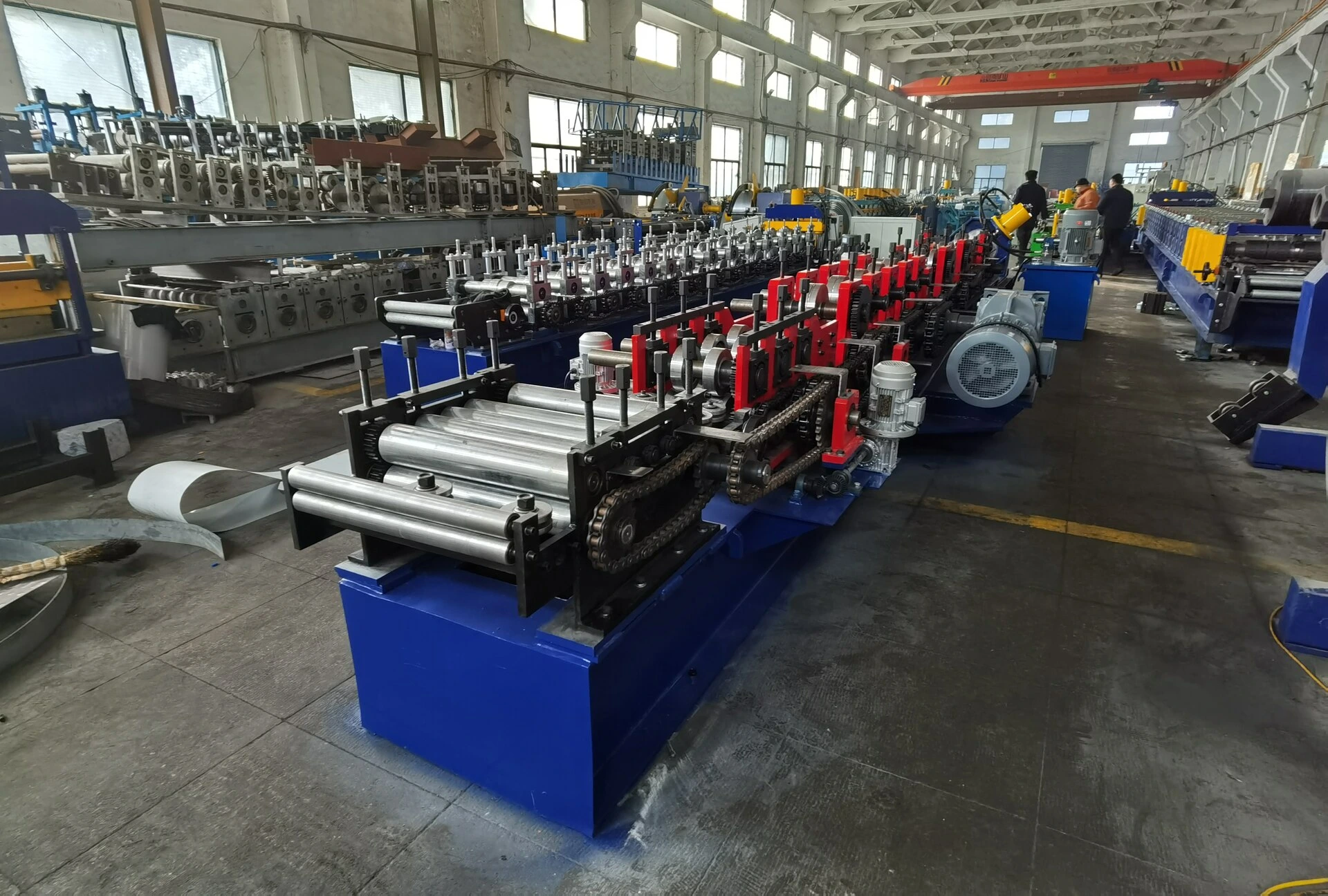
Dedicated C line from manual spacer adjustment to a reinforced version that forms 5.5 mm coil for infrastructure and heavy roof work.
View C purlin machine →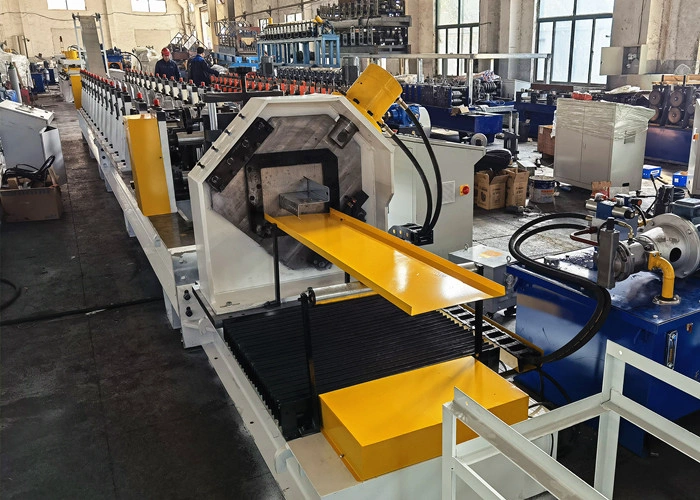
Z only line for lapped roof purlins, with sag rod holes and slotted connection holes punched before the mill.
View Z purlin machine →
Wide mill that forms several purlin beams side by side from one coil, built for plants running high volume on a narrow section range.
View multibeam purlin machine →The fifth layout is the multibeam mill, which forms several strands side by side instead of one. It is also offered as a general multibeam roll forming machine for other profile families. Send the section drawing and we confirm whether a multibeam layout beats several single strand lines.
A purlin is ordered for a building type, not for stock. These are the four runs most orders come from, and what each one asks of the section, the punch pattern and the purlin roll forming machine behind it.
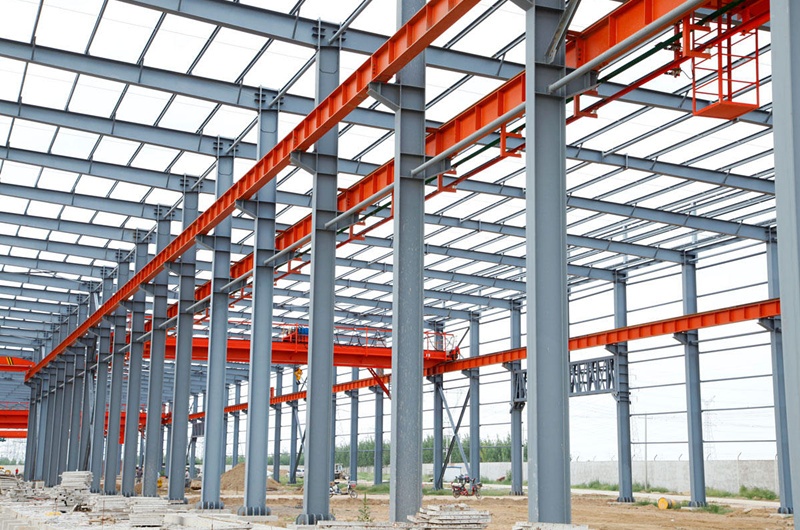
C purlins on the rafter line and wall girts between the columns. Cleat holes and sag rod holes are punched inline, so the frame bolts together without a drill on site.
Purlin lines for steel structure →
Long roof runs at 1.2 to 1.5 m purlin centres, carrying sandwich panel or single skin sheet. Z purlins lap over the rafter so the run stays continuous across six bays.
The cladding these purlins carry →
Ground mount rows use C sections as rails under the modules. Hole pitch has to match the clamp spacing, so the punch program is set from the mounting drawing, not from a standard pattern.
Roll forming for solar trackers →
Wide, low buildings with a light roof load. Purlins run 1.5 to 2.5 mm galvanized at wider centres than a factory, cut to the bay length so the shed closes in a day.
Agricultural roll forming applications →Sections off a purlin roll forming machine also turn up as mezzanine floor joists and as rails on solar trackers, both specified the same way with the hole pattern set by the connection detail. The mezzanine floor roll forming guide covers the first case in detail.
These are planning ranges. A purlin roll forming machine is quoted from the profile drawing first, then the steel grade and the output target.
| Web depth | 75 to 350 mm on C, 80 to 350 mm on Z |
|---|---|
| Flange width | 35 to 80 mm, fixed per tooling set |
| Material thickness | 1.5 to 5.0 mm, 5.5 mm on the heavy duty version |
| Coil width | Up to 500 mm, set by the developed width of the section |
| Forming stations | 14 to 20 standard, up to 24 on heavy gauge |
| Line speed | 10 to 15 m/min with hydraulic punch and shear, 20 to 30 m/min with servo punch and flying saw |
| Punching | Pre-punched coil, or an inline hydraulic press with a multi hole die |
| Cutoff | Hydraulic shear or flying saw, length set from the servo feeder |
| Drive | 7.5 to 22 kW, gearbox or independent servo drive per station |
| Control | PLC and HMI with recipe storage for each section |
Changeover is where most plants lose money on a purlin roll forming machine. Pick the adjustment system before you pick the price.
Shims and spacer rings set web and flange by hand. Lowest cost, and the slowest change, measured in hours with a two man crew.
Web and flange move on lead screws from the HMI. The same change drops to under half an hour on a well set up line.
Roll packs swap as a unit. Changeover falls to minutes, at the cost of a second set of packs per section family.
The mill turns a C section into a Z section without re-tooling the stands, so both purlin types stay in house.
Purlins are bolted, not welded. Every connection hole, slotted hole and sag rod hole has to land in the right place before the section is cut, or the frame will not assemble on site. On a purlin roll forming machine the press, not the mill, sets the cycle time.
Material is usually galvanized to EN 10346 (S250GD or S350GD) or ASTM A653, in Z275 or G90 coating. Tolerances follow the section tolerance rules used in steel construction, and lines shipped to the EU arrive with CE documentation under the EU CE marking rules.

What buyers ask before a purlin line is quoted, answered in plain terms.
A purlin roll forming machine is a production line that forms C, Z, U or Sigma purlins from galvanized coil. Coil is decoiled, leveled and fed through a punch press, then through 14 to 24 roll stations, and cut to length at the end. The section becomes the roof and wall framing of a steel building.
A C purlin has a flat web with two square flanges and is used where a simple span is enough. A Z purlin has flanges bent in opposite directions, so two sections nest and overlap over a rafter. The overlap makes the run continuous and carries more load on the same steel weight.
Standard purlin machines run 1.5 to 5.0 mm galvanized coil. A reinforced version forms up to 5.5 mm for infrastructure and heavy roof work. Below 1.5 mm the section tends to twist during forming, so light gauges are usually run on a separate light gauge mill.
10 to 15 m/min is normal when a hydraulic punch and shear are inline. With a servo punch and a flying saw the line runs 20 to 30 m/min. Real output depends on hole density, because the press, not the mill, sets the cycle on a heavily punched purlin.
Yes. A switchable C and Z mill changes section type without re-tooling every stand, and motorized web and flange adjustment sets the size from the HMI. Changeover is minutes on a cassette design and several hours on a fixed mill with manual spacers.
A dedicated C line with manual adjustment starts near USD 55,000. A switchable C and Z line with servo punching and a flying saw runs USD 110,000 to 180,000. Multibeam machines sit above that. On any purlin roll forming machine, section range, thickness, changeover system and the number of hole patterns move the price most.
Build time is 45 to 90 days after the drawing and deposit are confirmed. Sea freight adds 20 to 45 days depending on the destination port. Die sets for a second hole pattern are usually built in parallel and ship with the machine.
Send the purlin profile, the steel grade and the output you need per shift. We size the purlin roll forming machine around those three inputs and reply with the station count, the punch and cutoff arrangement and a price range before drawing work starts.
Page reviewed 29 October 2026.
 English English
 Español
 Português
 Русский
 العربية
 Bahasa Melayu
 Türkçe
 ไทย
 Bahasa Indonesia