Address
No 1, Yd Road, Huishan District, Wuxi City, Jiangsu. 214183
Work Hours
Monday to Friday: 9AM - 5PM
Saturday: 9AM - 4PM
Address
No 1, Yd Road, Huishan District, Wuxi City, Jiangsu. 214183
Work Hours
Monday to Friday: 9AM - 5PM
Saturday: 9AM - 4PM
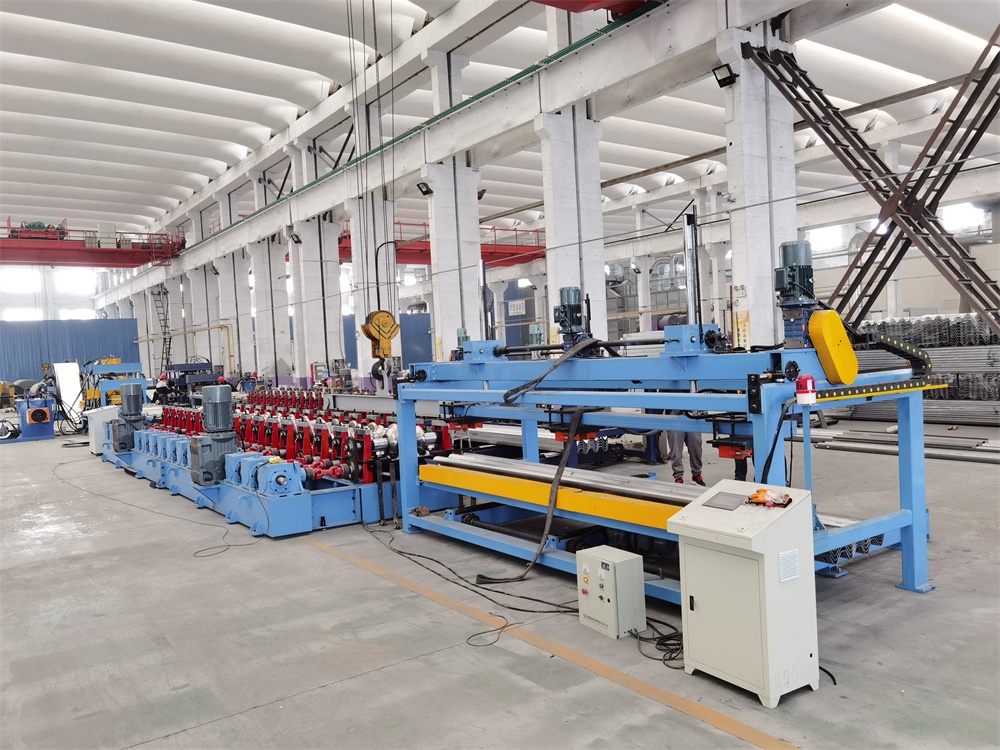
Guardrail, barrier posts, silo panels, greenhouse sections, steel studs, cable tray, scaffold planks and embossing lines. Eleven machines built from your section drawing, not from a catalogue.
Forms W-beam and Thrie-beam highway guardrail from 2.67 to 4.5 mm coil, with the bolt holes punched in line, so panels come off the line at the 3,810 or 4,000 mm length your market specifies.
View machine specsA dedicated W-beam crash barrier line for 3.2 mm strip at 5 to 10 m/min including punching and cutting, built around a 600 mm coil and a 13 station forming section.
View machine specsProduces the guardrail post and connector that hold the beam, with inline hydraulic punching before forming, 14 forming stages and a 110 mm shaft for the heavier gauges.
View machine specsRoll forms the angle, channel and cold formed sections used in greenhouse frames, 16 to 30 stands depending on the section, at 15 to 20 m/min with PLC and HMI control.
View machine specsRolls corrugated steel silo panels from 1.0 to 2.0 mm coil up to 1,250 mm wide, 18 to 20 stations, with a gantry pre-cutting device and a 15 tonne decoiler.
View machine specsA 16 station steel stud and track line running 15 m/min with chain and gear drive, hydraulic cutting and a 7.5 kW main motor, built to the stud profile you sell.
View machine specsTurns coil into perforated or solid cable tray in widths from 50 to 600 mm, with holes and slots punched before forming, so a tray comes off the line ready to install.
View machine specsForms walk board scaffold planks from 1.0 to 2.0 mm strip up to 600 mm wide at 15 m/min, with flying hydraulic cutting on a servo tracking carriage for long planks.
View machine specsAn embossing line that presses a straight or parallel pattern into sheet from 0.2 to 5.0 mm, with roller faces from 1,000 to 2,000 mm wide, inline with forming or standalone.
View machine specsStacks finished C, U and strut profiles automatically at the end of the line, with Yaskawa servos and a Siemens PLC, so one operator can run the line instead of two.
View machine specsA 110 to 315 tonne double crank press for blanking, punching, bending and forming the brackets and plates that a profile line cannot make in line.
View machine specsMost roll forming buyers start with a product they already sell: gutter, stud, purlin. A customized profile starts the other way round. The section exists first, usually because a customer, a code or a local standard demanded it, and the machine has to be designed around that shape. This page is the catalogue of the shapes we have already built lines for, but it is not the limit of what we can form.
What makes a custom line different is not the frame or the drive. It is the roll design. Every bend in the section is a decision about springback, and every springback decision costs you a stand, a gap or a tolerance. A drawing that looks simple on paper can need four more stands than the buyer expected, which is why we check the section before we quote it.
The first is the number of bends. Each bend normally needs one stand, and tight radii or thick material add more. The second is the heaviest gauge you will run, because gauge sets the shaft diameter: a 75 mm shaft at 2.0 mm is comfortable, and the same shaft at 4.5 mm deflects. The third is the coil width, because it sets the decoiler, the leveler and the frame width. The fourth is the tolerance band your customer inspects against, because a forming line held to plus or minus 0.1 mm is a different machine from one held to plus or minus 0.5 mm.
Everything else, speed included, follows those four. If a supplier quotes you a speed before asking about the section, the quote is a guess.
Highway guardrail is the family that shows why gauge matters. W-beam runs 2.67 to 4.5 mm, panels are about 310 mm high and 3,810 or 4,000 mm long, and the steel grade sits between 345 and 550 MPa. Three corrugation Thrie-beam is deeper again, around 506 mm. Holes have to be punched before forming, because a hole punched after forming distorts the corrugation around it.
Posts are a separate line. A post is a simpler section but a heavier one, so the line runs 14 forming stages on a 110 mm shaft with a 37 kW motor, and the hydraulic punch sits before the forming section. Crash barrier lines are usually specified at 3.2 mm and 13 stations, at 5 to 10 m/min once punching and cutting time is included.
Grain bin and silo panels are wide and thin by comparison: 1.0 to 2.0 mm coil up to 1,250 mm wide, 18 to 20 stations, and a gantry pre-cutting device because a panel has to leave the line at an exact developed length. The corrugation depth sets the number of stands more than the gauge does.
Greenhouse profiles are a family rather than one section: angles, channels and cold formed shapes that stiffen a glazing system. Lines run 16 to 30 stands at 15 to 20 m/min, and the reason to buy one is variety, so cassettes or adjustable spacing matter more than top speed.
Steel stud and track is the volume product in this group. A 16 station line at 15 m/min with a 7.5 kW motor will supply a drywall plant, and the profile is simple enough that changeover between widths is mostly a matter of roll spacing and cut off length rather than new tooling.
Two machines on this page are not forming machines at all. The auto stacker sits at the end of the line and takes finished C, U and strut profiles off the run out table, so one operator can run the line instead of two. The double crank press covers the brackets, plates and connectors that a roll former cannot produce in line, from 110 to 315 tonnes.
Embossing is the odd one out in a different way. It presses a straight or parallel pattern into sheet from 0.2 to 5.0 mm, with roller faces from 1,000 to 2,000 mm wide, and it can run inline with a forming line or as a standalone unit. For panels where the pattern is the product, the embosser is the machine and the former is the support act.
| Machine | Coil thickness | Forming stands | Notable |
|---|---|---|---|
| Highway guardrail | 2.67 - 4.5 mm | 13 - 18 | Panel height 310 mm W-beam, 506 mm Thrie-beam, 345 - 550 MPa |
| Guardrail post | 3.0 - 4.0 mm | 14 | Inline hydraulic punch, 110 mm shaft, 37 kW |
| W beam crash barrier | up to 3.2 mm | 13 | 5 - 10 m/min including punching and cutting, 600 mm coil |
| Steel silo panel | 1.0 - 2.0 mm | 18 - 20 | Coil 800 - 1,250 mm, gantry pre-cut, 15 t decoiler |
| Greenhouse profile | per drawing | 16 - 30 | 15 - 20 m/min, angle, channel and cold formed sections |
| Steel stud and track | per drawing | 16 | 15 m/min, chain and gear drive, 7.5 kW |
| Cable tray | 0.6 - 2.0 mm | per drawing | Widths 50 - 600 mm, perforation punched before forming |
| Embossing line | 0.2 - 5.0 mm | none | Roller face 1,000 - 2,000 mm, inline or standalone |
Send the section drawing with every bend and the fold or lock geometry, because that fixes the stand count. State the material and coating you will actually buy, because galvanized, pre painted and pickled strip form differently and mark differently. Give the full gauge range, not the nominal one. List every profile the line must cover, because that decides whether you need cassettes or a second roll set. Add the punch pattern, since hinge, bolt and slot positions are tooling. And tell us the output you need per shift, because that decides the decoiler, the cut off and whether a stacker belongs in the quote.
If the section is still at concept stage, our guide to choosing, operating and maintaining a roll forming machine covers the decisions from a wider angle. To work out how many metres a coil yields before you commit to a tonnage, the metal coil calculator does the arithmetic.
 English English
 Español
 Português
 Русский
 العربية
 Bahasa Melayu
 Türkçe
 ไทย
 Bahasa Indonesia