Address
No 1, Yd Road, Huishan District, Wuxi City, Jiangsu. 214183
Work Hours
Monday to Friday: 9AM - 5PM
Saturday: 9AM - 4PM
Address
No 1, Yd Road, Huishan District, Wuxi City, Jiangsu. 214183
Work Hours
Monday to Friday: 9AM - 5PM
Saturday: 9AM - 4PM
Short answer: A guardrail post roll forming machine turns flat galvanized coil into the posts that carry a W-beam, Thrie-beam or wire rope barrier. It punches the bolt holes, forms the sigma, U or C section, straightens the post and cuts it to length in one pass. Lines for this work carry 12 to 18 forming stations, run 3.0 to 5.0 mm coil and hold 8 to 12 m/min, with hydraulic punching ahead of the mill.
A guardrail is a system, not a panel. The beam takes the hit and spreads the load. The post takes that load into the ground. Without the post, the beam is a long piece of shaped steel lying on the shoulder.
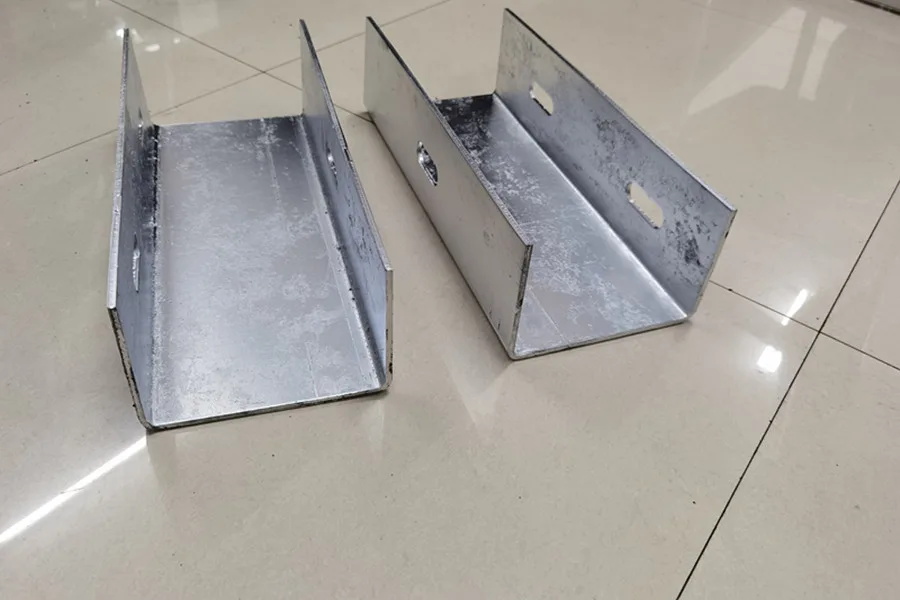
That is why the post section matters as much as the beam section, and why a guardrail post roll forming machine is specified around four numbers: section shape, steel thickness, hole pattern and cut length. Get the hole pattern wrong and the bolts will not pass at the joint. Get the section tolerances wrong and the blockout will not seat.
Four post families cover most tenders. One line can usually run all four with a roll change, which is why buyers ask for cassettes rather than a dedicated mill.
| Post type | Section | Coil width | Steel thickness | Main markets |
|---|---|---|---|---|
| Sigma post | 100 x 80 mm with folded lips | 300 to 420 mm | 3.0 to 4.0 mm | Europe, Australia, Middle East |
| U post | 150 x 75 mm | 340 to 400 mm | 3.0 to 4.5 mm | United States, Latin America |
| C post | 150 x 75 mm, 50 mm returns | 330 to 400 mm | 3.0 to 5.0 mm | Blockout and spacer systems |
| Heavy U post | 180 x 90 mm | 420 to 480 mm | 4.0 to 5.0 mm | Bridges, approaches, high speed roads |
| W6 x 8.5 post | Hot rolled I section | Not roll formed | 6.8 mm flange, 4.3 mm web | United States, cut and punched on a separate line |
The last row saves arguments. A hot rolled W section is bought from a mill and only needs cutting, punching and sometimes a domed end. A roll forming line does not make it. Anyone who promises a formed W post is offering a different, lighter solution.
On a customized profile roll forming machine the section drawing decides everything else: the coil width with edge trim, the number of passes, the roll diameter and the cut-off blade shape.
A highway guardrail is a passive barrier. It keeps errant vehicles inside the roadway. On impact it decelerates the vehicle, redirects it at a controlled exit angle and keeps the car away from trees, embankments and oncoming traffic. The same line of steel also makes the road edge visible at night, which matters on unlit rural roads.
Every part of that system has a job. The beam absorbs and spreads the impact. The blockout holds the beam away from the post so the post does not tear the beam. The post transfers the load to the soil. The fishtail terminal at each end turns the beam down so a vehicle cannot spear it.

Believe Industry builds both lines, so the post and the beam can be matched on hole spacing before either machine is cut. That is the part buyers regret skipping, because a 3 mm error at the post hole shows up on site as a bolt that will not enter.
The background of the barrier itself, including W-beam and Thrie-beam containment levels, is covered in what a highway guardrail is and how it works.
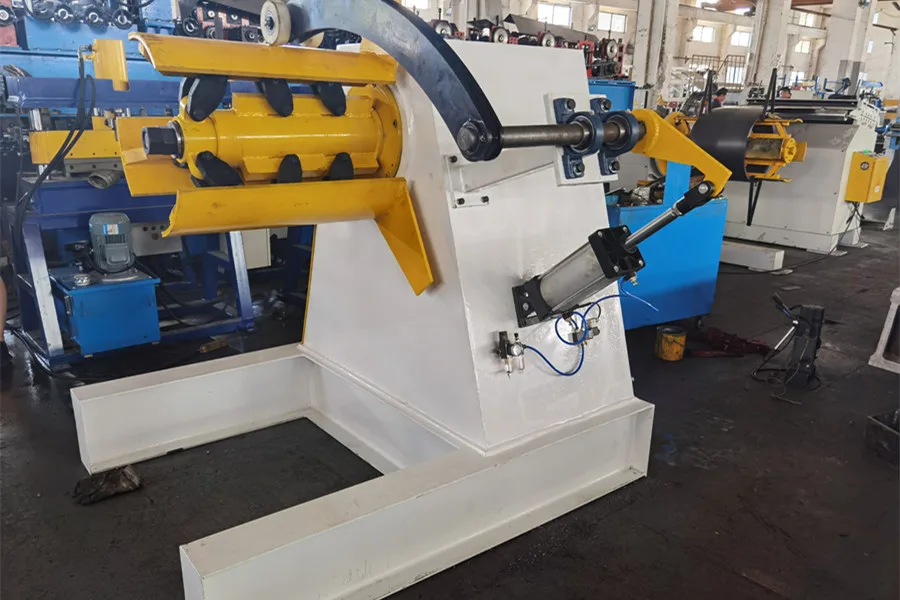
A guardrail post roll forming machine is a short line by steel framing standards. Most installations measure 22 to 30 m from decoiler to collection table, and they run one or two shifts rather than three.
| Post | Forming stations | Line speed | Punching |
|---|---|---|---|
| Sigma post 100 x 80 | 16 to 20 | 8 to 12 m/min | Inline hydraulic, 2 holes per pitch |
| U post 150 x 75 | 14 to 18 | 8 to 12 m/min | Inline hydraulic, slotted holes |
| C post 150 x 75 | 14 to 16 | 9 to 13 m/min | Inline hydraulic, bolt and blockout holes |
| Heavy U post 180 x 90 | 18 to 22 | 6 to 10 m/min | Inline hydraulic, 150 t press frame |
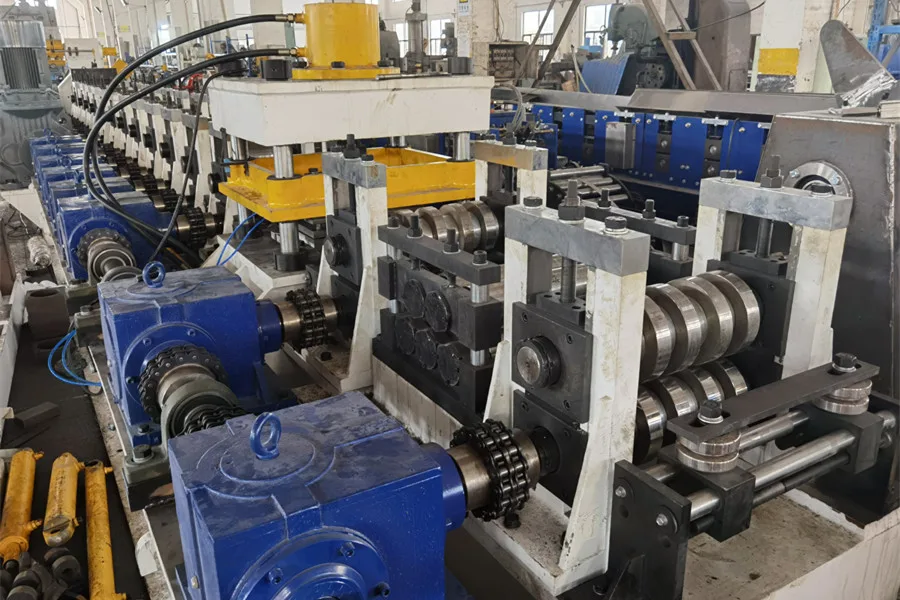
Station count is where the money sits on a guardrail post roll forming machine. Every extra stand adds a pair of shafts, four bearing blocks, a gear pair and a slice of motor load. It also removes one springback problem that operators would otherwise fight with shims at every changeover.
A sigma post with folded lips needs more passes than a plain U because each lip and each return flange is its own bend. A 4.5 mm U post needs more passes than a 3.0 mm one, and a 480 mm coil width needs a wider mill frame than 400 mm.

| Item | Specification |
|---|---|
| Uncoiler | 7 t hydraulic, hydraulic expansion, electric uncoiling, 5.5 kW uncoiling motor, 4 kW hydraulic motor, press arm |
| Feeding and leveling | 2 feed rolls, 7 leveling rolls, roll diameter 110 mm |
| Punching | Inline hydraulic before forming, SKD 11 punch pins |
| Forming stations | 14 |
| Main motor | 37 kW |
| Shaft diameter | 110 mm |
| Roller material | CR12MoV, heat treated |
| Transmission | Gearbox, cast iron stands |
| Hydraulic station | 22 kW with accumulator and oil cooling device |
| Control | Siemens PLC, touch screen, Yaskawa inverter |
| Cut length tolerance | ±2 mm |
| Section tolerance | ±0.5 mm |
| Straightness | 1 mm per metre |
Two of those rows decide how the post behaves on site. A 110 mm shaft keeps deflection low on a 4.5 mm section, so the gauge holds along the length. The straightener does the rest, because a post that leans will not sit plumb in the driver.
Guardrail posts are buried, splashed and salted. Zinc is the only thing standing between the steel and red rust, so the coating weight on the coil matters more than the steel grade.
Z275 gives 275 g/m² of zinc across both surfaces, roughly 20 µm per side. Z350 gives about 25 µm. Inland routes do fine on Z275. Coastal highways, deicing salt belts and desert projects with abrasive sand move the spec to Z350 or Z450 without much argument. The American Galvanizers Association publishes the coating thickness to service life figures behind that choice.
Cut edges and punched holes carry no coating at all. That is why the punch die should shear cleanly instead of tearing, and why the cut-off should not drag the strip. A torn edge rusts first, and it rusts inside the section where nobody looks until the post fails at the ground line. SteelConstruction.info covers the same failure mode on structural steelwork.
On the drawing side, the beam is normally specified to AASHTO M180 or an equivalent national standard, and the assembled barrier is crash tested to MASH TL-3 in the United States or to EN 1317 containment levels in Europe. Those documents fix the beam, the blockout and the post spacing. They do not fix the machine, but a machine that cannot hold ±0.5 mm on the section will not pass the joint test either.
If the coil arrives with an unknown grade or coating weight, read how to select steel coil for roll forming before the rolls are cut. Roll passes are built around one thickness and one yield strength, not around whatever the mill has in stock.
Most buyers run two machines. The beam line makes 3.81 m or 4 m panels. The post line makes 1.83 m or 2 m posts. Both feed the same installation crew, so the output of one has to keep up with the other.
The arithmetic is simple and it is where budgets go wrong. A panel every 19 seconds at 12 m/min needs two posts in the same 19 seconds, because post spacing on a W-beam run is about 2 m. That is a post every 9.5 seconds, or roughly 10 m/min on 1.83 m cuts. The line above does it. A 60 t press with a manual cut-off does not.
| Item | Beam line | Post line |
|---|---|---|
| Panel or post length | 3,810 mm or 4,000 mm | 1,830 mm or 2,000 mm |
| Cycle time | 19 to 28 s | 9 to 12 s |
| Forming stations | 16 | 14 |
| Steel thickness | 2.67 to 4.0 mm | 3.0 to 5.0 mm |
| Output per shift | 600 to 900 panels | 1,200 to 1,800 posts |
If you buy the beam line first, tell the machine builder the post spacing you intend to use. Hole positions on the post and hole positions on the beam are set on two different machines, and they only match if both were drawn from the same barrier layout.
The beam side is covered on the highway guardrail roll forming machine page and in the W-beam guardrail machine breakdown. If your project is a lower volume or a repair contract, crash barrier cold roll forming covers the smaller line options. Running footage of both lines is on the guardrail and crash barrier machine video page.
Five answers close most of the specification for a guardrail post roll forming machine. Send them together and the quote stops being a guess:
Believe Industry has built forming lines since 2005, with 80+ engineers and technicians, 500+ machines running in 50+ countries under ISO 9001 and CE. Post sections are one branch of the work; the sigma post roll forming machine covers the European equivalent in more detail, and the wider range sits under customized profiles.
Q: What does a guardrail post roll forming machine do?
A: It uncoils galvanized strip, levels it, punches the bolt holes, forms the post section over 14 to 22 stands, straightens the post and cuts it to length. One operator runs the line from a PLC touch screen.
Q: Which post sections can one line make?
A: Sigma, U and C sections from 3.0 to 5.0 mm, in widths from 300 to 480 mm of coil. A second section needs a roll cassette or a second set of rolls, not a new machine frame.
Q: How thick is guardrail post steel?
A: European and Australian sigma posts usually run 3.0 to 4.0 mm. US U and C posts run 3.0 to 4.5 mm. Bridge approach and heavy posts go to 5.0 mm. A hot rolled W6 x 8.5 section is not formed at all, it is bought with a 6.8 mm flange and only punched and cut.
Q: How fast does the line run?
A: 8 to 12 m/min on a 3.0 to 4.0 mm post with inline punching. A 1.83 m post comes off the line every 9 to 12 seconds, which keeps pace with a beam line making a 3.81 m panel every 19 seconds.
Q: Do I need inline punching?
A: Yes for guardrail work. Punching flat strip before forming is faster and cheaper than drilling a finished post, and it keeps hole pitch tied to the cut length instead of to a second operation.
Q: What tolerance can the machine hold?
A: ±0.5 mm on the section, 1 mm per metre on straightness and ±2 mm on cut length. Tighter than that needs a different roll design, not a different operator.
Q: Can one machine make both posts and beams?
A: Not on the same rolls. A beam is a wide, shallow wave section and a post is a closed or lipped channel. Two lines, or one frame with two cassettes, is the practical answer.
Q: What decides the price?
A: Coil width and thickness first, then station count, then the punch tonnage and the cut-off type. A 480 mm coil at 5.0 mm with 22 stands and a 150 t punch frame costs roughly twice a 400 mm line at 3.0 mm with 14 stands.
Send a post drawing to our engineering team and we will size a guardrail post roll forming machine around it, with station count, coil width and a line layout instead of a catalogue page. For a full barrier system, ask for the post and beam lines together so the hole pitches are matched before either machine is built.
Last updated: 2026-11-05
Article Changelog
2026-11-05: Rebuilt the page from 306 to 2,100 words, added the post section, station, parameter and line matching tables, eight FAQs and ten internal links.
Next Review Triggers
AASHTO M180, MASH TL-3 or EN 1317 post requirements change
Zinc coating recommendations for coastal or deicing routes change
A new cassette or auto stacker option is added to the range

A roll forming machine price ranges from 20,000 for a basic stud and...
Read More
Cable Tray Roll Forming Machine: Ladder vs Perforated Tray Lines...
Read More
Billboard & Signage Roll Forming: Advertising Structure Profiles Short answer:...
Read More
Heavy Duty Step Beam Roll Forming: Thick Coil and High-Strength...
Read More English English
 Español
 Português
 Русский
 العربية
 Bahasa Melayu
 Türkçe
 ไทย
 Bahasa Indonesia