Address
No 1, Yd Road, Huishan District, Wuxi City, Jiangsu. 214183
Work Hours
Monday to Friday: 9AM - 5PM
Saturday: 9AM - 4PM
Address
No 1, Yd Road, Huishan District, Wuxi City, Jiangsu. 214183
Work Hours
Monday to Friday: 9AM - 5PM
Saturday: 9AM - 4PM
A customized profile roll forming machine is built from your section drawing, not from a catalogue. Developed width, thickness, hole pattern and tolerance decide the pass design, the roll set and the cutoff, so two lines that look alike on the floor can differ at every stand.
Building custom lines since 2005. 500+ machines in 50+ countries. ISO 9001 certified, CE compliant.
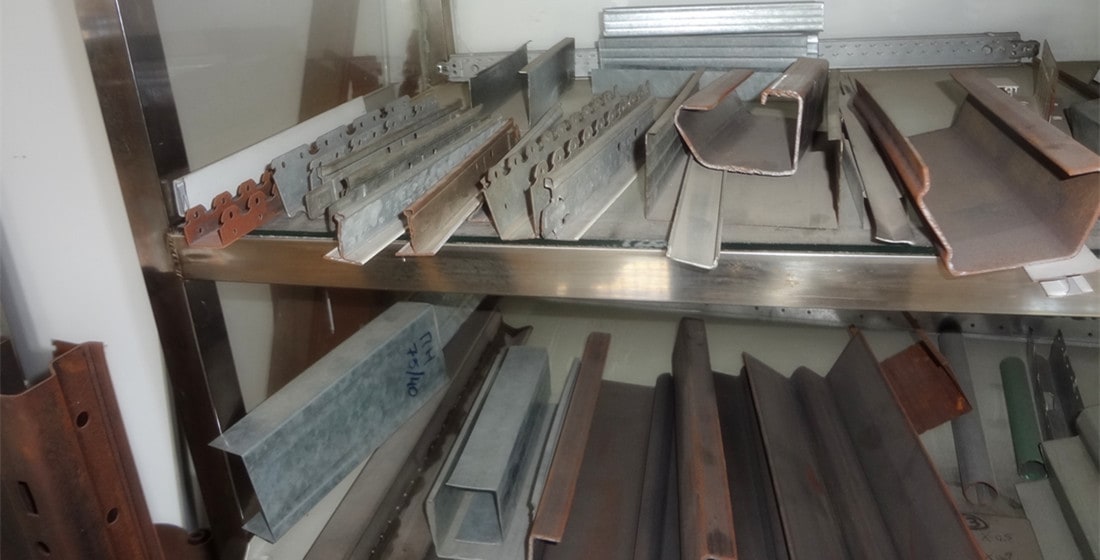
A customized profile roll forming machine starts with engineering, not with steel. The flower pattern is agreed before a roll is turned, because a mistake in the pass design is cheap on paper and expensive in the workshop.
We start from a DWG, DXF or a dimensioned sketch. Developed width, bend radii and hole positions are checked before the line is quoted.
The flower pattern is drawn station by station, with springback and bend allowance set from the material grade and the finish.
Rolls are turned from Cr12MoV or ASTM 1045, hardened to 58 to 62 HRC, then ground after heat treatment to hold the profile.
Welded frame, gearbox drive, PLC cabinet and safety circuit are assembled in one bay, then aligned to the centre line.
The line runs with your coil. First articles are measured against the drawing, and the pass settings are logged before packing.
These are the sections a customized profile roll forming machine is asked for most often. Each card links to the standard line for that family, and every one of them can be widened, re-punched or re-cut for a proprietary section.
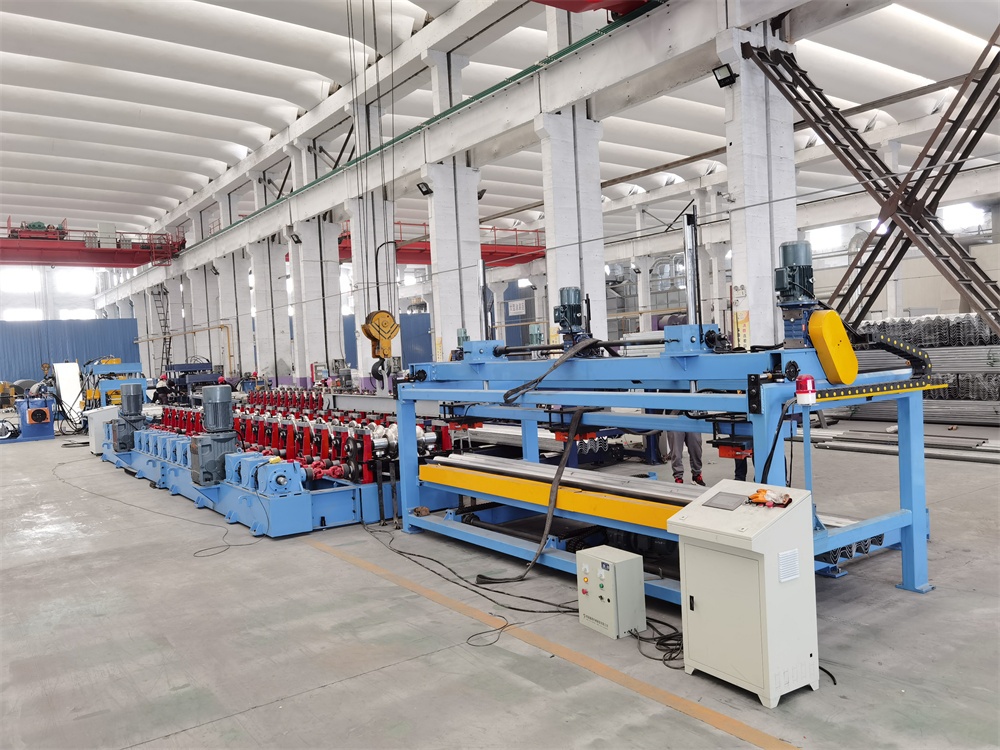
W beam, Thrie beam and C or sigma posts in 2.7 to 4.0 mm steel, punched to the bolt pattern of the barrier standard you build to.
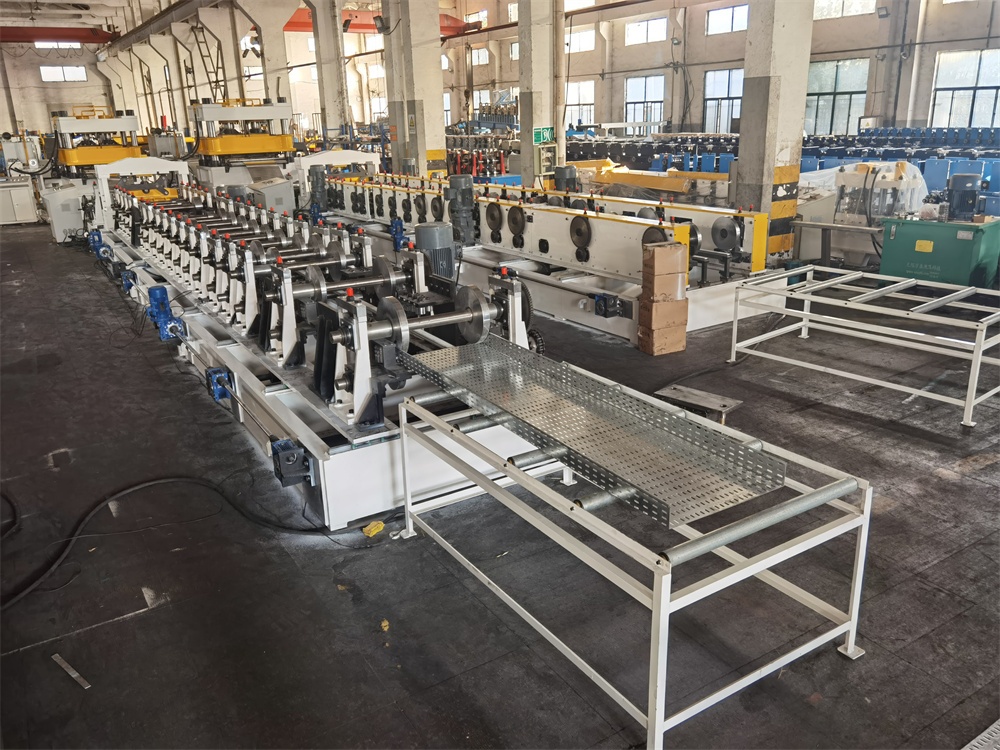
Perforated tray, top hat rail and slotted channel, with hole patterns punched inline and side walls squared to the base.
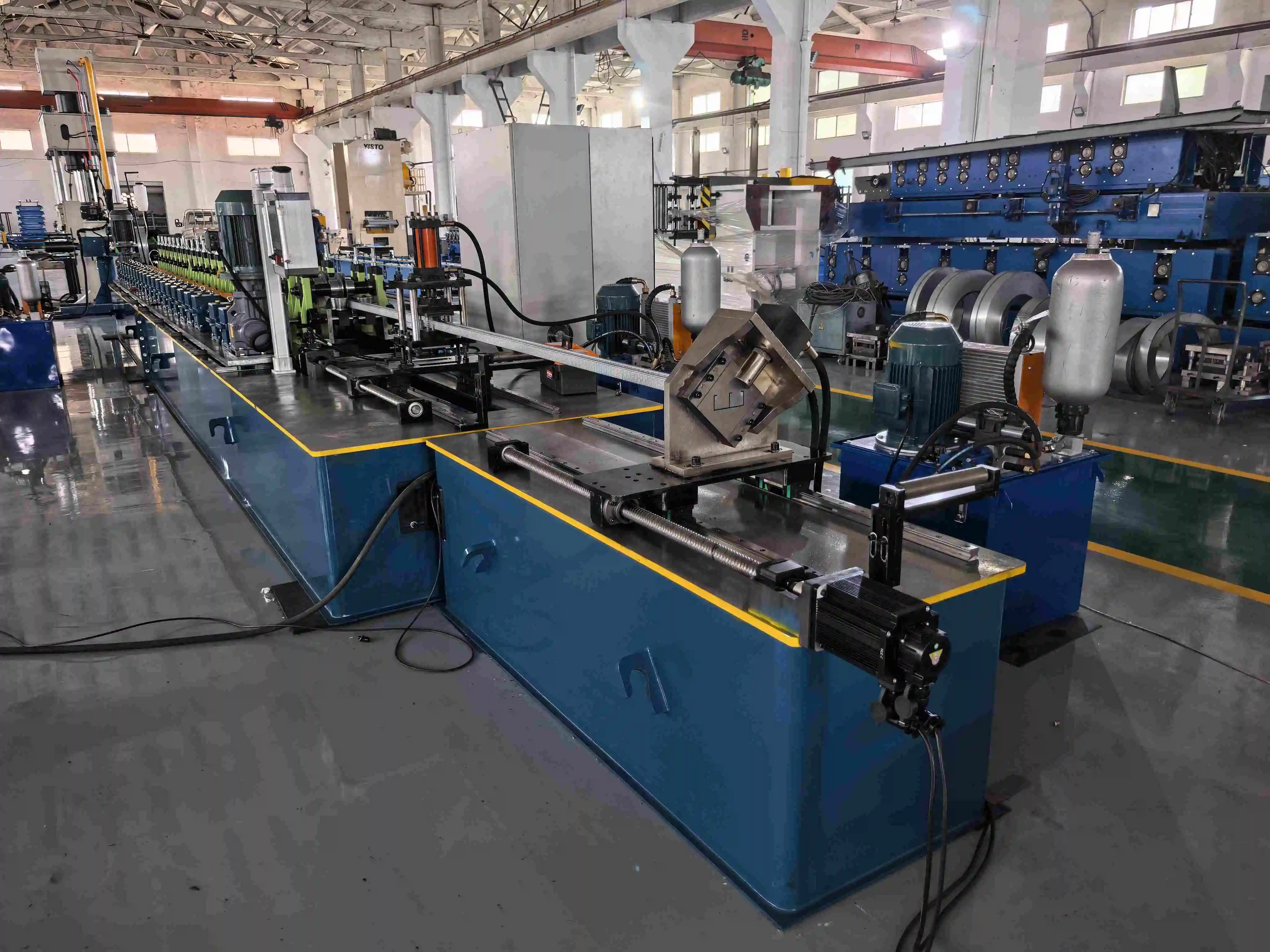
C, U and omega sections from 0.4 to 1.2 mm, cut to 3 m or 6 m and stacked without a second handling step.

Composite deck at 550 MPa yield, with embossed ribs and end closures, plus B deck for the US market and a separate embossing line.

Gutter connected greenhouse sections, hat fasteners and curved silo wall panels, where the radius and the hole pitch come from the structure.

Stacking, counting and bundling at the end of the line, sized for the section so a two man line can run one shift without a third operator.
Sections outside these six families are the normal case, not the exception. A customized profile roll forming machine can be built for one proprietary part, and a line that has to change section during the week is quoted with quick change cassettes or motorized width adjustment instead.
Planning ranges for a customized profile roll forming machine. The section drawing and the tolerance are quoted first, then the coil width, the punch content and the output target.
| Section types | Open profiles, closed tubes, hat, C, Z, U, sigma, box and deck sections |
|---|---|
| Developed width | 60 to 1,500 mm, set by the developed width of the section |
| Material | Galvanized, pre-painted, stainless, aluminum, copper and weathering steel |
| Material thickness | 0.3 to 6.0 mm, with 550 MPa yield on deck and guardrail work |
| Forming stations | 8 to 30, driven through gearbox and cardan shaft |
| Shaft diameter | 45 to 95 mm, set by thickness and roll load |
| Line speed | 5 to 40 m/min, set by the punch and cut cycle rather than the rolls |
| Tolerance | Plus or minus 0.3 mm on section width, plus or minus 0.5 mm on hole position |
| Punching | Hydraulic press with fixed dies, or servo punch with programmable positions |
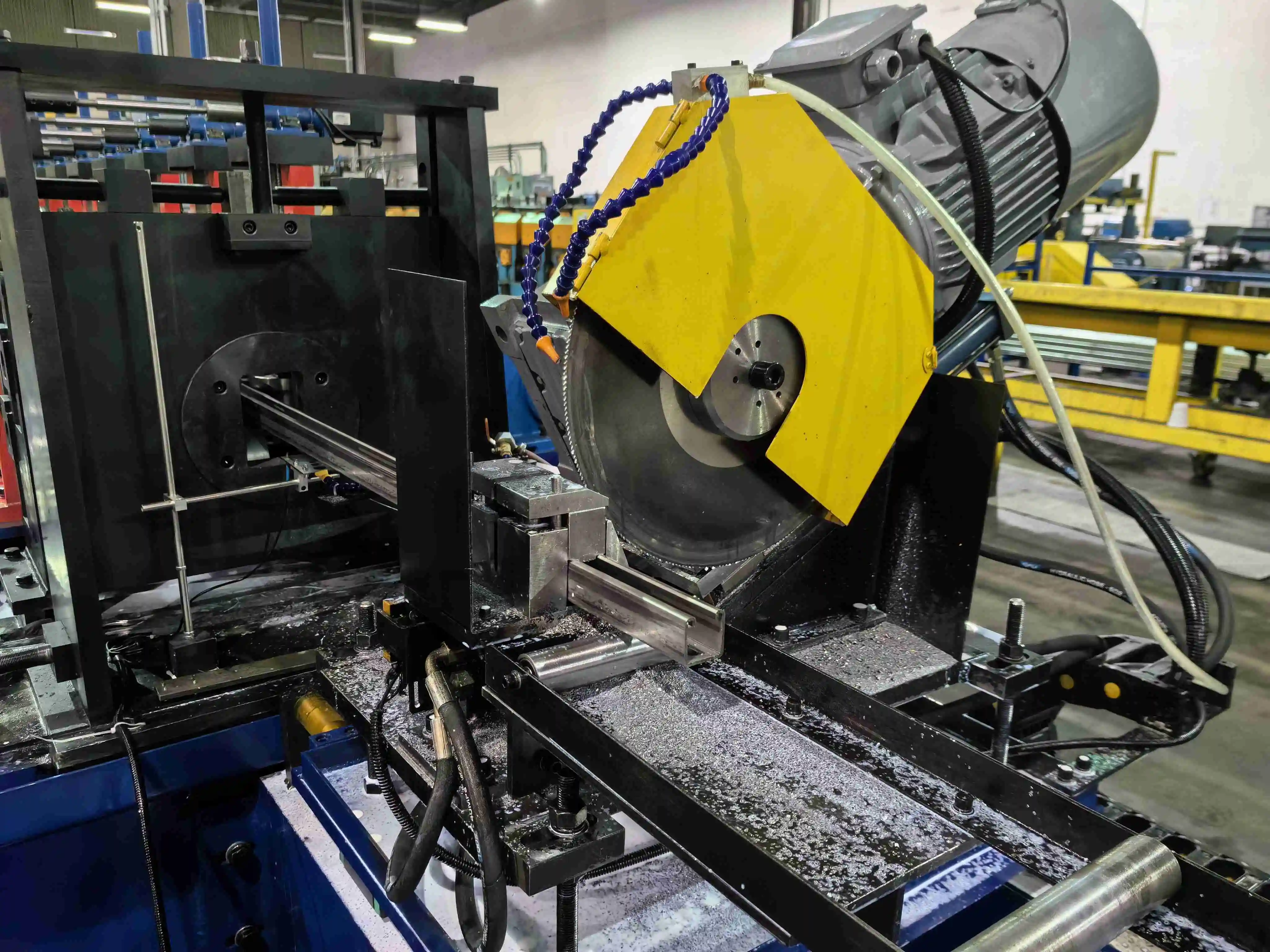
| Cutoff | Post cutter, flying shear or flying saw, with a length encoder on the line |
| Control | Siemens or Delta PLC with HMI, inverter drive and batch counter |
| Electrical supply | 380 V 50 Hz three phase, or 415 V, 440 V and 480 V for the destination |
Two quotes for the same section can differ by a factor of three. These are the four choices behind the gap, and the ones to settle before a customized profile roll forming machine is ordered.
On a customized profile roll forming machine a simple hat section needs 8 to 10 stations, while a deck profile with stiffeners needs 24 or more. Every stand is a pair of rolls, a shaft, a bearing block and a motor.
A 6.0 mm guardrail post needs 95 mm shafts and a heavier frame than a 0.5 mm ceiling channel. Steel weight scales through the base, the drive and the decoiler.
A servo punch that moves between four positions costs more than a fixed die set, and removes the changeover when the hole pattern changes with the part number.
A servo feeder, an auto stacker and a packing table add 15 to 30 percent and take one or two operators off the line, which on a customized profile roll forming machine is usually the whole payback case.
A customized profile roll forming machine is quoted from the section, not from a price list. Send these five and the reply is a station plan, a tooling proposal and a firm price instead of a range.
Sections are rolled to EN 10346 or ASTM A653 coil, and lines for the EU arrive with CE documentation under the EU CE marking rules. For the UK the same file is documented to UKCA through the GOV.UK UKCA guidance.
A customized profile roll forming machine is judged on the first article, not on the brochure. Each line is assembled, wired and run in our works with the customer's coil, then measured against the drawing.
The pass design of a customized profile roll forming machine is simulated before the rolls are cut, with springback and bend allowance taken from the grade. Material that has been formed once cannot be re-set without marks.
Width, height, angle, hole position and cut length are measured on the first ten pieces and logged. The report ships with the machine.
Roll setting charts, a spare parts list and a punch schedule arrive with the line. Remote support and on site commissioning are quoted as options.
What buyers ask before a custom line is quoted, answered in plain terms.
A customized profile roll forming machine is a line built for one section that no standard machine covers. The tooling, the pass design and the cutoff are drawn from the customer's section drawing, so the machine forms that profile and its size range rather than a catalogue shape.
Yes. A customized profile roll forming machine can be built from a sample: we measure it, rebuild the section as a drawing and check the developed width before quoting. A physical sample is often the fastest route when the original drawing is lost or the part is a copy of a competitor profile.
As a rule, two passes per bend plus two finishing passes, so a hat section lands at 8 to 10 stations and a deck with stiffeners at 24 or more. The final count comes from the flower pattern, not from the rule of thumb.
Plus or minus 0.3 mm on section width and plus or minus 0.5 mm on hole position are normal for a well set line. Tighter calls are possible on light gauge, and the cutoff tolerance is set by the shear type rather than the rolls.
Galvanized, pre-painted, stainless, aluminum, copper and weathering steel from 0.3 to 6.0 mm. A customized profile roll forming machine built for 0.3 mm cladding cannot run 6.0 mm guardrail, so the thickness range is fixed at the quotation stage.
For a customized profile roll forming machine, drawing review takes 3 to 5 days, pass design and tooling drawings 2 to 3 weeks, and build 45 to 70 days after approval and deposit. Sea freight adds 20 to 40 days, and commissioning on site is scheduled after arrival.
A simple 10 to 12 station line starts near USD 40,000. A line with servo punching, a flying shear and an auto stacker lands between USD 60,000 and 120,000, and heavy guardrail or deck lines with 24 stations and 95 mm shafts go above that.
Share the section drawing, material, thickness range, tolerance and output target. Engineering replies with a station plan, a roll set proposal and a customized profile roll forming machine configuration that matches your part.
Page updated October 2026.
 English English
 Español
 Português
 Русский
 العربية
 Bahasa Melayu
 Türkçe
 ไทย
 Bahasa Indonesia