Address
No 1, Yd Road, Huishan District, Wuxi City, Jiangsu. 214183
Work Hours
Monday to Friday: 9AM - 5PM
Saturday: 9AM - 4PM
Address
No 1, Yd Road, Huishan District, Wuxi City, Jiangsu. 214183
Work Hours
Monday to Friday: 9AM - 5PM
Saturday: 9AM - 4PM
A ceiling channel roll forming machine produces the light steel frame that carries a drywall ceiling. Believe Industry has built these lines since 2005, with 500+ machines running in more than 50 countries.
Short answer: A ceiling channel roll forming machine forms galvanized coil into furring channel, wall angle, POP main channel, false ceiling C channel and stud and track. Standard builds run 0.4 to 1.2 mm steel at 15 to 20 m/min. Flying shear builds reach 30 to 40 m/min, and length tolerance stays inside 1.5 mm.
A ceiling system is a family of profiles, not one part. Buyers who price a single profile usually return for a second machine within a year. One ceiling channel roll forming machine can be tooled for the whole set.
| Profile | Common size (mm) | Thickness (mm) | Job on site |
|---|---|---|---|
| Furring channel (hat) | 22 deep x 38 to 50 face | 0.40 to 0.80 | Carries the ceiling board |
| Wall angle (L) | 25 x 25, 30 x 30 | 0.40 to 0.60 | Perimeter trim and edge fixing |
| POP main channel | 38 x 12, 50 x 15 | 0.60 to 1.00 | Primary suspended grid |
| False ceiling C channel | 50 x 19, 60 x 27 | 0.45 to 0.80 | Secondary grid under the main channel |
| Stud and track | 50, 64, 76, 89, 92 | 0.45 to 1.20 | Partition walls and bulkheads |
| Top hat | 22 to 38 deep | 0.40 to 1.00 | Furring over purlins and rafters |
Sizes follow local practice, not one global standard. US framers work to a 7/8 inch furring depth on 33 ksi steel under ASTM C645. Chinese projects run DC50 x 19 under GB/T 11981. A ceiling channel roll forming machine tooled for one market rarely sells into another without new rollers.
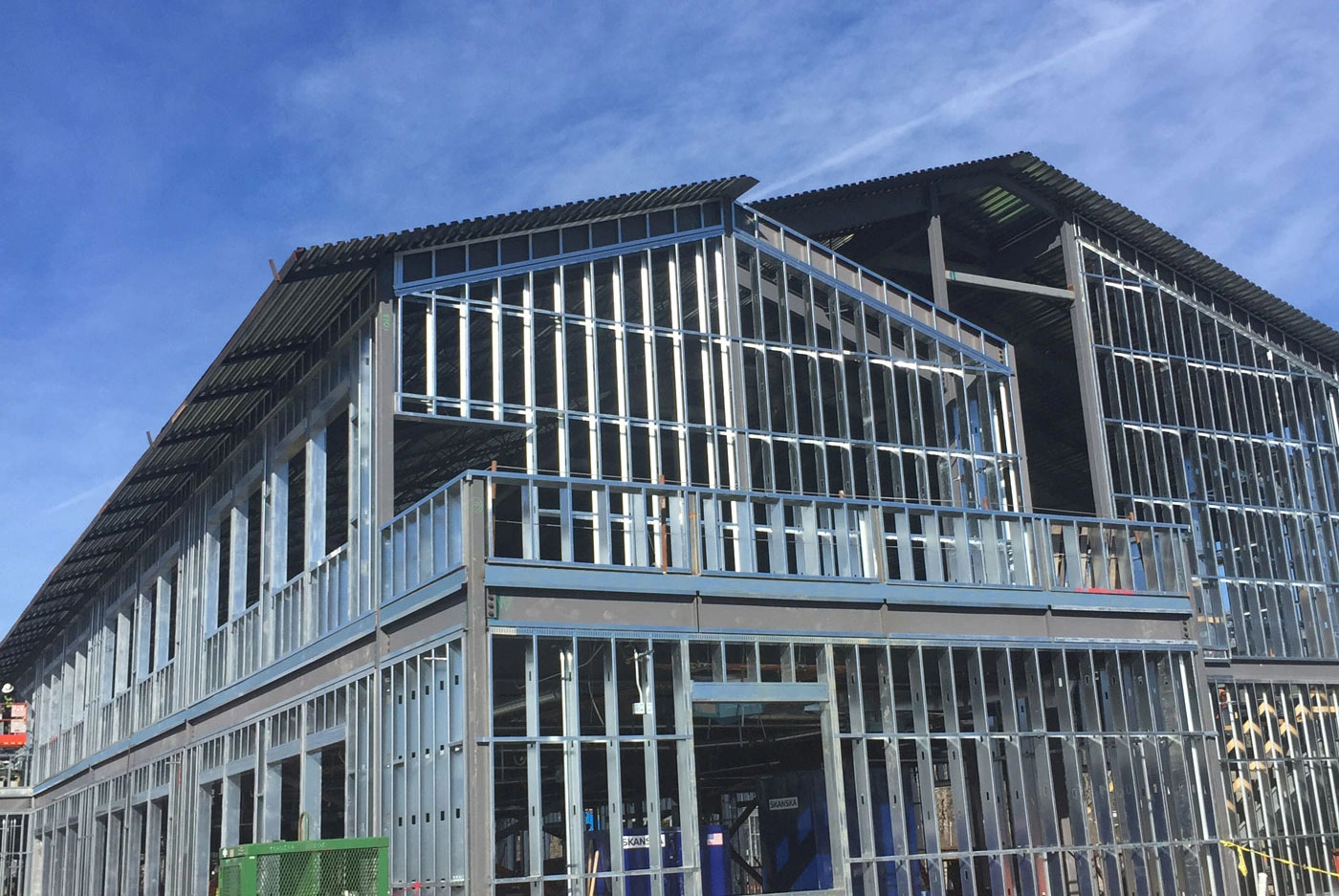
Check the list against the drywall and partition framing guide before locking tooling. Furring and top hat channel look close in size but differ in leg geometry, and the top hat guide explains where each wins.
Every forming decision follows the coil. A ceiling channel roll forming machine sized for 0.5 mm will not hold tolerance on 1.2 mm without more stands and a stiffer frame.
| Coil | Coating | Best for | Note |
|---|---|---|---|
| DX51D+Z | Z120 to Z275 | Interior ceiling channel | Easiest to form, lowest springback |
| SGCC | Z120 and up | General export orders | Widely stocked, price stable |
| S250GD | Z275 | Load bearing stud | Balances strength and formability |
| G550 (S550GD) | AZ150 or Z275 | Thin high strength section | Springback 40 to 60 percent higher |
| Aluzinc AZ150 | AZ150 | Coastal and humid sites | Cut edge protection decides life |
Yield strength and elongation decide whether a line runs a given coil. G550 has a minimum elongation of 2 percent under AS 1397, which leaves no stretch allowance, so the last two stands need 2 to 4 degrees of overbend to bring the flange back square.
Zinc coating matters more than thickness on coastal jobs. Z275 holds 20 years indoors, and the cut edge rusts first, so blade clearance deserves the same care as roller alignment.
Coil width comes from the developed length, never from the finished width. A 50 x 19 channel in 0.5 mm needs about 150 mm of strip once bend allowances and flange returns are added. The coil width guide walks the flat pattern. The coil selection guide covers grade.
A ceiling channel roll forming machine is a chain. One weak station shows up as twist ten metres downstream, and no amount of straightening hides it.


Frame stiffness is the part buyers skip. On a 16 stand ceiling channel roll forming machine, a light base flexes first, and the profile drifts out of shape after an hour of running.
Published speed is line speed. Output is pieces per minute, and on a ceiling channel roll forming machine the cutting method sets that number.
| Build | Line speed | Length tolerance | Fits |
|---|---|---|---|
| Hydraulic post cut | 15 to 20 m/min | ±1.5 mm | One shift, mixed orders |
| Servo feed plus hydraulic cut | 20 to 28 m/min | ±1.0 mm | Mid volume, punched profiles |
| Flying shear with servo | 30 to 40 m/min | ±1.0 mm | Two or three shifts, one profile |
| Cassette multi-profile | 12 to 18 m/min | ±1.5 mm | Wide mix, small batches |
Do the arithmetic before comparing quotes. A 3 m furring channel on a 20 m/min line leaves the machine six or seven times a minute. On a 40 m/min flying shear it reaches thirteen. The forming section is not the limit. The stop for a post cut is.
A 1.5 mm spread jams an auto screw gun on site once a stack runs long. Ask for a sample cut at running speed.
Most buyers of a ceiling channel roll forming machine want two or three profiles from the same floor space. Two designs deliver that, and they are not priced alike.
A shared shaft build carries two or three roll sets on the same stands, spaced by collars. Changeover takes 3 to 6 hours with two fitters. A cassette build gives each profile its own frame on rails, so changeover drops to 30 to 60 minutes for one operator.
A 3-in-1 build on shared shafts costs less than a cassette line and runs one profile at a time either way. Cassette pays back when batches are small and the mix is wide. The multi-profile comparison lists changeover numbers.
When you compare quotes for a ceiling channel roll forming machine, quote the standard, not only the dimension. Two lines can both claim 50 x 19 and still differ on flange return, steel grade and zinc mass.
| Market | Standard | What the buyer checks |
|---|---|---|
| United States | ASTM C645, AISI S220 | 7/8 inch depth, 33 ksi yield, gauge |
| Europe | EN 14195, CE marking | Dimensions, zinc coating, declaration of performance |
| China | GB/T 11981 | DC50 x 19, DU38 x 12, zinc 120 g/m2 and up |
| Australia and NZ | AS/NZS 4600, AS 1397 | BMT, Z275 or AZ150 coating |
| Gulf states | Project spec, SASO on Saudi jobs | Zinc class for humidity, contractor approval |
Send the governing standard with the drawing. AISI S220 replaced ASTM C645 in the 2015 IBC, and SFIA publishes the member tables US engineers design from. A ceiling channel roll forming machine built to one of these and one built to EN 14195 differ in detail, and the difference shows at inspection, not at quotation. The stud and track page applies the same logic to partition profiles.
A single profile ceiling channel roll forming machine is the lowest entry point in the light gauge category. Servo feed, in line punching and a stacker move the price more than the forming section does.
Four items drive the quote: stands, cutting method, tooling sets and control package. Ten stands with a hydraulic post cut and sixteen with a flying shear differ by more than first time buyers expect.
Lead time for a ceiling channel roll forming machine runs 6 to 10 weeks from signed drawing to shipment, plus 3 to 5 weeks of sea freight. The price guide breaks the cost down by component. Our engineers check your drawing against an existing line before quoting.
Q: What is the difference between a ceiling channel machine and a stud and track machine?
A: The architecture is the same. A stud line adds web punching for services and follows partition dimensions. A ceiling line runs lighter gauges and shorter flanges.
Q: What steel thickness can a ceiling channel roll forming machine run?
A: 0.4 to 1.2 mm as standard. Above 1.0 mm the line needs more stands and a heavier frame.
Q: How many forming stations does a ceiling channel profile need?
A: 10 to 12 for a simple furring channel, 14 to 16 for a false ceiling C channel with returns and stiffening ribs.
Q: Can one ceiling channel roll forming machine produce two or three profiles?
A: Yes. 2-in-1 and 3-in-1 builds share stands. Cassette builds cut changeover to under an hour.
Q: What length tolerance should I ask for?
A: 1.5 mm for a hydraulic post cut, 1.0 mm for servo feed with flying shear. Cut a sample at full speed before accepting.
Q: Which coil grade is right for interior ceilings?
A: DX51D+Z with Z120 covers most interior work. Use Z275 for humid sites and S250GD when the channel carries load.
Q: What power supply does the line need?
A: 380 V, 50 Hz, three phase, with a 5.5 to 7.5 kW main motor. US and Canadian orders are built for 220 or 440 V, 60 Hz.
Q: How long does installation take?
A: Three to five days for a single profile ceiling channel roll forming machine, with a technician on site, plus two days of trials. Each extra tooling set adds a day.
Send a profile drawing with thickness, steel grade and target output. You get a station count and a layout. Request a quote to start.
Last updated: 2026-11-05
Article Changelog
2026-11-05: Rebuilt from 371 words into a full buying guide with 4 tables, 8 FAQs and current standards.
Next Review Triggers
A new ASTM C645 or AISI S220 revision is published
GB/T 11981 zinc or thickness limits change
A new ceiling profile family is added to the line
Rolling Shutter Roll Forming: Shopfront to Warehouse Applications Short answer:...
Read MoreDoor Manufacturing Roll Forming: Residential to Industrial Applications Short answer:...
Read MoreFalse Ceiling Roll Forming Applications: T-Grid and Suspension Systems Short...
Read More
Heavy Duty Step Beam Roll Forming: Thick Coil and High-Strength...
Read More English English
 Español
 Português
 Русский
 العربية
 Bahasa Melayu
 Türkçe
 ไทย
 Bahasa Indonesia