ag panel roll forming machine buying guide

AG Panel Roll Forming Machine: The Complete Buy Guide (2026)

This ag panel roll forming machine buying guider covers everything you need to know before placing an order. An AG panel roll forming machine is a continuous cold-forming line that converts flat steel coil into the classic 7/8-inch ribbed AG panel profile. The panel ships worldwide — metal buildings, barns, equipment shelters, and light industrial roofing. If you are buying one for the first time or upgrading an older line, this ag panel roll forming machine buying guider walks you through every decision point.

Believe Industry has manufactured AG panel machines over 15 years. We have shipped lines to 10+ countries. What follows is the honest buy guider we would give our own production team.

What Is the AG Panel Profile?

The AG panel (also called the “agricultural panel”) has a 7/8-inch exposed-rib corrugation. Panel cover width is typically 36 inches. Standard material is Galvalume or PPGI, 26–29 gauge (0.4–0.6 mm).

It is the entry-level metal roofing panel in the North American market. Compared to standing seam or R-panel, AG panel is the most straightforward profile to form and the easiest for the end installer to handle. That simplicity extends to the machine itself — no clip systems, no concealed fasteners, and no complex tooling.

If you are choosing between AG panel and R-panel (PBR), this ag panel roll forming machine buying guider includes a head-to-head comparison table below. The machines differ in more ways than the profile name suggests.

AG Panel Metal Roof

Machine Components: What Is Inside an AG Panel Line

A complete ag panel roll forming line has four main sections. Every serious buyer should understand each one before comparing quotes. This ag panel roll forming machine buying guider breaks down all four.

1. Hydraulic Uncoiler

The uncoiler holds the coil and feeds it at a controlled tension into the forming mill. For AG panel, coil width runs 914–1250 mm. Standard hydraulic uncoiler capacity is 5 tons; heavy-duty lines go to 10–15 tons.

Key specs to check:

  • Mandrel expansion range (must cover your coil ID)
  • Hydraulic vs. manual expansion
  • Whether a coil car is included (essential for coils above 5 tons)
  • Induction brake vs. servo tension control

A hydraulic uncoiler with a coil car is the industry standard on any production line running shifts. Manual uncoilers belong on job-site portables, not factory floors. Every ag panel roll forming machine buying guider should flag the uncoiler spec early — a weak uncoiler bottlenecks the entire line.

For a full breakdown of uncoiler types, see Believe Industry’s uncoiler page.

2. Main Roll Forming Machine

This is the heart of the line. The mill has a series of paired roller stations that progressively bend the coil strip into the AG profile. A typical AG panel machine runs 16–20 roller stations.

Key specs to check:

  • Number of stations (16 is minimum for a clean AG profile; 18–20 is better for heavier gauge)
  • Shaft diameter (most 50–75 mm for this profile)
  • Drive: gearbox or chain?
  • Base material: welded steel, not cast iron knockoffs
  • Shaft material: 45# steel, heat-treated

Gearbox drive is significantly more durable than chain drive for production speeds above 30 m/min. If a supplier quotes you chain drive at “60 m/min,” ask for their maintenance record on that claim.

See the roofing sheet roll forming machine category page for the full range of panel machines Believe Industry builds.

3. Shearing / Cutting Unit

The cutting unit trims the panel to the ordered length after forming. This is one of the most important decisions in the whole buy guider — the cutting method directly affects your panel quality, cycle time, and long-term maintenance cost.

There are three solutions. See the full comparison table below.

4. Auto Stacking System

The auto stacker receives cut panels from the output conveyor and stacks them in neat bundles. For high-speed lines (35 m/min+), an auto stacker is not optional — a human catcher cannot keep up.

Key specs to check:

  • Stack height (typically up to 30–40 panels per bundle)
  • Belt conveyor vs. roller conveyor exit
  • Whether stacking speed matches forming speed (check the belt motor spec)
  • Manual vs. pneumatic bundle ejection

Lines without auto stacking require 2–3 workers at the exit end. Lines with auto stacking cut exit labor to one. At volume, the stacker pays for itself in six months. A practical ag panel roll forming machine buying guider never treats the stacker as optional on a production line — it is cheap insurance against labor cost overruns.

AG Panel Machine Speed vs. Supplier Type

Different speed classes serve different production volumes. Here is where suppliers sit.

SpecEconomy China (no-name)Believe Industry (China)European / US Brand
Forming speed20–30 m/min35–60 m/min40–80 m/min
Drive systemChainGearboxGearbox / Servo
Stations14–1616–2018–24
Cutting methodPost stationaryPost stationary or flyingPre-cut or flying
PLC brandGeneric / domesticSiemens / DeltaSiemens / Allen-Bradley
Shaft material40# steel45# heat-treatedAlloy steel
Warranty1 year (parts only)1–2 years (parts + support)2–3 years
Lead time25–35 days35–50 days90–150 days
FOB price range15,000–22,00022,000–45,00080,000–160,000
After-sale supportWeakVideo + on-site availableStrong but at cost

What the table tells you: Economy Chinese machines are tempting on price. The trade-off is build quality and support. If you are running one shift per week making samples, that might work. If you are running two shifts producing for a distributor, cut corners on price and you pay twice — first for the machine, then for the downtime.

Following this ag panel roll forming machine buying guider, you will see that Believe Industry sits in the mid-tier: factory-grade build quality, competitive pricing, and after-sale teams that actually respond. Any honest ag panel roll forming machine buying guider will confirm that mid-tier machines from established Chinese exporters offer the best value proposition for most buyers.

AG Panel vs. R-Panel (PBR) — Which Machine Do You Need?

Different speed classes serve different production volumes. Here is where suppliers sit. A reliable ag panel roll forming machine buying guider always starts with this comparison.

FeatureAG PanelR-Panel / PBR Panel
Rib height7/8 inch (22 mm)1¼ inch (32 mm)
Coverage width36 inch (914 mm)36 inch (914 mm)
Typical gauge26–29 ga (0.4–0.6 mm)24–26 ga (0.5–0.7 mm)
Primary marketAgricultural, light industrialCommercial, industrial roofing
Load capacityLow–mediumMedium–high
Fastener styleExposed screwExposed screw
Machine stations16–2018–22
Tooling costLowerHigher (deeper rib)
Speed (typical)35–50 m/min30–45 m/min
Machine price range22,000–40,00026,000–48,000
Profile changeoverN/A (single profile)N/A (single profile)
Double-layer optionYes (AG + IBR or corrugated)Yes (R-panel + corrugated)

Conclusion: Buy an AG panel machine if your target market is residential-agricultural. Buy an R-panel machine if your customers are building commercial warehouses or industrial sheds. If you need both, the double-layer roll forming machine runs two profiles on a single frame — a real option if floor space is limited. This ag panel roll forming machine buying guider recommends the double-layer route whenever you sell into both market segments.

Cutting Solution — Pre-Cut vs. Post Stationary vs. Post Flying

The cutting method is the most debated spec in any roofing panel buy guider. Here is the honest breakdown.

Cutting TypeHow It WorksSpeed ImpactPanel End QualityBest For
Pre-cut (shear first)Coil is cut to blank length before formingSlowest cycle (machine stops per sheet)Clean, no deformationShort-run job-site machines, custom lengths
Post stationary (stop-cut)Machine stops, hydraulic die cuts, machine restarts15–30 m/min effectiveSlight end deformation possible at high gaugeMedium-volume, single-length runs
Post flying cutHydraulic die moves with the panel at forming speed — no stop35–60 m/min effectiveClean ends, no deformationHigh-volume, multi-length production

What to buy:

  • Less than 500 panels per day → post stationary is fine and cheaper
  • 500–2,000 panels per day → flying cut is worth the premium
  • Job site or custom-length → pre-cut portable line

Flying cut adds roughly 4,000–8,000 to the machine price. At 1,000 panels per day, the speed advantage recovers that cost within weeks of operation. For most factory buyers, flying cut is the right answer.

Believe Industry builds all three cutting systems. The AG panel roll forming machine page shows the current models and configurations.

Related Machines Worth Considering

Before finalizing your order, check whether you need a complete roofing product line. Many buyers start with AG panel, then add profiles within 12 months:

If you need to understand machine pricing before requesting quotes, the roll forming machine price guide gives a realistic range by category and automation level.  When following this ag panel roll forming machine buying guider, match the cutting method to your volume, not your budget alone.

What to Check Before Buying: The 8-Point Buy Checklist

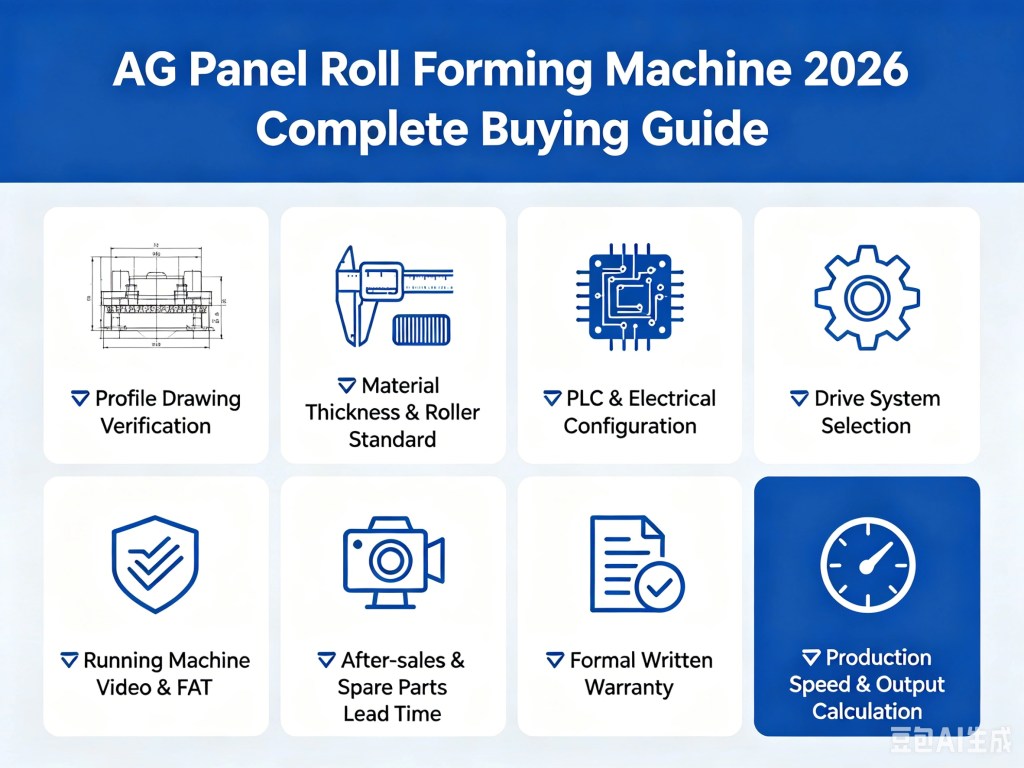
This is the most important section in this ag panel roll forming machine buying guider. The following 8-point checklist saves you from a bad purchase:

1. Profile drawing confirmed?
Get the exact AG panel drawing — rib height, cover width, leg angle. Confirm it matches the tooling specification in the contract.

2. Material thickness range?
Most AG panel lines run 0.3–0.8 mm. If you plan to run 0.8 mm (24 gauge) routinely, specify high-strength forming rollers (GCr15 or better).

3. PLC and electrical standards?
Siemens or Delta PLC is the baseline for a machine you want to maintain for 10 years. Domestic-only PLCs mean expensive proprietary service calls.

4. Drive: gearbox or chain?
Chain drive works below 25 m/min. Above that, ask for gearbox drive.

5. Video of the actual machine running?
Any serious supplier will video the factory acceptance test (FAT) before shipment. If they refuse, that is your answer.

6. After-sale and spare parts?
Ask: how long for a spare roller set to arrive? If the answer is “we’ll quote you then,” budget for a 3–6 week downtime. A responsible ag panel roll forming machine buying guider always flags weak after-sale support as a dealbreaker.

7. Warranty terms in writing?
A verbal “one year” is meaningless. Get it in the contract with a clear definition of covered parts.

8. Does the cutting speed match your daily target?
Calculate: forming speed (m/min) ÷ average panel length (m) = panels per minute. Multiply by 480 (8-hour shift minutes) to get daily output. If that number is less than your order forecast, the machine is undersized.

Run through all eight points with every supplier. Our ag panel roll forming machine buying guider is designed so that no checkbox gets skipped, because the cost of one missed detail is weeks of downtime.

FAQ: AG Panel Roll Forming Machine Buy Guider

What is an AG panel roll forming machine?

An ag panel roll forming machine buying guider always starts with definitions. An AG panel roll forming machine is a cold-forming production line that continuously bends flat steel coil into 7/8-inch ribbed agricultural roofing panels. A complete line includes an uncoiler, the main roll forming mill, a cutting unit, and an auto stacker. Output is finished AG panels cut to the ordered length.

How much does an AG panel roll forming machine cost?

factory-grade AG panel machine from Believe Industry costs between 22,000 and 45,000 FOB China, depending on forming speed, cutting solution, and automation level. Economy Chinese machines start at 15,000.European andUS brands start at 80,000. The mid-range machines from established Chinese exporters offer the best cost-to-performance ratio for most buyers. Any ag panel roll forming machine buying guider worth its salt walks you through the supplier tiers above, not just the sticker price.

What is the difference between an AG panel machine and an R-panel (PBR) machine?

The AG panel profile has a 7/8-inch rib; R-panel (PBR) has a 1¼-inch rib. The machines use different tooling sets and cannot swap profiles. AG panel is the standard for agricultural and light residential applications. R-panel targets commercial and industrial projects. If you need both, consider a double-layer machine. This ag panel roll forming machine buying guider includes a full comparison table above.

Which cutting method is best: pre-cut, post stationary, or flying cut?

For production volumes above 500 panels per day, flying cut is the best choice. It allows full forming speed (35–60 m/min) with clean panel ends. Post stationary cutting works for smaller volumes but reduces effective speed to 15–30 m/min. Pre-cut is suited for job-site portables and very short production runs. This ag panel roll forming machine buying guider covers all three cutting solutions in detail with a dedicated comparison table.

How many roller stations does an AG panel machine need?

A minimum of 16 stations for standard 0.4–0.6 mm material. Heavier gauge (0.6–0.8 mm) performs better with 18–20 stations. More stations means smoother progressive forming and less springback in the finished panel.

What is a typical daily output for an AG panel line?

At 40 m/min forming speed with a flying cut and average panel length of 3 meters, a single shift produces approximately 3,800 panels in 8 hours. Post stationary machines at 20 m/min effective speed produce roughly 1,800–2,200 panels per shift. Use this ag panel roll forming machine buying guider to calculate your required speed before requesting quotes.

Can I run both AG panel and corrugated sheet on the same machine?

Not on a single-profile machine — the tooling sets are profile-specific. A double-layer roll forming machine can run two profiles on one frame with a quick manual switch. See Believe Industry’s double-layer machine for details.

Does Believe Industry offer on-site installation for AG panel machines?

Yes. Believe Industry offers video guidance as standard and can arrange on-site engineers for larger projects. The installation scope depends on your location and order size. Contact the team directly for a quote.

What coil material is compatible with an AG panel machine?

Standard material is Galvalume (ASTM A792), galvanized (ASTM A653), or PPGI coated coil. Coil thickness: 0.3–0.8 mm. Coil width: 914–1250 mm depending on the target panel coverage. Material yield strength should be 230–550 MPa; rollers should be hardened accordingly for the high-strength end.

How do I compare AG panel machines from different suppliers?

Request: a technical drawing of the machine, a video of the line running at claimed speed, and the full BOM (bill of materials) with part brands called out. Compare shaft material, PLC brand, drive type, and cutting method. Price alone is a poor filter — two machines at the same price can have very different service lives.  This ag panel roll forming machine buying guider gives you the framework; now apply it across every quote you receive.

Why Buy From Believe Industry?

Believe Industry has been manufacturing cold-roll forming machines over 15 years. We export to 20+ countries. Our AG panel machines run in roofing factories in the US, Australia, South Africa, the Middle East, and Southeast Asia.

We build to customer spec — panel width, speed, cutting solution, and automation level are all configurable. Every line ships with a factory acceptance test video. Spare parts and engineering support are available post-shipment.

For full product details and a quotation, visit the AG panel roll forming machine or contact us directly.

We hope this ag panel roll forming machine buying guider saved you time and uncertainty. A good buying decision starts with the right information — and if you have read this far, you are already ahead of most buyers.

High Speed AG Panel Machine in Action

External Resources

For technical background on cold-form metal roofing profiles and material specifications:

Table of Contents

New Updates

Discover more from Believe Industry Company| Roll Forming Machine Manufacturer, Supplier & Exporter

Subscribe now to keep reading and get access to the full archive.

Continue reading

BELIEVE INDUSTRY | CUSTOM SOLUTIONS

REQUEST YOUR
ENGINEERING PROPOSAL