Address
No 1, Yd Road, Huishan District, Wuxi City, Jiangsu. 214183
Work Hours
Monday to Friday: 9AM - 5PM
Saturday: 9AM - 4PM
Address
No 1, Yd Road, Huishan District, Wuxi City, Jiangsu. 214183
Work Hours
Monday to Friday: 9AM - 5PM
Saturday: 9AM - 4PM
Short answer: A Klip-Lok roof sheet roll forming machine turns 0.42 to 0.60 mm galvanized or pre-painted coil into a concealed-fix roof profile with a 700 mm or 406 mm net cover. It forms the wide pans and deep ribs, crimps the male spurs that lock into the KL70 clip, and cuts each sheet to the length the roof needs. Believe Industry builds these lines with 32 forming stations, a 15 kW main motor, a 5 t uncoiler and a running speed of 10 to 15 m/min.
Klip-Lok is a wide cover roof sheet with a bold rib and a flat pan between the ribs. The sheet is fixed from underneath, through a stainless clip, so the roof surface has no screw heads in it. That single detail decides almost everything else about the profile.
With no fasteners breaking the surface, water cannot enter around a screw washer. Thermal movement is taken up by the clip instead of fighting a fixed screw. The pan stays clean and straight, which is why architects specify this profile where the underside of the sheet is the ceiling.
Two numbers control the machine. Cover width sets the coil width. Rib height and spacing set the station count.
| Property | Klip-Lok 700 | Klip-Lok 406 |
|---|---|---|
| Net cover width | 700 mm | 406 mm |
| Rib height | 40 mm (43 mm on the high strength variant) | 41 mm |
| Rib centres | 233.3 mm | 203 mm |
| Base metal thickness | 0.42 mm or 0.48 mm | 0.48 mm |
| Mass per square metre | 4.61 kg at 0.42 mm, 5.24 kg at 0.48 mm | 5.56 kg |
| Minimum roof pitch | 2 degrees at 0.42 mm, 1 degree at 0.48 mm | 1 degree |
| Coil width | 940 mm | 610 mm |
| Typical use | Industrial and commercial roofs, long runs, low pitch | Domestic roofs, patios, small spans, walling |
The 406 profile carries less steel per metre but covers 294 mm less roof, so it uses more sheet per square metre. On a 1,000 m2 roof the 700 profile saves close to 40 percent of the sheet count, which is why most first-time buyers go with 700.
Three profiles sit under the Klip-Lok name and they are not interchangeable. A roll set is cut for one of them. Ask which one your market actually builds before you approve a drawing.
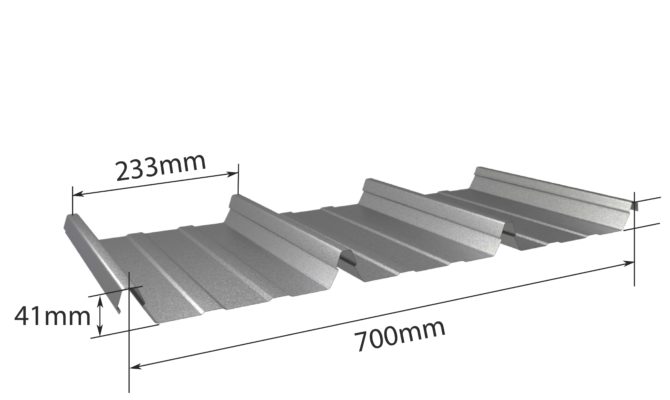
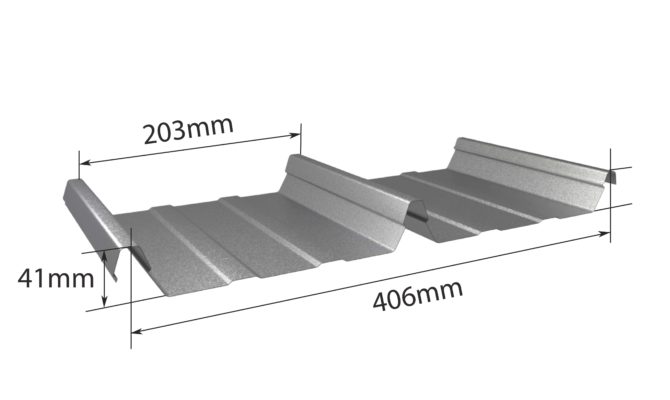
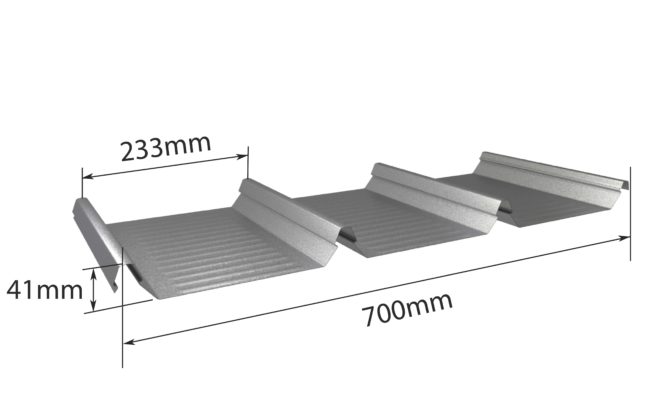
The 700 sheet carries four trapezoidal ribs across the cover, at 233.3 mm centres. The male rib has spurs that give a positive double interlock at the side lap, and every pan carries two stiffener ribs running lengthwise. Those stiffeners are what let the sheet span 1,500 mm or more between purlins without oil canning. For the original profile drawings, LYSAGHT publishes the 700 section.
The 406 sheet uses the same lock geometry at a shorter pan. It is the profile for carports, patio covers and house roofs where a 700 mm pan looks too wide. Machine-wise the difference is coil width, roll set and a shorter shaft, not a different frame.
Klip-Tite sits in the same family and is the one buyers most often confuse with 406. It uses a different rib and clip, so a 406 roll set will not produce it. The same lock principle runs through the wider standing seam roll former family.
A KL70 clip is fixed to the purlin with two screws before the sheet arrives. The sheet is then pushed down over the clip and the male rib closes onto it. Roughly 1.5 clips per square metre are needed, so a 1,000 m2 roof takes about 1,500 clips.
The clip does three jobs at once. It holds the sheet against wind uplift. It keeps the fixing off the weather surface. And it lets the sheet slide as the roof heats and cools, which is what allows a single sheet to run 20 m or more without an expansion joint.
That movement is the reason the minimum pitch matters. Klip-Lok 700 is rated to 1 degree at 0.48 mm and 2 degrees at 0.42 mm. Below those pitches the side lap wets out and no amount of clip pressure fixes it.
On site the sheet is walked into place, not screwed. Two installers lay 200 to 300 m2 a day on a straight roof.
The Klip-Lok roof sheet roll forming machine is a straight sequence from coil to stacked sheet. Each part has to be sized for 940 mm coil at 0.6 mm, a heavier pull than a 610 mm narrow line.

A pneumatic shear is cheaper and fine up to about 0.6 mm. Where the sheet must be cut without a burr on the pan, a hydraulic shear with a guided blade is the better build. Both cut after forming, so length is set at the controller.
| Parameter | Klip-Lok 700 line | Klip-Lok 406 line |
|---|---|---|
| Coil width | 940 mm | 610 mm |
| Coil thickness | 0.40 to 0.60 mm | 0.40 to 0.60 mm |
| Coil weight | 5 t | 5 t |
| Coil ID / OD | 500 to 650 mm / 1,500 mm max | 500 to 650 mm / 1,500 mm max |
| Forming stations | 32 | 26 to 28 |
| Main motor | 15 kW | 11 kW |
| Forming speed | 10 to 15 m/min | 10 to 15 m/min |
| Roller material | ASTM 1045, quenched, chrome plated 0.05 mm | ASTM 1045, quenched, chrome plated 0.05 mm |
| Shaft | 75 mm solid, ASTM 1045 | 65 mm solid, ASTM 1045 |
| Drive | Chain and gearbox | Chain and gearbox |
| Cut-off | Post-cut flying shear, pneumatic or hydraulic | Post-cut flying shear |
| Control | PLC with HMI touch screen | PLC with HMI touch screen |
| Length tolerance | ±2 mm | ±2 mm |
| Profile tolerance | ±0.5 mm on cover width | ±0.5 mm on cover width |
At 12 m/min a 6 m sheet leaves the shear every 30 seconds. Sheet length is limited by transport, not by the machine. A 40 ft container takes about 11.8 m, so a longer run ships as two sheets with an end lap, and the lap needs the LOK-KLIP joint rather than a plain overlap.
The profile was drawn around Australian steel, so the coil it expects is G550 with an AZ150 zinc-aluminium coating. That is 550 MPa yield and 150 g/m2 of coating. Feeding a 250 MPa mild steel coil through the same rolls will form a sheet, but it will not carry the spans in the load table and it will dent under foot traffic.
Where the roof is specified to Australian standards, three documents govern the job. AS 1397 covers the steel sheet itself, AS/NZS 2728 covers the pre-painted and metallic coated product, and AS 1562.1 covers design and installation of metal roofing. Wind pressures come from AS/NZS 1170.2. A machine does not have to meet these standards, but a sheet that will be signed off does, and that starts with the coil grade.
If the market is the Middle East or Southeast Asia, 0.50 mm with a higher build coating is common, and the colour range shifts from COLORBOND equivalents to local pre-painted product. The line forms the same profile. What changes is the coil supplier and, on some jobs, a slightly larger roll gap so a thicker paint film does not mark on the last stands. The regional LYSAGHT data sheet lists the coating class and steel grade the profile was designed around.
For buyers comparing suppliers across regions, the requirements differ enough to affect the spec sheet. The USA market guide covers the North American side of that split.
Six answers get you a firm quote instead of a catalogue page.
One machine can change between 700 and 406 with a cassette swap, at a cost between one line and two. The swap takes 2 to 3 hours.
Believe Industry has been building roll forming machines since 2005, with 80+ engineers and technicians on the design and commissioning side, 500+ machines delivered and machines running in 50+ countries. The workshop holds ISO 9001 and the machines carry CE marking for European delivery.
Roofing is one part of the range. The same plant builds purlin roll forming machines for the support structure, floor deck machines for the slab, and downspout and gutter machines for the water path. Most buyers order the roof line and the purlin line together, because purlin spacing and sheet span have to agree before either machine is cut.
For the wider picture on profile choice and coil supply, the roofing sheet roll forming machine buy guide walks through the decisions in order. For a wider cover with different rib geometry, see the widespan roof sheeting machine.
Send a profile drawing to our engineering team and you get a station count, a coil width and a line layout back, not a price list. The profile drawing is the only document that matters at the quoting stage.
Q: What is the difference between Klip-Lok 700 and Klip-Lok 406?
A: Cover width. The 700 profile covers 700 mm per sheet with ribs at 233.3 mm centres; the 406 covers 406 mm with ribs at 203 mm. Both are concealed fix with the same lock principle. The 700 needs 940 mm coil, the 406 needs 610 mm.
Q: Can one machine make both 700 and 406?
A: Yes, with a cassette or a second roll set. The frame and drive stay, the rolls and the coil handling change. Expect a 2 to 3 hour changeover, which is why two lines are usually better if both profiles run daily.
Q: What steel thickness can the machine form?
A: 0.40 to 0.60 mm as standard, with rollers set for the range you actually buy. The common Klip-Lok gauges are 0.42 and 0.48 mm base metal thickness. Tell us the top of your range when you order, because a roll gap set for 0.48 will mark a 0.60 sheet.
Q: What is the minimum roof pitch?
A: 1 degree for Klip-Lok 700 at 0.48 mm and for Klip-Lok 406. Klip-Lok 700 at 0.42 mm needs 2 degrees. Below these pitches the side lap wets out and the anti-capillary rib cannot hold.
Q: How fast is the line and how long a sheet can it make?
A: 10 to 15 m/min, so a 6 m sheet every 30 seconds. Sheet length is limited by how you ship it. A 40 ft container takes about 11.8 m, so longer runs are made as two sheets with a LOK-KLIP end joint.
Q: Do I have to buy the clips from you?
A: No. KL70 clips are a consumable, and most buyers source them locally. What matters is that the clip matches the rib you form. Send a sample clip with your profile drawing and we will match the rib to it.
Q: What decides the price of the machine?
A: Profile first, then station count, then the cut-off and the options. A 32 station 700 line with a hydraulic shear and an automatic stacker sits well above a 26 station 406 line with a pneumatic shear. Coil width drives the frame size, and frame size drives most of the steel in the machine.
If you already have a profile drawing, send it with the coil width and the thickness range you buy. That is enough to come back with a station count, a line layout and a price. If you are still choosing between 700 and 406, send the roof drawings instead and we will tell you which profile the spans actually support.
Last updated: 2026-11-06
Article Changelog
2026-11-06: Rebuilt the page from 316 to 2,276 words. Added the 700 and 406 comparison table, the parameter table, the clip system section, the coil and standards section, the specification checklist, seven FAQs and ten internal links. Fixed the misspelled brand name in the title tag and the misspelled word in the introduction.
Next Review Triggers
Klip-Lok 700 or 406 profile dimensions change at the roll former
AS 1562.1 or AS/NZS 2728 is revised
A cassette or stacker option is added to the range

A roll forming machine price ranges from 20,000 for a basic stud and...
Read More
Cable Tray Roll Forming Machine: Ladder vs Perforated Tray Lines...
Read More
Billboard & Signage Roll Forming: Advertising Structure Profiles Short answer:...
Read More
Heavy Duty Step Beam Roll Forming: Thick Coil and High-Strength...
Read More English English
 Español
 Português
 Русский
 العربية
 Bahasa Melayu
 Türkçe
 ไทย
 Bahasa Indonesia