Address
No 1, Yd Road, Huishan District, Wuxi City, Jiangsu. 214183
Work Hours
Monday to Friday: 9AM - 5PM
Saturday: 9AM - 4PM
Address
No 1, Yd Road, Huishan District, Wuxi City, Jiangsu. 214183
Work Hours
Monday to Friday: 9AM - 5PM
Saturday: 9AM - 4PM
Steel door frames that fold at the corner, insulated garage door panels, curved shutter tracks, interlocking shutter slats, and window frame profiles. Four lines, each built to your section drawing and run on test coil before shipment.
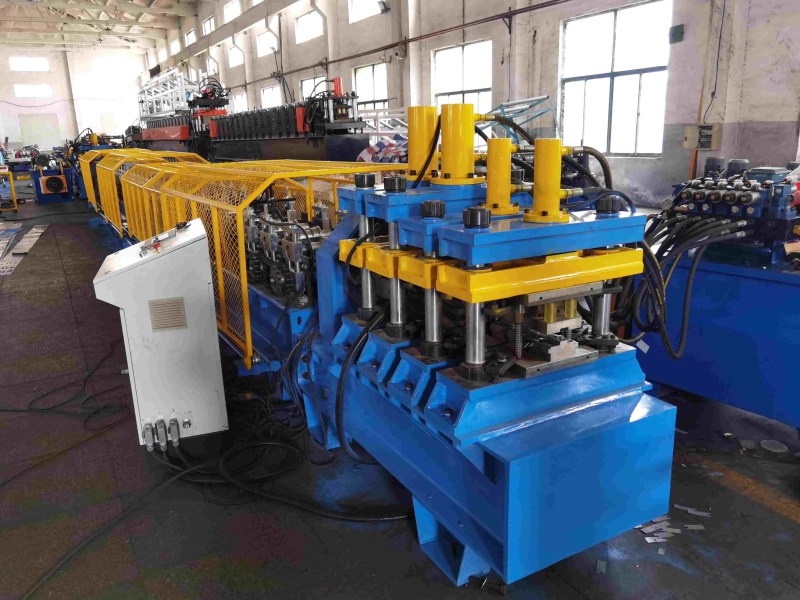
Turns galvanized coil into a folding steel door frame on one line: miter notches, hinge slots and lock cutouts are punched before forming, so the frame folds at 90 degrees on site without a second operation.
View machine specsForms garage door panels from 200 to 600 mm wide coil at 12 to 15 m/min, with embossing and pattern punching in line, and an optional PU injection station for insulated composite panels.
View machine specsProduces the guide track that carries a roller shutter or garage door up and down, in straight or curved sections from 0.8 to 1.5 mm galvanized or cold rolled strip, with assembly holes pre-punched.
View machine specsRolls the horizontal slats that interlock into a roller shutter curtain, for warehouse, factory, kitchen and vehicle doors, with hollow, foam filled and PU insulated variants.
View machine specsA door is not one profile. It is a frame that folds at the corners, a leaf or a curtain that closes the opening, and a track that guides it. Each of those is a separate roll formed section, and each has its own tolerance problem. That is why this page lists four machines rather than one: buyers who want a complete door production line normally buy two or three of them together.
The dividing line in the catalogue is between frames and panels. A frame is an open profile that is notched and folded on site or in the plant. A panel or a slat is a closed or semi closed section that has to look right on the face, because it is the part the customer sees every day.
Any press brake can bend a door frame. What a roll forming line adds is the notch: the miter cut that lets the profile fold into a 90 degree corner without a weld. The punch unit also cuts hinge slots, the strike plate opening, the lock prep and the anchor holes, all before forming, so the finished profile comes off the line ready to assemble.
Our frame line runs 0.8 to 2.0 mm galvanized coil through 22 forming stations with a servo punch, at 15 to 20 m/min. In real output that is roughly 6 to 8 frames a minute, against 1 to 2 frames a minute by manual press brake work. The gap is not speed on the bend, it is the number of separate handling steps that disappear.
Gauge is the first thing to fix. A 1.2 mm frame suits a stud partition; a 1.6 to 2.0 mm frame suits a masonry opening with a fire rating. The roll design, the shaft diameter and the punch tonnage all follow that number, so deciding it late is expensive.
Garage door panels are formed from 200 to 600 mm wide coil at 12 to 15 m/min, excluding punching and cutting. The line embosses the surface pattern and punches the hinge and handle positions in the same pass, which matters because a panel that is formed flat and punched later never lines up perfectly across a run.
There are two products here. A single skin panel is one formed sheet, sold on price and used on light domestic doors. A composite panel is two skins with polyurethane foam injected between them, and it is what the insulation value in a modern garage door actually comes from. The forming section is shared; the foaming press, the injection station and the curing time are not.
The track is the guide. It is an open channel formed from 0.8 to 1.5 mm galvanized or cold rolled strip at 8 to 15 m/min, and the version that sells in volume is the curved track, because real openings sit in real walls with returns and soffits. Assembly holes are punched in line so the installer does not drill on a ladder.
The slat is the curtain. Each slat is a closed interlocking section, and the whole door is a stack of them hinged together, which means the tolerance on one slat multiplies by the number of slats in the opening. That is why slat lines are specified on repeatability rather than on top speed.
Slats are also the most varied product in this family. Hollow slats for warehouses and factories, foam filled slats for kitchens and shop fronts, PU filled slats for insulation and wind load, and small sections for vehicle and van doors. Each variant is a different roll set on the same machine base.
Window frames, sashes, mullions, sills and trim are roll formed on the same architecture as door frames. The section is different: thinner in gauge, normally 0.5 to 1.5 mm, but wider across the face, up to about 250 mm, at 10 to 25 m/min. That width is what makes the roll design the critical part, because a wide shallow section springs back more than a narrow deep one.
Steel and aluminum both run, but not with the same rolls. Steel strip at 0.5 to 1.2 mm forms predictably and holds the section. Aluminum alloy is softer, wider and easier to mark, so the roll surfaces are polished and the pass schedule is gentler. If you plan to run both materials on one machine, say so before the design is fixed rather than after.
| Profile | Coil thickness | Speed | Notable |
|---|---|---|---|
| Steel door frame | 0.8 - 2.0 mm | 15 - 20 m/min | 22 stations, servo punch, miter notch and lock prep in line |
| Garage door panel | coil 200 - 600 mm wide | 12 - 15 m/min | Embossing and pattern punching, PU injection for composite panels |
| Shutter track | 0.8 - 1.5 mm | 8 - 15 m/min | Straight or curved, assembly holes pre-punched |
| Shutter slat | per drawing | per drawing | Interlocking section, hollow, foam filled or PU insulated |
| Window frame profile | 0.5 - 1.5 mm | 10 - 25 m/min | Face width up to 250 mm, steel or aluminum, quick change cassettes |
Five answers decide most of the quotation. The section drawing with the fold or lock geometry, because that fixes the stand count. The material and coating you will actually buy, because bare, galvanized and pre painted strip need different roll finishes. Every size the line must cover, because a frame line that runs one width and a frame line that runs four are different machines. The punch pattern, because hinge and lock positions are tooling, not software. And the output you need per shift, because that decides whether you buy one line or a line plus a stacker.
If you are still comparing forming methods, our guide to choosing, operating and maintaining a roll forming machine covers the same decisions from a wider angle. To work out how far a coil will run before you commit to a tonnage, the metal coil calculator does the arithmetic.
 English English
 Español
 Português
 Русский
 العربية
 Bahasa Melayu
 Türkçe
 ไทย
 Bahasa Indonesia