Address
No 1, Yd Road, Huishan District, Wuxi City, Jiangsu. 214183
Work Hours
Monday to Friday: 9AM - 5PM
Saturday: 9AM - 4PM

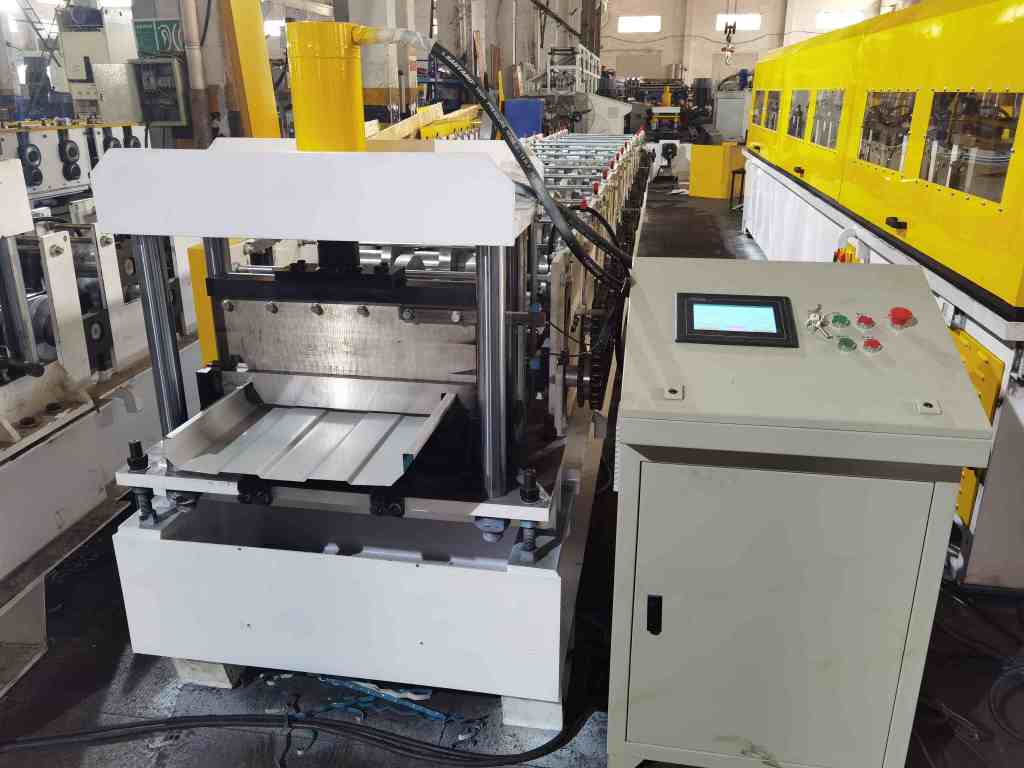
A Standing Seam Roll Forming Machine is an automated production line that shapes metal coils (aluminum, steel, or copper) into roofing panels with vertical ribs and concealed fasteners. By utilizing a series of precision-mated rollers, the machine creates a weather-tight, mechanically seamed joint that accommodates thermal expansion, making it the gold standard for modern industrial and commercial roofing.
In the competitive landscape of industrial manufacturing, the Standing Seam Roll Forming Machine stands as the pinnacle of metal roofing technology. Unlike traditional corrugated sheeting, standing seam systems offer a sleek, fastener-free aesthetic combined with unmatched structural integrity. At Beli Rollforming, our 2026 engineering updates have focused on three core pillars: precision, material versatility, and the elimination of common defects like oil canning.
Modern architectural designs often move beyond simple rectangles. Conical roofs and arched entryways require panels that are not only curved but also tapered. Our advanced machine configurations include:
Adjustable Guide Rails: Controlled via a Siemens PLC, these rails adjust the input width dynamically to create tapered panels.
Integrated Slitting: The line includes a pre-slitting unit that cuts the taper before the metal enters the forming stands.
Curving Integration: For radius roofs, the Standing Seam Roll Forming Machine can be paired with an offline or inline curving unit to achieve the exact “radiusing” required by the site specifications.
The physics of roll forming requires a deep understanding of material springback. According to the Roll Forming Handbook (George T. Halmos), the bending radius must be carefully calculated based on the yield strength of the material. For a Standing Seam Roll Forming Machine, we typically utilize a 1.25x bending radius for 0.8mm aluminum to prevent micro-cracking at the seam, which could lead to long-term corrosion.
| Category | Technical Parameter | 2026 Industrial Specification | Rationale & Engineering Insight |
| Material Capabilities | Suitable Materials |
Aluminum (3003, 5052), PPGI, Copper, Zinc
|
Accommodates thermal expansion and corrosion resistance.
|
| Thickness Range |
0.3mm – 1.0mm (Up to 0.040″)
|
Precision bending avoids micro-cracking in light-gauge metals.
|
|
| Yield Strength |
Up to 200,000 psi (G550 Grade)
|
High-tensile steel requires specialized roller pressure calibration.
|
|
| Forming Precision | Number of Stations |
18 – 22 Forming Passes
|
Gradual forming reduces edge stress and eliminates “oil canning”.
|
| Shaft Diameter |
75mm (ASTM 1045 Hardened)
|
Minimizes shaft deflection to ensure tight seam tolerances.
|
|
| Shaft Alignment |
Baseline Tolerance: ±0.05mm
|
Critical for prevent profile distortion and accelerated tool wear.
|
|
| Operational Performance | Line Speed |
12 – 20 m/min (Variable AC/DC)
|
Variable frequency drives manage material coasting for accurate cuts.
|
| Pass Line Height |
900mm – 1025mm (Standard)
|
Designed for ergonomic operator access and secondary unit integration.
|
|
| Seaming Method |
Mechanical / Hidden Fastener
|
Ensures 100% weather-tightness through secondary seaming operations.
|
|
| Tooling & Engineering | Roller Material |
GCr15 or ASTM 1045 (Heat Treated)
|
Surface hardness is optimized to prevent “pick-up” of metallic coatings.
|
| Design Software |
Ubeco PROFIL / Copra FEA
|
Simulates flower patterns to calculate exact bend allowance and springback.
|
|
| Tolerance (Width) |
±0.5mm on finished profile
|
Required for seamless panel interlocking on large-scale industrial roofs.
|
In high-precision roll forming, calculating the Coil OD (Outer Diameter) and total Strip Length is critical for inventory management and production scheduling. Overestimating length leads to wasted material; underestimating leads to incomplete production runs.
Estimate production yield for your Standing Seam Roll Forming line.
*Calculation based on theoretical density. Actual length may vary by ±1% depending on coating thickness.
Aluminum, Zinc, and PPGI (Pre-painted Galvanized Iron) are ideal due to their ductility and superior corrosion resistance.
Yes, our 2026 models feature adjustable input guides and integrated slitting to produce tapered profiles for complex geometries.
We use extra forming stations (up to 22) and stress-relieving rollers to ensure even tension across the panel face.
Our industrial lines reach speeds of 20m/min, significantly higher than portable field units.
Yes, through modular tooling changeovers, rib heights can be adjusted to meet specific architectural wind-load requirements.
With our motorized width-adjustment system, width changes are completed in approximately 8-10 minutes.
Don’t risk project delays with inferior profiles. Our engineers are ready to help you calibrate the perfect Standing Seam Roll Forming Machine for your specific material—be it aluminum magnesium manganese or high-tensile PPGI.
Request a Custom Technical Quote Average Response Time: < 24 Hours
A step beam machine is an advanced industrial roll forming...
Read MoreA Strut Channel Machine Mexico is a high-speed, automated production...
Read MoreIn the rapidly evolving landscape of industrial manufacturing, the Box...
Read MoreWhat are the benefits of using top step tile roll...
Read More