Table of Contents

pallet upright frame roll forming machine

Pallet Upright Frame Roll Forming Machine: Complete Buyer’s Guide

pallet upright frame roll forming machine turns flat steel coils into precision upright columns used in warehouse storage rack systems. If you’re sourcing industrial racking equipment — or you’re a roll forming manufacturer expanding your product line — understanding every stage of this process matters more than you’d think. The wrong material choice alone can cost thousands in downstream waste.

This guide walks through the full production chain: raw material specs, tooling design, machine configuration, quality control checkpoints, and supplier evaluation. No fluff — just what a purchasing manager or production engineer needs to make informed decisions.

What Is a Pallet Upright Frame Roll Forming Machine?

An upright frame — sometimes called an upright column or vertical post — is the backbone of any selective pallet racking system. It stands vertically and supports horizontal beams, which in turn hold palletized loads. Every storage rack upright column machine on the market is designed around this single principle: turn flat steel into a structurally sound vertical member that won’t buckle under load.pallet upright frame roll forming machine

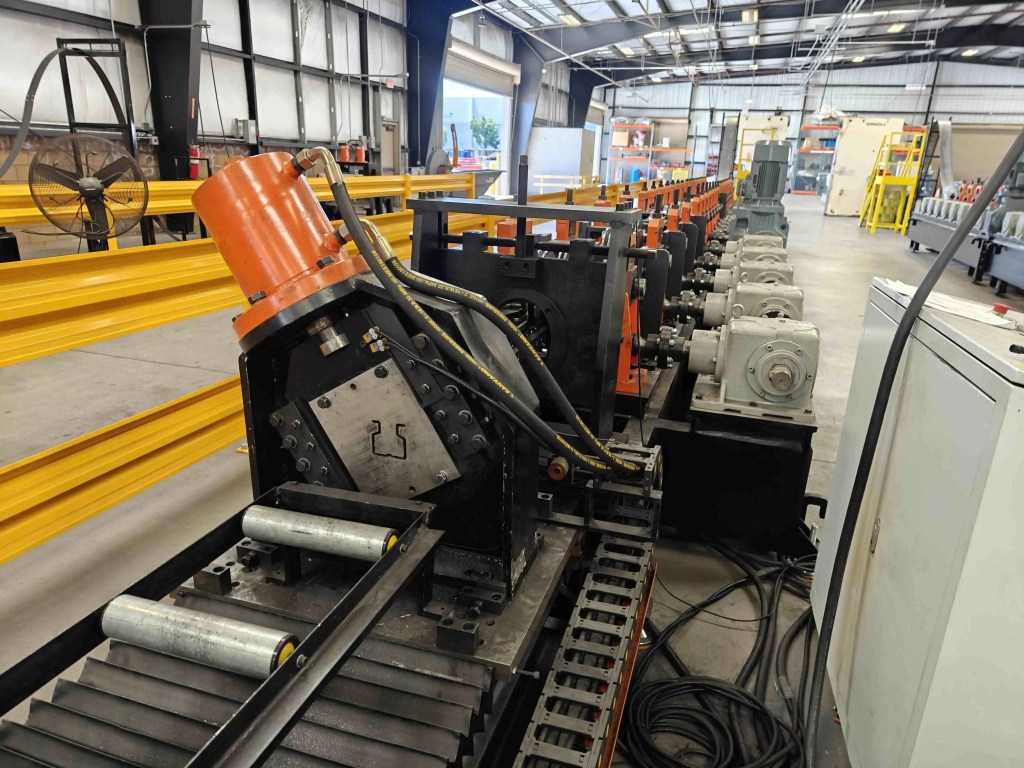
pallet upright frame roll forming machine feeds steel strip through a sequence of forming stations (called roll stands). Each station bends the strip incrementally until the finished cross-section exits the line. Most upright profiles use an open-section design with punched flange holes (teardrop, diamond, or rectangular patterns) that accept beam connectors.

Typical production speeds range from 8 to 25 meters per minute, depending on material thickness and profile complexity.

Material Selection

Steel Grade and Chemical Composition

Most Pallet Upright Frame Roll Forming Machines process high-strength low-alloy (HSLA) steel in the range of Q235 to Q355 (Chinese standard, per GB/T 699) or SS400 to S550 (JIS G 3101). For heavy-duty racking, some manufacturers push into 690 MPa yield strength material following EN 10210 specifications for hot-finished structural hollow sections.

The chemistry matters. Higher carbon content improves strength but hurts formability. Here’s what to look for:

PropertyLight-Duty RackStandard RackHeavy-Duty Rack
Yield Strength235–250 MPa300–355 MPa460–690 MPa
Material Thickness1.5–2.0 mm2.0–2.5 mm2.5–3.5 mm
Typical GradeQ235 / SPCCQ345 / S350Q460–Q690 / S550
Coil Weight2–3 tons3–5 tons5-10 tons

Galvanized vs. Pre-Painted vs. Raw Cold-Rolled

  • Hot-dip galvanized (HDG) coil — Most common for indoor racking. Provides 40–80 μm zinc coating per ASTM A123. Feeds smoothly through most roll formers but may accelerate roller wear compared to bare steel.
  • Pre-painted (PPGI/PPGL) — Used when visual appearance matters (retail back-room storage). Requires soft polyurethane or rubber-coated rollers to avoid scratching.
  • Bare cold-rolled steel — Cheapest option. Post-forming powder coating is typical. Watch for surface rust during storage — use climate-controlled warehousing for coils.

Coil Width and Tolerance

The coil width determines the final profile’s unfolded dimension. Tolerance should be within ±0.5 mm for consistent hole alignment during punching. Wider tolerances cause edge wave and mismatched flange dimensions.

When sourcing coils, always specify: grade, thickness tolerance (±0.03 mm preferred), width tolerance (±0.5 mm), coil ID (usually 508 mm or 610 mm), and max coil OD that your decoiler can handle. Material traceability is also non-negotiable — each coil should carry a heat number matching the mill test certificate per ASTM A6 requirements.

Roll Forming Stations: How Many Stages Does It Take?

Typical Station Count

For a standard upright profile with flange holes, most lines use 14 to 22 forming stations plus a separate pre-punch unit. Complex profiles with multiple bends per flange may need up to 28 stations. The chain transmission design commonly used in strut channel lines also applies here — it maintains synchronized roller speed across all stations, which is critical for profile straightness.

Station-by-Station Breakdown

Here’s what happens at each phase of a typical upright frame production line:

StageStation RangeFunction
Entry Guide1Centers the strip and prevents lateral drift
Breakdown2–5Creates initial bend angles on web and flanges
Forming6–15Gradually bends to near-final angles (typically 85–88°)
Overbend16–18Slightly overbends to compensate for springback
Sizing19–22Final dimensional calibration to spec
Post-CutLastFlying shear or stop-cut to length

Springback is the enemy of precision. The final forming angle should overbend by 1–3° beyond the target. Actual overbend depends on material grade and thickness — harder steel needs more compensation. This principle is well-documented in cold-forming engineering references such as ASM Handbook Volume 14B: Sheet Forming.

Roller Material Choices

Rollers take the most abuse on any line. Common options include:

  • 45# forged steel with chrome plating — Budget pick. Works for galvanized coil at moderate speeds. Expect roller replacement every 18–24 months at typical production volumes.
  • Cr12MoV tool steel — Harder surface (HRC 58–62). Lasts 2–3x longer than chrome-plated rollers. Better for high-strength material (355+ MPa). This grade is widely used in Chinese machine tools — similar performance to D2 tool steel in Western markets.
  • Cemented carbide inserts on forming surfaces — Premium option. Best for continuous high-volume production with abrasive HDG coil. Higher upfront cost but lower lifetime cost per ton.

Pre-Punching and Hole Patterns

Inline Punching Before Forming

Most upright frames need punched holes along both flanges to accept beam connector hooks. The standard approach is hydraulic pre-punching before the strip enters the forming stations. This punching process shares principles with mechanical punch press operations used in other metal forming applications.

Punching accuracy matters. Hole position tolerance should be within ±0.3 mm relative to the strip centerline. Misaligned holes mean beams won’t connect properly — a deal-breaker for racking systems.

Common Hole Patterns

  • Teardrop holes — Industry standard in North America. Punched on 50.8 mm (2-inch) pitch. Compatible with most major racking brands (Interlake, Steel King, Ridg-U-Rak). The RMI (Rack Manufacturers Institute) publishes design standards for these hole patterns in ANSI MH16.1.
  • Diamond/punched rectangular — Common in European and Asian markets. Hole spacing varies by manufacturer: 50 mm, 75 mm, or 100 mm pitch.
  • Louvered slots — Used in some proprietary systems. Requires specialized punch tooling.

The pre-punch unit on a Pallet Upright Frame Roll Forming Machine typically runs 2–4 punching stations in series, each handling a row of holes. CNC-controlled servo feed ensures precise pitch accuracy.

Cutting Systems: Flying Shear vs. Stop-Cut

Flying Shear (Recommended)

A flying shear cuts the profile without stopping the line. The shear head tracks the moving strip and cuts on-the-fly. This means no speed reduction — production stays at full pace.

Best for: high-volume production where cycle time matters. Typical cut length accuracy is ±1.0 mm. A well-tuned flying shear on a selective pallet rack column roll former can achieve ±0.5 mm — essential when beams must connect without play.

Stop-Cut (Hydraulic Press)

The line stops, a hydraulic press cuts the profile, then the Pallet Upright Frame Roll Forming Machine restarts. Slower but mechanically simpler.

Best for: lower-volume operations, thick material (>3.0 mm) where shear blade life is a concern, or profiles requiring special end treatment.

Post-Forming Options

Some manufacturers add a stamping or embossing station after cutting for:

  • End-cap identification marks (part number, load rating)
  • Forklift pocket indentations on the profile base
  • Additional bolt holes for base plate connection

Key Pallet Upright Frame Roll Forming Machine Specifications

When evaluating an upright frame roll former, these specs separate good machines from bad:

SpecificationEntry LevelProfessionalHigh-End
Forming Speed8–12 m/min12–20 m/min20–30 m/min
Stations14–1618–2222–28
Shaft Diameter60–70 mm70–80 mm80–100 mm
Motor Power15–22 kW22–37 kW37–55 kW
Material Thickness1.5–2.5 mm1.5–3.0 mm1.5–4.0 mm
Control SystemBasic PLCPLC + HMI touch screenPLC + HMI + remote monitoring
Roller MaterialChrome-plated 45#Cr12MoVCarbide inserts

The control system is worth paying extra for. Modern lines use servo tracking systems that maintain speed synchronization between the forming line and the cut-off unit. Older mechanical linkage systems produce more variation. The servo-driven approach is now considered best practice across the roll forming industry for precision profile production.

Profile Design Considerations

Cross-Section Geometry

The most common upright profile is a modified open box section with inward-bending flanges (often called a “C-section with lips” or “hat section”). Key dimensions:

  • Web height: 80–120 mm (standard), up to 150 mm for heavy-duty
  • Flange width: 40–70 mm
  • Lip depth: 15–25 mm
  • Overall depth: 60–100 mm

Deeper profiles carry heavier loads but require more forming stations and larger-diameter rollers. The trade-off between structural capacity and manufacturing complexity is a key design decision.

Moment of Inertia and Load Capacity

For a given steel thickness, a deeper profile has significantly higher moment of inertia (I-value). This directly translates to greater upright capacity. However, going deeper also means:

  • Larger coil width (more material cost per meter)
  • More forming stations (higher machine cost)
  • Slower production (more passes per meter)

Working with your structural engineer to find the optimal cross-section for the target load rating is essential before committing to tooling. Structural design of racking systems follows guidelines established by FEM 10.2.02 (European Federation of Materials Handling) and AS 4084 (Australian standard for steel storage racking).

Quality Control Checkpoints

Dimensional Inspection

Every batch should be checked against the approved drawing. Critical dimensions include:

  • Overall width and height (±0.5 mm)
  • Web flatness (no more than 1.0 mm deviation per meter)
  • Flange angle (±0.5° from nominal)
  • Hole position and size (±0.3 mm)

Surface Quality

Inspect for:

  • Coating damage — scratches, flaking, or bare spots on galvanized material
  • Edge cracking — micro-cracks along the bend radius, especially with high-strength steel
  • Oil canning — wavy appearance on the web surface caused by residual stress

Material Testing

Certificate of conformance (mill test report) should match the ordered specification. For critical applications, request:

  • Tensile test (yield strength, ultimate strength, elongation) per ASTM A370
  • Chemical analysis (C, Mn, Si, P, S content)
  • Coating weight test (for galvanized material) per ASTM A90/A90M

Comparing Production Approaches: Roll Forming vs. Press Braking

FactorRoll Forming MachinePress Braking
Production Speed8–30 m/min3–8 pieces/min
Length CapabilityUnlimited (coil-fed)Limited by press bed
Dimensional ConsistencyHigh (±0.5 mm)Moderate (±1.0 mm)
Material WasteMinimal (continuous)Higher (fixed length)
Tooling CostHigh (50,000)Low (3,000)
Changeover Time30–60 min5–15 min
Best ForVolume production (>500 pcs/day)Prototyping and low volume

Roll forming wins for dedicated production runs. Press braking makes sense for prototype shops or when you need to produce many different profiles in small batches.

Supplier Evaluation: What to Look For

Pallet Upright Frame Roll Forming Machine Builder Checklist

When choosing a supplier for your upright production line, evaluate these factors:

  1. Profile samples — Ask for samples run on their equipment with your specified material. Don’t accept samples run on different material than you plan to use.
  2. Roller design capability — Can they design custom rollers in-house, or do they outsource? In-house design means faster iteration and better after-sales support.
  3. After-sales service — Check response time commitments, spare parts availability, and whether they offer remote troubleshooting.
  4. Installation support — Do they send technicians for on-site installation and commissioning? How many days are included in the price?
  5. Warranty terms — Standard is 12 months. Some suppliers offer 18 months. Clarify what’s covered (electrical vs. mechanical vs. wear parts). Also ask about how to operate the machine — good suppliers provide hands-on training during commissioning.

Red Flags

  • Supplier won’t provide video of the machine running your specific profile
  • No mention of trial run at their factory before shipping
  • Quoted price seems 30–40% below competitors with no clear explanation
  • Unable to provide references from buyers in your region

Production Line Layout and Integration

A complete Pallet Upright Frame Roll Forming Machine typically includes:

Decoiler → Leveler → Pre-Punch Unit Forming Line → Cutting Unit → Runout Table → Stacking System

Each component needs to be sized correctly:

  • The decoiler capacity should match your coil weight (typically 10–20 tons for upright production). Consider a double-head decoiler for continuous operation — one coil feeds while the next is loaded. For material preparation, a slitting line can trim coils to the exact width needed for your upright profile.
  • The leveler flattens the strip before punching. Critical for consistent hole alignment. 5-roll or 7-roll levelers work for most applications.
  • The runout table should be at least 1.5x the maximum cut length. For 12-meter uprights, you’ll need a 18+ meter table.

Automation level varies by budget. At minimum, consider automatic stacking and bundling. Fully automated lines include coil loading, product counting, strapping, and label printing — reducing labor from 3–4 operators to 1.

Installation and Commissioning Timeline

PhaseDurationKey Activities
Foundation Preparation5–10 daysPour concrete base, install anchor bolts, level
Equipment Delivery20–40 daysOcean shipping for international orders
Mechanical Assembly7–14 daysPosition machines, align shafts, connect drive chains
Electrical Installation3–5 daysWire motors, sensors, control panel, connect to power
Trial Running3–5 daysRun test coils, adjust rollers, fine-tune punching
Production Validation2–3 daysProduce sample batch, inspect dimensions, approve
Operator Training2–3 daysMachine operation, maintenance, troubleshooting

Total timeline from order to first production: typically 3–5 months for international orders, 6–10 weeks for domestic.

Maintenance Guide: Keeping the Line Running

Daily Checks

  • Inspect roller surfaces for wear marks or material buildup
  • Check hydraulic oil level and pressure
  • Verify punch die alignment (shifted dies cause off-position holes)
  • Clean strip guides and entry section

Monthly Maintenance

  • Lubricate chain drives and bearing points
  • Check belt tension on main drive
  • Inspect cutting blades for wear or chipping
  • Verify speed synchronization between forming and cutting units

Annual Overhaul

  • Replace worn roller surfaces or re-chrome
  • Inspect and replace punch dies (typical die life: 500,000–1,000,000 strokes)
  • Check all shaft bearings for play
  • Recalibrate hole pitch and profile dimensions
  • Verify PLC program backup is current

Wear parts inventory should include: spare cutting blades, punch die sets, roller bearings, drive belts, and hydraulic seals. Stocking these on-site prevents costly downtime. For preventive maintenance scheduling, reference ISO 9001 quality management system requirements that many racking manufacturers follow.

Cost Considerations

Machine Price Range

Machine TypePrice Range (USD)Notes
Basic (14–16 stations)40,000Light-duty, simple profiles
Standard (18–22 stations)70,000Most common for pallet upright production
High-End (22–28 stations)120,000Heavy-duty, high-speed, automated stacking

Production Cost per Meter

For a typical standard upright profile (Q345, 2.0 mm thick):

  • Raw material: ~2.50/m (varies with steel price)
  • Electricity: ~0.08/m
  • Labor: ~0.15/m
  • Tooling amortization: ~0.05/m
  • Total: roughly 2.80 per meter

Material accounts for 85–90% of production cost. This means steel price fluctuations directly impact your margin more than any other factor.

FAQ: Pallet Upright Frame Roll Forming Machine

What is the minimum order quantity to justify investing in an upright frame roll forming machine?

Most manufacturers break even at 50,000–100,000 linear meters per year. Below that volume, consider purchasing from a dedicated roll former or using press braking. For smaller-scale racking projects, upright rack beam welding machines may also be worth evaluating as an alternative manufacturing method.

Can one Pallet Upright Frame Roll Forming Machine produce different upright profiles?

Yes, if designed for quick changeover. Look for quick-change roller cassettes that reduce setup time from hours to under 30 minutes. However, some profiles are too different to share a line — web heights differing by more than 40 mm usually need separate tooling.

What's the typical lead time for custom roller design?

 3–5 weeks from approved drawings. This includes CNC machining of the rollers and on-site testing with your material at the supplier’s facility.

How does material thickness affect production speed?

Thicker material requires more forming force and slower speed. As a rule of thumb, every 0.5 mm increase in thickness reduces maximum speed by 15–25%. A line running at 20 m/min with 1.5 mm material will typically manage 12–15 m/min at 3.0 mm.

Do I need a separate machine for horizontal beams?

 Yes. Beams use a completely different profile (typically an open C or box section). Look for suppliers who offer both upright and beam lines — they can ensure dimensional compatibility between the two profiles. You may also need a box beam welding machine for beam end connector fabrication.

What safety features should the machine include?

Emergency stop buttons at entry and exit, safety interlocks on all access panels, strip break detection, overload protection on the main drive, and light curtains at the cutting station. CE-certified machines follow EN 1010 safety standards.

What's the expected lifespan of a pallet upright frame roll forming machine?

A well-maintained line lasts 15–20 years. The forming stations (shafts, housings, bearings) are the most durable components. Wear parts — rollers, cutting blades, punch dies — need periodic replacement depending on production volume and material abrasiveness. Machines processing HDG coil at full capacity typically need roller re-conditioning every 2–3 years.

How much floor space does a complete upright production line need?

Plan for 25–35 meters in length and 4–6 meters in width. This includes decoiler, pre-punch, leveler, forming line, cutting unit, and runout table. A high-speed line with automated stacking requires additional space — up to 45 meters total. Ceiling height should be at least 4 meters for crane access during installation and maintenance.

Can the machine handle both light-duty and heavy-duty upright profiles on the same line?

It depends on the thickness range the line is designed for. Most standard Pallet Upright Frame Roll Forming Machines handle 1.5–3.0 mm, which covers light through standard-duty. Heavy-duty profiles (3.0–4.0 mm) require reinforced shafts, heavier bearings, and a more powerful main drive motor. Running thin material on a heavy-duty line works but wastes energy — running thick material on a light-duty line will cause dimensional inconsistency and premature roller wear.

What power supply is required

Most upright forming lines need three-phase 380V/50Hz (or 440V/60Hz for North American markets). Total installed power ranges from 30 kW for basic lines to 75+ kW for high-speed automated systems. Make sure your factory’s electrical panel has sufficient amperage capacity — a 55 kW machine draws roughly 100A per phase at 380V. Ask the supplier for the exact power requirement before ordering.

Is it possible to add online welding to the upright production line?

Yes, some manufacturers integrate a welding station after the forming and cutting stages. This is used for welding base plates or diagonal bracing directly to the upright frame. Laser welding and seam welding are the two common methods — laser welding offers narrower heat-affected zones and cleaner appearance, while seam welding is faster for thicker sections.

How do I verify the machine produces profiles that meet load rating requirements?

Request a third-party structural test report from the machine supplier. This involves producing sample profiles on their equipment and submitting them to a certified lab for compression testing per ASTM E8 (tensile) and column buckling analysis. For racking systems destined for markets with strict compliance, a test report matching the target load class (e.g., RMI Class I–IV or FEM load categories) is often required by end users.

What's the difference between a pallet upright frame and a shelving upright?

 Pallet rack uprights are heavier (2.0–3.5 mm steel, taller profiles) and designed for point loads from forklift-placed pallets. Shelving uprights use thinner material (1.2–1.8 mm) and shorter profiles for hand-loaded applications. While some shelving panel machines can produce light-duty uprights, a dedicated Pallet Upright Frame Roll Forming Machine is built for the higher forming forces and precision required in heavy-duty storage systems.

Do I need to level the factory floor before installation?

Yes — and this is more important than most buyers realize. The Pallet Upright Frame Roll Forming Machine base must sit on a flat, level concrete slab (tolerance within ±2 mm over the full line length). An uneven floor causes shaft misalignment, which leads to profile twist, uneven flange dimensions, and accelerated roller wear. Most suppliers include floor preparation requirements in their installation documentation. Budget for a foundation pouring and anchor bolt installation before the equipment arrives.

Conclusion

Specifying the right upright frame forming equipment comes down to matching your production volume, material grade, and profile complexity to the correct equipment tier. Start with your target profile geometry and annual volume — these two parameters drive most of the decision.

Focus on material selection first. Getting the right steel grade and coating type prevents downstream problems that no amount of machine precision can fix. Then evaluate machine suppliers based on their ability to produce your specific profile with your material — not just a catalog demo piece.

The difference between a good and bad upright frame comes down to ±0.5 mm in critical dimensions. That tolerance determines whether racking components connect smoothly, whether the assembled rack meets its rated capacity, and whether your end customer comes back for the next order.

For manufacturers already producing racking system box beams or supermarket shelving panels, adding an upright production line completes the vertical-to-horizontal product offering — and captures more of the total racking project value. Those looking to diversify further might also explore pallet racking roll forming machines for a broader racking system product portfolio.

Discover more from Believe Industry Company| Roll Forming Machine Manufacturer, Supplier & Exporter

Subscribe now to keep reading and get access to the full archive.

Continue reading

BELIEVE INDUSTRY | CUSTOM SOLUTIONS

REQUEST YOUR
ENGINEERING PROPOSAL