Home / Roll Forming Machine / Metal Sheet Roll Forming Machine / Roofing Sheet Roll Forming Machine

Roofing Sheet Roll Forming Machine

Cover Width Decides the Line, Not Sheet Length

Short answer: A roofing sheet roll forming machine turns flat coated coil into finished roof and wall sheets in one continuous pass. It is sized by the profile section and the cover width, not by the sheet length. A standard build forms 0.2 to 0.8 mm steel at 8 to 15 m/min across 16 to 26 stands.
Most roofing sheet roll forming machine buyers open with a photo of a roof and a request for a price. The photo cannot answer the two questions that shape the build. What section sits on that sheet, and how wide is one finished panel once it is lapped. Those two numbers fix the roll set, the shaft diameter, the cutter stroke, and a large share of the final price.
This page covers the whole family. Each profile named below has its own detailed page with dimensions and tooling. Read this one first to decide which roofing sheet roll forming machine you need, then open the profile page for the numbers.
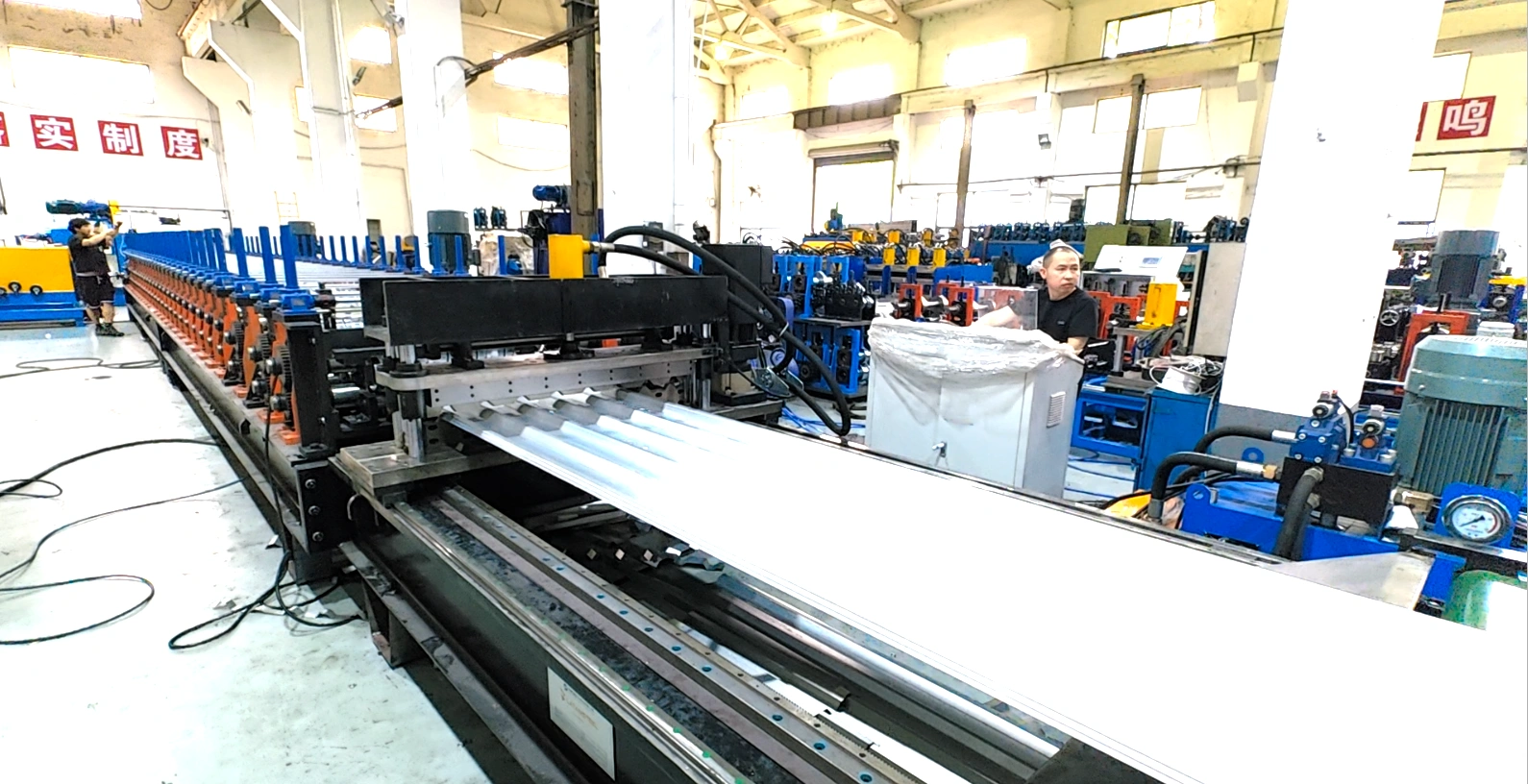
Trapezoidal Ribbed Spandeck Roof and Wall Cladding Roll Forming Machine

What a Roofing Sheet Roll Forming Machine Does

Six modules make up a roofing sheet roll forming machine. Coil enters at one end, finished sheets leave at the other, and nothing is manual once the line is set.
  1. Decoiler, 5 t as standard, holds the coil and pays it out under back tension.
  2. Feeding and guiding, a pair of adjustable side rolls that keep the strip on centre.
  3. Forming stations, the roll stands that bend the strip into the profile step by step.
  4. Punching or embossing, only on tile profiles that need the tile step or a shadow line.
  5. Cutting, a shear or saw that cuts the moving strip to the ordered length.
  6. Runout table or stacker, which catches the sheet without marking the coating.
Cutting is where roofing sheet roll forming machine builds differ most. A post cut shear rides the strip and cuts on the fly, so the mill never stops between sheets. That is what keeps a 15 m/min line at 15 m/min. A stop and cut saw costs less and handles thicker material, but each sheet costs a stop and a restart, roughly one second per cut at 3.6 m lengths.
Roofing Sheet Roll Forming Process

Six Profile Families, One Frame Design

A roofing sheet roll forming machine is a frame, a drive, and a set of rolls. The frame and drive repeat across the whole family. The rolls and the side guides do not. That is why one workshop can serve several markets with the same base machine and different tooling.
Profile familyCover widthRib or pitchWhere it sells
Corrugated, round wave762 mm or 1000 mm76.2 mm pitch, 18 mm depthAfrica, Middle East, general export
IBR, inverted box rib686 mm or 890 mm38 mm rib heightSouthern Africa
Trapezoidal or spandeck840 mm or 1000 mm35 mm rib, 200 mm pitchEurope, GCC, Australia
Box profile1000 mm32 mm rib, flat panUK, Ireland
Standing seam300 to 500 mm25 to 65 mm seamCommercial, low slope roofs
Tile and step tile1000 to 1200 mm moduleTile pitch plus stepResidential, retrofit markets
A roofing sheet roll forming machine ordered for export usually ships with one of the first three families. Corrugated is the cheapest roll set and the most forgiving on coil width. IBR wins where the buyer works to a national sheet standard. Trapezoidal carries the widest span between purlins, which is why it dominates industrial sheds.

Technical Specification

These are the numbers on our standard single layer roofing sheet roll forming machine. Thickness and coil width move the shaft, the motor, and the stand count, so treat the top of each range as a different machine.
ParameterStandard buildEffect on the line
Coil width600 to 1250 mmRoll face width and guide travel
Material thickness0.2 to 0.8 mmRoll gap, motor size, cut force
Yield strength235 to 550 MPaStand count and shaft stiffness
Forming stands16 to 26Surface finish and rib accuracy
Shaft diameter76 mm, ASTM 1045Deflection at full width
Roller materialASTM 1045, chrome 0.05 mmCoating wear on painted coil
Main motor7.5 kWSpeed at maximum thickness
Hydraulic station4 kWCut cycle and decoiler options
Running speed8 to 15 m/minOutput per shift
ControlPanasonic PLC, encoder lengthLength tolerance and batch count
Length toleranceplus or minus 1.5 mmSite fit and waste
Power supply380 V, 50 Hz, 3 phaseGenerator sizing on site
Above 0.8 mm at 1250 mm width, ask for the 90 mm shaft and an 11 kW motor. The frame and the cutter have to grow with it. Building a 1.2 mm roofing sheet roll forming machine on a 0.5 mm frame is the single most common specification mistake we see in incoming drawings.

From Coil Width to Cover Width

On a roofing sheet roll forming machine, cover width is always smaller than coil width. The gap is the steel consumed by the ribs plus the edge trim, and the roll set fixes it. An operator cannot change it by adjusting a guide.
Coil widthCover widthSteel taken by ribs and trimProfile
1250 mm1000 mm250 mm, 20.0 percentTrapezoidal TR35
1000 mm840 mm160 mm, 16.0 percentTrapezoidal narrow
940 mm890 mm50 mm, 5.3 percentIBR 890
762 mm686 mm76 mm, 10.0 percentIBR 686
914 mm762 mm152 mm, 16.6 percentCorrugated 3 inch
1250 mm1050 mm200 mm, 16.0 percentWidespan
Quote in cover width, buy coil in feed width. A roofer prices per square metre of finished roof, so the number that reaches the customer is always cover. The percentage column is the real cost lever. Run the same tonnage through a profile with 20 percent trim and you sell 20 percent less roof from the same coil.

Speed, Output and Shift Maths

Speed on a roofing sheet roll forming machine datasheet is mill speed with no interruptions. Real output is lower, and the gap between the two is where most business plans fail.
BuildStandsMill speedSheets per 8 hour shift at 3.6 m
Standard single layer16 to 208 to 15 m/min750 to 1,400
High speed servo20 to 2625 to 30 m/min1,900 to 2,800
Double layer16 plus 168 to 12 m/min700 to 1,100
Tile with step press18 to 223 to 6 m/min250 to 500
The maths is simple. At 12 m/min a 3.6 m sheet takes 18 seconds, so a roofing sheet roll forming machine makes about 200 sheets an hour with no stops. A shift is eight hours, but coil changes, packing, and operator breaks take 25 to 35 percent. Plan on 70 percent of the theoretical number and you will not be disappointed.
Mill speed is rarely the bottleneck on a roofing sheet roll forming machine. A 5 t coil at 0.5 mm and 1250 mm width runs about 1,000 m, which is roughly 280 sheets. That is one coil change every 85 minutes at full speed, and each change costs 8 to 12 minutes with a hydraulic decoiler. Buy the 10 t decoiler before you buy the faster mill.
high speed roof panel roll forming machine

Wall Panel or Guide Pillar

Two side structures appear on every roofing sheet roll forming machine. Both hold the sliding blocks that carry the shaft ends. The difference is how the load travels.
A wall panel is a full steel plate on each side, bored for every stand. It is stiff, it is simple, and it stays square after a decade in a hot workshop. A guide pillar uses separate pillars per stand. It looks lighter and gives better access to the rolls for cleaning.
Our view is blunt. For 0.2 to 0.8 mm roofing work at 1250 mm width, a welded steel plate frame is stronger than a pillar frame at the same price, and most Chinese factories already build it that way. Choose pillars when service access matters more than stiffness, which happens on cassette and double layer lines where rolls are changed often.
Double Layer Roofing Roll Forming Machine

Options That Change the Price

Six of these ship on every roofing sheet roll forming machine we build. The rest are quoted per project, and each one moves the delivered price by a known order of magnitude.
ItemCommon we useOptional
Decoiler5 t manual5 t or 10 t hydraulic
Side structureWall panel typeGuide pillar type
Roller material45# steel, chrome platedGCr15 bearing steel
Product handlingUnpowered runout tableAuto stacker
BearingsHRBSKF, FAG, NSK
Electric partsDomestic brandSiemens, Panasonic, Mitsubishi
CuttingPost cut shearFly saw for heavy gauge
ControlPush button plus counterTouch screen, batch memory, remote support
Two roofing sheet roll forming machine options pay for themselves fastest. A hydraulic decoiler removes the manual coil load and the 10 minute changeover that comes with it. An auto stacker protects the paint film on the last sheet of every stack, which is the sheet the customer inspects.

How to Specify the Line

Send four things and the roofing sheet roll forming machine quotation stops being a guess.
  1. A section drawing of the sheet with rib height, pitch, and cover width. A photo is not enough, because 20 mm of rib difference changes every roll.
  2. Coil width and thickness range, with the steel grade and coating. Galvanized, prepainted, and Galvalume form differently at the same thickness.
  3. Required output per shift and the sheet length you sell most. Both decide the cut type and the runout length.
  4. Site power. A 380 V supply and a generator with a soft start are different machines.
From that, we build the roll set in Copra, simulate the flower pattern, and confirm the stand count before any steel is cut. If your profile is not in our library, the customized profiles page lists what the drawing has to contain. The metal sheet machine brochure has the full catalogue of frames and options.
For panel lines that feed a bigger plant, the same drawing also sets how the double layer and ridge cap machines are matched to it, so the roof and its trims come off one set of tooling.
We have built roofing sheet roll forming machines since 2005, with 80+ engineers and technicians and 500+ machines across 50+ countries, under ISO 9001 and CE. Roof profiles built to a national standard are checked against that standard before shipment. For the US and Canadian market, the Metal Building Manufacturers Association publishes the panel and load tables your customers will quote back at you. Coil suppliers and roofers work to NRCA detailing practice, and the American Galvanizers Association covers the zinc coating side of the specification.

Frequently Asked Questions of Roofing Sheet Roll Forming Machine

Q: What is the standard specification of a roofing sheet roll forming machine?

A: 600 to 1250 mm coil, 0.2 to 0.8 mm thickness, 16 to 26 stands, 76 mm shaft, 7.5 kW main motor, 4 kW hydraulic station, and a 5 t decoiler. That build runs 8 to 15 m/min with a length tolerance of plus or minus 1.5 mm.

Q: Can one machine run several roofing profiles?

A: Not with one roll set on a single roofing sheet roll forming machine. Rib height, pitch, and cover width live in the rolls, so a new section needs new rolls or a cassette. Changing coil width alone needs no new tooling, just a side guide adjustment.

Q: How many sheets can it produce per shift?

A: A standard single layer roofing sheet roll forming machine at 12 m/min makes about 1,400 sheets of 3.6 m in eight hours at 70 percent efficiency. High speed servo lines reach 2,000 or more, but a 5 t coil change every 85 minutes caps the real number.

Q: What steel thickness and strength can the line form?

A: 0.2 to 0.8 mm at 235 to 550 MPa on the standard frame. Roofing normally runs 0.45 to 0.55 mm galvanized or prepainted. Above 0.8 mm at full 1250 mm width, ask for the 90 mm shaft and the 11 kW motor.

Q: How much coil width do I lose to cover width?

A: Between 5 and 20 percent depending on the profile. Ask the seller of any roofing sheet roll forming machine for that percentage before comparing prices. IBR 890 loses 5.3 percent, corrugated 3 inch loses 16.6 percent, and trapezoidal TR35 loses 20 percent. That percentage is the fastest way to compare two profiles on cost per square metre.

Q: Wall panel or guide pillar, which should I choose?

A: Wall panel for a roofing sheet roll forming machine forming 0.2 to 0.8 mm at 1250 mm width. It is stiffer and holds square longer. Guide pillar makes sense on cassette and double layer lines where rolls come out often and access matters more than rigidity.

Q: Is a double layer machine better than two single lines?

A: It depends on floor space. One frame runs IBR and corrugated from one decoiler and one control cabinet, which halves the footprint and the operator count. Two single lines cost more but let you run both profiles at the same time.

Q: What is the lead time and what happens on site?

A: 45 to 60 days after drawing approval, with two to three weeks added for cassette tooling. Commissioning and operator training take 7 to 10 days with our engineer on site, including the first coil run and the length calibration.
Last updated: 2026-11-01
Article Changelog
2026-11-01: Full rewrite of page 593. Replaced the 2018 copy, added the six profile families with cover widths, coil to cover conversion, shift output maths, a 12 row specification table, four body images, profile pages and authority links, and eight FAQ entries.
Next Review Triggers
National roof sheet standard revision in a major export market
Coil price movement above 15 percent
New cassette or double layer tooling released

Quick Inquiry

Send us your requirement — we'll reply within 24 hours.

Click or drag files here
PDF, DWG, DXF, STEP, PNG, JPG — Max 20MB

Inquiry Sent Successfully!

Thank you for your interest in Believe Industry.
Our engineering team will get back to you within 24 hours.

Need urgent response? Email enquiry@believeindustry.com

Table of Contents

Latest Posts Believe Industry

Buying Guider & Machinery Technology & Maintainence Tips