Address
No 1, Yd Road, Huishan District, Wuxi City, Jiangsu. 214183
Work Hours
Monday to Friday: 9AM - 5PM
Saturday: 9AM - 4PM
Address
No 1, Yd Road, Huishan District, Wuxi City, Jiangsu. 214183
Work Hours
Monday to Friday: 9AM - 5PM
Saturday: 9AM - 4PM
A metal sheet roll forming machine turns coated steel or aluminium coil into roof and wall panels in one pass. Coil goes in at one end, a finished panel is cut and stacked at the other, with rib height and cover width set from the drawing.
Building lines since 2005. 500+ machines in 50+ countries. ISO 9001 certified, CE compliant.
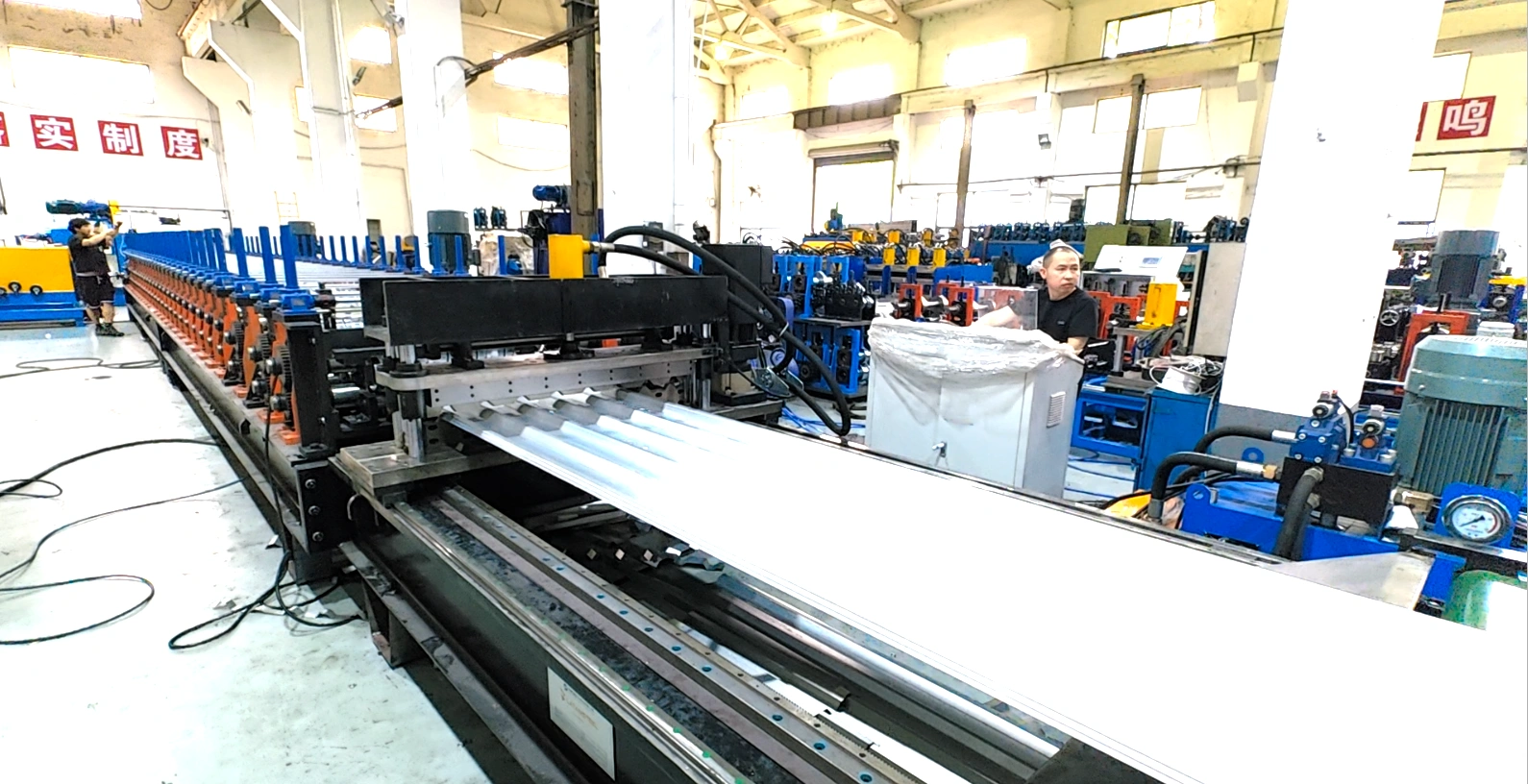
Every metal sheet roll forming machine runs the same five steps. What changes is coil width, station count and how much runs without an operator.
Manual or hydraulic mandrel takes 5 to 10 t coils. A coil car loads without crane time.
The leveler removes coil set, then a servo feeder sets the length of each panel.
Fastener holes and end notches are punched inline, with scrap dropping clear.
12 to 26 driven stations form the ribs in steps. Station count follows rib height and thickness.
A shear or flying saw cuts to length. Panels leave on a runout table or an automatic stacker.
The panel drawing starts every quote for a metal sheet roll forming machine. Cover width, rib height and fixing detail decide the roll set.
Trapezoid ribs 12 to 32 mm high. The default roof and wall panel on industrial buildings, at 686 to 1,000 mm cover.
A round wave with no sharp corner. Cheap to run, common in Africa and South America, at 762, 840 or 900 mm cover.
Concealed fixing under a raised seam that is crimped or snapped shut. Used where a low pitch has to stay watertight.
Step tile, glazed tile and Monterey press a tile look into steel. The roof reads as clay from the street at a fraction of the weight.
Each page covers one panel family with its drawing, station count and output. All six share one frame, drive and control platform.

Inverted box rib at 686 mm cover. The default roof and wall sheet for steel buildings in Africa and the Middle East.
View IBR line →
Round wave at 762, 840 or 900 mm cover. Often run as a double layer mill with a trapezoidal profile above.
View corrugated line →
Concealed clip fixing at 406 mm cover. No fastener through the sheet, so the roof stays tight down to 2 degrees.
View Klip-Lok line →
Shallow rib cladding with a flat pan between ribs. Panels run 0.4 to 0.8 mm and stack flat for transport.
View wall panel line →
Pressed tile relief on 0.3 to 0.6 mm sheet. Villas, schools and small commercial roofs that have to read as tile.
View glazed tile line →
Square box ribs with a wide flat pan, the common UK and export profile. Long runs stay straight at a shallow rib.
View box profile line →Two more layouts sit outside this list. A double layer roll forming machine runs two profiles on one frame, and a Bemo sheet line covers the deep trapezoidal profiles of large span roofs.
Planning ranges for a metal sheet roll forming machine. The line is quoted from the panel drawing, then the steel grade and the output target.
| Coil width | 1,000, 1,220 or 1,250 mm as standard, up to 1,500 mm on request |
|---|---|
| Material thickness | 0.3 to 1.2 mm, 1.5 mm on a reinforced mill |
| Cover width | 686 to 1,000 mm, fixed by the profile drawing |
| Rib height | 12 to 32 mm on trapezoidal, 3 to 6 mm on corrugated |
| Forming stations | 12 to 26, driven through gearbox and chain |
| Line speed | 10 to 15 m/min with a hydraulic shear, 25 to 35 m/min with a flying shear |
| Cutoff | Hydraulic shear, flying shear or flying saw, tolerance plus or minus 1 mm |
| Control | PLC with HMI, inverter drive, length encoder and batch counter |
| Electrical supply | 380 V 50 Hz three phase, or 415 V, 440 V and 480 V for the destination |
Two quotes for the same panel can differ by a factor of three. These four choices explain the gap, and they are the ones to settle before a metal sheet roll forming machine is ordered.
Every extra station adds a stand, a pair of rolls and a motor. A 14 station mill costs far less than a 24 station tile mill.
A hydraulic shear is the cheapest cut. A flying shear adds cost and lets the line run two to three times faster.
Wider panels need a wider frame, longer shafts and a bigger decoiler. A 1,250 mm line is a heavier machine, not a stretched 1,000 mm one.
Servo feeding, an automatic stacker and a packing table add 15 to 30 percent and take two operators off the line.
Panel choice follows the building, not the machine. These four jobs cover most of the orders we quote, and each sets the rib and the coating.

Trapezoidal and IBR panels over steel purlins, usually 0.5 mm galvanized with a colour coat on the weather face.
Roof and wall panels for steel buildings →
Shallow rib panels clip over the girt line and hide the fixing. The same line runs the liner panel inside.
Wall cladding roll forming lines →
Wide low roofs with a light load. Panels are cut to the full slope, so the shed closes without an end lap.
Agricultural roll forming applications →
Cold store walls use a shallow box panel as the outer skin with foam behind it. Flat pans matter more than rib height.
Box profile line for cold storage →Panels are rolled to EN 10169 or ASTM A792 coating standards, and lines for the EU arrive with CE documentation under the EU CE marking rules. For the UK the same line is documented to UKCA through the GOV.UK UKCA guidance.
A metal sheet roll forming machine is only as good as its first coil. Each line is assembled, wired and run in our works with the customer's material, then measured against the drawing before packing.
Coil for a metal sheet roll forming machine is galvanized to EN 10346 or ASTM A653 and prepainted to EN 10169, in 0.3 to 1.2 mm. On a thin panel, thickness tolerance matters more than coating weight.
What buyers ask before a line is quoted, answered in plain terms.
A metal sheet roll forming machine is a continuous line that bends coated steel or aluminium coil into roof and wall panels. Coil is decoiled, leveled and fed through 12 to 26 driven stations, then cut to length by a shear or saw. Holes and notches are punched inline on the same pass.
Standard lines run 0.3 to 1.2 mm. Roof panels sit at 0.4 to 0.8 mm, wall panels 0.4 to 0.7 mm and tile profiles 0.3 to 0.6 mm. A metal sheet roll forming machine with 65 mm shafts reaches 1.5 mm, at a higher cost and a lower speed.
10 to 15 m/min with a hydraulic shear and 25 to 35 m/min with a flying shear. Panel length sets the real limit, because a flying saw needs a run-up and run-down for every cut.
A metal sheet roll forming machine needs 12 to 16 stations for shallow corrugated or wall panels, 18 to 20 for IBR and Klip-Lok, and 20 to 26 for a tile profile. Too few stations leaves spring back in the rib, and the panel will not nest on the roof.
Yes, two ways. A double layer machine puts one profile on the top frame and the other underneath, so the line switches by changing the feed direction. A single layer machine needs a second set of roll packs, and changeover takes two to four hours.
A metal sheet roll forming machine for one corrugated or wall panel profile starts near USD 25,000. An IBR or Klip-Lok line with a hydraulic shear lands at USD 35,000 to 60,000. A tile line with 24 stations, servo feeding and a stacker runs USD 70,000 to 120,000.
Build time is 30 to 60 days after the drawing and deposit. A single profile line loads into one 40 ft container, a double layer line into a 40 ft high cube. Sea freight adds 20 to 40 days.
Share the panel profile, thickness, cover width and output target. Engineering replies with a station plan, a cutoff recommendation and a metal sheet roll forming machine configuration that fits your roof.
Page updated October 2026.
 English English
 Español
 Português
 Русский
 العربية
 Bahasa Melayu
 Türkçe
 ไทย
 Bahasa Indonesia



