Address
No 1, Yd Road, Huishan District, Wuxi City, Jiangsu. 214183
Work Hours
Monday to Friday: 9AM - 5PM
Saturday: 9AM - 4PM

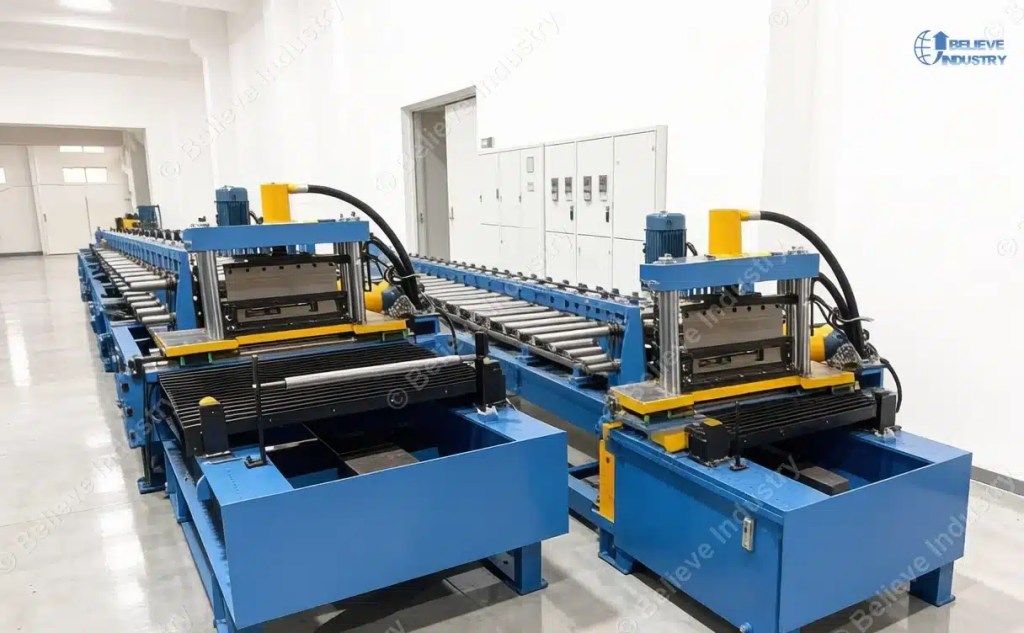
A wall cladding roll forming machine takes flat steel coil and turns it into finished wall panels in one continuous pass. The same basic process that makes roofing sheets also makes wall profiles. But wall cladding has its own set of rules.
Roof panels shed water. Wall panels shed water and they have to look good doing it. Nobody stares at your roof from 5 meters away. They do stare at your walls. That changes everything about profile design, coating selection, and production quality control.
Believe Industry has shipped wall cladding roll forming machines to over 20 countries. We have seen what works in humid tropical climates and what fails in salty coastal air. This guide breaks down the machines, profiles, and material choices for both interior and exterior wall cladding applications.
A wall cladding roll forming machine is a continuous sheet metal forming line that produces metal wall panels from galvanized steel, aluminum, or prepainted coil stock. The machine uncoils the raw material, feeds it through a series of roller stations that progressively shape the metal into the target wall profile, then cuts the finished panel to length with a flying cutoff shear.
These machines differ from roofing roll formers in three key ways. First, they prioritize surface finish because wall panels are highly visible. Second, they often handle wider profiles since wall panels can span 600 mm to 1,250 mm in coverage. Third, many wall cladding machines include embossing stations or texture rollers that add visual depth to the finished panel.
A standard wall cladding roll forming line includes a hydraulic decoiler, a leveling unit, the roll forming mill itself with 14 to 22 stands, an inline punching or embossing station, a hydraulic flying cutoff, and an automatic stacker. High-end lines add servo-driven feeding for tighter length tolerance and automatic wrapping systems for export packaging.
The same machine concept powers multiple product categories across the building envelope sector. If you already run a roofing sheet roll forming machine, you understand the core technology. Wall cladding simply shifts the design focus from water drainage to visual appeal and thermal performance.
Interior wall cladding serves a different purpose than exterior cladding. Inside a building, you are not fighting rain and wind. You are managing acoustics, fire ratings, cleaning requirements, and the look and feel of the space.
Modern open-plan offices use metal wall panels as demountable partitions. These panels snap into aluminum tracks and can be reconfigured when floor plans change. A dedicated metal wall panel roll former produces panels with flush joints and integrated cable management channels.
The panels typically use 0.5 mm to 0.7 mm galvanized steel with a polyester powder coat finish in RAL colors. Production speed runs 8 to 12 m/min since surface quality matters more than output rate. Believe Industry machines for this segment include automatic film applicators that protect the painted surface during handling and transport.
Cold storage facilities demand insulated metal panels with polyurethane or PIR foam cores. The wall cladding roll forming machine for this application pairs with a laminating line that injects foam between two metal skins. Panel thickness ranges from 50 mm to 200 mm depending on the required R-value. For operations that need both single-skin and insulated panel output, a double layer roll forming machine configuration can handle two different panel types without duplicating the entire line.
These panels lock together with tongue-and-groove joints and cam-lock fasteners. The machine must hold a profile tolerance of plus or minus 0.5 mm across the full panel width. Even a 1 mm deviation creates gaps that leak cold air and drive up energy costs.
Hospitals, pharmaceutical plants, and electronics cleanrooms need wall panels with absolutely smooth, non-porous surfaces. The profile is dead flat or has only micro-ribs to break up visual monotony. A wall cladding roll forming machine for this sector uses polished chrome-plated rollers to avoid transferring any surface imperfection to the finished panel. The same attention to surface finish applies to metal roof tile roll forming machines used for step-tile wall cladding profiles that mimic traditional clay or slate textures.
Stainless steel grade 304 or 316 is common here. The machine needs higher forming forces and hardened roller tooling. Believe Industry supplies GCr15 bearing steel rollers with hardness above HRC 60 for stainless steel wall panel lines.
Retail fit-outs use decorative metal wall panels with wood-grain prints, brushed metal textures, or perforated patterns. A corrugated sheet roll forming machine can also produce wall panels with wave profiles that add rhythm to a retail space.
These projects run on short production batches with frequent profile changes. A cassette-style quick-change roll set cuts changeover time from hours to under 15 minutes. The value is in flexibility, not raw output.
Exterior wall cladding is where the engineering gets real. UV exposure, thermal cycling, wind loads, and driven rain all attack the panel surface 24/7. The wall cladding roll forming machine has to produce profiles that hold up for 30 years or more. Every wall cladding roll forming machine shipped to coastal or desert climates needs roller tooling and drive systems built for the specific coating and substrate combination those environments demand.
Rainscreen cladding is the gold standard for commercial building envelopes. An outer metal skin deflects rain while an internal drainage cavity lets any moisture that gets through evaporate harmlessly. The system needs two things from the wall cladding roll forming machine: precise profile dimensions and consistent fastener hole placement.
Common rainscreen profiles include trapezoidal ribs at 200 mm to 333 mm spacing, flat lock panels with concealed clips, and cassette panels that hang like oversized tiles. The standing seam roll forming machine technology adapts well to vertical wall panel applications with its snap-lock or mechanical seaming joint designs.
Warehouses and factories use through-fastened wall panels, the same basic profile as roofing but oriented vertically. A PBR panel roll forming machine produces panels with 1.25-inch high ribs at 12-inch centers, suitable for both roof and wall applications. This dual-use flexibility makes PBR panels the most popular metal wall cladding profile in North America.
For the wall orientation, the machine runs standard 26-gauge or 24-gauge Galvalume coil. Panel lengths go from 8 feet to 40 feet. The big concern on wall panels is oil canning, that wavy distortion that shows up under certain lighting conditions. Believe Industry addresses this with tension-leveled coil feed and optimized roll pass design that minimizes residual stress in the formed panel.
Farm buildings and equipment sheds use the most basic wall cladding profiles: corrugated or 3-inch trapezoidal. The ag panel roll forming machine runs these profiles on the same line that produces agricultural roofing, with quick die changes to switch between roof and wall rib patterns.
Material choice is usually 29-gauge or 26-gauge galvanized steel. These are cost-sensitive applications. The machine has to run fast, 25 to 35 m/min, with minimal scrap. Believe Industry lines for this market use servo-driven cutoff systems that achieve plus or minus 1.5 mm length accuracy at full production speed.
High-end commercial buildings use custom wall cladding profiles as design statements. Perforated metal screens, curved panels, and three-dimensional folded profiles all fall into this category. The wall cladding roll forming machine for architectural work often integrates a CNC punching station before the forming section so each panel can have a unique perforation pattern.
Aluminum is the dominant material here, typically 0.7 mm to 1.2 mm thickness in alloy 3003 or 5052. Aluminum forms differently than steel. It work-hardens faster and springs back more after forming. Believe Industry adjusts roll pass angles and overbend compensation specifically for aluminum grades, a detail that separates purpose-built wall cladding machines from converted roofing lines.
| Factor | Interior Wall Cladding | Exterior Wall Cladding |
|---|---|---|
| Primary Concern | Aesthetics, acoustics, cleanability | Weather resistance, UV stability, thermal movement |
| Common Thickness | 0.4-0.7 mm steel, 0.5-1.0 mm aluminum | 0.5-1.2 mm steel, 0.7-1.5 mm aluminum |
| Coating | Polyester powder coat, PVC film laminate | PVDF (70% Kynar), SMP, weathering steel |
| Fastener Type | Concealed clips, adhesive, magnetic mounts | Exposed screws with EPDM washers, hidden clips |
| Profile Depth | 3-15 mm micro-rib or flat | 20-45 mm trapezoidal or standing seam |
| Insulation | Often none, acoustic backing optional | PIR/PUR/mineral wool core 50-200 mm |
| Fire Rating | Class A interior (ASTM E84) | Class A exterior (ASTM E108), NFPA 285 assembly |
| Machine Speed | 8-15 m/min (surface quality priority) | 15-35 m/min (throughput matters) |
| Material | Best For | Gauge Range | Coating Options | Relative Cost |
|---|---|---|---|---|
| Galvanized Steel (G90/G275) | Industrial, warehouse, agricultural | 29-22 ga (0.4-0.8 mm) | SMP, PVDF, acrylic | $ (lowest) |
| Galvalume (AZ50/AZ55) | Commercial, pre-engineered metal buildings | 26-22 ga (0.5-0.8 mm) | Clear coat, PVDF | $$ |
| Aluminum 3003/3105 | Architectural facades, coastal buildings | 0.7-1.5 mm | PVDF, anodized, powder coat | $$$ |
| Stainless Steel 304/316 | Cleanrooms, food processing, marine | 0.5-1.0 mm | Mill finish, brushed, embossed | $$$$ |
| Weathering Steel (Corten) | Architectural feature walls, landscape screens | 1.0-2.0 mm | Natural rust patina | $$$ |
| Prepainted Steel (SMP/PVDF) | Commercial, retail, institutional | 26-22 ga (0.5-0.8 mm) | Factory-applied Kynar 500, Hylar 5000 | $$ |
Coil width is the first thing to get right. Wall panels are wider than roof panels in many markets. A metal roof panel machine running 914 mm coil cannot simply stretch to 1,250 mm for wall cladding. The roll former shaft diameter, stand spacing, and cutoff stroke all scale with material width. Believe Industry sizes the wall cladding roll forming machine to the widest profile the customer plans to run, then adds 100 mm of future-proofing margin.
What separates a good wall cladding roll forming machine from one that fights you every shift? Five specs matter more than the brochure numbers.
Roller Material and Hardness. GCr15 bearing steel with HRC 58-62 is the industry standard. For stainless steel or high-volume aluminum, upgrade to Cr12MoV or D2 tool steel. Polished to Ra 0.2 micrometer or better for architectural surfaces.
Stand Count and Shaft Diameter. Wall profiles with deep ribs need more forming stations to avoid stretching or tearing the metal. Expect 16 to 22 stands for trapezoidal profiles, 12 to 16 for micro-rib or flat panels. Shaft diameter of 60 mm to 90 mm handles the forming loads.
Drive System. Chain drive works for profiles up to 0.6 mm steel. Gearbox drive is standard for 0.7 mm to 1.2 mm. Individual servo drives per stand are the premium option for quick-change cassette systems. A double layer roll forming machine shares one frame for two profiles, cutting floor space and capital cost.
Cutoff Accuracy. Hydraulic flying cutoff with PLC encoder feedback achieves plus or minus 1.5 mm. Servo-driven cutoff tightens that to plus or minus 0.5 mm. For rainscreen panels where every panel must align perfectly, the servo upgrade pays for itself in fewer rejected sheets.
Line Speed. Interior panels run 8 to 15 m/min. Exterior industrial panels run 20 to 35 m/min. Export-oriented factories with high labor costs push for 30 m/min or faster with automatic stackers. Believe Industry configures the motor and gearbox ratios to match the target throughput, not just the peak speed on a spec sheet.
Wall cladding standards vary by region. A machine built for one market does not automatically meet the requirements of another.
North America. 36-inch (914 mm) coil width with 32-inch net coverage is standard for through-fastened wall panels. ASTM A653 for galvanized substrate, ASTM A792 for Galvalume. IBC and UL 580 govern wind uplift. Visible wall panels often require Kynar 500 or Hylar 5000 PVDF coatings with a 30-year film integrity warranty. The Metal Construction Association publishes design guides for metal wall panel systems that are referenced by building codes across the United States.
Europe. Metric widths of 1,000 mm to 1,250 mm. EN 10346 for structural steel grades S250GD to S350GD. CE marking under EN 14782 is mandatory for self-supporting metal wall panels. Fire classification per EN 13501-1 drives material and coating selection in multi-story buildings. A wall cladding roll forming machine for the European market must include CE-compliant documentation and safety guarding per the Machinery Directive.
Middle East / GCC. Twin demands of extreme UV and sand abrasion. PVDF coatings with ceramic pigment are standard. SASO and ESMA certifications are required for government projects. Believe Industry pre-loads GCC-compliant documentation packages with every wall cladding roll forming machine shipment to the region.
Australia / New Zealand. COLORBOND steel dominates with zinc-aluminum-magnesium coatings. BCA Section J energy efficiency rules push insulated sandwich panels for commercial walls. Cyclonic wind regions (C3 and C4) require tested clip-based fastening systems that the wall cladding profile must be designed to accept.
A wall cladding roll forming machine is a capital investment that pays back through higher margin on finished panels versus buying coil and reselling it. Here is the math for a typical mid-range line producing 2,000 metric tons per year. For manufacturers comparing panel profiles, our R Panel vs AG Panel comparison breaks down the same cost logic for roofing and siding panels.
Raw coil cost runs $800 to $1,200 per ton depending on grade and coating. Finished wall panels sell at $1,800 to $2,800 per ton for standard profiles, more for architectural custom work. The conversion margin of $600 to $1,600 per ton covers machine amortization, labor, power, and facility overhead.
Believe Industry’s standard wall cladding roll forming line runs about $85,000 to $180,000 FOB depending on width, stand count, and automation level. At 2,000 tons annual output and $800 per ton average conversion margin, the machine pays back in 2 to 5 months of operation. Even at 1,000 tons per year, payback stays under 12 months.
The wildcard is profile changeover time. A machine that takes 4 hours to switch profiles bleeds production capacity. Cassette-type quick-change systems bring changeover under 20 minutes. That one feature can double the effective output of a line running 3 or more profiles per week.
Yes, if you spec the machine for it up front. A roll forming line with cassette-style quick-change roll sets can switch between wall and roof profiles in under 20 minutes. The frame, shaft diameter, and motor power must be sized for the wider, deeper profile you plan to run. Retrofitting a roofing-only machine to run wall panels rarely works well because the shaft length and stand spacing are usually insufficient for wider wall profiles.
Through-fastened panels have exposed screw heads visible on the face. Concealed-fastener systems use hidden clips or interlocking joints so no fasteners show. Concealed-fastener panels cost more to produce because they need tighter tolerances and extra forming stations, but they are the standard for architectural and commercial projects where appearance matters.
The 3-inch trapezoidal through-fastened panel. It is simple to produce, uses standard 26-gauge coil, works on walls and roofs, and sells into every market from agriculture to light industrial. Start with this profile, make money, then add architectural profiles once you have cash flow and market knowledge.
Oil canning is caused by residual stress in the formed panel. Four things help: use tension-leveled coil stock, not just leveled; run the correct roll pass design with proper overbend compensation; keep roller surfaces polished and free of wear grooves; and specify a minimum rib depth of 20 mm or more on wide flat panels. Believe Industry uses finite element analysis to optimize roll pass sequences that minimize locked-in forming stress.
PVDF (polyvinylidene fluoride) coatings, sold under brand names like Kynar 500 and Hylar 5000, last 30 to 40 years on vertical wall surfaces. They resist chalking, fading, and chemical attack far better than SMP or polyester. For coastal or industrial environments, specify a 4-coat PVDF system with a corrosion-resistant primer. A wall cladding roll forming machine that runs PVDF-coated coil needs extra care on roller entry guides to avoid scratching the coating before the panel is fully formed.
Yes, but the roll tooling needs adjustment. Aluminum has higher springback than steel, so the roll pass angles and overbend need recalibration. The rollers themselves can be the same GCr15 steel as long as the aluminum surface is not critical. For architectural aluminum with a Class 1 anodized finish, use chrome-plated or polished stainless steel rollers to avoid surface marking.
Standard machines ship in 60 to 90 days. Custom profiles with bespoke roll tooling add 30 to 45 days for roll design and manufacturing. Believe Industry keeps common profile tooling in stock for PBR, trapezoidal, and corrugated wall panels, which can ship in 30 days.
Completely different. Sandwich panel lines integrate two roll forming machines, one for each metal skin, with a polyurethane or PIR foam injection system between them. The line is 10x longer than a single-skin line and costs 5x to 10x more. It is a separate business decision, not an add-on to a standard wall cladding roll former.
Wall cladding roll forming machines are not just roofing machines turned sideways. Interior and exterior applications demand different profiles, coatings, tolerances, and production speeds. The machine that makes warehouse siding at 35 m/min will not produce cleanroom wall panels to architectural standards. Pick your market first, then spec the machine to match.
Believe Industry has designed and shipped wall cladding roll forming lines for over 15 years, covering everything from basic corrugated wall panels to PVDF-coated rainscreen facades. Our engineering team designs roll passes specific to your target profile, not a generic approximation. If you are evaluating a wall cladding machine purchase, bring us your panel
Last Updated: July 29, 2026
Article Changelog:
– v1.0 (July 29, 2026): Initial publication. Covers interior and exterior wall cladding applications, material comparison table, regional standards, and production economics.
Next Review Triggers:
Introduction A wall cladding roll forming machine takes flat steel...
Read MoreRetail is shelf space. Every supermarket aisle, every department store...
Read MoreIntroduction The global cold chain market is on fire. Valued...
Read MoreIntroduction Interior partition walls used to mean wood studs, sawdust,...
Read MoreSubscribe now to keep reading and get access to the full archive.