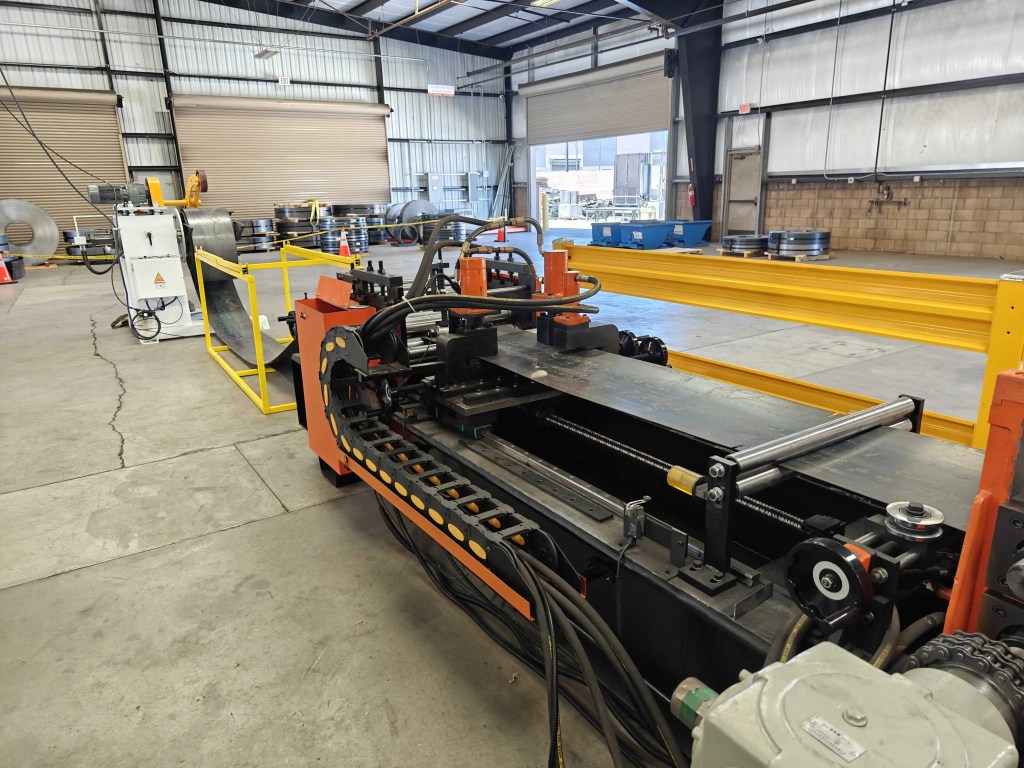
Heavy duty step beam roll forming line with coil, forming stands and run out table

Heavy Duty Step Beam Roll Forming: 6 Rules for Thick Coil

Need a Roll Forming Machine for Your Project?
Get a free quote from Believe Industry — 15+ years of custom roll forming manufacturing.
Request a Quote Download Catalogue

Heavy Duty Step Beam Roll Forming: Thick Coil and High-Strength Steel

Short answer: Heavy duty step beam roll forming starts at 3.0 mm strip and runs to 5.0 mm, with 6.0 mm on request. Moving up from a standard line is not a motor upgrade. Shaft diameter, roll diameter, stand count, punch tonnage and cut-off type all change together, and line speed roughly halves.

A 2.5 mm step beam line and a 5.0 mm step beam line can be quoted at similar machine length. Run thick coil through the light one and the gap shows in the first bundle: bowed webs, torn hole edges, and shafts that deflect under load.

This guide covers what changes when heavy duty step beam roll forming moves into the 3.0 to 5.0 mm band, and which of those changes belong in the purchase order.

What Heavy Duty Step Beam Roll Forming Covers

In heavy duty step beam roll forming, duty is a thickness and depth pair, not a marketing label. Published rack load tables separate the bands below, and the machine follows the band rather than the other way round.

ClassStrip thicknessBeam depthLoad per beam pairTypical system
Light1.5 to 2.0 mm80 to 120 mm1,000 to 1,500 kgSelective racking, retail
Standard2.0 to 3.0 mm100 to 160 mm1,500 to 2,500 kgDistribution centre
Heavy duty3.0 to 5.0 mm140 to 200 mm2,500 to 4,500 kgDrive-in, double deep, high bay
Extra heavy5.0 to 6.0 mm180 to 250 mm4,500 kg and aboveMezzanine, crane access, export racking

Two consequences follow for heavy duty step beam work. Above 4.0 mm the beam usually takes a welded end plate instead of a notched connector, because the notch removes too much of the load path. And the coil grade stops being a purchasing detail, since a 4.0 mm section in the wrong grade will crack at the step radius no matter how the rolls are set.

Finished heavy duty step beams stacked on the run out table of a roll forming line

Where Thick Coil Breaks a Standard Line

Bending force scales with thickness squared at a fixed bend radius. That is why heavy duty step beam roll forming jumps so hard from 2.5 mm to 5.0 mm: four times the force, same bend radius.

Roll shafts carry that force across a fixed span, and deflection falls with the fourth power of diameter. A shaft holding 0.10 mm of deflection at 2.5 mm strip needs about 1.4 times the diameter at 5.0 mm, which in practice turns an 80 mm shaft into 110 or 120 mm. Frame, bearing housing, and gearbox grow with it.

Item1.5 to 2.5 mm line3.0 to 5.0 mm line
Shaft diameter65 to 80 mm95 to 120 mm
Roll outside diameter180 to 220 mm260 to 340 mm
Forming stands20 to 2628 to 34
Drive per stand group5.5 to 7.5 kW11 to 18.5 kW
Line speed18 to 25 m/min8 to 15 m/min
Punch capacity40 to 60 t120 to 200 t
Cut-offFlying shearFlying saw
Decoiler5 to 10 t10 to 15 t

Speed is the number buyers notice first. A heavy duty step beam roll forming line runs at roughly half the strip speed of a light line, and no amount of motor power closes that gap, because the limit is metal flow at the bend, not torque.

Steel Grade: Q345, S355MC, and Why G550 Stops at 1.2 mm

The G550 question comes up on nearly every heavy duty step beam enquiry, and the answer is short. G550 coil is supplied thin. BlueScope quotes 0.45 to 1.2 mm base metal thickness, AS 1397 sets minimum elongation at 2 percent, and the same standard permits forming only at a generous bend radius. There is no 4.0 mm G550 step beam because there is no 4.0 mm G550 coil.

GradeStandardYieldUsual thicknessNote for heavy beams
Q235BGB/T 700235 MPa1.5 to 4.0 mmCheapest option, needs paint or galvanizing
Q345BGB/T 1591345 MPa2.0 to 5.0 mmDefault grade on Chinese heavy beam lines
S355MCEN 10149-2355 MPa2.0 to 5.0 mmMost consistent springback, preferred for export racking
S420MCEN 10149-2420 MPa2.0 to 4.0 mmMore overbend and faster roll wear
G550AS 1397 / S550GD550 MPa0.4 to 1.2 mmNot available thick, 2 percent elongation

For heavy duty step beam work at 3.0 to 5.0 mm, the practical choice sits between Q345B and S355MC. Both hold 15 to 22 percent elongation, which is what a step radius of 1.5 times thickness needs. S355MC costs more per tonne and returns it in repeatability, because a mill certificate with a narrow yield band means the overbend setting stays valid from coil to coil. That matters when a line runs the same beam for months.

S420MC is worth it above 200 mm depth where the load table is tight. Expect 20 to 30 percent more forming force and a shorter roll life.

Punching 3 to 6 mm Strip

Holes still go in before forming on any heavy duty step beam line, for the reason covered in our step beam production process guide: flat strip sits on a solid die and the hole edge stays clean. What changes is tonnage.

Hole diameter3.0 mm4.0 mm5.0 mm6.0 mm
14 mm18 t24 t30 t36 t
18 mm23 t31 t39 t46 t
22 mm28 t38 t47 t57 t

Size the press for the largest hole in the mix, then add 25 to 30 percent. A press working at its rated tonnage deflects, the die wears unevenly, and slug pull starts long before anything looks broken.

Die clearance runs 8 to 12 percent of thickness per side, so 3.0 mm strip wants 0.25 to 0.35 mm and 6.0 mm strip wants 0.50 to 0.70 mm. Tight clearance raises punch wear on high strength steel. Loose clearance produces a torn edge that a connector pin will not seat against.

Alignment checks that keep a die alive are the same at any thickness, and our punching die installation guide lists the sequence.

Servo feeder and hydraulic punch press punching flat strip on a heavy duty step beam line

Forming Strategy: Stations, Overbend and Edge Cracking

A heavy duty step beam roll forming line needs 28 to 34 stands. The extra stands over a standard line are not for the profile, they are for load distribution. Ten or eleven break the flange and lip at 15 to 20 degrees per pass, fourteen bring the section to shape, and four to six sizing stands correct what the earlier passes left.

Springback is where most heavy duty step beam first runs fail. S355 springs back 40 to 60 percent more than Q235 at the same radius, so the final passes overbend two to four degrees past 90 and let the steel recover into square. A line tuned on Q235 will run every S355 beam with flanges sitting open.

Minimum inside radius drives cracking. At 4.0 mm strip, 1.5 times thickness means a 6 mm inside radius. A drawing that calls for 4 mm cracks the outer fibre on the first pass, and no lubricant fixes it. Change the drawing or change the grade.

Rolls for heavy duty step beam tooling run GCr15 at HRC 58 to 62, with chrome or hard-chrome finish on the last sizing stands to stop marking. Surface pressure on 5.0 mm coil is roughly double the light-line figure, so roll marks appear where a lighter line would run clean.

Cut-Off, Tolerance and Coil Logistics

A 5.0 mm section cannot be sheared cleanly on a light frame. Shear force for a 300 mm wide strip at 5.0 mm and 450 MPa runs near 675 kN, which is 67 t at the blade.

Heavy duty step beam lines cut with a flying saw: carbide blade, 8 to 15 m/min, burr under 0.1 mm, cut length held to plus or minus 1.5 mm. A shear still works below 4.0 mm, and the step beam vs box beam comparison covers where each section type lands.

Coil logistics decide the shift. A 12 t coil of 300 mm by 5.0 mm strip holds about 1,019 m, which is 85 minutes of running at 12 m/min. The same coil in 3.0 mm holds 1,697 m and runs 141 minutes. In heavy duty step beam roll forming, a 15 t decoiler with a coil car is not a luxury, it is the difference between three and five coil changes per shift.

Output in heavy duty step beam roll forming follows the same arithmetic. A 6 m beam needs 30 seconds of forming at 12 m/min, plus punch and cut time, so a well-run heavy line turns out 80 to 110 beams per 8 hour shift. The stacker usually sets that number, not the mill.

Hydraulic cut off unit and run out table cutting a formed step beam profile

What to Put in the Enquiry

Five numbers separate a heavy duty step beam quotation from a guess:

  • Thickness range and the grade you actually buy, with the mill certificate yield band
  • Beam depth range, since each depth needs its own tooling set
  • Connector type or end plate drawing, because it sets notch geometry
  • Annual metres, which decides cut-off type and payback
  • Coil weight and inner diameter available from your supplier

A heavy duty step beam line typically prices 30 to 50 percent above a standard line of the same depth range. The difference sits in shafts, rolls, drive power, punch tonnage and saw, not in the control system. Standards behind the load tables are published by the Rack Manufacturers Institute, and galvanized beam coating rules by the American Galvanizers Association. HSLA grades for cold forming are specified in EN 10149-2, summarized by SteelConstruction.info.

Believe Industry has built custom roll forming lines since 2005, with 15+ years of experience, 80+ engineers and 500+ projects in 50+ countries under ISO 9001 and CE.

We size shafts, stands, punch tonnage and cut-off against your beam range.

A step beam machine from our works matches the section you sell. For a full four machine racking setup, see the pallet racking roll forming machine overview, and for depth changes on one line, the multi profile line guide. Upright columns that pair with these beams are covered under upright rack roll forming.

Frequently Asked Questions

Q: What thickness counts as a heavy duty step beam?

Heavy duty step beam roll forming starts at 3.0 mm and runs to 5.0 mm, with 6.0 mm built to order. Below 3.0 mm the beam belongs to the standard band, where a lighter line with 20 to 26 stands holds tolerance at twice the speed.

Q: Can a standard step beam line run 4.0 mm coil?

It can be forced through once. Shafts deflect, the last sizing stands cannot correct the section, and hole position drifts as the frame flexes. A line rated to 2.5 mm will not hold plus or minus 0.5 mm hole pitch at 4.0 mm, whatever the motor rating says.

Q: Why not use G550 for a heavy beam?

G550 coil is supplied at 0.45 to 1.2 mm with 2 percent minimum elongation. Heavy beams need 3.0 mm and above, so the material does not exist in that thickness, and the ductility would crack at a step radius if it did.

Q: How many forming stands does a heavy duty line need?

28 to 34. Ten or eleven pre-bend the flange, fourteen form the section, and four to six size it. Under 26 stands there is no room to overbend for springback and still recover the angle in the sizing passes.

Q: How fast does heavy duty step beam roll forming run?

Heavy duty step beam roll forming runs 8 to 15 m/min, against 18 to 25 m/min on a light line. A 12 t coil of 300 by 5.0 mm strip gives 85 minutes of run time at 12 m/min, so coil changes set the shift rhythm more than line speed does.

Q: What causes bow in a thick beam?

Three sources, in order of frequency. Coil camber that the straightener did not remove, unequal roll gap between left and right, and residual stress released when the beam is cut. Check camber on the first 3 m of every new coil before adjusting any roll.

Last updated: 2026-11-04

Article Changelog

2026-11-04: Initial publication.

Next Review Triggers

A buyer requests 6.0 mm coil or G550 above 1.2 mm; RMI revises beam capacity tables; HSLA coil prices shift the grade choice between Q345B and S355MC.

Table of Contents

New Updates