Address
No 1, Yd Road, Huishan District, Wuxi City, Jiangsu. 214183
Work Hours
Monday to Friday: 9AM - 5PM
Saturday: 9AM - 4PM
Short answer: Signage roll forming turns 0.8 to 3.4 mm galvanized or prepainted strip into U-channel posts, billboard stringers and cabinet frames at 20 to 55 m/min. The part that wins the order is rarely the profile. It is the 3/8 inch hole on 1 inch centres, and whether a 12 ft post stands straight.
A 14 by 48 ft billboard face carries 12 panels of 4 ft, and all of them hang on four steel stringers bolted to uprights. Those stringers, the corrugated skirt below them and the posts holding every roadside sign are what signage roll forming can make. The monopole and the hot rolled I-beams behind it are not.
A machine sold as a billboard line is usually a post and stringer line with a punching press attached. Expecting it to produce the torsion bar is a specification error that surfaces at commissioning.
Six profile families carry most of the volume in signage roll forming. They differ far more in strip width and thickness than in pass design.
| Profile | Coil width | Thickness | Stands | Line speed |
|---|---|---|---|---|
| U-channel sign post | 100 to 160 mm | 1.9 to 3.4 mm | 14 to 18 | 30 to 55 m/min |
| Square sign post | 145 to 320 mm | 1.5 to 3.0 mm | 16 to 22 | 20 to 40 m/min |
| Billboard stringer angle | 120 to 250 mm | 3.0 to 6.0 mm | 12 to 16 | 15 to 25 m/min |
| Sign cabinet frame | 60 to 140 mm | 0.8 to 2.0 mm | 16 to 22 | 20 to 35 m/min |
| Corrugated skirt | 300 to 1,000 mm | 0.4 to 0.8 mm | 12 to 18 | 25 to 40 m/min |
| Pylon cladding and trim | 100 to 300 mm | 0.8 to 1.5 mm | 14 to 18 | 20 to 30 m/min |
One line almost never covers all six. Doubling thickness from 1.9 mm to 3.4 mm changes roll pressure, shaft diameter and motor size, so signage roll forming is normally split into a thin line for posts and frames and a heavy line for stringers.
A steel billboard is a stack of named parts. The column carries the load, the torsion bar resists twist, outriggers set the V, uprights hold the face, stringers carry the panels, and the skirt hides the torsion bar from the road.
Signage roll forming supplies the stringers, the skirt, the panel trim and the cabinet frame. The column, torsion bar and outriggers are tube and hot rolled I-beam, cut and welded, not formed from coil.
Stringers run as angle, 40 x 40 x 3 mm up to 50 x 50 x 4 mm, punched at fixed pitch so panel runs line up without site drilling. A kinked stringer telegraphs through the face, so straightness beats section accuracy here. The C bracing section line shows the same angle family formed with pre-punched connection holes.
The skirt is corrugated sheet at 0.4 to 0.8 mm on an 80 to 100 mm pitch, the cheapest part of the structure and the first to look tired. Cabinet frames behind a light box are the third billboard part, run in aluminium at 0.8 to 1.5 mm with a return near 0.1 mm, thin enough that the last two stands carry the tolerance.
Post weight per foot is the number buyers quote, and it maps to gauge, load and price. These three classes follow North American practice, where the 3/8 inch hole is standard.
| Class | Weight | Gauge | Post length | Where it is used |
|---|---|---|---|---|
| Light | 1.12 lb/ft | 14 ga (1.9 mm) | 6 to 8 ft | Parking, driveways, light advertising boards |
| Heavy | 2.00 lb/ft | 11 ga (3.0 mm) | 7 to 12 ft | Municipal streets, permanent signs |
| Extra heavy | 3.00 lb/ft | 10 ga (3.4 mm) | 7 to 12 ft | Highways, breakaway systems, high wind sites |
Signage roll forming holds the hole pattern at 3/8 inch on 1 inch centres, full length on the 2.0 and 3.0 lb/ft posts and stopping about 30 inches from the top on the 1.12 lb/ft post. Embedment runs 24 to 36 inches below grade, so a 12 ft post shows roughly 9 ft and sits at the height the traffic engineer drew.
Square posts run 1 inch to 2 1/2 inch, perforated on four sides, and most are electric resistance welded tube rather than roll formed. The guardrail post line shows the open post approach used on highway furniture, and the W beam barrier line covers heavier profiles on the same coil.
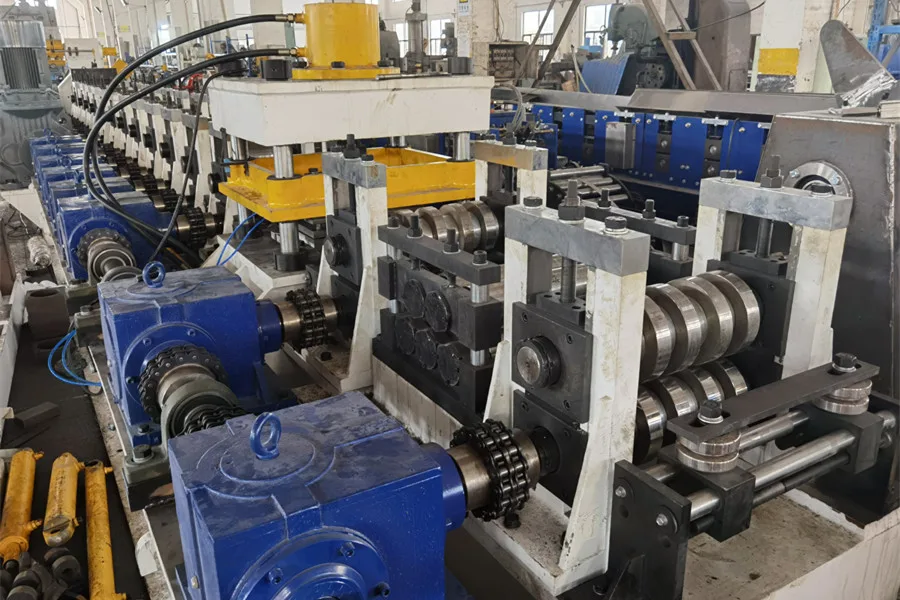
A signage roll forming line runs decoiler, leveler, servo feed with punch press, forming mill, flying shear, run out table and stacker. It lives or dies on the order of the first four.
The uncoiler and straightener feeder matters more here than on a roofing line. A post is judged by straightness over 3.6 m, and coil camber invisible on a 1 m sheet becomes a 4 mm bow on a 12 ft post.
Punching before the mill uses flat strip and simple dies, at the risk of distortion where a hole sits near a bend. Keep the hole edge 1.5 times the thickness from the bend line and it stays round enough to take a bolt. Punching after forming avoids that distortion and triples tooling cost per profile.
Long parts need a run out table and a stacker. The auto stacker on a 6 m line removes the manual catch that limits most post plants to 25 m/min in practice. Cutting is a flying shear on thin posts and a flying saw on stringers above 4 mm, and both are routine on signage roll forming equipment.
A 1 inch pitch is 25.4 mm, so at 40 m/min the strip passes 1,575 holes a minute, or 26 a second. No press running 300 strokes a minute can do that, so a production signage roll forming line uses gang dies.
| Line speed | Holes per minute | Holes per stroke at 300 spm |
|---|---|---|
| 20 m/min | 787 | 3 |
| 30 m/min | 1,181 | 4 |
| 40 m/min | 1,575 | 6 |
| 55 m/min | 2,165 | 8 |
This is the number to ask about in a quotation. A line quoted at 55 m/min with a single hole die runs at 12 m/min in production, and the mill capability is wasted. Lines that hold 40 m/min use a 6 hole gang die and a servo feed that corrects position every stroke, keeping hole position within plus or minus 0.3 mm along the length.
A 14 by 48 ft face is 62.8 square metres of solid area. At a 40 m/s design wind the free stream pressure is about 980 Pa, and a solid sign with a force coefficient of 1.8 sees roughly 1,760 Pa. Across that face the drag is 110 kN, or 11 tonnes.
That load travels through the stringers and uprights into the torsion bar and the column, which is why a stringer runs 3 to 6 mm and not 1.5 mm. Signage roll forming sets the section that carries it, and the structure around it follows local code.
In the United States the documents are the MUTCD for sign size and placement, AASHTO LTS for the support structure, ASCE 7 for wind, and NCHRP 350 or MASH for a post that must break away on impact. Material is ASTM A1011 Grade 50 sheet with ASTM A653 coating, galvanized to ASTM A123. In Europe the post is designed to EN 1991-1-4, executed to EN 1090-2 and specified against EN 12899 for fixed vertical road signs.
The advertising side has its own body. The Out of Home Advertising Association of America publishes the formats billboard faces are bought and sold against, and those formats decide panel width, which decides stringer spacing.
Signage roll forming usually runs galvanized coil specified by coating mass, Z275 up to Z600. Signage roll forming shears the strip, so every cut end and punched hole exposes bare steel, and on a post standing in wet ground that edge is where rust starts.
Batch hot dip galvanizing after fabrication covers the cut edges, at the cost of an extra handling step and a straightening pass on thin posts. Zinc rich paint on the cut ends is the cheap answer for inland sites. Powder coat looks best and traps moisture at a damaged edge if pretreatment is skipped.
In signage roll forming, prepainted coil suits cabinet frames and pylon cladding, where the part is visible and the edge sits inside a joint. It is wrong for a post driven into soil. The galvanizing reference covers coating thickness against service life, which is the argument to have with a buyer who wants a 25 year post at a 10 year price.
Five items decide a signage roll forming quotation, and missing one moves the price 20 percent or more.
Believe Industry has built custom roll forming lines since 2005, with 15+ years of experience, 80+ engineers and 500+ projects in 50+ countries under ISO 9001 and CE. We size signage roll forming lines against the hole pattern first, because that number sets the press, the feed and the real speed.
Both the punching die guide and the preventative maintenance routine cover what keeps hole position stable across a shift. The DIN rail line is a close comparison for small punched profiles.
Q: Can one signage roll forming line make both U-channel and square posts?
Q: What is the standard hole pattern on a sign post?
Q: How fast can a sign post line run?
Q: Why do posts come off the line bowed?
Q: Does signage roll forming produce the billboard column and torsion bar?
Q: Do punched holes deform when the post is formed?
Last updated: 2026-11-08
Article Changelog
2026-11-08: Initial publication, backfilled into the 2026-11-06 calendar slot.
Next Review Triggers
MUTCD or AASHTO LTS revises sign support requirements; a buyer asks for a post above 3.4 mm; zinc prices move galvanized coil enough to change the finish recommendation.
Billboard & Signage Roll Forming: Advertising Structure Profiles Short answer:...
Read MoreHeavy Duty Step Beam Roll Forming: Thick Coil and High-Strength...
Read MoreRolling Shutter Roll Forming: Shopfront to Warehouse Applications Short answer:...
Read MoreStep Beam Production Process: From Coil to Pallet Rack Beam...
Read More