Address
No 1, Yd Road, Huishan District, Wuxi City, Jiangsu. 214183
Work Hours
Monday to Friday: 9AM - 5PM
Saturday: 9AM - 4PM
Address
No 1, Yd Road, Huishan District, Wuxi City, Jiangsu. 214183
Work Hours
Monday to Friday: 9AM - 5PM
Saturday: 9AM - 4PM
Short answer: A B deck roll forming machine produces the 1.5 inch structural deck that US commercial roofs and composite floors are built on. It forms 36 inch panels from 22 to 16 gauge galvanised coil at 12 to 30 m/min, with a nesting sidelap that locks panel to panel on site.
A B deck roll forming machine is a dedicated line, not a converted roofing mill. Six wide ribs at 6 inch centres, a 1.5 inch rib depth, and geometry stiff enough to carry wet concrete between joists. Every module on the line follows from those numbers.
B deck is a wide rib structural panel. The rib is 1.5 inch deep, the pitch is 6 inch on centre, and six ribs give 36 inch of coverage. Top flange 3.5 inch, bottom flange 2.5 inch, which is why insulation boards sit flat instead of sagging between ribs.
| Profile property | B deck value |
|---|---|
| Rib depth | 1.5 inch (38 mm) |
| Coverage width | 36 inch (914 mm) |
| Rib count and pitch | 6 ribs at 6 inch centres |
| Top flange / bottom flange | 3.5 inch / 2.5 inch |
| End lap | 1.75 inch nesting sidelap |
| Coil gauges | 22, 20, 18 and 16 gauge |
| Steel grades | 33 to 80 ksi yield, G60 or G90 galvanised |
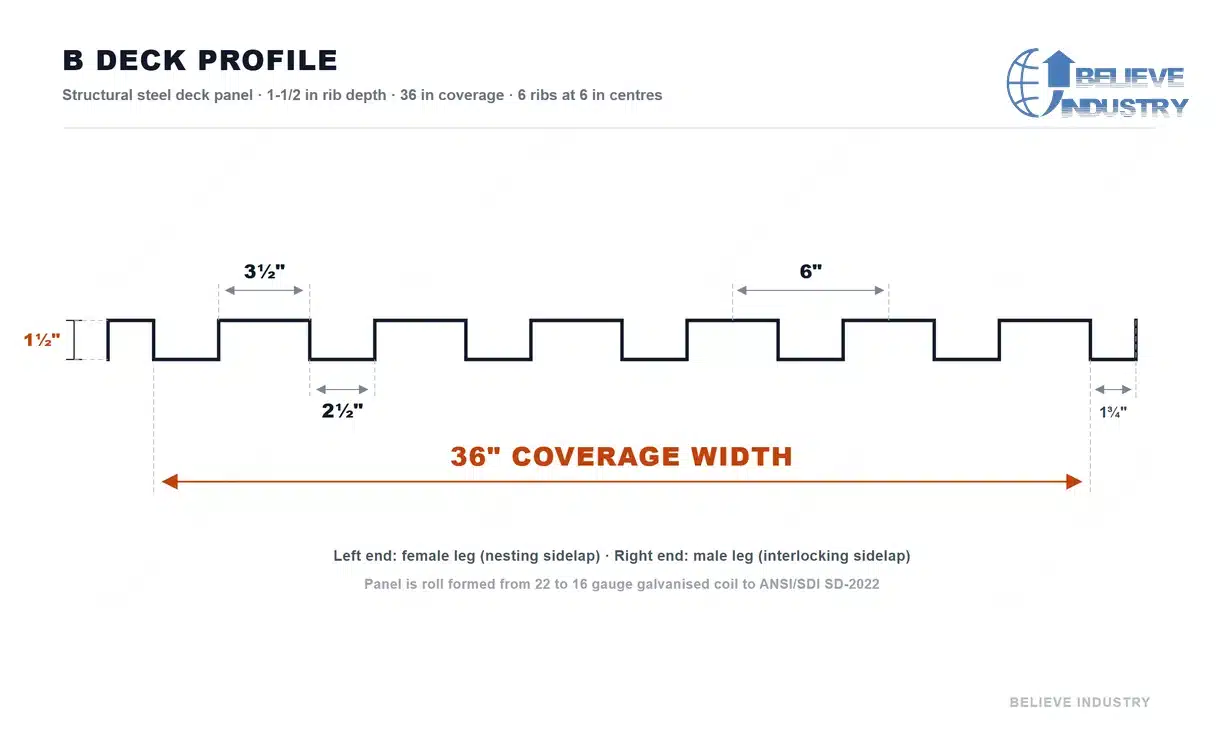
The 3.5 inch flange carries the insulation, the 1.5 inch rib carries the moment, and the sidelap carries the diaphragm shear. A B deck roll forming machine that misses any of the three ships deck that fails inspection.
Roof and floor deck share one profile. Dimensions are identical. What changes is coil thickness, sidelap detail, and whether panels carry embossments for composite action.
| Item | B roof deck | B floor deck |
|---|---|---|
| Coil thickness | 0.3 to 0.8 mm (22 to 20 ga) | 0.8 to 1.5 mm (20 to 16 ga) |
| Cutoff load | Light, hydraulic shear is enough | Heavy, needs a reinforced frame |
| Embossment | None | Formlok pattern for concrete bond |
| Sidelap | Nesting lap, screwed or welded | Nesting lap plus shear studs |
| Typical span | 3 to 10 ft between joists | Set by the slab design |
A floor deck order pushes buyers toward a heavier B deck roll forming machine. Going from 0.8 mm to 1.5 mm adds load to every station, so shafts, bearings and the shear cylinder all step up. Budget a B deck roll forming machine for the thickest coil, never the average.

If your book mixes deck with deeper structural profiles, the steel floor deck roll forming machine page covers 75 mm composite sections. Buyers comparing floor systems should read the mezzanine floor roll forming guide before locking a rib height.
A standard B deck roll forming machine runs on one straight axis. Coil enters at one end, formed panel leaves at the other, and every module between is sized for 1.5 mm steel at full width.
| Module | Standard specification | What it does |
|---|---|---|
| Hydraulic uncoiler | 10 ton, with coil car | Pays off coil under controlled tension |
| Feeder and guide | Entry pinch rolls plus edge guides | Keeps strip centred before station one |
| Roll former | 24 to 28 stations, 90 mm shafts | Forms six ribs and both sidelap legs |
| Embossing section | Optional, 4 to 10 stations | Adds the Formlok pattern for floor deck |
| Cutoff | Hydraulic or flying shear | Cuts to length, stopped or on the move |
| Runout table | 6 to 12 m, manual or automatic | Receives panels, builds bundles |
| Control cabinet | PLC with length and batch counter | Sets cut length, quantity and speed |

Three modules decide whether the line earns money. The shear decides speed, the stacker decides labour, the uncoiler decides how much coil handling fills each shift.
These numbers hold for a standard B deck roll forming machine. Anything outside them is a custom build, and we quote it as one.
| Parameter | Specification |
|---|---|
| Raw material | PPGI, GI, PPGL, GL |
| Coil thickness | 0.3 to 0.8 mm roof deck, 0.8 to 1.5 mm floor deck |
| Forming stations | 24 to 28 |
| Shaft | 40 Cr, 90 mm diameter, keyed |
| Rollers | GCr15, heat treated, surface chromed |
| Main motor | 22 kW x 2, chain or gearbox drive |
| Forming speed | 12 to 30 m/min, set by the cutoff |
| Profile tolerance | Rib height within 1 mm, coverage within 3 mm |
| Power supply | 380 V 50 Hz three phase, or matched to site |
| Control | PLC, inverter drive, batch and length presets |
The 90 mm shaft is what buyers under-specify most. A 1.5 mm floor panel at 36 inch width puts real torque into the shaft, and a 70 mm shaft deflects enough to show in rib height.
Speed on a B deck roll forming machine follows the cutoff, not the motor. The forming section can always outrun the machine’s ability to stop a moving panel.
At 20 m/min for eight hours, a B deck roll forming machine makes about 9,600 m of panel. At 36 inch coverage that is roughly 94,500 sq ft per shift. A hydraulic shear at 12 m/min lands near 56,000 sq ft, so the shear moves plant capacity more than the motor does.
Coil changeover is the hidden cost on any B deck roll forming machine. A 10 ton coil at 1.5 mm yields about 1,600 m of panel. Two fitters with a coil car change it in 8 to 12 minutes. Without a coil car, double it.
Buyers who also form roofing usually order both from one supplier to keep tooling and spares consistent. Our roofing sheet roll forming machine buy guide covers that, and the US roll forming machine market guide explains the voltage, gauge and documentation American buyers expect.
B deck is a structural product, so the paper trail matters as much as the profile. The governing document is the ANSI/SDI SD-2022 Standard for Steel Deck, which consolidated the earlier roof, floor and composite standards and is referenced by the International Building Code.
Coil falls under ASTM A653 for galvanised sheet, G60 standard and G90 for coastal work. Diaphragm values follow AISC practice, and rated assemblies are listed through UL. Every B deck roll forming machine ships with mill certificates, profile drawings and a dimensional report.
Our quality system is ISO 9001 certified and the machines carry CE marking for export. The tolerance we hold is tighter than the standard requires, because a panel 4 mm wide will not nest on the third run.
We have built roll forming machines since 2005, with more than 15 years in structural deck and over 500 projects in more than 50 countries. The engineering team runs 80 plus people, which is why a custom deck profile is not a six month experiment.
Deck work is familiar here. We have shipped B deck roll forming machines to the US, Mexico, Australia and the Middle East, and we know American buyers want 480 V, imperial drawings and a shear that holds length within 3 mm. Those details sit in the quotation, not in a later change order.
If your requirement sits outside the standard B profile, the customized profile roll forming machine range covers hat sections and interlocking panels. The wider roll forming machine catalogue shows the full line up by category.
Q: How much does a B deck roll forming machine cost?
A roof deck line with hydraulic shear starts near $65,000. A B deck roll forming machine built for both roof and floor deck, 22 to 28 stations with a flying shear, lands between $95,000 and $140,000. Adding a stacker and butt welder pushes a high output line toward $190,000. The floor deck roll forming machine cost breakdown shows how each module moves the number.
Q: How fast can a B deck roll forming machine run?
Between 12 and 30 m/min in normal production, with the ceiling set by the cutoff. Hydraulic shear holds the line near 12 to 15 m/min because the panel stops for each cut. A flying shear lets the same forming section run at 20 to 30 m/min.
Q: Can one B deck roll forming machine make both roof deck and floor deck?
Yes, and most buyers order it that way. The profile is identical. Roof deck runs 0.3 to 0.8 mm coil without embossing, floor deck runs 0.8 to 1.5 mm and needs the Formlok section for concrete bond.
Q: What coil gauges do I need for B deck?
22, 20 and 18 gauge cover most work, with 16 gauge for heavy slabs. In metric that is 0.76 mm to 1.52 mm. Grade matters too: 33 ksi is common for roof deck, while 50 to 80 ksi appears in longer span floor designs.
Q: How long does a profile change take?
Gauge changes on a B deck roll forming machine take 15 to 30 minutes and need no tooling swap. Moving to a different profile, such as 3 inch deck or a hat section, means a roll set change and takes 4 to 8 hours with two fitters.
Q: What is the difference between B deck and 3 inch deck?
Rib depth and span. B deck is 1.5 inch deep and spans 3 to 10 ft. A 3 inch deck is twice as deep and reaches longer spans with heavier loads, at a higher coil cost.
Q: What site services does a B deck roll forming machine need?
A level concrete floor rated for the line weight, a 380 V or 480 V three phase supply sized to the motors, and compressed air for the pneumatic guides. A 26 station line draws 45 to 60 kW and occupies about 28 m of floor length.
Q: How long is delivery and installation?
Standard lines ship in 55 to 75 days from drawing approval. Installation and commissioning take 10 to 14 days with our engineer on site, followed by operator training on the PLC, gauge changes and blade maintenance.
Tell us the rib depth, coverage, coil thickness range and target output. We will return a line layout, a station count and a firm price within one working day.
Request a B deck line quotationLast updated: 31 October 2026. Article changelog: profile dimensions corrected and verified against ANSI/SDI SD-2022, the 2023 promotional title replaced, dead outbound domain removed, four specification tables and eight buyer questions added. Next review triggers: SDI standard revision, coil gauge range change beyond 22 to 16 ga, or a shift in US deck demand toward deeper profiles.
Rolling Shutter Roll Forming: Shopfront to Warehouse Applications Short answer:...
Read MoreDoor Manufacturing Roll Forming: Residential to Industrial Applications Short answer:...
Read MoreFalse Ceiling Roll Forming Applications: T-Grid and Suspension Systems Short...
Read More
Heavy Duty Step Beam Roll Forming: Thick Coil and High-Strength...
Read More English English
 Español
 Português
 Русский
 العربية
 Bahasa Melayu
 Türkçe
 ไทย
 Bahasa Indonesia