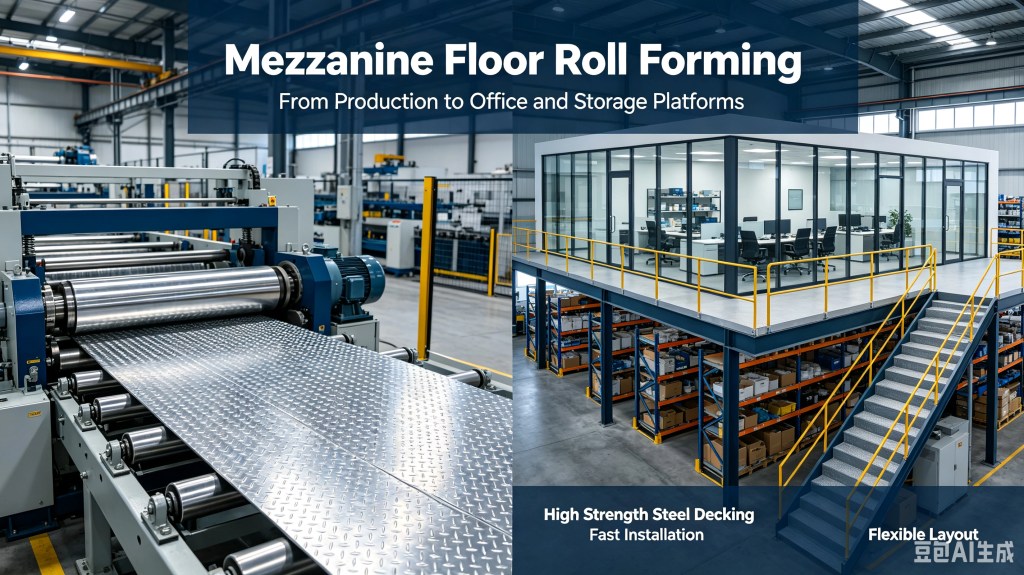
Mezzanine Floor Roll Forming Applications

Mezzanine Floor Roll Former Guide: 5 Critical Components Explained

Need a Roll Forming Machine for Your Project?
Get a free quote from Believe Industry — 15+ years of custom roll forming manufacturing.
Request a Quote Download Catalogue

Introduction

A mezzanine floor doubles your usable space without expanding your building footprint. You add a steel platform between existing floor and ceiling, creating a second level for offices, storage, or production. The structural sections that hold up these platforms come from a process called mezzanine floor roll forming.

Mezzanine floor roll forming turns flat steel coil into shaped structural profiles. These profiles include joists, main beams, edge trim, floor decking, support channels, and handrail posts. Each profile has a specific load rating and connection method. Together they form a complete mezzanine floor system.

Believe Industry Company builds mezzanine floor roll former machines for manufacturers worldwide. Over 15 years of experience, shipped to 20+ countries. This guide covers what these machines produce, which applications they serve, and what specifications matter most.

What Is Mezzanine Floor Roll Forming?

Mezzanine floor roll forming is a cold roll forming process that shapes steel strip into structural profiles for elevated platforms. The steel passes through a series of rollers at room temperature. No heat treatment, no welding distortion, no material waste.

A typical mezzanine floor roll former line starts with a decoiler, feeds steel strip through straightening rollers, then through 18 to 30 forming stations. Each station bends the steel incrementally until the final profile emerges. A flying cutoff saw cuts the finished section to length without stopping the line.

The result is a consistent structural section with tight dimensional tolerances. Holes for bolts and connectors can be punched inline before or after forming. This matters because mezzanine platforms are bolted structures, not welded. Every connection point needs precise hole placement.

Roll formed mezzanine sections outperform welded alternatives in three ways: dimensional consistency, production speed, and material optimization. A well-configured mezzanine floor roll forming line runs at 15 to 25 meters per minute. That means a single shift can produce enough sections for a 500 square meter mezzanine floor.

You can learn more about the underlying process on our roll forming machine page.

6 Core Profiles From a Mezzanine Floor Roll Former

A complete mezzanine floor system needs six distinct profile types. Each requires its own roll former tooling configuration.

ProfileFunctionMaterial ThicknessForming Stations
Main Beam (C or Z)Primary load-bearing span2.5 to 4.0 mm22 to 30
Floor JoistSecondary support, perpendicular to beam2.0 to 3.0 mm18 to 24
Floor Deck PanelWalking surface substrate0.8 to 1.5 mm16 to 22
Edge TrimPerimeter finishing and safety edge1.0 to 2.0 mm14 to 18
Support ChannelColumn connection and bracing2.0 to 3.5 mm18 to 24
Handrail PostSafety railing support2.0 to 3.0 mm12 to 16

Main beams

Main beams carry the structural load of the entire mezzanine floor. They span between support columns and determine the floor’s maximum live load capacity. Most mezzanine floor roll forming systems produce C-channel or Z-section beams because these profiles offer high strength-to-weight ratios and nest efficiently for shipping.

A C-section beam at 3.0mm thickness, 150mm web height, and 60mm flange width can support a uniformly distributed load of 400 kg per square meter over a 4-meter span. That meets the requirements for most office and light storage mezzanine applications.

Floor joists and deck panels

Floor joists run perpendicular to main beams and provide the attachment points for floor decking. The decking panel is the walking surface itself. In many systems, the deck panel is a corrugated or ribbed steel sheet that interlocks side by side and fastens to joists with self-drilling screws.

The deck panel profile needs enough rigidity to prevent deflection under foot traffic. A 1.0mm thick ribbed deck panel with 38mm rib height typically deflects less than 1/360 of the span under standard live load. That is the threshold most building codes accept for mezzanine floor roll forming applications.

The pallet racking roll forming machine systems we build share similar design principles with mezzanine floor roll former lines. Both produce structural sections for warehouse environments, but mezzanine profiles handle floor loads while rack profiles handle vertical storage loads.

Office Platform Applications

Office mezzanine floors serve a different purpose than storage platforms. They need to feel solid underfoot, support partition walls, and accommodate HVAC, electrical, and data routing. The roll forming requirements shift accordingly.

Acoustic and vibration control

Office mezzanine floors transmit sound and vibration if not properly engineered. The solution is a secondary sub-floor layer above the steel deck panel, typically cement board or plywood over acoustic isolators. The steel deck panel from the mezzanine floor roll former provides the structural base.

Vibration matters more than static load in office applications. A floor that bounces when people walk is unacceptable. The fix is stiffer joists at closer spacing. Office mezzanine floors typically space joists at 400mm centers compared to 600mm for storage platforms.

Partition wall integration

Office mezzanine floors often need demountable partition walls. The main beam profile from the roll former should include a pre-punched slot pattern that accepts partition wall connectors. We design upright rack roll forming machines with similar inline punching systems. Servo-driven hydraulic punches create hole patterns at programmable intervals along the beam length.

Office mezzanine floors

Storage Platform Applications

Storage mezzanine floors handle heavier loads than office platforms. The design priority is load capacity, not acoustic comfort. Typical storage mezzanine live loads range from 500 to 1000 kg per square meter. Some industrial storage platforms reach 2000 kg per square meter.

Beam sizing for heavy storage

ApplicationLive Load (kg/m2)Beam ThicknessJoist SpacingDeck Thickness
Light storage5002.5 mm600 mm0.8 mm
Medium storage7503.0 mm500 mm1.0 mm
Heavy storage10003.5 mm400 mm1.2 mm
Industrial storage1500-20004.0 mm300 mm1.5 mm

Heavier loads demand thicker steel and closer spacing. A mezzanine floor roll former must handle material up to 4.0mm for heavy storage applications. The forming stations need heavier roller shafts and bearing blocks compared to light-duty lines.

Integration with ground-level racking

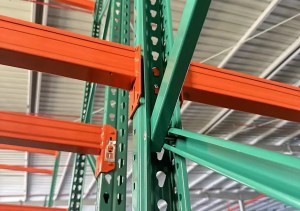
Many storage mezzanines sit above ground-level pallet racking. The mezzanine columns align with the rack uprights below. This shared column approach saves floor space and reduces total steel tonnage. The box beam roll forming machine produces the horizontal beams for both the racking system and the mezzanine floor edge.

In these integrated systems, the mezzanine floor roll former produces the floor structure above the racks. The pallet racking line produces the storage structure below. One manufacturer supplying both systems ensures dimensional compatibility between the two levels.

Storage Platform Applications

Key Machine Specifications

When specifying a mezzanine floor roll former, six parameters determine production capability.

ParameterRangeWhy It Matters
Material Thickness0.8 to 4.0 mmCovers deck panels to main beams
Profile Width50 to 300 mmAccommodates edge trim to main beam
Forming Speed15 to 25 m/minThroughput for project deadlines
Roller Stations12 to 30More stations for complex profiles
Cut Length Toleranceplus or minus 1.5 mmBolt-up assembly requires precision
Punching SystemServo-hydraulic, inlineHole patterns for connections

Material thickness range is the first decision point for any mezzanine floor roll forming project. If you only produce deck panels, 0.8 to 1.5mm is sufficient. If you produce main beams and joists on the same line, you need 2.0 to 4.0mm capability. Some manufacturers run two separate mezzanine floor roll forming lines: one for light gauge deck panels, one for structural sections.

Forming speed directly affects project timelines. A 1000 square meter mezzanine floor needs approximately 2000 linear meters of joist sections. At 20 m/min, that is under two hours of mezzanine floor roll forming machine time. Add beam production, deck panels, and trim, and a complete floor package can roll off one production line in a single shift.

Material and Standard Requirements

Mezzanine floor roll forming typically uses galvanized steel coil to ASTM A653 (US), EN 10346 (EU), or AS 1397 (Australia) standards. The zinc coating provides corrosion resistance for warehouse environments where humidity fluctuates.

StandardRegionYield StrengthZinc Coating
ASTM A653 SS Grade 50US340 MPaG90 (Z275)
EN 10346 S350GDEU350 MPaZ275
AS 1397 G450Australia450 MPaZ275
JIS G 3302 SGCCJapan205+ MPaZ275

For outdoor or high-humidity applications, some manufacturers upgrade to Z350 or use aluminum-zinc coated steel (AZ150). The roll former tooling handles these coatings without modification since the forming process works at room temperature.

The C bracing section roll forming machine uses the same galvanized steel range. Bracing sections for mezzanine columns and racking systems share material specifications.

Mezzanine Floor Roll Forming vs. Alternative Methods

Roll forming is not the only way to produce mezzanine floor sections. Two alternatives exist, but each has drawbacks.

MethodSpeedDimensional ToleranceMaterial WasteSetup Cost
Roll forming15-25 m/minplus or minus 0.5 mmunder 2 percentHigh
Press braking2-4 m/minplus or minus 1.0 mm5-8 percentLow
Welded fabrication0.5-1.5 m/minplus or minus 2.0 mm10-15 percentMedium

Press braking works for small-batch production. The tooling cost is lower and setup is faster. But the speed is 4 to 10 times slower than mezzanine floor roll forming, and tolerance control is worse. For a 500 square meter mezzanine floor requiring 3000 linear meters of sections, press braking would take 4 to 6 days versus one shift on a roll former.

Welded fabrication is the slowest and least precise method. It makes sense only for one-off custom sections that do not justify roll tooling investment. Most commercial mezzanine floor projects use roll formed sections exclusively.

The strut channel roll forming machine demonstrates another comparison. Strut channels serve similar support functions in mezzanine systems, and roll forming produces them at the same speed and precision as mezzanine structural sections.

Safety and Code Compliance

Mezzanine floors fall under specific building codes depending on location. In the US, the International Building Code (IBC) governs mezzanine floor design. In the EU, Eurocode 3 (EN 1993) applies. Australia follows the Building Code of Australia (BCA).

The AISI S100 standard covers cold-formed steel design in North America. This is directly relevant because mezzanine floor roll forming produces cold-formed steel sections. The standard provides design formulas for calculating load capacity of roll formed profiles based on their cross-sectional properties.

OSHA 1910.23 requires guardrails on all open-sided mezzanine floors 4 feet or higher. The handrail post profile from the mezzanine floor roll former must support a 200-pound lateral force at the top rail. This requirement dictates the post thickness, typically 2.5mm minimum.

The slotted strut channel roll forming machine produces channels that can serve as handrail rails and intermediate supports. These channels bolt to the handrail posts and complete the safety railing system.

Choosing a Mezzanine Floor Roll Former Supplier

Three factors determine whether a supplier can deliver a production-ready mezzanine floor roll former: tooling experience, line configuration, and after-sales support.

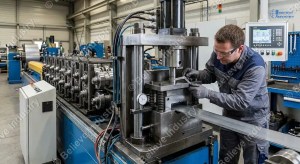
Every mezzanine profile is a custom design. The supplier must translate your profile drawings into roller tooling through CAD simulation and prototype testing. A complete mezzanine floor roll forming line includes decoiler, straightener, servo-feeder, punch press, forming stations, flying cutoff, and run-out table. The supplier must configure each station for your material range and profile dimensions. A mismatch causes springback and distortion.

Roll forming machines need ongoing maintenance. Bearings wear, rollers need reconditioning, PLC programs need updates. A supplier with 24-hour technical support and spare parts keeps your mezzanine floor roll forming production running.

Believe Industry Company has tooled over 200 custom roll forming profiles across roofing, racking, strut channel, and cable tray applications. That experience transfers directly to mezzanine floor roll forming projects.

Frequently Asked Questions

What is a mezzanine floor roll former?

A mezzanine floor roll former is a cold roll forming machine that shapes steel coil into structural profiles for mezzanine floors. It produces main beams, floor joists, deck panels, edge trim, support channels, and handrail posts. The machine operates continuously, cutting sections to length with a flying saw without stopping production.

How thick is steel for a mezzanine floor?

Steel thickness for mezzanine floor sections ranges from 0.8mm to 4.0mm. Deck panels typically use 0.8 to 1.5mm. Floor joists use 2.0 to 3.0mm. Main beams use 2.5 to 4.0mm. The exact thickness depends on the live load requirement, span length, and joist spacing.

How much does a mezzanine floor roll forming machine cost?

A mezzanine floor roll former costs between  45,000 and 180,000 depending on profile complexity, material thickness range, forming stations, and punching system. Lines with inline punching sit at the higher end. Contact Believe Industry for a quotation based on your profile drawings.

Can one machine produce all mezzanine floor profiles?

No. Most manufacturers use two mezzanine floor roll forming lines: one for structural sections (beams, joists, channels) and one for sheet sections (deck panels, edge trim). The thickness gap between structural and sheet sections makes a single-line approach impractical.

No. Most manufacturers use two mezzanine floor roll forming lines: one for structural sections (beams, joists, channels) and one for sheet sections (deck panels, edge trim). The thickness gap between structural and sheet sections makes a single-line approach impractical.

A mezzanine floor is a permanent structural addition to a building, fully compliant with building codes and designed for occupied use (offices, production areas). A raised storage platform is a lighter structure designed solely for material storage. Mezzanine floors require thicker steel, acoustic treatment, and code-compliant guardrails. Storage platforms prioritize load capacity over comfort.

How long does it take to install a roll formed mezzanine floor?

A 500 square meter mezzanine floor takes 5 to 10 days to install on site when all roll formed sections arrive pre-cut and pre-punched. The bolted assembly method means no on-site welding. Installation time depends on crew size, site access, and integration complexity with existing building structures.

What maintenance does a mezzanine floor roll former need?

Daily maintenance includes checking hydraulic oil, cleaning roller surfaces, and verifying punch alignment. Monthly tasks include bearing lubrication and servo-feeder calibration. Annual maintenance involves roller reconditioning and PLC software updates.

Summary

Mezzanine floor roll forming produces the steel sections that create elevated platforms for offices and storage. The process is fast, precise, and material-efficient. Six core profiles make up a complete mezzanine floor system, each requiring dedicated roll former tooling.

Office platforms need acoustic treatment, closer joist spacing, and partition wall integration. Storage platforms need heavier steel and integration with ground-level racking. Both benefit from the consistency and speed that mezzanine floor roll forming delivers.

Believe Industry Company manufactures mezzanine floor roll former machines with over 15 years of tooling experience. Shipped to 20+ countries. Every machine comes with custom-designed rollers, inline punching systems, and full after-sales support. Contact us to discuss your mezzanine profile requirements.

Last Updated: July 8, 2026

Article Changelog:

  • July 8, 2026: Initial publication. Covered 6 core mezzanine profiles, office and storage applications, machine specifications, material standards, and comparison with alternative methods.

Next Review Triggers:

  • New AISI or Eurocode cold-formed steel design updates
  • Changes to OSHA 1910.23 mezzanine guardrail requirements
  • New mezzanine deck panel profile developments
  • Updates to ASTM A653 or EN 10346 galvanized steel specifications
  • New project case studies from Believe Industry installations

Table of Contents

New Updates

Discover more from Believe Industry Company| Roll Forming Machine Manufacturer, Supplier & Exporter

Subscribe now to keep reading and get access to the full archive.

Continue reading