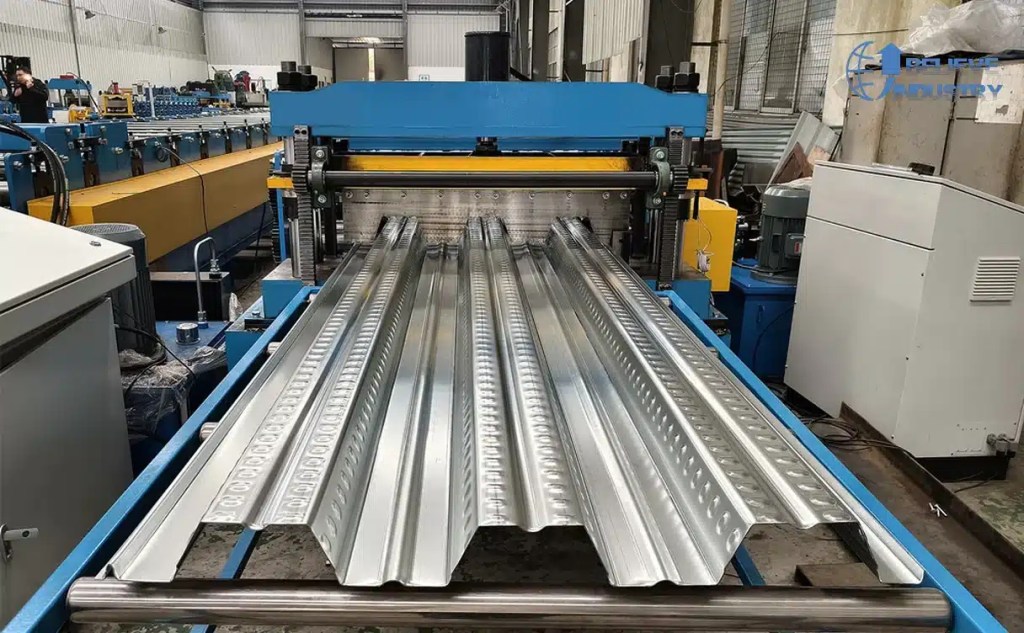
Floor Deck Roll Forming Machine Cost

Floor Deck Roll Forming Machine Cost: 5 Price Factors 2026

Need a Roll Forming Machine for Your Project?
Get a free quote from Believe Industry — 15+ years of custom roll forming manufacturing.
Request a Quote Download Catalogue

How Much Does a Floor Deck Roll Forming Machine Cost?

Short answer: A floor deck roll forming machine cost ranges from about $35,000 for a basic non-composite form deck line to about $150,000 for a high-speed embossed composite deck line with inline embossing and servo flying shear. The profile type, embossing requirements, and production speed set the price.
A floor deck roll forming machine cost depends on whether you need composite deck with embossing or simple non-composite form deck. Composite deck requires additional forming stations for embossment patterns that create mechanical bond with concrete. Form deck skips this step and costs less. This guide breaks the market into five price tiers, explains what each tier includes, and shows how embossing tooling and speed requirements move the number. If you are new to the product, read what is a roll forming machine line first, then return to price.
A basic coil slitting setup upstream also reduces scrap and protects margins before the deck line runs.
floor deck roll forming machine production line

Floor Deck Roll Forming Machine Cost by Profile Type and Speed

The table below maps deck type to forming stations, embossing needs, typical speed, and price range.
Deck typeForming stationsEmbossingTypical speedPrice (USD)
Non-composite form deck18 to 22None8 to 15 m/minabout $35,000
Standard composite deck22 to 26Light embossing10 to 20 m/minabout $55,000
Embossed composite deck26 to 32Deep embossment pattern15 to 25 m/minabout $80,000
High-speed embossed deck28 to 34Deep embossment + servo shear25 to 35 m/minabout $120,000
Premium high-speed line32 to 40Precision embossment + rotary shear35 to 50 m/minabout $150,000
These bands cover standard 0.8 to 1.5 mm galvanized steel in common deck profiles (38 mm rib height, 915 mm cover width). Thicker material, wider profiles, or custom embossment patterns raise the floor deck roll forming machine cost inside each tier.

What Sets the Price at Each Tier

A non-composite form deck line is the entry build. It forms the steel profile without embossing for concrete bond, used where the deck serves only as permanent formwork. The floor deck roll forming machine cost lands at about $35,000 and suits fabricators supplying basic form deck for low-rise construction.
A standard composite deck line adds light embossing for concrete interlock. The embossment rolls add stations and complexity. Expect about $55,000 for a line of this class. This tier suits regional suppliers serving mid-rise commercial projects.
An embossed composite deck line with deep embossment pattern uses more forming stations and heavier embossing tooling. The floor deck roll forming machine cost runs about $80,000. Deep embossment increases surface area for concrete bond and suits high-load applications like parking garages.
A high-speed embossed deck line moves to servo flying shear and faster drive systems. The floor deck roll forming machine cost reaches about $120,000. Speed matters on large projects where daily footage requirements exceed 2,000 linear meters, the same economics behind high-volume roll forming lines.
A premium high-speed line with precision embossment and rotary shear hits about $150,000. This tier handles the thickest material (up to 2.0 mm), widest profiles, and continuous production at 50 m/min. Few suppliers build this reliably. The price reflects precision tooling and heavy-duty frame construction. Review our punching die installation guide before committing to a hole pattern.

Embossing: The Single Largest Cost Driver

Embossing is what separates composite deck from form deck. Three levels appear in the market:
  • No embossing. Form deck only. The floor deck roll forming machine cost stays lowest.
  • Light embossing. Shallow patterns for standard composite bond. Adds 4 to 6 stations and about $15,000.
  • Deep embossment. Aggressive patterns for maximum concrete interlock. Adds 8 to 12 stations and about $35,000.
Each embossing station needs precision tooling hardened to HRC 58 to 62. The rolls are profile-specific and cost $2,000 to $5,000 per station. A full embossing section with 10 stations adds $20,000 to $50,000 in tooling alone. Buyers often underestimate embossing costs when budgeting a composite deck line.
floor deck embossing rolls and forming station

Profile, Material Thickness, and Width

Beyond embossing, the profile itself moves the number. A standard 38 mm rib height deck runs on 22 to 26 stations. A deeper 76 mm rib deck needs 28 to 32 stations for proper forming. Material thickness from 0.8 to 1.2 mm runs on standard stands. Thickness above 1.5 mm needs heavier-duty stands with larger shafts and bearings, adding $8,000 to $18,000.
Cover width affects stations too. A 915 mm standard width fits most lines. Widths to 1,200 mm need wider machine beds and longer shafts. Wider profiles raise the floor deck roll forming machine cost by $5,000 to $12,000. Steel grade matters as well. Galvanized steel to ASTM A653 or EN 10346 runs standard. Stainless or high-strength steel may need roll material changes but does not always raise machine price.
Deck standards include ASTM A653 for steel and SDI design manuals for load tables in North America. International projects follow EN 1994 for composite slab design.

Cutoff Method: Hydraulic, Flying, or Rotary

The cutoff method is the second major cost driver after embossing:
Cutoff methodSpeed rangeBest forAdded cost
Hydraulic shearUp to 15 m/minEntry lines, low volumeStandard
Servo flying shear15 to 35 m/minMid-speed composite deckabout $25,000
Rotary shear35 to 50 m/minHigh-speed premium linesabout $40,000
Hydraulic shear stops the line for each cut. It works for speeds under 15 m/min and keeps the floor deck roll forming machine cost lowest. Servo flying shear cuts on the fly without stopping material flow. It adds about $25,000 but doubles viable production speed. Rotary shear uses continuous rotary blades for speeds above 35 m/min. It adds about $40,000 and suits only the highest-volume operations.
Most buyers over-specify the cutoff. Match the method to your real daily footage. A hydraulic shear handles under 1,000 meters per day. Servo flying shear protects delivery promises above 2,000 meters per day.
floor deck hydraulic shear cutting device

Optional Add-Ons That Change the Total

Most quotes start with the base line and add modules. The common ones:
OptionWhat it doesAdded cost
Coil end shearing and butt welderJoins coil ends for continuous productionabout $8,000
Auto stackerStacks finished deck and counts bundlesabout $30,000
Inline curving deviceAdds slight longitudinal curve for drainageabout $12,000
Side lap seaming toolMechanically locks deck sheets side-to-sideabout $6,000
A coil end shearing and butt welder matters on high-speed lines where stopping to swap coils wastes minutes every hour. It costs about $8,000. An auto stacker cuts labor on any tier and costs about $30,000. Neither is required, but both raise the floor deck roll forming machine cost in exchange for lower running cost. Inline curving and side lap seaming are profile-specific and quoted per project.

Typical Configuration and Price Scenarios

Three real-world builds show how the numbers land:
  1. Small fabricator, form deck only, 10 m/min, hydraulic shear, manual stack. About $35,000. Suits local contractors with occasional deck needs.
  2. Regional supplier, embossed composite deck, 20 m/min, servo flying shear, with auto stacker. About $110,000 (embossed deck line about $80,000 plus servo shear upgrade about $25,000 plus auto stacker about $30,000, less package discount). Serves multi-story commercial projects.
  3. Export line, high-speed embossed deck, 35 m/min, servo feed system, with butt welder and stacker. About $158,000 (high-speed line about $120,000 plus butt welder about $8,000 plus auto stacker about $30,000). Ships containers weekly to international markets.
These scenarios show why a single price quote is misleading. The floor deck roll forming machine cost is a configuration question. A multi-profile line with quick-change tooling can spread investment across several product families including roof deck and wall panels.
galvanized steel floor deck profile with embossment

How to Choose the Right Price Tier

Start from your required daily footage and profile mix, not from a budget number. A line running 8 hours at 10 m/min makes roughly 4.8 km of deck per day. The same hours at 35 m/min make nearly 17 km. If you need under 3 km per day and serve only form deck market, the entry tier is correct and saves $45,000 or more. If you ship composite deck to commercial construction weekly, the embossed composite tier protects delivery promises. Our USA market guide covers import and compliance steps for North American buyers.
The right floor deck roll forming machine cost is the one matched to footage and embossing requirements, not the cheapest quote on paper. Believe Industry has built custom roll forming lines since 2005, with 15+ years of experience, 80+ engineers and 500+ projects delivered to 50+ countries under ISO 9001 and CE. We size the embossing stations and cutoff method to your actual profile and volume, so the floor deck roll forming machine cost reflects production need rather than a catalog default.

Frequently Asked Questions of Floor Deck Roll Forming Machine Cost

Q: What is the lowest floor deck roll forming machine cost for a working line?

A basic form deck line without embossing, 10 m/min speed, hydraulic shear, starts around $35,000. Add freight and tooling for your profile, and most buyers land near $40,000. Embossing for composite deck doubles the entry cost.

Q: Why does embossed composite deck cost more than form deck?

Embossing requires 4 to 12 additional forming stations with hardened tooling. Each station adds $2,000 to $5,000. Deep embossment patterns for maximum concrete bond add about $35,000 over a form deck line. The tooling and station count are the cost drivers.

Q: Is a servo flying shear worth the extra money?

It adds about $25,000 over hydraulic shear and removes the stop-start cycle. At 20 m/min and above, the flying shear pays back through higher daily output. Below 15 m/min, hydraulic shear is sufficient and lowers the floor deck roll forming machine cost.

Q: Does an auto stacker pay back?

At about $30,000, it removes manual handling and counting. It pays back fastest on lines running more than one shift or shipping bundled deck. For single-shift low-volume operations, manual stacking may suffice.

Q: Can one line make both form deck and composite deck?

Yes, with cassette or quick-change tooling that swaps embossing sections. The multi-profile setup adds cost but lets a single floor deck roll forming machine cost cover multiple product lines including roof deck and wall profiles.

Q: How does material thickness affect price?

Standard 0.8 to 1.2 mm galvanized steel runs on standard stands. Material above 1.5 mm needs heavy-duty stands with larger bearings and shafts. This adds $8,000 to $18,000 depending on profile width.
*Last updated: 2026-10-28*
*Article Changelog: 2026-10-21: Initial publication. 2026-10-28: Added 4 images, corrected SEO metadata block format (SEO Title 1 / Meta Description 1), added 6 internal links.*
*Next Review Triggers: Steel coil price moves beyond 15 percent; embossing tooling lead times exceed 12 weeks; major buyer requests 60+ m/min tier.*

Table of Contents

New Updates