Address
No 1, Yd Road, Huishan District, Wuxi City, Jiangsu. 214183
Work Hours
Monday to Friday: 9AM - 5PM
Saturday: 9AM - 4PM
Address
No 1, Yd Road, Huishan District, Wuxi City, Jiangsu. 214183
Work Hours
Monday to Friday: 9AM - 5PM
Saturday: 9AM - 4PM

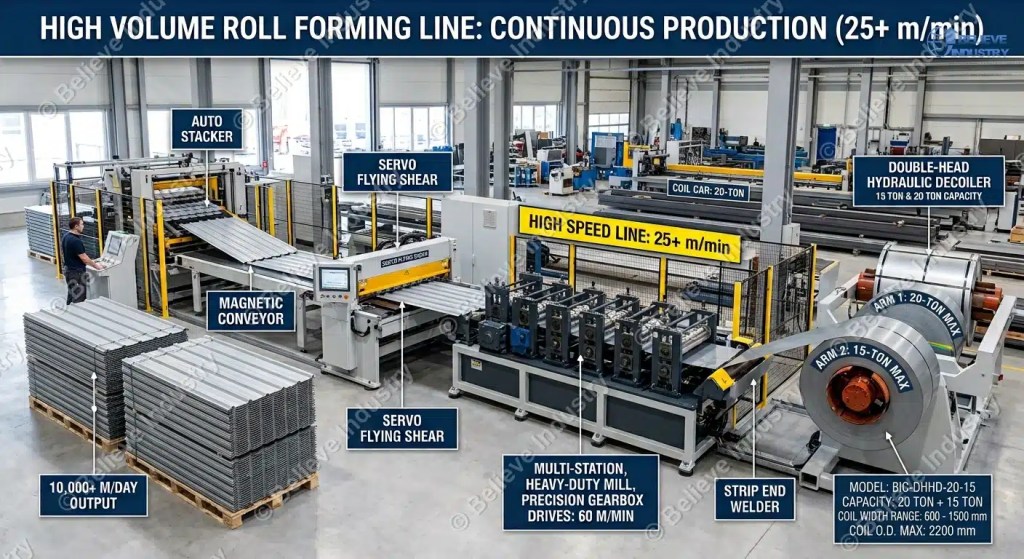
The best high volume roll forming machine is a line built for continuous running: a gearbox-driven mill at 25 m/min or faster, a servo flying shear, a hydraulic decoiler big enough to feed it, and an auto stacker at the exit. In 2026 the five categories worth shortlisting are the high-speed roof panel line, the servo C/Z purlin line, the corrugated sheet line, the cable tray line with automatic size change, and the pallet racking upright line with rotary punching. Each one clears 10,000 meters per day when it is specified and run correctly.
Speed alone does not get you there. We have seen 60 m/min lines output less than an old 20 m/min line because the decoiler starved the mill and the stacker bottled up the exit. This guide covers the five machines and the four components that decide whether your high volume roll forming machine actually produces high volume.
Believe Industry Company has built high output lines for over 15 years and shipped machines to 20+ countries. Everything below comes from those projects.
High volume roll forming machine definition: a roll forming line engineered for continuous production at 25 m/min or more, with a flying cut-off that never stops the strip, a decoiler sized to keep the mill fed, and an exit system that clears finished parts as fast as they are cut. Practical benchmark: 10,000 or more finished linear meters per day.
The number that matters is not the brochure speed. It is finished meters out the door per shift. That number is line speed multiplied by uptime, minus scrap.
A 25 m/min roll former sounds slow next to a 60 m/min line. Do the math before you judge. 25 m/min is 1,500 meters per hour at nameplate. Real plants run 70 to 80 percent uptime because of coil changes, profile changes, breaks, and packing delays. At 75 percent, that same line delivers 1,125 meters per hour. Two shifts gets you 18,000 meters per day. One shift still clears 9,000.
| Line speed | Meters/hour nameplate | Meters/shift at 75% uptime | Meters/day, 2 shifts |
|---|---|---|---|
| 15 m/min (standard) | 900 | 5,400 | 10,800 |
| 25 m/min | 1,500 | 9,000 | 18,000 |
| 40 m/min | 2,400 | 14,400 | 28,800 |
| 60 m/min (top end) | 3,600 | 21,600 | 43,200 |
Two takeaways from that table. First, a standard 15 m/min machine on two shifts just barely crosses 10,000 meters per day, with zero margin for problems. Second, above 40 m/min the decoiler, shear, and stacker matter more than the mill itself. The mill can always run faster. The rest of the line sets the ceiling. Uptime benchmarks come from standard OEE practice, where world-class discrete manufacturing runs at 85 percent availability (OEE.com).
| # | Machine | Profile | Working speed | Real output/day | Typical price |
|---|---|---|---|---|---|
| 1 | High-speed roof panel line | Roof and wall panels | 40-60 m/min | 25,000-43,000 m | $60,000-$120,000 |
| 2 | Servo C/Z purlin line | C and Z purlins | 25-35 m/min | 15,000-25,000 m | $55,000-$95,000 |
| 3 | Corrugated sheet line | Corrugated and IBR sheet | 30-45 m/min | 20,000-32,000 m | $45,000-$85,000 |
| 4 | Auto size-change cable tray line | Cable trays | 20-25 m/min | 10,000-16,000 m | $90,000-$160,000 |
| 5 | Racking upright line, rotary punch | Rack uprights | 15-25 m/min effective | 8,000-14,000 m | $70,000-$130,000 |
The high-speed roof panel roll forming machine is the fastest category in roll forming. Gearbox transmission instead of chain drive, because chains lose sync above 25 m/min. Flying hydraulic or servo cut. Auto stacker standard, since a 2-meter panel exits every two seconds at 60 m/min and no crew can hand-stack that.
Best fit: steel building factories and roofing contractors supplying pre-engineered buildings. The pre-engineered building segment keeps growing with industrial construction, and roof sheet is the volume product in that sector (Grand View Research).
Watch out for: buying a 60 m/min mill and skipping the stacker. We have quoted that configuration and talked buyers out of it more than once.
The C/Z purlin roll forming machine with servo punching and servo flying shear is the workhorse of structural volume production. C and Z sizes swap in minutes on the good ones. The servo punch handles hole patterns at full line speed, so purlins come out finished, not just formed.
At 25 to 35 m/min with inline punching, one line feeds an entire frame plant. That is why frame factories in the US, Australia, and the Gulf almost all run this configuration.
Best fit: purlin and girt producers, steel frame fabricators, exporters quoting per-container volumes.
Watch out for: hydraulic punching on a 30 m/min line. The punch cycle becomes the bottleneck and the mill never reaches nameplate speed.
Corrugated profiles are simple. Few forming stands, shallow bends, forgiving tolerances. That simplicity is why the corrugated sheet roll forming machine runs 30 to 45 m/min without drama, at a lower price than deep-rib profiles. For pure meters-per-dollar on roofing volume, nothing beats it.
Best fit: roofing distributors and profile suppliers running large batches of one or two profiles.
Watch out for: batch size. If you change profiles five times a day, buy quick-change cassettes or accept that your real speed is your changeover time.
Cable tray is a different volume problem. Widths and heights change constantly, so throughput comes from changeover speed, not raw line speed. The automatic size-change cable tray machine adjusts width, height, and flange by recipe in a few minutes. Twenty m/min with 5-minute changeovers beats 30 m/min with 45-minute changeovers on any realistic order book.
Data centers and infrastructure projects are driving this category hard right now. A single hyperscale site can order hundreds of kilometers of tray.
Watch out for: underestimating the fitter, embosser, and cover line. Tray volume means the accessory lines must keep pace too.
Rack uprights are punched, not just formed, and hole patterns eat cycle time. The pallet racking roll forming machine with a rotary punch head cuts holes while the strip moves, which lifts effective speed from 8-15 m/min to 20-25 m/min. The warehouse boom in e-commerce logistics keeps these lines booked solid.
Watch out for: die change time between hole patterns. Specify servo-adjustable dies if your order book changes patterns daily.
A high volume roll forming machine is a system. The mill is rarely the weak link.
A stop-cut shear halts the strip for every piece and burns 2 to 5 seconds per cut. A flying shear travels with the profile and never stops the line, worth roughly 30 percent more output per shift. Above 25 m/min, servo beats hydraulic: a servo flying shear holds length to plus or minus 0.5 mm and supports 30 to 40 m/min line speed, while hydraulic response lags past 25 m/min. Full details are in our flying shear guide. The engineering behind the tracking cycle is documented in flying shear research.
The decoiler decides whether your mill ever sees full speed. Two specs matter. Capacity: a 25 m/min line eats a 5-ton coil in about 40 minutes, so 10-ton minimum, 15 to 20 tons for high-speed lines. Configuration: a hydraulic decoiler with coil car and hydraulic expansion cuts coil loading to minutes. Better, a double-head decoiler with an end welder. The second head is loaded while the first feeds, strips are welded end to end, and the line runs continuously through coil changes. That one option recovers most of the 20 to 45 minutes per change that single-decoiler plants lose.
At 25 m/min with 3-meter panels, a finished panel exits every 7 seconds. At 40 m/min, every 4.5 seconds. Manual stacking caps a line near 15-20 m/min no matter what the mill can do. An auto stacker counts, layers, and bundles to preset quantities. Specify stacking height to 800 mm, automatic count alarm, and a discharge conveyor that moves bundles clear before the next stack starts.
If the profile has holes, the punch sets the pace. Rotary punching and servo punching run at line speed. Hydraulic press punching stops or slows the strip. On purlin, strut, and rack lines, this single choice swings effective output by 40 percent.
Uptime is where high volume lives or dies. On a two-shift day, three coil changes at 40 minutes each costs you 1,800 meters. Same day, same machine, three changes at 5 minutes each with a double decoiler and end welder: you keep almost all of it. Our coil changeover reduction guide covers the full checklist: pre-staged coils, coil cars, strip guides, and written changeover sequences. The plants that hit 80 percent uptime treat changeover as a timed, rehearsed operation, not a break.
Match the machine to your order book, not to the fastest brochure.
| Your situation | Right machine |
|---|---|
| Roofing volume, one or two profiles | Corrugated or roof panel line, 40-60 m/min |
| Structural purlins, mixed C/Z sizes | Servo purlin line, 25-35 m/min |
| Tray for data centers, many sizes | Auto size-change tray line |
| Rack uprights, frequent hole patterns | Upright line with rotary or servo punch |
| 10,000 m/day on one shift only | 40 m/min minimum, double decoiler mandatory |
Ask three questions before you sign. What profile mix, in what batch sizes? What is the real daily meter target this year and next year? Who maintains servo systems on your team? If the speed roadmap says 25 m/min in year two, buy the servo shear and the big decoiler now. Retrofitting later costs more than the difference. The roll forming machine price guide breaks down how each of these components moves the quote.
Budget in 2026 terms. A 25 m/min corrugated or roof panel line runs $45,000 to $85,000. A servo purlin line with inline punching runs $55,000 to $95,000. A cable tray line with automatic size change starts near $90,000. Add the double decoiler with end welder at $15,000 to $25,000 and the auto stacker at $12,000 to $20,000.
Run the payback on finished meters. A servo shear and auto stacker premium of roughly $30,000 that lifts output 25 percent on an 18,000-meter day gives you 4,500 extra meters daily. At even $0.30 margin per meter, that premium repays itself in about 22 working days. High volume lines pay for their speed fast. Slow lines pay for their slowness forever.


 English English
  Español
 Português
 Русский
 العربية
 Bahasa Melayu
 Türkçe
 ไทย
ไทย
 Bahasa Indonesia