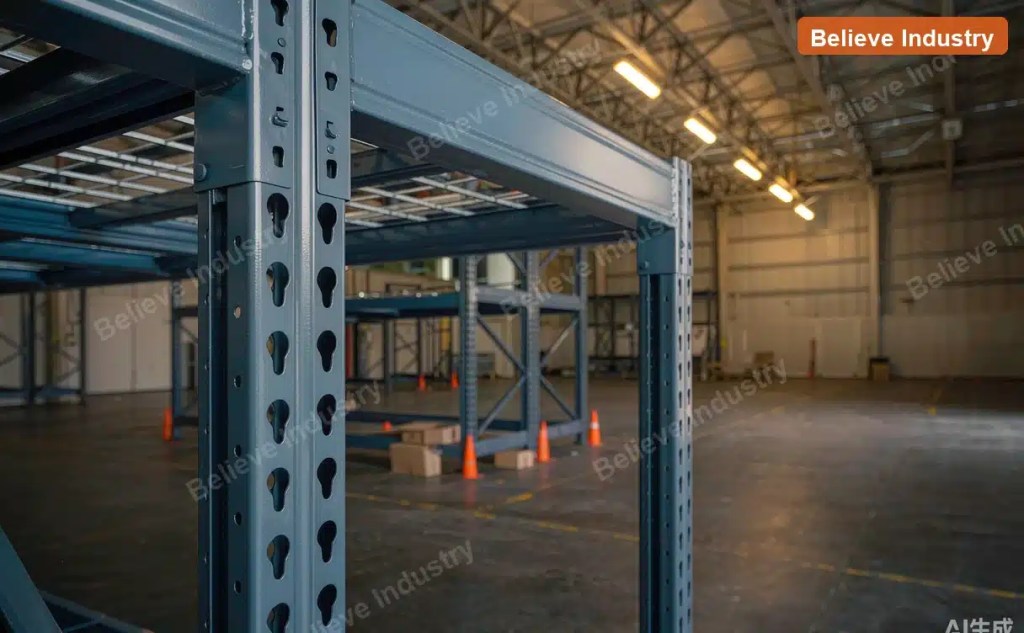
upright column steel grade

Upright Column Steel Grade: 5 Grades for a Safer Pallet Rack

Need a Roll Forming Machine for Your Project?
Get a free quote from Believe Industry — 15+ years of custom roll forming manufacturing.
Request a Quote Download Catalogue

Upright Column Steel Grade: 5 Proven Grades for a Stronger, Safer Pallet Rack

What Steel Grade Does a Pallet Rack Upright Use?

An upright column steel grade is the specified yield strength of the coil that an upright rack column roll forming machine turns into the front post of a pallet rack. It is the one spec that decides how much load the finished rack can legally carry. That is why serious rack factories treat steel selection as a design decision.
Upright column steel grade definition: the coil specification, quoted by minimum yield strength in MPa or ksi, that governs the load capacity, connector hole performance, and code compliance of a roll formed pallet rack upright column.
Short answer: North American pallet rack uprights run ASTM A1011 SS Grade 50 or A572 Grade 50, 1.9 to 4.5mm thick at 345 MPa minimum yield. European designs use S355 at 355 MPa yield, and Chinese export mills supply Q355B to the same strength. Yield strength, not tensile strength, sets the rack rating.
The coil spec touches every station from uncoiler to cutoff, so place the column in the roll forming machine line layout before you spec the machine.

The Column Carries Everything, So the Grade Is a Design Decision

A pallet rack upright is a thin walled column with holes punched down its front face. It carries compression from the beams, bending and torsion from the punched face. Every rating in the rack design code assumes a minimum yield strength. Feed the column a coil that is 30 MPa light and the whole load table is quietly wrong.
We raise the upright column steel grade before machine talks with new rack factories. A well built upright rack roll forming machine will form almost anything you feed it. The machine shapes the column. The grade carries the rack.
Rack design codes in the Americas, principally ANSI MH16.1 as maintained by MHI, require actual tested or specified material properties.

The 5 Steel Grades That Hold Pallet Racks Up

Five steel grades cover most upright column steel grade orders you will ever place.
GradeStandardMin yieldMarketNotes for column production
ASTM A1011 SS Gr 50ASTM345 MPaNorth AmericaHot rolled sheet, 2 to 3mm light and medium duty
ASTM A572 Gr 50ASTM345 MPaNorth America heavyStructural spec, 3.5 to 4.5mm heavy and seismic
ASTM A1011 HSLAS Gr 50/60ASTM345 to 410 MPaNA upgradesTighter chemistry, better formability
EN S355EN 10025355 MPaEurope, Middle EastEuropean rack design, pairs with EN 15512
Q355BGB/T355 MPaChina exportClose to S355, check cold impact class
Two things surprise buyers. First, A1011 SS Gr 50 and A572 Gr 50 share the same minimum yield but arrive from different sides of the mill, sheet versus structural, with different coil tolerances. Second, the upright column steel grade is only half the spec. Thickness drives capacity almost as hard as yield, and the two trade against each other. The right upright column steel grade also depends on what your bending and punching cells were set up to run.

Why Yield Strength Sets the Rack Rating

Rack columns are designed around yield because the codes treat local buckling and connector bearing as yield governed phenomena. The minimum yield line on the mill cert is the first number to read when you compare one upright column steel grade against another. Pick the upright column steel grade first, then design the section around its yield.
PropertyA1011 SS Gr 50Role in upright
Yield strength345 MPa minimumSets compression and buckling capacity
Tensile strengthAbout 450 MPaGoverns tear out at bolted fittings
ElongationAbout 16 to 23%Lets the column form without cracking
Yield to tensile ratioRoughly 0.75High ratios complicate seismic checks
Cold forming works in your favour. Rolling flat coil into a column cold works the material, and the corner regions leave the machine with yield strength 10 to 20% higher than the incoming coil. The same mechanics are in our cold roll forming article.
What cold forming cannot do is fix chemistry. A coil that met yield by stretching the spec, or quotes typical instead of minimum values, is worthless for the calculation. Insist on minimum values, heat number by heat number.

Hole Wall Quality Is Where Grade and Connector Meet

The beam connector bears on the wall of the punched hole, on a 2 inch or 50mm pitch, not on the column face. The steel around that hole takes a local beating during punching, and its condition decides whether the connection performs like the design table says.
Three things degrade a connector hole. Burr height reduces bearing area and scratches connector coatings. Work hardening at the hole edge climbs 10 to 15% harder and turns brittle. Punching a tough grade at 4mm takes roughly double the tonnage of 3mm steel, so the grade sets the hole wall budget.
Hole wall conditionEffect on the connectionControl
Clean shear, low burrFull bearing area, connectors seat smoothCorrect clearance, sharp dies, regrind
Heavy burrLost bearing area, installer complaintsRegrind on hit count, deburr
Torn hole wallPremature hole elongation under loadProper clearance, guided punch
Excess work hardeningBrittle edge, cracking riskPunch in the flat before forming
Hole wall quality is a joint product of the upright column steel grade, thickness, and tooling discipline, and the better it is the closer your rack performs to its paper rating.

Thickness and Grade Trade Off Against Each Other

Capacity is a function of yield and section geometry together. A 2.0mm S355 column and a 2.5mm SS Gr 50 column can carry remarkably similar loads.
Three cautions on thinner high strength steel. Springback grows with yield, so the roll tooling needs more overbend compensation. Hole punching needs more tonnage and tighter clearance control, which shortens die life. Thin high strength columns also dent more easily in handling, so downstream packing deserves a look before you commit. Above about 3.5mm, a lower upright column steel grade rarely saves money once transport is counted. Below 2.5mm, high strength grades usually win when tooling is designed for them.

What Roll Forming Does to Each Grade

The forming section treats upright column steel grades differently, and knowing the differences prevents two common production surprises.
Higher yield steel springs back more after the last roll stand, so a switch from SS Gr 50 to HSLAS Gr 60 can open the finished column by fractions of a millimetre per side. Roll sets are compensated for one target upright column steel grade, and the corners of a teardrop column profile see the most cold work and crack first if the steel lacks elongation. Two coils that both meet 345 MPa yield can behave very differently on the same line.
Neither problem is a reason to avoid high strength steel. Both are reasons to fix the upright column steel grade list before the roll tooling is cut. Every line we build is roll compensated and punch rated for the specific steel basket the customer commits to, and the custom roll forming machine page shows what that looks like when the grade list spans ASTM and EN material.

Mill Certificates and Traceability Decide Tenders

From a certain order size upward, the upright column steel grade stops being a commodity purchase and becomes a documented one. EU Construction Products Regulation work, seismic tenders in North America, and most Gulf government projects all ask for full traceability from finished column back to heat number.
Match every coil to its mill test certificate quoting minimum yield, tensile, elongation, and chemistry. Keep the heat number readable through the line, or stencil it onto columns at cutoff. Buy to EN 10204 3.1 level where the tender allows, so the certificate comes from the mill quality department.

Which Upright Column Steel Grade Should You Choose?

  1. Where do you sell? Americas expects A1011 SS Gr 50 or A572 Gr 50 under ANSI MH16.1. Europe expects S355.
  2. What duty class? Light and medium duty uprights run 1.9 to 2.5mm; heavy columns use 3.5 to 4.5mm A572 Gr 50 or HSLAS.
  3. Who tests your rack? A third party lab locks the tested upright column steel grade to the certificate.
  4. What does your machine expect? Springback, punch tonnage, and die clearance are set for one upright column steel grade range.
The upright column steel grade is a fifteen year decision wearing the costume of a purchasing decision. Choose it with the same seriousness as the machine itself. The pallet racking roll forming machine family you feed performs to its design table for the life of the plant.
Our upright rack roll forming machine guide pairs with this page. The general mechanics sit in how a roll forming machine works.
One closing opinion from the coil yard. Buyers who squeeze 20 dollars a tonne on steel yet accept a cutoff saw with no length accuracy have the ratio backwards. Spec steel and machinery as one system, and ASTM and EN standards become your ally, not your audit risk.

Frequently Asked Questions About Upright Column Steel Grades

Q: What steel grade is used for pallet rack upright columns?

A: North American uprights run A1011 SS Gr 50 or A572 Gr 50 at 345 MPa, 1.9 to 4.5mm. Europe uses S355 at 355 MPa. China exports Q355B at the same strength.

Q: Why is yield strength more important than tensile strength for rack columns?

A: Rack codes build the rating on minimum yield, since buckling and bearing are yield governed. Tensile strength matters only for tear out at fittings.

Q: Can I substitute a cheaper steel grade in my upright columns?

A: Only after recalculation and retesting, because a different upright column steel grade invalidates every load table based on the original yield assumption.

Q: Does roll forming change the strength of the steel?

A: Yes, beneficially. Cold forming raises corner yield by 10 to 20% through strain hardening, which codes let designers account for in the rating.

Q: What thickness does an upright rack column need?

A: Light duty 1.9 to 2.0mm, medium 2.3 to 2.5mm, heavy or seismic 3.0 to 4.5mm. Thickness and yield trade off, so specify the yield by thickness pair.

Q: Is Q355B an acceptable substitute for S355 in rack columns?

A: Mechanically both offer 355 MPa minimum yield and share tooling. European tenders often require EN mill certificates, so confirm market acceptance first.
Last updated: 2026-09-21
Article Changelog
  • 2026-09-21: Initial publication. Five grade comparison, yield vs tensile, hole wall quality, thickness trade off, mill cert discipline.
  • 2026-10-12: Full rewrite to the 2,100 word hard budget. Three core tables, tightened prose, GEO short answer, FAQ, and external authority links to MHI, FEM, ASTM.
Next Review Triggers
  • ASTM or EN revision changing minimum yield requirements for rack steel
  • A major market adopts a new default grade for upright columns
  • New high strength coil grades entering rack production with better formability
  • Changes to seismic design provisions affecting steel selection

Table of Contents

New Updates