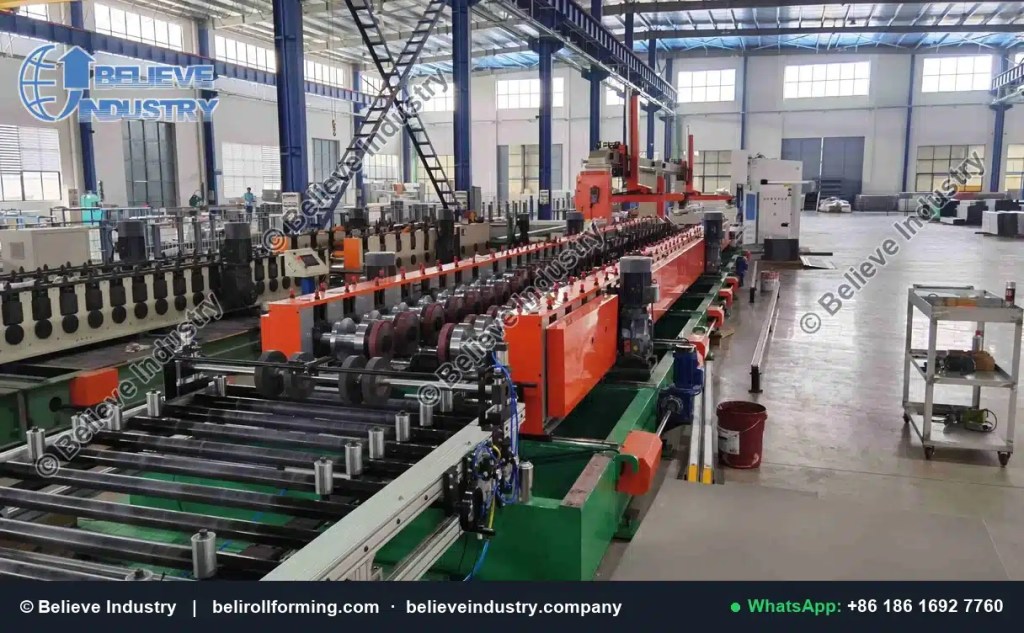
Cable tray machine upgrade: full line with decoiler, roll stands and run out

Cable Tray Machine Upgrade: 5 Retrofit Steps, 40% More Output

Need a Roll Forming Machine for Your Project?
Get a free quote from Believe Industry — 15+ years of custom roll forming manufacturing.
Request a Quote Download Catalogue

Cable Tray Machine Upgrade: 5 Retrofit Steps That Lift Output by 40 Percent

Keywords: cable tray machine upgrade, cable tray line retrofit, servo punching, flying shear cut off, automatic stacking, cable tray line output, retrofit versus new line

Short answer

A cable tray machine upgrade rebuilds the weak stations of a line you already own. The usual scope is a servo punch press, a flying cut off, an automatic stacker and new controls. Budget runs 80,000 to 150,000 USD, output rises 25 to 40 percent, and payback lands in 12 to 18 months.

A cable tray machine upgrade only pays when the frame, the stands and the shafts are still sound. If the line was built for 1.2 mm strip and you now sell 2.5 mm tray, no retrofit saves it. The audit in step one decides that question before anyone signs a purchase order.

Most cable tray lines delivered before 2015 share one weakness. The punch press works in steps, so the line waits for the press on every pitch. The forming stands can run 25 m/min, and the press holds the same line to 3 or 4 m/min. A cable tray machine upgrade moves the bottleneck, and the bottleneck is where the money is.

When a cable tray machine upgrade beats a new line

A retrofit is a mechanical decision, not a budget decision. The table below is the screen we use on enquiry. Five of the seven rows point to an upgrade. Two of them point to a new line, and no supplier should talk you out of that.

Situation on your lineCable tray machine upgradeNew line
Frame and stands sound, 12 to 22 stands, shafts 60 mm or largerYesNot needed
Line built for 0.8 to 1.2 mm strip, you now need 2.0 to 2.5 mmNoYes
Punch press limits the line to 3 or 4 m/minYesNot needed
Width change eats a full shiftPartial, with motorised width and recipesOnly if you need cassette speed
Cut length tolerance of plus or minus 3 mm, customer wants plus or minus 1 mmYes, with a flying cut offNot needed
Three operators stacking by handYes, with an automatic stackerNot needed
Fewer than 10 stands or 50 mm shaftsNoYes

The first question is shaft diameter. A 50 mm shaft carries a light section at low tension. Put a 2.5 mm trough with return flanges through it and the shaft deflects, the section opens, and the holes drift. A new stand set costs more than the rest of the upgrade combined, and that is where a new line wins.

The second question is stand count. A shallow C channel tray needs 12 to 14 stands. A perforated trough with return flanges needs 18 to 22. If your line has 12 stands and the new tray needs 20, a cable tray machine upgrade cannot add stations into a frame that has no room. Our guide to what a cable tray roll forming machine is sets out station counts per tray type.

What the five steps replace

A cable tray machine upgrade is modular. You can buy one step, three steps or all five. Each step has its own price band and its own effect on output. Prices below are 2026 shop figures for a line running 100 to 600 mm tray, and they exclude freight and civil work.

StepWhat changesTypical price (USD)Output effectLine downtime
1. Audit and baselineMeasurement, not hardware3,000 to 8,000None directly, protects the restNone
2. Servo punch and feederHydraulic step press to servo press with servo feeder35,000 to 65,000Largest single gain, 30 to 50 percent3 to 4 days
3. Flying cut offStop and cut to track and cut18,000 to 35,000Removes the stop at every cut2 to 3 days
4. Run out and stackerManual stacking to automatic count and stack15,000 to 30,000Frees 1 to 2 operators1 to 2 days
5. Controls and recipesRelay logic to PLC with stored recipes8,000 to 18,000Cuts changeover and scrap1 to 2 days

The five steps overlap. A servo punch without a flying cut off still stops at every cut, so the punch gain is capped. A flying cut off without automatic stacking leaves the line waiting for a person at the end. That is why a cable tray machine upgrade sold as one package usually beats the same money spent on one large component.

One constraint sits above all five steps. The finished section must stay inside the envelope of NEMA VE 1 in North America or IEC 61537 in Europe, the Middle East and Asia. A cable tray machine upgrade changes how the section is made. It must not change the section the buyer already approved.

cable tray machine upgrade full line

Step 1: Audit the line and find the real bottleneck

Run the line for one full shift and record four numbers. Metres produced. Minutes stopped and why. Metres scrapped. Punches per minute actually achieved. Most plants guess the bottleneck and guess wrong.

Take a perforated tray at 12 pitches per metre. A hydraulic press with a 1.2 second cycle gives roughly 4 m/min. A 0.8 second servo cycle gives roughly 6.2 m/min. The forming stands were never the limit. If the audit shows 3.5 m/min on a line rated 25 m/min, the press is the target and the cable tray machine upgrade should start there.

The audit also protects you. Without a baseline, no supplier can prove a 30 percent gain after the retrofit. With one, the acceptance test at the end of the project has a number to hit.

Step 2: Servo punching replaces the step press

The servo press is the core of most retrofits. A servo motor drives the ram, so stroke, speed and dwell are programmable. The press can punch while the feeder indexes, and it can skip a pitch when a pattern needs it. Tonnage stays in the same range, 40 to 125 t for tray work, because the die decides the tonnage, not the drive.

Two details decide whether the retrofit fits. First, the die set must match the new press bed and shut height. Second, the feeder must hold pitch accuracy of plus or minus 0.1 mm at speed. A cable tray machine upgrade that keeps an old mechanical feeder will lose the gain in hole drift.

cable tray punch press retrofit

Die sets are per pattern. Ventilation slots, splice holes, mounting holes and rung holes all live in the die. Ask for the full die list in the quotation, and ask which dies from the old press can be adapted. Adapting a die is usually cheaper than a new die, but only if the shut height allows it.

Step 3: Flying cut off removes the stop at every cut

A stop and cut unit halts the strip, cuts, then restarts. At 6 m lengths, that is a stop every 30 seconds at 12 m/min. A flying shear tracks the moving profile and cuts on the fly, so the strip never stops. Length accuracy improves from plus or minus 3 mm to plus or minus 1 mm on most lines.

The flying shear guide explains the hydraulic and servo tracking options. For tray, a servo flying shear is the usual choice because tray lengths are long and the cut repeat is high. A cable tray machine upgrade that adds a flying shear but keeps a worn run out table will still mark the tray surface.

Step 4: Run out and automatic stacking

Manual stacking ties one to three people to the end of the line, and it caps output at whatever a person can lift. An automatic stacker counts lengths, forms a bundle and pushes it out on a pallet. For 3 m tray the usual bundle is 20 to 40 pieces, and for 6 m tray 15 to 25.

An automatic stacker is also a safety upgrade. Manual handling of 6 m hot dip galvanised tray is the most common injury point on a tray line. The galvanizeit handling guidance explains why coated tray marks so easily. For a plant running 6 m lengths, step 4 is often the first part of a cable tray machine upgrade to pay back. It removes labour and damage at the same time.

cable tray run out and stacker upgrade

Stacking is where the line reveals its true capacity. If the stacker handles 18 m/min, a punch upgrade to 12 m/min is fully usable. If the stacker handles 8 m/min, the line will queue at the end and the gain shrinks.

Step 5: Controls, recipes and operator handover

Old lines change width with hand wheels and a tape measure. A new PLC stores a recipe per width and per hole pattern. The operator selects the recipe, the line sets punch positions and cut length, and the first piece confirms the setting.

Recipe control is where a cable tray machine upgrade touches the automatic size change question. If you already have motorised width adjustment, a recipe layer removes most of the remaining setup time. If width is set by hand, the recipe saves the arithmetic but not the spanner work.

servo feeder and punch press cable tray

Budget two days of operator training before production restarts. A servo press that nobody trusts will be run in manual mode, and manual mode gives back the whole gain.

What a cable tray machine upgrade cannot fix

Be blunt with yourself about four limits. First, frame rigidity. A light frame twists under a heavier section, and no cable tray machine upgrade corrects that. Second, stand count and roll design. Missing stations cannot be added into a full frame. Third, shaft and bearing size. Thin shafts limit thickness and tension. Fourth, straightener capacity. A leveler sized for 1.2 mm will not flatten 2.5 mm coil, and unflat coil ruins hole position.

If two or more of those limits apply, compare a new line. The cable tray line cost guide sets out what a new line includes, so the comparison is like for like.

Downtime plan for a cable tray machine upgrade

Most retrofits run in a planned shutdown of 5 to 8 days. The sequence below is for a full five step scope. Partial scopes compress it.

DayWorkOutput
Before shutdownPre assemble skids, test servo press, label cablesLine still running
Day 1Isolate, lock out, remove old press and feederNone
Day 2 to 3Install servo press, feeder, align to the first standNone
Day 4Flying cut off, tracking encoder, run out changesTrial lengths
Day 5Stacker, controls, recipes, safety interlocksTrial bundles
Day 6 to 7First article, tolerance check, operator trainingRamp up
Day 8Handover with signed acceptance recordFull output

Lock out and tag out applies to every task in the table. The OSHA 1910.147 procedure is the reference most export buyers ask to see in the method statement.

cable tray flying shear cut off

Plan the shutdown around your order book, not around the supplier calendar. A tray plant that stops in its peak month loses more than the retrofit gains.

Cost, output and payback

The arithmetic is simple and it is worth doing before the quotation arrives. Take a line at 4 m/min, one shift of 8 hours, 250 working days. At 70 percent availability that is 3,360 m per day, or 840,000 m per year.

A cable tray machine upgrade that lifts line speed to 6 m/min raises output to 1,260,000 m per year at the same availability. At a contribution of 0.60 USD per metre, the extra 420,000 m adds 252,000 USD a year. Against a 120,000 USD retrofit, payback is under six months.

Most real plants land between 12 and 18 months, because demand, not capacity, sets the extra metres sold. The formula still matters. It tells you the minimum volume that justifies the spend, and it shows which step buys the most metres for the money.

ScenarioLine speed beforeAfter upgradeExtra metres per yearPayback at 0.60 USD/m
Punch only4 m/min5.5 m/min315,0009 to 12 months
Punch and shear4 m/min6.5 m/min525,00010 to 14 months
Five step scope4 m/min6.5 m/min plus 2 operators525,000 plus labour12 to 18 months

The labour line is real money. Two operators at 6,000 USD a year each is 12,000 USD of cost removed, and that number arrives every year without a sales effort.

What to put in the retrofit contract

A cable tray machine upgrade fails on scope wording more often than on hardware. Six items belong in the contract.

  1. Baseline numbers, measured on your line, with the method written down.
  2. Acceptance targets, in metres per shift and in cut length tolerance.
  3. Die list, including which old dies are adapted and which are new.
  4. Downtime cap in days, with a daily penalty clause.
  5. Spare parts list for the first two years, priced.
  6. Training days and the name of the person who signs off.

Run the acceptance test on your own material, not on the supplier sample coil. Coil with heavy coil set or a different coating changes the result, and the argument afterwards costs more than the test. A cable tray machine upgrade with a clear acceptance target is easier to defend in month six, when the line has been through a busy period.

Frequently Asked Questions

Q: How much does a cable tray machine upgrade cost?

A full five step upgrade runs 80,000 to 150,000 USD, excluding freight and civil work. A punch and feeder retrofit alone is 35,000 to 65,000 USD. A servo punch plus flying cut off, the most common pair, sits at 55,000 to 95,000 USD. A new line starts near 250,000 USD, which is why the comparison is worth doing.

Q: Can you retrofit servo punching onto an old cable tray line?

Yes, if the frame accepts a new press bed and the die shut height can be matched. Check three things first: bed opening size, distance from press centre to the first forming stand, and feeder pitch accuracy. A cable tray machine upgrade that keeps a worn mechanical feeder will lose the gain to hole drift within a month.

Q: How long does the line stay down during a cable tray machine upgrade?

Five to eight days for the full scope, three to four days for punch and feeder only. Pre assembly off line removes two days. Plants that run the retrofit over a planned holiday break often lose no production at all.

Q: Will a cable tray machine upgrade improve cut length tolerance?

Yes, when a flying cut off is part of the scope. Stop and cut units hold plus or minus 3 mm on long lengths. A servo flying shear holds plus or minus 1 mm and removes the stop at every cut. If length tolerance is not a complaint from your customers, spend the money on the press first.

Q: Can an upgrade let me run wider or thicker tray?

Width yes, within the frame and shaft limits. Most lines take 100 to 600 mm after a width upgrade. Thickness is different. A line built for 1.2 mm cannot safely run 2.5 mm without new shafts, bearings and often new stands, and at that point a new line is the honest answer.

Q: How do I know if my line is worth upgrading?

Measure shaft diameter, stand count, frame condition and straightener capacity. If shafts are 60 mm or more, stands are 14 or more, and the frame is straight, the line is a good candidate. If two or more of those fail, price a new line before you price a cable tray machine upgrade.

Where to go next

The cable tray roll forming machine product page lists delivered layouts with station counts. If the section itself is still open, the ladder versus perforated tray comparison settles the tray type first. For a retrofit quote, send four things: a photo of the line, the shaft diameter, the current metres per shift, and one dimensioned tray drawing with its hole pattern. Those four inputs are enough to price a cable tray machine upgrade without a site visit.

Last updated: 2026-11-18

Article Changelog

2026-11-18: Initial publication. Five step retrofit scope, decision table against a new line, downtime plan, payback arithmetic, contract items and 6 FAQ.

Next Review Triggers

Servo press and flying shear prices move more than 10 percent; new cable tray machine upgrade project data from shipped lines; NEMA VE 1 or IEC 61537 revision; quarterly SERP check for the focus term.

Table of Contents

New Updates