Address
No 1, Yd Road, Huishan District, Wuxi City, Jiangsu. 214183
Work Hours
Monday to Friday: 9AM - 5PM
Saturday: 9AM - 4PM
Address
No 1, Yd Road, Huishan District, Wuxi City, Jiangsu. 214183
Work Hours
Monday to Friday: 9AM - 5PM
Saturday: 9AM - 4PM

A flying shear is a cut-to-length device that moves forward with the moving metal profile while cutting it, then returns to the start position for the next cut. It lets a roll forming line keep running at full speed instead of stopping for every piece. Most roof sheet, purlin, and cable tray lines sold today use either a hydraulic flying shear or a servo flying shear. That choice drives cut speed, length accuracy, blade life, and total line cost.
Flying shear definition: a flying shear is a cutting unit mounted on a moving carriage that matches the strip speed during the cut, so the profile never stops moving. It is the standard cutting system for continuous roll forming lines running above 10 m/min.
A static shear forces the line to stop, cut, and restart for every length. That cycle eats 2 to 5 seconds per piece. A flying cut-off removes the stop, which is worth roughly 30% more sheets per shift on a typical roofing line.
The shear sits on a carriage that slides on linear guides or a rack and pinion. When the profile reaches the programmed length, the PLC triggers the cut. The carriage accelerates to line speed, the blade closes, the carriage returns, and the line never slows. Two motion designs dominate:
Every cut-off unit shares the same core parts: carriage, drive, blade holder, die set, and a PLC that reads length from an encoder on the forming line. The encoder is the part most buyers ignore, and it decides whether lengths land at plus/minus 1 mm or plus/minus 3 mm. Academic research on flying shear design documents the mechanics behind this cycle.
Feature | Static (stop-cut) shear | Flying cut-off |
Line behavior during cut | Stops, cuts, restarts | Runs continuously |
Output at 20 m/min, 3 m parts | About 320 pcs/hour | About 400 pcs/hour |
Length accuracy | Good, no tracking error | Depends on servo follow |
First cost | Lower | Higher |
Best suited to | Short runs, low speeds | Continuous, high-volume lines |
Flying cut-off is not always right. A shop making 200 short pieces a day saves nothing by flying the cut. A contractor running 10,000 linear meters a week loses money on a static one. Match the cutting system to production volume, not the brochure.
A hydraulic flying shear uses a cylinder to push the blade through the profile. The carriage is driven by a hydraulic motor or mechanical linkage. Cutting force stays high through the stroke, which matters for thick steel and wide profiles.
What hydraulic cut-off does well:
Where it struggles:
A servo flying shear replaces the cylinder with a servo motor and ball screw, rack, or crank. The controller commands exact blade position and speed through every cut. That is why servo cut-off holds lengths at plus/minus 0.5 mm where hydraulics drift past plus/minus 2 mm.
What servo cut-off does well:
Where it costs you:
The market has moved. Servo electric roll forming grew fast through 2024 and 2025, and most new export-grade lines ship with servo cut-off systems. Rollforming Magazine has tracked that shift in its coverage of servo-driven cutting. Believe Industry has built both types for over 15 years and ships to 20+ countries; our 2026 new-line mix sits near 70% servo.
Specification | Hydraulic flying shear | Servo flying shear |
Typical length accuracy | Plus/minus 2 to 3 mm | Plus/minus 0.5 mm |
Max practical line speed | 20 to 25 m/min | 30 to 40 m/min |
Blade stroke control | Variable, oil dependent | Precise, closed loop |
Energy per cut | Higher, unit idles | Lower, on demand |
First cost | Lower | 20% to 35% higher |
Maintenance | Oil, seals, filters | Bearings, ballscrew, tuning |
Best for | Thick profiles, budget lines | Thin coated sheet, high output |
Run the numbers on your own material before choosing. The cheapest shear is the one that fails your tolerance spec and has to be replaced.

Three numbers decide if a cutting system fits your line: cut speed, length accuracy, and blade life.
Cut speed. A full cut cycle takes 0.5 to 1.5 seconds. Hydraulic systems land at the upper end, servo systems at the lower end. The shear must return before the next piece arrives, so cycle rate at your line speed matters more than raw speed.
Length accuracy. Measure it at the speed you will run, not at 5 m/min. A shear that holds plus/minus 1 mm at 10 m/min can drift to plus/minus 3 mm at 25 m/min. On site, every millimeter of error becomes a gap or an overlap in the frame.
Blade life. Expect 100,000 to 500,000 cuts between regrinds depending on material and blade grade. On 0.5 mm coated sheet, 300,000+ cuts is realistic. On 3 mm structural steel, far less. Budget blade cost into the per-meter price.
Blade grade decides edge quality and cost per cut. The common grades are SKD11, D2, M2 high-speed steel, and carbide-tipped blades for high-volume thin sheet lines. Tooling makers such as Roll-Kraft publish grade guidance for roll forming cut-off dies, and trade coverage from The Fabricator regularly benchmarks blade life across material thicknesses.
Blade grade | Best for | Life vs cost | Weakness |
SKD11 / D2 | Default roll forming cut-off | Good life, low cost | Slower wear on thick steel |
M2 HSS | Thicker steel | Long edge life | Higher cost, needs proper grinders |
Carbide-tipped | Thin coated sheet, high volume | Longest life | Brittle if misaligned, highest price |
Blade gap and overlap must be set per material. Too tight a gap tears thin sheet. Too wide a gap rolls a burr on thick steel. Reset the gap at every blade change and log settings per material. The cold roll former cutting position guide covers how the blade should enter and exit the profile.
A flying cut-off can sit before the last forming stations (pre-cut) or after the full profile is formed (post-cut). Post-cut is the common setup: the profile is fully formed, then cut, so edges stay clean and the die matches the final shape. This is what most buyers mean by a flying cut-off.
Pre-cut blanks the strip before forming. It avoids a profile-shaped die but limits production to the blank length and complicates coil joining. For the full trade-off on waste, tooling, and accuracy, see our pre-cut and post-cut difference guide.
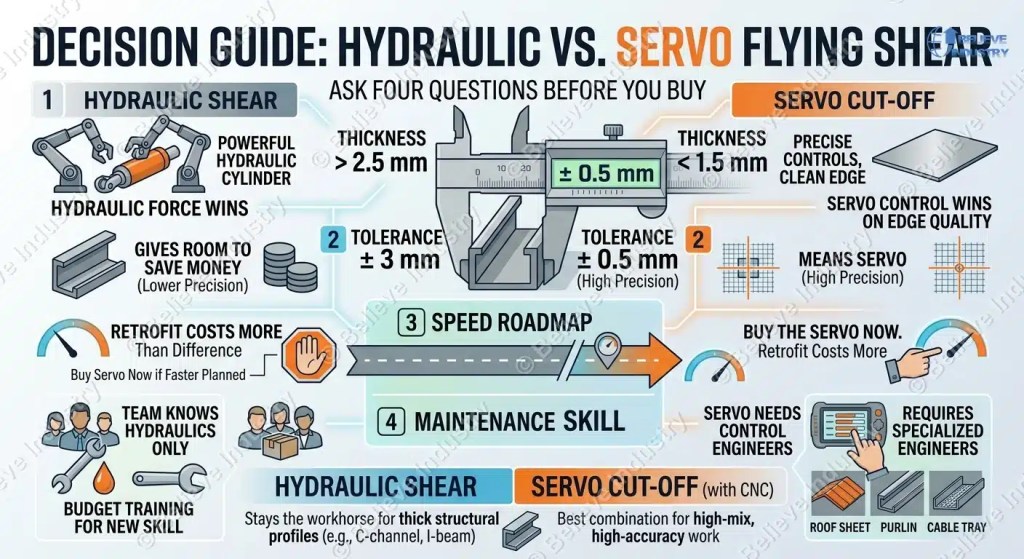
Ask four questions before you buy:
A CNC roll forming machine with a servo cut-off is the best combination for high-mix, high-accuracy work. A hydraulic shear stays the workhorse for thick structural profiles.

A hydraulic cut-off adds about 8,000 to 15,000 to a line. A servo version adds 12,000 to 25,000. The servo premium pays back when output rises 20% to 30%, scrap drops because lengths hold tolerance, and changeover time falls because recipes are stored in the PLC.
Run the math on your shift output. At 400 sheets per shift, a 25% gain is 100 extra sheets. At 3 of margin each, that is 300 per shift, which repays the premium in roughly 60 shifts. The roll forming machine price guide shows how the cutting system moves the total quote.
Buyers repeat the same five mistakes:


An electrical roll forming machine turns steel coil into the...
Read More

What Is a Container Roll Forming Machine? Container roll forming...
Read More
What Is an Upright Rack Column Roll Forming Machine? An...
Read More
Drainage roll forming machine lines turn steel coil into the...
Read More English English
  Español
 Português
 Русский
 العربية
 Bahasa Melayu
 Türkçe
 ไทย
ไทย
 Bahasa Indonesia