Address
No. 1 Yudong Road, Huishan District, Wuxi City, Jiangsu. 214103
Work Hours
Monday to Friday: 9AM - 5PM
Saturday: 9AM - 4PM
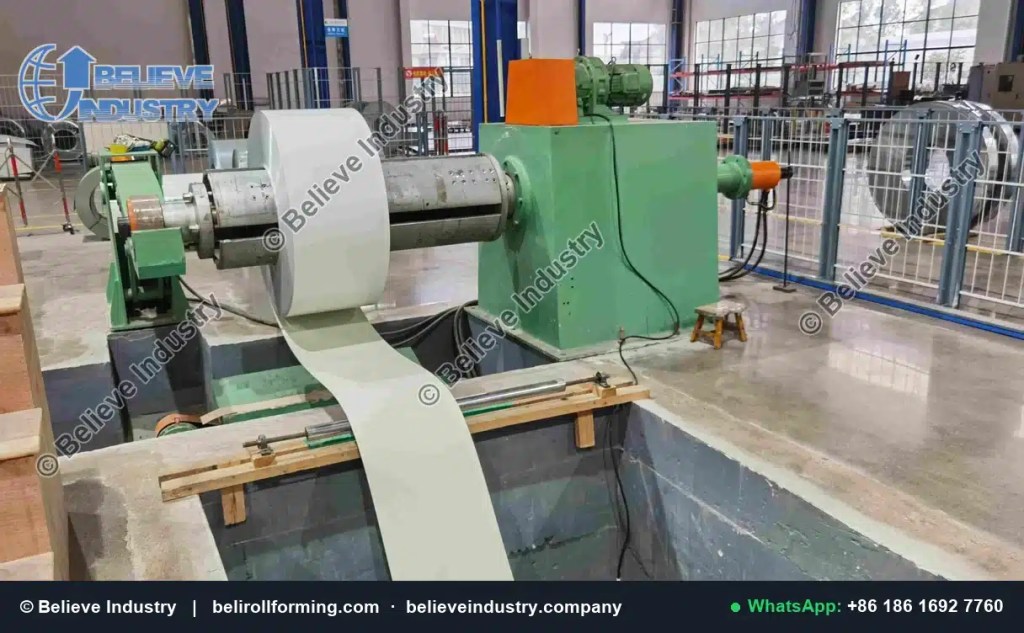
Cable tray coil width is the strip width that feeds the roll forming line, and it is decided by one calculation, the developed width of the tray section, plus a working margin of 8 to 15 mm. Set it well and total scrap stays between 2 and 5 percent of the coil you buy. Set it loosely and scrap doubles before anyone notices.
The cable tray coil width itself is not negotiable at the machine. The section demands a fixed developed width, so the real decisions live around it. How much margin over the developed width. What edge trim you accept on galvanized coil. How you recover punch scrap and cut loss. And how you turn the whole chain into a quote number.
This guide walks the calculation, names the six places scrap hides, and shows the reverse quote method, where you work backwards from yield per coil to cost per metre. Buyers who quote this way catch margin errors that a price list never shows.
Every tray section starts as flat strip. Bending the side walls consumes a little length at each bend, so the flat width is not the sum of the legs. The flat width is the developed width, and it follows from the section drawing through bend allowance.
| Tray section | Legs and flanges | Developed width, about | Working coil width |
|---|---|---|---|
| Ladder side rail 100 by 50 mm | 2 side walls, 15 mm return flange | 240 to 250 mm | 255 to 265 mm |
| Perforated trough 100 by 50 mm | 2 side walls, small return | 245 to 255 mm | 260 to 270 mm |
| Perforated trough 300 by 100 mm | 2 side walls, 20 mm return flange | 560 to 580 mm | 575 to 595 mm |
| Ladder side rail 300 by 100 mm | 2 side walls, 20 mm flange | 565 to 585 mm | 580 to 600 mm |
| Cover strip for 300 mm tray | Single pan, 2 small turns | 330 to 345 mm | 345 to 360 mm |
The exact numbers belong to your roll tooling drawings, and the four tray types compared explains why ladder rails and perforated troughs of the same nominal size develop differently. The lesson for the coil buyer is simpler. Every tray width in your catalogue maps to one cable tray coil width, and that mapping is fixed by tooling, not by preference.
If the tray type itself is still an open question, start with what a cable tray roll forming machine is and match the section to the market first.
Cable tray coil width is specified as developed width plus margin. The margin exists for three reasons: mill edge condition, width tolerance from the slitter, and small drift as the strip wanders through the punch and the stands.
| Margin over developed width | What it buys | What it costs |
|---|---|---|
| 8 to 10 mm | Covers slit tolerance and edge wave | Tight but workable, needs a good slitter |
| 11 to 15 mm | Comfort on edge trim, room for camber | Adds 1 to 2 percent to material input |
| Over 15 mm | Almost never justified | Pure scrap, trimmed off every metre |
Two mistakes dominate. The first is ordering exactly the developed width to save material. One bad slit edge and the flange comes up short, and the whole coil goes to rework. The second is padding the margin to feel safe. Twelve extra millimetres on a 260 mm strip is nearly 5 percent of the coil, gone forever, on every metre.
The honest approach is to fix cable tray coil width once, in writing, per tooling set. Then hold the slitter to it. Our general guide to coil width calculation for roll forming covers the same margin logic for other profile families, and the numbers transfer.
Cable tray coil width sets the ceiling on yield, but the scrap report has six lines, and width is only one of them. The table below is a realistic breakdown for a perforated tray line running 1.5 mm pre galvanized coil, one shift, mixed lengths.
| Scrap source | Typical share of coil | Where it comes from | Control |
|---|---|---|---|
| Edge trim | 1.5 to 3.0 percent | The margin, cut or folded off both edges | Fix the margin, tighten slit tolerance |
| Punch waste | 0.3 to 0.8 percent | Vent holes and slots, punched out of the web | Larger holes cost more scrap, nest patterns on the die |
| Cut off kerf | 0.1 to 0.3 percent | Shear blade clearance at every cut | Longer lengths dilute it, sharp blades reduce it |
| Head and tail | 0.2 to 0.5 percent | Thread up, tail out, coil butt joints | Operator technique, coil end welding where fitted |
| Setup pieces | 0.5 to 2.0 percent | Width and pattern changes, first articles | Batch orders, recipe storage on the line |
| Rejects and rework | 0.5 to 1.5 percent | Holes off pitch, flange waviness, surface marks | First article discipline, straightener setup |
Sum the middle of each band and you land near 3.5 percent, which is why 2 to 5 percent is the honest overall band for a running line. Two observations follow for anyone tuning cable tray coil width and scrap together.
Setup pieces swing more than any other line. A plant that changes width three times per shift pays a setup tax all day. This is where automatic size change on a cable tray machine pays back, because stored recipes cut the setup scrap, not just the setup minutes.
Edge trim is the widest band, and it is set at cable tray coil width ordering time, not on the line. Once the margin is bought, the scrap is bought.
Ventilation holes dominate the look of a perforated tray, so buyers assume the punch eats serious material. It does not. Open area on a perforated tray web runs 20 to 40 percent, but the punched slugs collapse into a small bin, and against the coil mass the share stays under 1 percent. Cable tray coil width sets the ceiling on yield, and the punch only trims a fraction from it.
The number that matters more is pattern nesting on the die. A die that punches holes only where the pattern needs them, instead of a full grid everywhere, trims punch waste and speeds the line at the same time, because fewer holes per hit means shorter dwell.
For the hardware behind that logic, the cable tray machine upgrade guide shows what a servo press changes, including skip punching on the fly.
Here is the calculation that turns cable tray coil width into money. Work it before the price discussion, not during.
Take a 300 by 100 mm perforated trough, 1.5 mm thick, running on 585 mm strip. One tonne of coil contains:
Strip volume per metre is 0.585 by 0.0015 by 1 m, which is 0.0008775 cubic metres. At 7,850 kg per cubic metre, one metre weighs about 6.9 kg. One tonne therefore holds about 145 metres of raw strip.
Apply the yield. At 4 percent total scrap, sellable output is about 139 metres per tonne. At a coil price of 780 USD per tonne, material cost per metre of finished tray is about 5.60 USD.
Now move the cable tray coil width. If the margin was set 15 mm too wide, strip runs 600 mm instead of 585, one metre weighs 7.07 kg, and the same coil yields 141 raw metres, about 135 sellable. Material cost rises to about 5.80 USD per metre. On 300,000 metres per year, that lazy 15 mm costs 60,000 USD a year, forever.
The same arithmetic runs backwards from a quote. If the market pays 9.50 USD per metre and your conversion cost is 2.20 USD per metre, the coil price you can afford is fixed. Cable tray coil width then decides whether that price leaves margin or loses it. This is the check most price lists skip, and it is the reason two plants running identical machines earn different money.
Cable tray coil width is delivered by the slitter, so the slitting specification carries your margin. Three lines belong in the purchase order.
First, width tolerance, because it keeps cable tray coil width inside the margin you specified. Ask for plus or minus 0.5 mm on slit widths for tray work, and measure incoming coils, because slitters drift as blades wear. Second, edge condition. Slit edges carry burr and camber, and a burred edge shows up later as a flange defect and a glove hazard. Third, camber limit. Strip that snakes 5 mm over 2 m fights the edge guide all shift, and the fight shows up as width wander at the punch.
Coating changes the edge story too. Hot dip galvanizing after forming seals the slit edge, while pre galvanized coil exposes it. The galvanizing industry guidance explains why cut edges are the corrosion weak point on pre coated stock, which is another reason not to buy more margin than the tooling needs. Every extra trimmed millimetre is an extra bare edge on some designs.
For thickness and grade selection behind the width, the cable tray line cost guide shows how material share dominates the budget, and NEMA VE 1 remains the reference for the load classes the section must meet in North America. European buyers work to IEC 61537, and the width logic is identical under both.
Most tray plants do not run one width. They run a width ladder, one cable tray coil width per tray size, and the ladder is where the scrap report gets interesting.
A line set for a 585 mm cable tray coil width cannot run a 100 mm tray without a width change, because the developed widths differ by more than 300 mm. Width changes cost setup time and setup scrap, so the ladder shapes the production plan. Batch the wide trays together, then change once. Plants that interleave sizes pay the setup tax twice per change, once in time and once in the first articles.
When a catalogue keeps growing, count the width ladder before adding tray sizes. A 45 to 60 metre line with a motorised width system handles six to eight widths economically. Beyond that, a second narrow line dedicated to small tray often beats one giant line that changes width all day.
Q: How is cable tray coil width calculated?
Q: What scrap rate is normal for cable tray production?
Q: How much does a wrong cable tray coil width cost per year?
Q: Should I buy coil at exactly the developed width to save material?
Q: Does perforation waste a lot of coil material?
Q: Can one line run all tray widths from one coil width?
The cable tray machine cost guide puts the material number into the full budget, and the NEMA type explainer maps which tray classes your width ladder must cover. For a width and yield review of your own catalogue, send the tray drawings, the current strip widths, and one recent scrap report. We return the developed width table, the margin recommendation, and the yield math per tray size. Cable tray coil width is the cheapest variable in the plant to fix, and the fastest one to pay.
Last updated: 2026-11-19
Article Changelog
2026-11-19: Initial publication. Developed width method with a section table, the 8 to 15 mm margin rule, a six line scrap breakdown, the reverse quote method with worked numbers, slit coil specification and 6 FAQ.
Next Review Triggers
Coil prices move more than 10 percent; a shipped line adds new yield benchmark data; NEMA VE 1 or IEC 61537 revision; quarterly SERP check for the focus term.
Cable Tray Coil Width and Scrap: Yield From Coil to...
Read MoreUpright Punch Tooling for 3 US Hole Patterns: Teardrop, Keyhole,...
Read MoreCable Tray Machine Upgrade: 5 Retrofit Steps That Lift Output...
Read MoreHow to Identify Your Pallet Rack Upright: 6 Punch Patterns,...
Read More