Address
No 1, Yd Road, Huishan District, Wuxi City, Jiangsu. 214183
Work Hours
Monday to Friday: 9AM - 5PM
Saturday: 9AM - 4PM

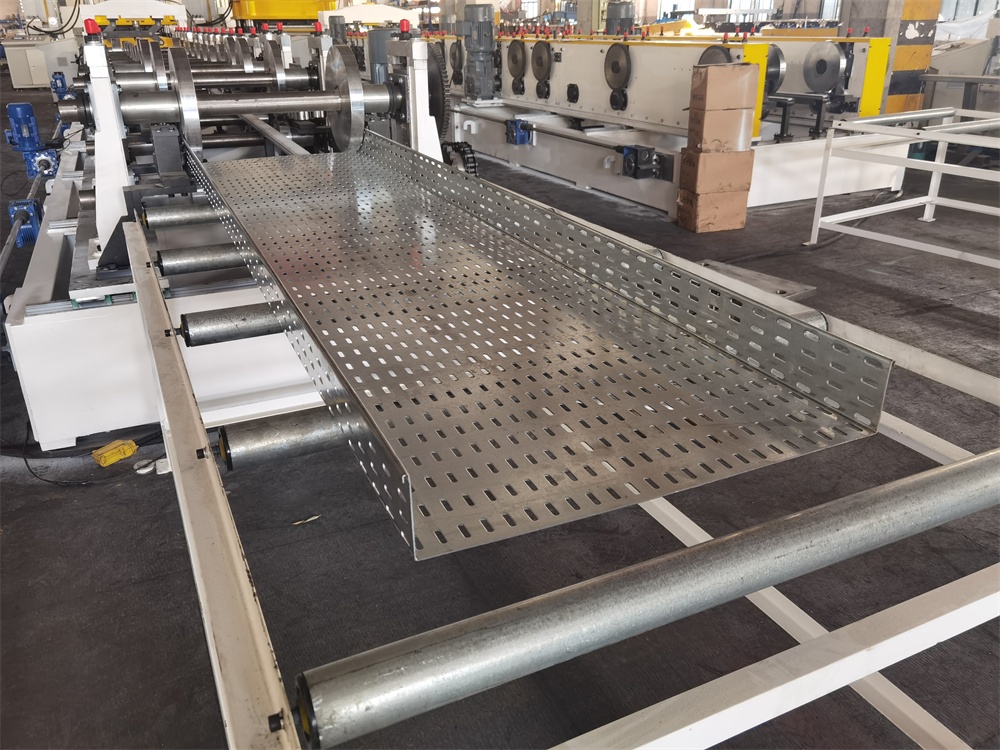
A cable tray roll forming machine turns flat metal coils into finished cable tray profiles in one continuous pass. Raw galvanized steel, stainless steel, or aluminum strip feeds in from one side. Finished tray sections come out the other—cut to length, punched, and ready to ship.
No heating. No welding during forming. Just cold bending through a sequence of precisely machined roller stations.
That is the core of what a cable tray roll forming machine does. It replaces manual bending, slow press operations, and inconsistent hand-fabrication with an automated production line that runs at 10–15 meters per minute.
Cable tray is a structural system that supports routed electrical cables, data lines, and instrumentation wiring in commercial and industrial buildings. According to Wikipedia’s cable tray reference and the National Electrical Code (NEC) Article 392, cable tray is recognized as a recognized support system—distinct from conduit and open wiring.
Unlike conduit, cable tray lets you lay new cables directly into the tray without pulling them through a pipe. That makes future upgrades and cable additions fast and cheap.
This is why cable tray has become the default choice for:
The NEMA VE 1 standard governs cable tray classification, load testing, and material specifications in North America. Similar standards like CSA C22.2 apply in Canada.
Not every cable tray machine produces the same profile. Tray type depends on the application, cable load, and environment. The EIA/TIA cable tray standards further classify installation requirements by industry sector.
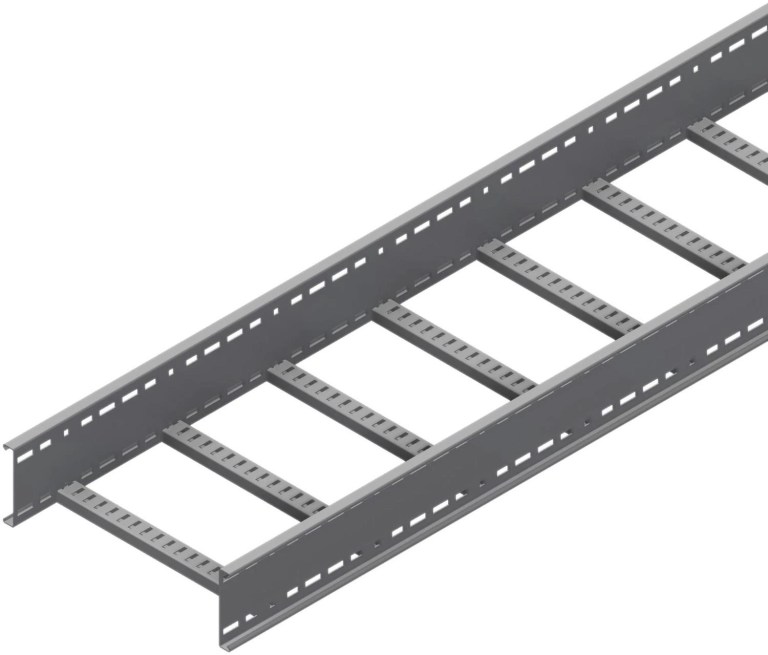
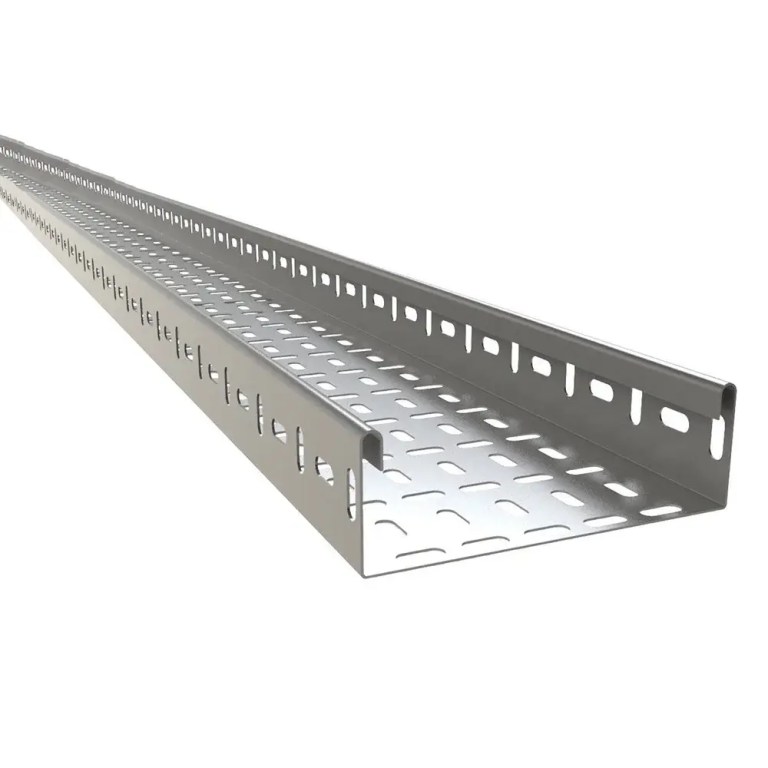
Ladder-type trays have two parallel side rails connected by rung bars at regular intervals. They offer maximum ventilation and the easiest cable access. Most heavy-duty power installations use ladder tray because the rung structure provides high strength-to-weight ratio. This is the most common profile produced on a cable tray roll forming machine.
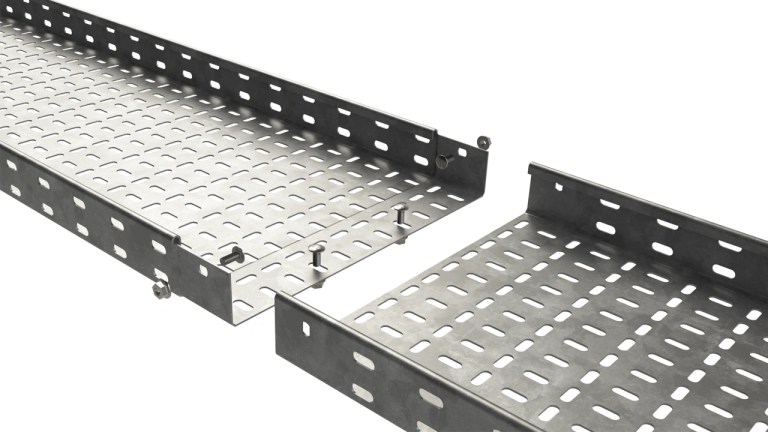
Perforated trays have a solid bottom with ventilation holes punched in a pattern. They offer more cable support surface than ladder trays while still allowing some airflow. Common in commercial buildings and light industrial settings.
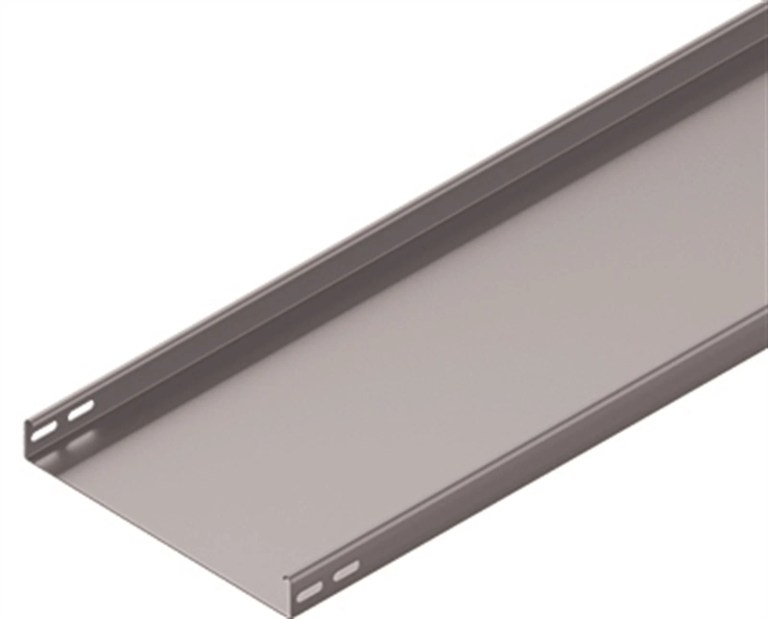
Solid bottom trays enclose cables completely. They provide maximum protection from dust, debris, and physical damage. Used in clean rooms, food processing plants, and areas with falling object hazards.
Channel tray is a single-piece trough—no cover, no perforations. Simple, low-cost, and suited for small cable runs. Often used for instrumentation and control wiring. Some buyers start with a basic cable tray machine for channel profiles, then upgrade to a full production line as order volume grows.
Russian-type cable tray—locally known as лоток (latok)—follows the GOST standard (ГОСТ Р МЭК 61537) rather than NEMA or IEC 61537 directly. The profile geometry differs from Western designs in several ways:
| Feature | Russian-Type (GOST) | Western NEMA/IEC |
|---|---|---|
| Side rail profile | Inward-flanged Z-section | Straight or outward-flanged C |
| Standard widths | 50, 100, 150, 200, 300, 400, 600 mm | 100–600 mm (NEMA steps) |
| Standard lengths | 2,000 mm and 3,000 mm | 3,000 mm (10 ft in NA) |
| Cover attachment | Snap-fit or screw-on, tight-fitting | Clip-on or separate fastener |
| Material standard | GOST 14918 (galvanized sheet) | ASTM A653 / EN 10346 |
| Surface finish | Hot-dip galvanized or powder-coated | Pre-galvanized or HDG |
| Governing standard | GOST R 52868 / GOST R IEC 61537 | NEMA VE 1 / IEC 61537 |
Why the profile difference matters for the roll forming machine:
The Z-section side rail requires a different roll tooling sequence compared to a standard C-channel ladder tray. The inward flange folds back on itself, demanding tighter roller clearances and an additional forming pass. When a buyer in Russia, Kazakhstan, Belarus, or other CIS markets specifies cable tray, they typically require GOST-compliant profiles—which means the cable tray roll forming machine must be tooled specifically for that geometry.
Perforated лоток (ЛПО — perforated tray) and solid-bottom лоток (ЛМ) are the two most common variants in the Russian market. The perforation pattern on ЛПО follows GOST norms with defined hole spacing and edge margins.
A cable tray machine configured for GOST profiles can typically also produce standard Western profiles with a roll changeover, giving manufacturers flexibility for mixed export markets.
A modern cable tray roll former machine can switch between these profiles through roll changeover and PLC-controlled width adjustment. Some lines even handle both the tray and the matching cover on the same equipment.
Material selection affects corrosion resistance, load capacity, and cost. The Steel Construction Institute provides detailed guidance on galvanized steel performance in structural applications. The ASTM A653 specification covers galvanized steel sheet requirements commonly used as feedstock for a cable tray roll forming machine.
| Material | Best For | Typical Thickness |
|---|---|---|
| Pre-galvanized steel | Indoor commercial, standard industrial | 1.0–1.5 mm |
| Hot-dip galvanized | Outdoor, high-corrosion, chemical plants | 1.5–2.5 mm |
| Stainless steel (304/316) | Food processing, marine, pharmaceutical | 1.0–2.0 mm |
| Aluminum | Lightweight installations, offshore platforms | 1.2–2.0 mm |
Pre-galvanized steel is the most common feedstock for a cable tray roll forming machine because it balances cost and corrosion protection. Hot-dip galvanized material is specified when the installation environment demands it—but the thicker zinc coating can accelerate roller wear over time.
This Cable Tray Load & Type Engine is a professional-grade structural tool designed for the electrical and roll forming industries. It calculates the Safe Working Load (kg/m) and Deflection based on NEMA VE 1 standards, allowing users to switch between Ladder, Perforated, and Solid Bottom architectures.
By inputting specific side rail heights, tray widths, and material thicknesses, engineers can determine if a profile will support specific cable weights over a given span. It is an essential utility for optimizing material usage while ensuring compliance with industrial safety and structural integrity requirements.
Industrial Roll Forming Specification Tool
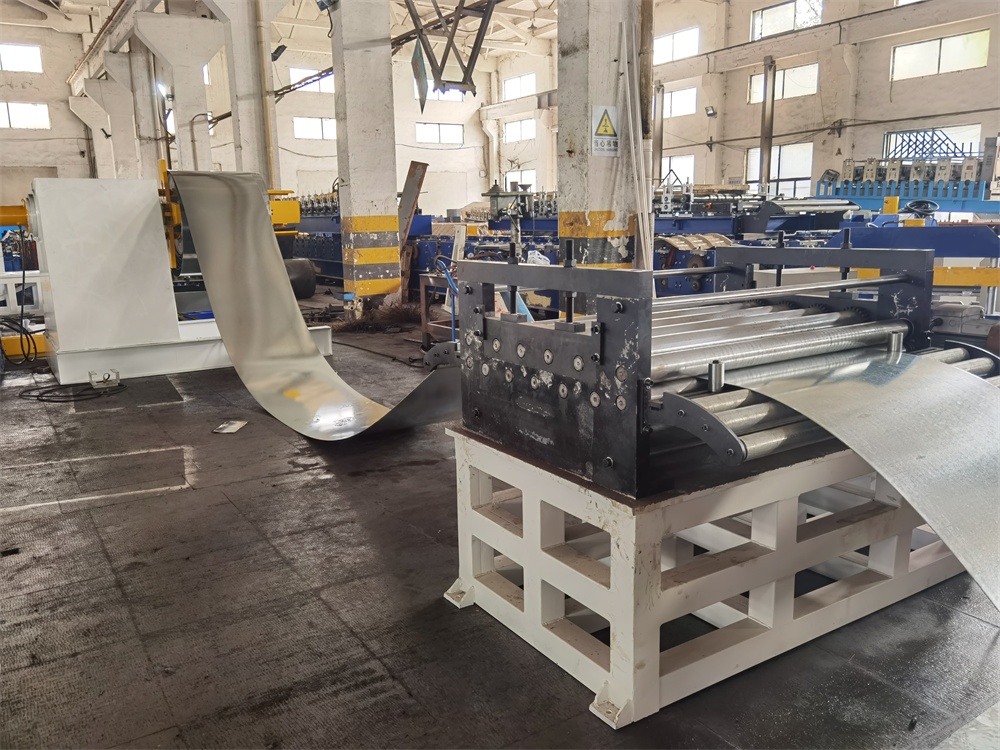
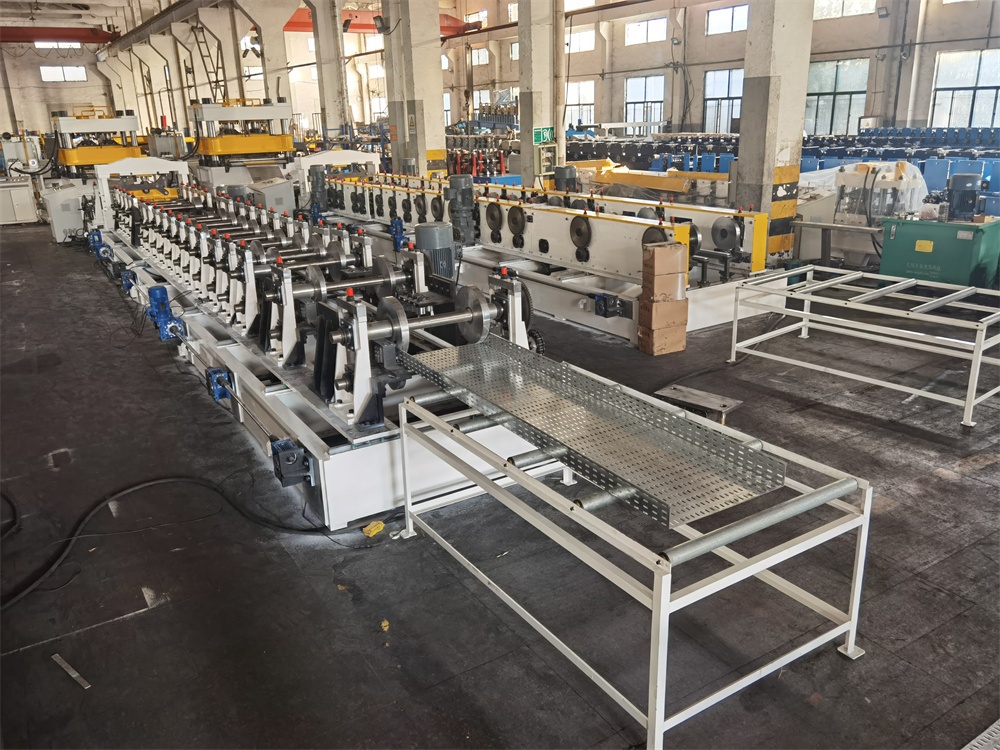
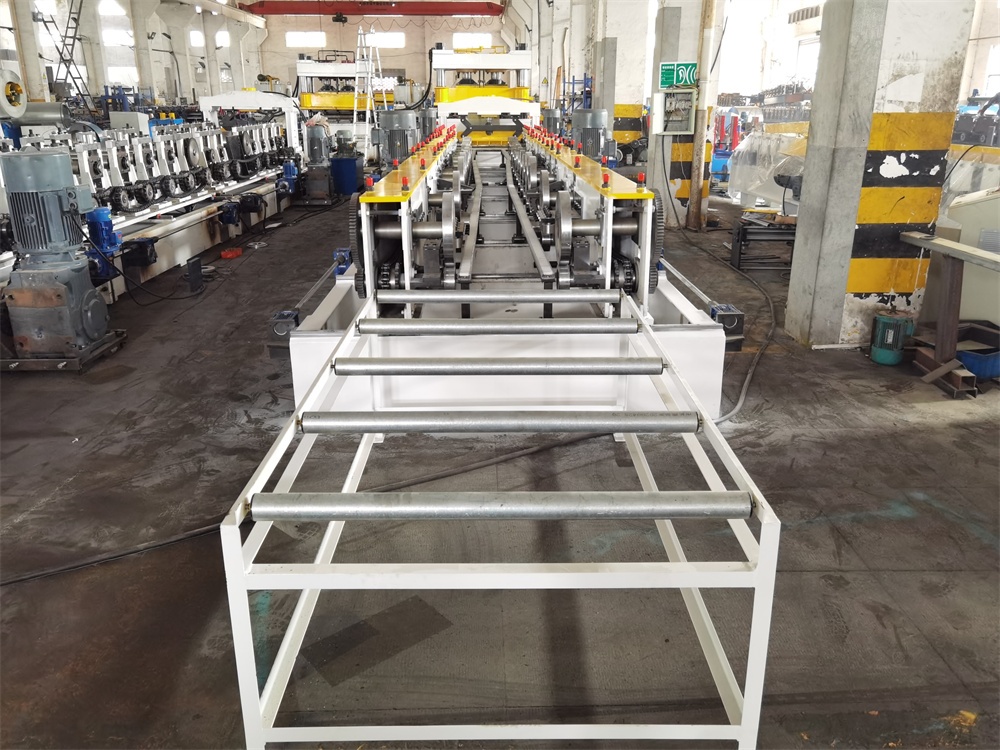
The whole line is consist of Uncoiler, Leveler, Servo Feeder and Punch Press, Roll Former, Cutoff Unit, Controlled Box, Collection Table.

| Parameter | Specification |
|---|---|
| Maximum capacity | 3 tons |
| Inner diameter | 508 mm |
| Outer diameter | Up to 1,500 mm |
| Motor power | 3 kW |
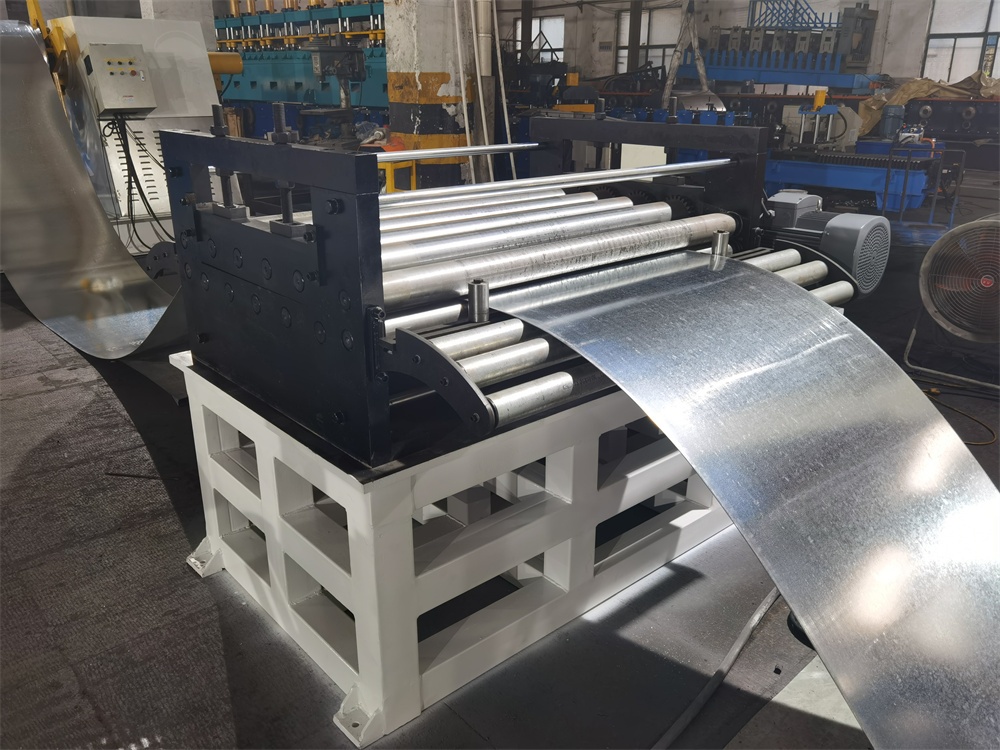
The decoiler holds the coil and feeds strip at controlled tension. A 3-ton capacity handles standard production coil weights for cable tray work.
| Parameter | Specification |
|---|---|
| Configuration | 3 upper + 4 lower (7 total) |
| Shaft diameter | 80 mm |
| Motor power | 3 kW |
Leveling removes coil set and longitudinal curvature from the strip before it enters the forming stations. Without proper leveling, the formed tray will have bow or twist defects. This is especially critical for a cable tray machine that processes pre-galvanized material, where residual stress from the coating process can amplify flatness problems.
| Parameter | Specification |
|---|---|
| Feeding type | Servo-driven |
| Material width | 0–200 mm |
| Material thickness | 0–3.2 mm |
| Feeding motor | 3 kW |
| Max line speed | 200 m/min |
| Punch press model | APA-110 |
| Punch capacity | 110 tons |
| Stroke rate | 60–90 SPM |
| Main motor | 11 kW × 4 |
| Die cushion | 6.3 tons |
The punch press handles all prepunching—mounting holes, ventilation slots, and identification marks. Servo feeding ensures punch position accuracy within ±0.1 mm at production speed.
This is where the cable tray roll former machine separates from cheaper alternatives. A 110-ton press with servo feeding punches clean, burr-free holes in galvanized or stainless material at full line speed.
| Parameter | Specification |
|---|---|
| Forming thickness | 1.0–2.5 mm |
| Forming speed | 10–15 m/min |
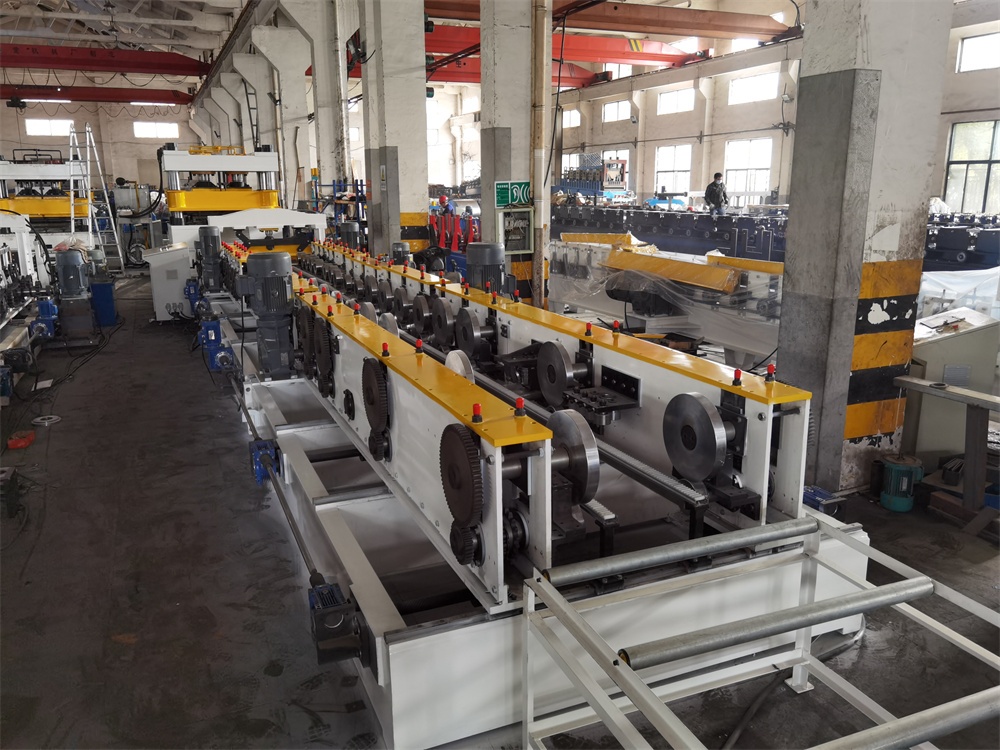
| Forming stations | 22 stands |
| Roller material | GCR15 bearing steel, quenched and tempered |
| Shaft material | ASTM 1045, 75 mm diameter, tempered |
| Drive type | Chain or gear box |
| Motor power | 15 kW |
| Width adjustment | PLC-controlled automatic |
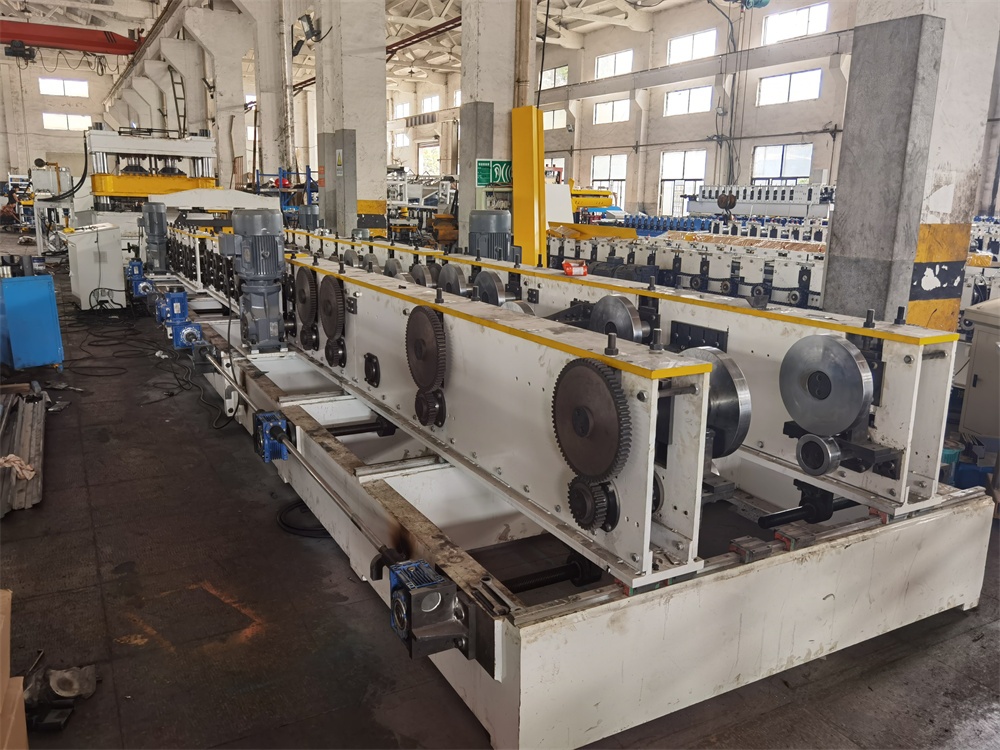
Twenty-two forming stations progressively bend the flat strip into the finished tray cross-section. The roll forming process uses incremental bending at each station—typically 1–3 degrees of angle change per pass—to prevent material cracking and maintain dimensional tolerance.
The PLC-controlled width adjustment allows quick changeover between different tray widths (300 mm, 450 mm, 600 mm) without manual repositioning of the forming stands. This flexibility is a major advantage of a modern cable tray roll former machine over older fixed-width designs.
| Parameter | Specification |
|---|---|
| Cutting type | Tracking hydraulic (non-stop) |
| Blade material | Cr12Mov, HRC 58–62 |
| Hydraulic station power | 15 kW |
Hydraulic cutting runs synchronized with the line. The cutting blade tracks the moving strip, cuts at the target length, and retracts—all without stopping production. Cr12Mov tool steel holds an edge through hundreds of thousands of cuts in standard gauge material. This non-stop cutting capability is essential for a high-output cable tray roll forming machine that targets continuous shift operation.
| Component | Brand |
|---|---|
| PLC | Panasonic or Siemens |
| Encoder | Omron |
| Touch screen | MCGS or Siemens |
| Inverter | Yaskawa |
| Wiring | Aviation plug connectors |
The PLC control system manages the entire line from a single interface. Operators set batch quantity, piece length, and production speed on the touch screen. The encoder tracks material position for accurate length measurement and punch synchronization. A well-configured cable tray roll forming machine relies on this automation to maintain consistent quality across production batches of thousands of pieces.
Production speed depends on material thickness, profile complexity, and punch pattern density.
| Profile Type | Typical Speed | Production Rate (6m pieces/hr) |
|---|---|---|
| Ladder tray 300mm | 12 m/min | ~120 pcs |
| Ladder tray 600mm | 10 m/min | ~100 pcs |
| Perforated tray 450mm | 10 m/min | ~100 pcs |
| Solid bottom 300mm | 15 m/min | ~150 pcs |
A standard cable tray machine running one shift (8 hours) can produce 800–1,200 pieces. That replaces 15–20 manual fabrication stations running the same shift. A cable tray roll forming machine running two shifts doubles that output without doubling labor costs.
Cost varies based on configuration, material range, and automation level. Check our detailed cable tray roll forming line cost breakdown for 2026 for current pricing. The International Electrotechnical Commission (IEC) also publishes reference standards that influence cable tray roll forming machine design requirements for different export markets.
Key cost drivers include:
Compare this with the broader roll forming machine cost landscape to understand where cable tray lines fit in the market.
Believe Industry Company has manufactured and exported roll formed products since 2005. Our factory in Wuxi, China produces a full range of metal forming equipment. Cable tray production lines represent one of our core product categories alongside pallet racking machines, strut channel formers, and slitting lines.
What sets our cable tray roll forming machine apart:
One unit. Beli Rollforming manufactures each cable tray roll former machine to order. No batch minimums.
Yes, with roll changeover. A single cable tray roll former machine handles different tray widths through PLC adjustment. Profile changes (ladder vs. perforated vs. solid bottom) require a roll set change. Changeover typically takes 2–4 hours.
Standard cable tray lines handle 1.0–2.5 mm. Heavy-duty configurations extend to 3.0 mm. The 110-ton punch press accommodates punching through 3.2 mm material. When you specify a cable tray roll forming machine, make sure the thickness range matches your most common orders.
On-site installation and commissioning runs 5–7 days for a standard cable tray production line. This includes mechanical alignment, electrical connection, PLC calibration, test runs, and operator training. Every cable tray roll former machine ships with a detailed setup manual and video documentation.
Most manufacturers recover the equipment cost within 12–18 months through labor savings, material efficiency, and increased output. The Fabricators & Manufacturers Association (FMA) reports that automated roll forming typically reduces per-unit labor costs by 60–80% compared to manual fabrication. See our detailed cable tray line cost analysis for ROI calculations based on your production volume.
One operator monitors the PLC touch screen during production. Loading coils and unloading finished trays may require a second worker depending on coil weight and production speed. Training a new operator on a cable tray roll former machine typically takes 1–2 days of supervised hands-on practice.
Yes. Aluminum cable tray is common in lightweight and marine applications. Roller pressure and speed settings need adjustment for aluminum compared to steel—but the same cable tray machine handles both with configuration changes.
Routine maintenance includes roller lubrication, hydraulic oil checks, punch die inspection, and encoder calibration. A properly maintained cable tray roll forming machine delivers consistent output for 10–15 years. Our roll forming machine lubrication guide covers the complete maintenance schedule.
Ready to spec out your next cable tray machine? Tell us your target profile dimensions, material range, and production volume. Whether you need a ladder tray line, perforated tray system, or a multi-profile cable tray roll forming machine that handles it all—our engineering team will return a detailed proposal with:
Contact Believe Industry Company today for a no-obligation technical consultation.
Don’t let outdated equipment bottleneck your production potential. Take the next step in industrial automation with Beli Rollforming’s world-class solutions.
Consult with our Experts: Get a tailored technical analysis of your specific profile requirements.
Request a Quote: Receive a comprehensive breakdown of our latest cable tray forming lines.
Explore Our Technical Library: Read our comprehensive analysis of roll forming machine technology to understand the mechanics behind our precision engineering.
[Contact Believe Industry Company Today] — Your Partner in High-Performance Rollforming Solutions.
Thank you for your interest in Believe Industry.
Our engineering team will get back to you within 24 hours.
Buying Guider & Machinery Technology & Maintainence Tips
A mining roll forming machine is a heavy duty roll...
Read MoreUpright roll forming machine speed is the finished-column line speed...
Read MoreAn electrical roll forming machine turns steel coil into the...
Read MoreAgricultural roll forming machines turn steel coils into the gutters,...
Read More