Address
No 1, Yd Road, Huishan District, Wuxi City, Jiangsu. 214183
Work Hours
Monday to Friday: 9AM - 5PM
Saturday: 9AM - 4PM
Address
No 1, Yd Road, Huishan District, Wuxi City, Jiangsu. 214183
Work Hours
Monday to Friday: 9AM - 5PM
Saturday: 9AM - 4PM

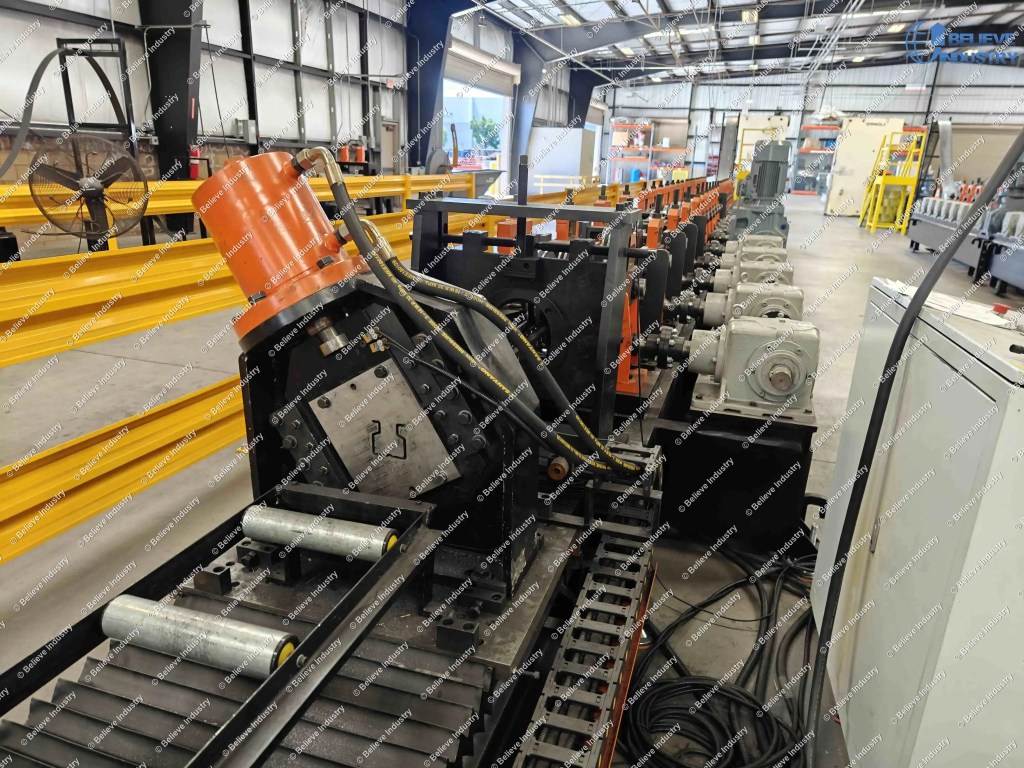
Upright roll forming machine speed is the finished-column line speed in metres per minute at which a coil-fed line forms, punches, and cuts pallet rack uprights, and it is the most misquoted number in racking equipment sales. Brochures print 25 or 30 m/min while installed lines run anywhere from 3 to 30 m/min, and one decision drives the gap: how the holes get punched. After that decision, upright roll forming machine speed has almost nothing to do with the forming mill.
Short answer: rack column lines come in three speed classes, and the punching method decides which one you buy. Hydraulic punching runs 3 to 4 m/min. A mechanical punch press with clustered dies runs 10 to 15 m/min. Roll punching, where rotary dies punch continuously as the strip travels, runs 30 m/min and above. Gauge and hole density move you within a class, not between classes.
Establish the class first, because every other figure in the quote hangs off it.
| Punching class | Typical line speed | Hole method | Best fit |
|---|---|---|---|
| Hydraulic punching | 3 to 4 m/min | Single hydraulic punch, strip pauses or slows per stroke | Low volume, thick gauge, tight budget |
| Mechanical punch press | 10 to 15 m/min | Flywheel press with clustered dies, 4 to 8 holes per stroke | The mainstream rack factory line |
| Roll punching (rotary) | 30 m/min and above | Rotary dies punch continuously, no strip stop | High volume, long runs, one hole pattern |
Read that table as a hierarchy of motion, not of quality. A hydraulic punch stops the strip at every stroke, a press with cluster tooling punches several holes per stroke, and only a roll punch keeps the strip moving. That is why quotes at 12 m/min and 30 m/min can describe two honest machines and still not be comparable.

The arithmetic is short. On a 2 inch teardrop pitch with both faces punched, every metre of column carries roughly 39 holes. Multiply by line speed and you get the holes per minute the punching system must deliver.
| Speed class | Line speed | Holes per minute required, both faces | How it is achieved |
|---|---|---|---|
| Hydraulic punching | 3 to 4 m/min | 118 to 158 | Single stroke punch, strip slows or stops per hit |
| Punch press | 10 to 15 m/min | 394 to 591 | Cluster dies, 4 to 8 holes per stroke, 55 to 70 strokes per minute |
| Roll punching | 30 m/min and above | 1,180 and above | Rotary dies punch continuously, strip never stops |
That middle row is where most rack factories live and where most quotes go wrong. A press with single hole dies cannot deliver 472 holes per minute at any sane stroke rate, so the line falls back to hydraulic class pace. The same press with 8 hole cluster tooling needs only 59 strokes per minute to hold 12 m/min. Identical press, identical tonnage, four times the speed, and the offer may not say which tooling is included.
Double sided punching compounds the effect by halving the strokes per column. On a tear drop pallet rack roll forming machine built for 2 inch pitch this is standard, and it is what makes 10 to 15 m/min realistic rather than theoretical.
Roll punching removes the stop entirely, the only mechanism that reaches 1,180 holes per minute without stalling or breaking dies. The trade is pattern flexibility: a rotary punch is built for one pattern at one pitch, so it suits long runs of a standard column. Both architectures sit on the same roll forming machine line layout, and both are described in our upright rack roll forming machine guide.

Even with punching solved, the line does not hold nameplate pace all shift. Losses cluster around the same stations on every column line we commission.
| Loss source | Typical share of shift | Where it comes from |
|---|---|---|
| Flying cutoff cycle | 3 to 5% | Die acceleration gaps between cuts |
| Column handling and stacking | 4 to 6% | 9m pieces need guided exit and alignment |
| Coil changeover | 2 to 4% | Twice a shift on average, 8 to 15 min each |
| Spec changeover and minor stops | 4 to 8% | Recipe change mid-shift, sampling, burr checks |
That is 13 to 23 percent of the shift producing nothing. The loss is normal. What is not normal is a quote that ignores it and then blames your operators when month one delivers 60 percent of the promised output.
The stacker deserves its own warning. It is the cheapest station in the line and the most common cause of lost pace on 9 metre columns, because an exit side that cannot catch, align, and clear each piece makes the operator slow the line down without telling anyone. Above 15 m/min the stacker stops being an accessory and becomes the real production limit: at 30 m/min a 9 metre column reaches the exit every 18 seconds, faster than most handling systems can clear a piece.
Use the formula that holds: daily output = effective minutes x line speed / column length. Effective minutes is shift time minus coil changes, changeovers, and minor stops. Single shift, 8 hours before losses:
| Speed class | Line speed | 9m columns per hour at full pace | Columns per 8h shift at 75 to 80% uptime |
|---|---|---|---|
| Hydraulic punching | 3 to 4 m/min | 20 to 27 | 120 to 170 |
| Punch press, cluster tooling | 10 to 15 m/min | 67 to 100 | 400 to 600 |
| Roll punching | 30 m/min and above | 200 and above | stacker limited, 1.5 to 2.5x press output |
Read the third row as a caution, not a promise. Two shifts multiply the column count by roughly 1.8, because coil changes and die checks take a larger share of a compressed schedule.
Annual output is speed multiplied by available time, and changeover attacks available time directly. A line rated at 15 m/min that needs 6 hours to move from 3 inch to 4 inch columns produces fewer columns per year than a 10 m/min line that changes over in 40 minutes.
Modern servo lines treat width and gauge as recipe values. Roll adjustment is motorized, punch pitch is a program entry, and cutoff length is a setpoint. On the multi-spec upright column line platform a full spec change runs 2 to 3 hours including first-piece verification, against 6 to 8 hours on older screw-adjust designs.
Rotary punching tooling swaps remain the slowest part of the job, which is the hidden cost of the fastest class. A mixed-market factory should price pattern changeover before it prices the 30 m/min, because a press line with changeable cluster dies will out-produce the faster machine on a mixed order book. Buying a higher upright roll forming machine speed does not fix a slow changeover, and the capability and cost trade shows up in our roll forming machine price guide.
Steel grade shifts you within a class rather than between classes. Moving from 340 MPa to 550 MPa changes springback, so roll gaps need adjustment and the forming pace usually drops: a hydraulic line at 4 m/min on 2.0mm runs nearer 3 on 4.0mm, a press line slides from 15 toward 10, and a roll punching line loses proportionally less. The grades behind those numbers are defined in ASTM A1011 for hot rolled sheet steel.
Speed ratings are the least standardized claim in this industry, so verification is your job. Three checks, in order of value.
Ask which punching class the quoted speed refers to, and refuse an answer that describes the forming mill instead of the punching station.
Ask for the hole count per stroke at your drawing, at your gauge, on both faces. A vendor who cannot answer from their machine data has not built your product before. The pattern also has to satisfy the connector requirements in ANSI MH16.1, maintained by the Rack Manufacturers Institute, so ask how their tooling maps to that standard.
Ask what the line ran last month at a customer with a similar mix, and demand video of continuous production with the timecode visible and the part length stated. A 30 second clip of the mill turning proves nothing.
Speed without tolerance is scrap at velocity, and the pallet racking roll forming machine family shows how tight the tolerances between rack components really are. The European rack design code EN 15512 sets the pitch and fit requirements your customers in that market will test against.


3 Strut Channel Roll Forming Machines Ready to Ship to...
Read More

Scaffold Sheet Machine Ready to Ship to a United States...
Read More
Marine Roll Forming Machines: 5 Shipbuilding Profiles A marine roll...
Read More
Railway Roll Forming Machine: 5 Track Infrastructure Profiles A railway...
Read More English English
  Español
 Português
 Русский
 العربية
 Bahasa Melayu
 Türkçe
 ไทย
ไทย
 Bahasa Indonesia