rulo şekillendirme makinesi İngiltere

Rulo Şekillendirme Makinesi İngiltere Kılavuzu: CE/UKCA ve BS Standartları

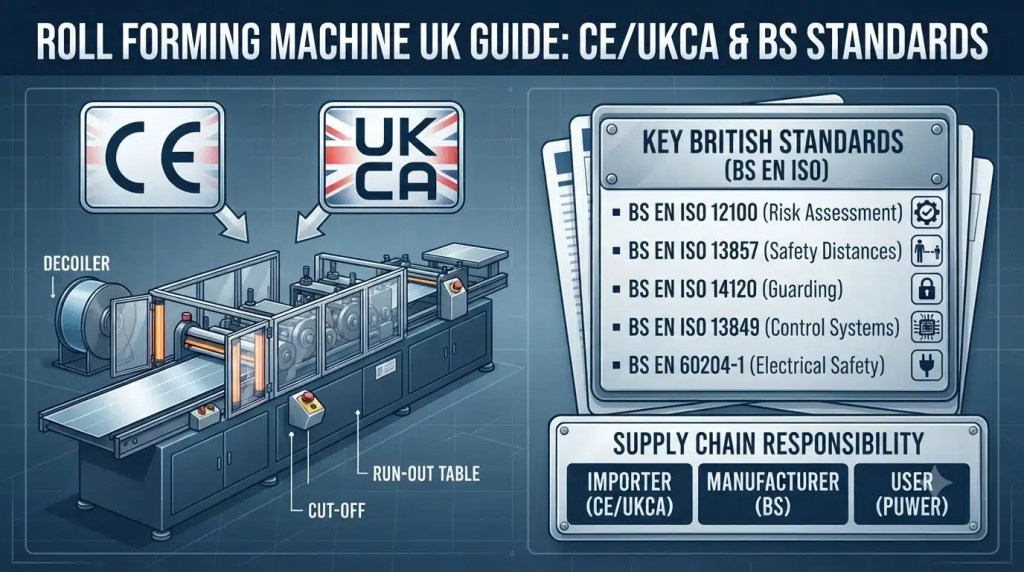
Buying a roll forming machine UK side in 2026 means dealing with paperwork most machine builders in Asia never think about. UKCA marking. BS EN 14782. 400 volt three-phase. Approved Document L. If you get any of it wrong, your machine sits at Felixstowe while your contractor burns through project deadlines.

I have been shipping roll forming lines into the UK from China for over 15 years. The rules changed after Brexit. They are still changing. But none of it is complicated once you know what the UK actually requires and what is just noise.

This guide walks through every compliance piece you need for a UK-bound rulo şekillendirme makinesi: UKCA versus CE, which BS EN standards matter, the 400V/3ph/50Hz electrical spec, UK roofing profiles, and how British construction regulations shape your machine configuration.

UKCA vs CE Marking: What Changed for Roll Forming Machines

The UK left the EU. CE marking is a European thing. So the UK created its own: UKCA, which stands for UK Conformity Assessed.

For roll forming machines heading to England, Scotland, or Wales, UKCA is the mark you need. Northern Ireland has its own arrangement under the Windsor Framework. If your machine is going to Belfast, CE marking still works. For the rest of GB, UKCA is the expectation from the UK government.

The deadline keeps getting pushed back. The UK government first said January 2023. Then June 2025. The latest extension pushes recognition of CE marking for machinery further, but nobody in UK construction procurement is waiting. Main contractors and building specifiers already write UKCA compliance into tender documents.

Believe Industry ships every UK-bound roll forming line with a full UKCA documentation package: Declaration of Conformity, technical file, risk assessment, and test reports. The UKCA process mirrors CE in substance. The difference is the approved body. For CE it was an EU notified body. For UKCA it is a UK Approved Body. Same tests. Same standards. Different stamp.

Bottom line: if you are buying a box profile roofing sheet roll forming machine for the UK today, ask for UKCA documentation. Do not accept “CE is enough” unless your project is in Northern Ireland.

Key BS EN Standards for UK Roll Forming Machines

British Standards are the UK’s version of European Norms. Most BS EN standards mirror their EN counterparts exactly. The prefix “BS EN” tells you it is a British Standard adopting a European Norm. Here are the three that matter most for roll forming.

BS EN 14782 — Self-Supporting Metal Sheet for Roofing

This is the big one. BS EN 14782 sets the performance requirements for metal sheets used in roofing, cladding, and wall panels. If your roll forming machine is making roof sheets for a UK site, the finished profile must meet BS EN 14782.

The standard covers material thickness tolerance, profile geometry, coating adhesion, and mechanical resistance. A machine that cannot hold profile tolerances within the BS EN 14782 band is not fit for the UK market. Believe Industry configures roll forming stands to hit these tolerances at the design stage. It is not something you retro-fit.

BS EN 1090 — Execution of Steel Structures

BS EN 1090 applies when the profiled sheets form part of a structural system. UK building control officers ask for BS EN 1090 compliance on any project where the roof or wall panels carry load beyond their own weight. This includes standing seam roofs on commercial buildings, industrial mezzanine decking, and structural cladding on steel-frame builds.

The standard mandates factory production control (FPC) certification. For a roll forming machine buyer, this means your machine must produce consistent output that passes FPC audit. Believe Industry machines ship with calibration documentation that supports FPC certification for the UK end user.

BS 5427 — Code of Practice for Profiled Metal Roofing

BS 5427 is the UK’s own code of practice. It tells you how to install profiled metal roofing correctly: lap distances, fastener spacing, condensation risk, thermal movement, and drainage. It is not a machine standard. But UK contractors reference it in every project spec. If your machine output does not match what BS 5427 expects for installation, the UK contractor will flag it.

çatı levhası rulo şekillendirme makinesi built for the UK must produce profiles that installers can fix per BS 5427. That means correct side lap geometry, enough flat area for fastener placement, and ridge and verge details that work with UK detailing practice.

Electrical Requirements: 400V/3ph/50Hz for the UK Market

The UK industrial grid runs on 400 volts, three-phase, 50 hertz. Not 380V like the Middle East. Not 415V like Australia. Not 480V/60Hz like North America. 400V/3ph/50Hz.

This matters because the motor speeds, hydraulic pump outputs, and PLC timing in a roll forming line are all tuned to the incoming frequency. A 50Hz motor running on 60Hz spins 20% faster. On a oluklu sac rulo şekillendirme makinesi running 18 stations, that speed delta compounds across every stand.

Believe Industry ships UK-spec machines with:

  • Motors: 400V/3ph/50Hz, IP55 rated, IE3 efficiency class
  • Control cabinet: 400V input, UK-standard colour coding (brown/black/grey phases, blue neutral, green-yellow earth)
  • PLC: Customer choice (Siemens S7-1200 is the most common UK pick; Mitsubishi and Delta are options)
  • HMI: English-language touchscreen with imperial/metric dual display
  • Plug/socket: BS EN 60309 industrial connectors (the red 5-pin CEE form everyone in UK construction recognises)

BS 7671, the UK Wiring Regulations (IET 18th Edition), applies to fixed installations on UK sites. Your machine’s electrical panel must be compatible with BS 7671 for connection. We build UK panels with BS EN 60204-1 machine safety compliance and the earthing arrangements that UK site electricians expect.

Tell your machine builder the voltage and frequency on day one. Do not assume they know. A machine wired for 380V/60Hz because someone assumed “Europe is Europe” will trip breakers on a UK site.

UK Roofing Profiles: What the British Market Actually Uses

The UK roofing market has its own profile preferences. If you buy a machine set up for a profile nobody in the UK specifies, you have just bought an expensive paperweight.

32/1000 Box Profile

This is the workhorse of UK industrial roofing. 32mm deep trapezoidal profile with 1000mm cover width. You see it on warehouses, agricultural buildings, retail sheds, and factory extensions across England, Scotland, and Wales.

The 32/1000 profile comes in anti-condensation, acoustic, and standard variants. A çift katmanlı rulo şekillendirme makinesi that runs both 32/1000 box profile and a tile effect or corrugated profile is a popular UK setup. It gives the contractor flexibility without buying two separate lines.

Dik Dikiş

Standing seam roofing is growing fast in the UK, driven by architectural demand and Part L thermal performance requirements. UK architects specify standing seam for schools, hospitals, apartment blocks, and high-end commercial builds.

The typical UK standing seam profile is narrower than European equivalents. Rib centres of 300mm to 400mm are common, with 25mm seam height. The metal çatı kiremiti rulo şekillendirme makinesi category covers some standing seam configurations as well, depending on the coil width and profile geometry.

Tile Effect Profiles

The UK domestic market loves tile effect metal roofing. Brands like Britmet and Metrotile set the expectation. These profiles mimic clay or slate tiles but use coated steel coil. They are popular for residential extensions, garden rooms, and low-rise housing developments. The coil width is typically 1250mm with a formed cover width around 1050mm to 1100mm.

13/3 Corrugated

The old British standard corrugated profile. 13mm deep, 76mm pitch (3 inches, hence “13/3”). Still specified on agricultural buildings and listed-building sympathetic projects. Simple profile. Simple tooling. But make sure your machine can handle the thin gauge: 0.4mm to 0.7mm base metal thickness is typical for UK 13/3.

ProfilÖrtü GenişliğiDepthCommon UK ApplicationTipik Ölçüm Cihazı
32/1000 Box Profile1000 mm32mmIndustrial, warehouses, farm buildings0.5-0.7mm
Standing Seam (300-400mm)300-400mm25mmCommercial, schools, hospitals0.7-0.9mm
Tile Effect (Metrotile style)1050-1100mm25-38mmResidential, extensions0.4-0.5mm
13/3 Corrugated762mm13mmAgricultural, heritage0.4-0.7mm
UK Roofing Profiles_ What the British Market Actually Use

UK Building Regulations and Roll Forming Equipment

UK building regulations touch roll forming output in three ways that machine buyers need to understand.

Approved Document L (Conservation of Fuel and Power) sets thermal performance targets for building envelopes. For metal roofing, this means composite panel systems and insulated liner trays are growing. A machine that only runs single-skin profiles limits the UK buyer’s market. Machines that can produce liner trays or work with composite panel tooling open more doors.

Approved Document A (Structure) covers structural safety. Roof sheeting must withstand UK wind loads and snow loads. The profile geometry, steel grade, and gauge all feed into structural calculations. BS EN 1991-1-4 gives UK wind load maps that engineers use. Your machine’s profile must match a section that UK structural engineers can calculate. Obscure profiles with no section properties data are a dead end.

Approved Document B (Fire Safety) matters for multi-occupancy buildings and anything over 18 metres. External cladding fire performance came under intense scrutiny after Grenfell. If your machine produces cladding panels for UK buildings above 18 metres, the coating system and core material must comply with the latest fire safety guidance. Believe Industry can configure machines for fire-rated material stacks.

None of these are machine standards per se. But they determine which profiles sell and which do not. A machine built for British construction codes sells into a larger addressable market.

Frequently Asked Questions of Roll Forming Machine UK

Do I still need CE marking on a roll forming machine for the UK?

CE marking is recognised in the UK under transitional arrangements that keep getting extended. But the UK government intends UKCA to be the permanent mark for Great Britain. If you are buying a machine today for long-term UK use, get UKCA documentation. It costs nothing extra and covers you when the transition ends. For Northern Ireland, CE marking remains valid under the Windsor Framework.

What voltage does my roll forming machine need for the UK?

400 volts, three-phase, 50 hertz. That is the UK industrial standard. Do not accept 380V. Do not accept 60Hz. Specify 400V/3ph/50Hz in your purchase order and check the motor nameplates when the machine arrives.

Can I run both box profile and tile effect on the same machine?

Yes. A double-layer machine with two cassette sets does exactly that. One set of forming stations for 32/1000 box profile, another for tile effect. Switchover takes 15 to 20 minutes. You save factory space and roughly 30% on capital versus buying two separate lines.

What BS EN standards apply to roll forming machines in the UK?

BS EN 14782 governs the finished metal sheet performance. BS EN 1090 applies if the profiles form part of a structural system. BS EN 60204-1 covers machine electrical safety. BS EN ISO 12100 covers machine safety risk assessment. BS 5427 sets the installation code of practice for profiled metal roofing.

How long does it take to get a roll forming machine delivered to the UK?

Production takes 45 to 60 days after design confirmation. Sea freight from Shanghai to Felixstowe or Southampton runs 28 to 35 days. Customs clearance adds 3 to 5 working days. Budget 12 to 14 weeks from order to UK delivery. Believe Industry handles the full logistics chain including UK customs documentation.

Do I need a UK Approved Body to certify my machine?

For UKCA marking of machinery, most roll forming machines fall under self-declaration. You do not need a UK Approved Body for standard roll forming equipment. The machine builder produces the technical file, risk assessment, and Declaration of Conformity. If the machine includes certain safety components or is classified as a higher-risk machine under UK Supply of Machinery Regulations, a UK Approved Body review may be needed. We check this at the design stage and tell you if any external certification is required.

What UK roofing profiles have the highest demand?

32/1000 box profile is the dominant UK industrial profile. Standing seam is the fastest-growing segment, particularly for commercial and public-sector buildings. Tile effect profiles have steady residential demand. 13/3 corrugated is a niche but persistent market for agricultural and heritage work.

Can I visit a working machine in the UK before buying?

Believe Industry can connect serious UK buyers with existing customers who run our machines. Seeing a line in production answers questions that spec sheets never will. Ask your account manager to arrange a reference visit.

Getting Your UK Roll Forming Machine Right

Buying a roll forming machine for the UK market is not harder than buying for any other export destination. It is just different. The UK has its own mark. Its own standards prefix. Its own voltage. Its own profile preferences.

The worst outcome is not a machine that fails. It is a machine that arrives in perfect working order but cannot be connected because the plug is wrong, or cannot be commissioned because the documentation is incomplete, or produces a profile nobody in the UK building trade recognises.

Get the profile right. Get the UKCA documentation right. Get the voltage right. Everything else follows from those three decisions.

Believe Industry has been shipping rulo şekillendirme makineleri to the UK for over 15 years. Our UK-spec lines run across England, Scotland, and Wales, producing box profile sheets, standing seam panels, tile effect roofing, and corrugated profiles for the British construction market. If you need a UK-compliant line backed by real documentation and real support, we should talk.

Last updated: July 29, 2026

Makale Değişiklik Günlüğü:
– July 29, 2026: Initial publication. Covers UKCA marking, BS EN standards, 400V/3ph/50Hz specs, UK roofing profiles, and UK Building Regulations.

Sonraki İnceleme Tetikleyicileri:
1. UK government announces new UKCA deadline or policy change
2. New revision of BS EN 14782 or BS EN 1090 published
3. UK Building Regulations Approved Documents updated
4. Significant shift in UK roofing profile demand patterns
5. Northern Ireland Windsor Framework regulatory update

İçindekiler

Yeni Güncellemeler

Believe Industry Company| Roll Forming Machine Manufacturer, Supplier & Exporter sitesinden daha fazla şey keşfedin

Okumaya devam etmek ve tüm arşive erişim kazanmak için hemen abone olun.

Okumaya Devam Edin

BELIEVE INDUSTRY | ÖZEL ÇÖZÜMLER

TALEBİNİZİ İLETİN
MÜHENDİSLİK TEKLİFİ