perakende raf rulo şekillendirme makinesi

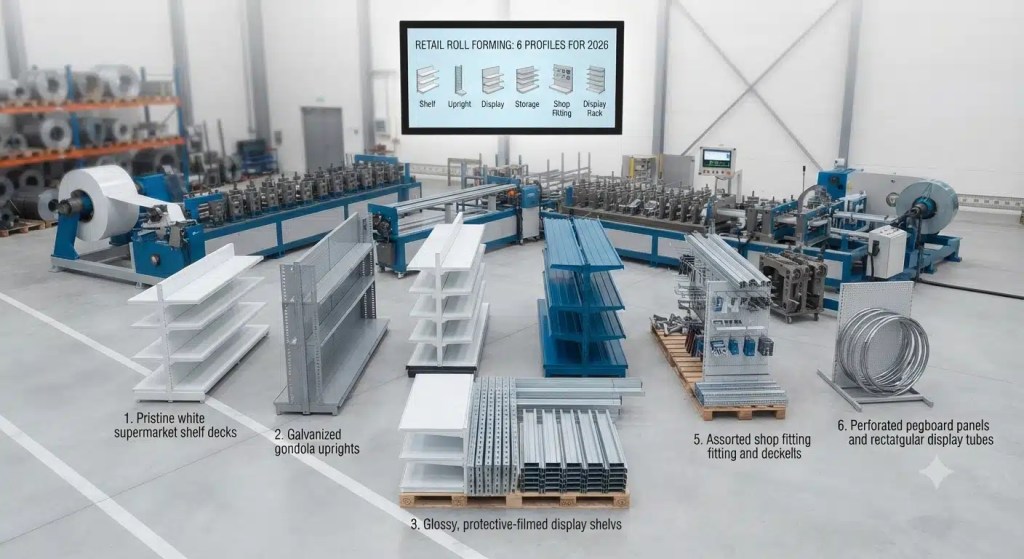
Perakende Raf Şekillendirme Makineleri: 2026 İçin 6 Raf Profili

Retail is shelf space. Every supermarket aisle, every department store display, every warehouse club pallet rack that customers walk past was roll formed from steel coil. The global retail shelving market hit $12.6 billion in 2025 and keeps climbing. Behind every shelf is a perakende raf rulo şekillendirme makinesi turning flat steel into the profiles that hold products, attract shoppers, and define store layouts.

Believe Industry Company has built roll forming lines for retail and commercial shelving for over 15 years, shipping to 20+ countries. This guide covers the six shelf and display rack profiles that retail manufacturers need and the machines that produce them.

Why Retail Shelving Roll Forming Is Its Own Category

Retail shelving is not warehouse racking. The loads are lighter. Most supermarket shelves carry 100 to 300 kg per bay. The difference is appearance, finish, and dimensional consistency. A shelf with a visible burr on the front edge does not get installed. A gondola upright with one millimeter of twist over 2 meters looks crooked to every customer who walks past it.

perakende raf rulo şekillendirme makinesi addresses these demands through tighter cosmetic tolerances, pre-painted and powder-coated strip compatibility, and profiles designed for snap-together assembly without field modification. The National Retail Federation reports that store fixture spending grows 5% to 7% annually as retailers refresh layouts every three to five years. The ANSI/BIFMA X5.9 shelving standard specifies structural and durability testing protocols for retail storage units sold in North America. That steady replacement cycle makes retail shelving one of the most consistent markets for roll forming production.

Six profile types dominate retail shelving. Each needs specific roll forming machine configurations.

Profile 1: Supermarket Shelf Roll Forming Machine

Supermarket shelving is the most widely produced retail profile on the planet. Every grocery store, convenience store, and hypermarket uses identical shelf formats. A supermarket rack roll former produces the main shelf deck, rear back panel, and front edge trim that form the horizontal surface products sit on.

The shelf deck profile is typically 300mm to 600mm deep and comes in lengths from 600mm to 1200mm. Steel thickness runs 0.6mm to 1.0mm. Pre-painted galvanized steel is standard. White and gray make up 80% of production. The metal çatı paneli makinesi shares the same coil handling and feeding systems, so factories already running roofing lines can retool for shelving decks with minimal upstream changes.

Front edge trim sets supermarket shelves apart. The nose of the shelf has a roll-formed bend of 20mm to 40mm that hides the raw edge of the shelf deck and serves as the mounting surface for price labels and shelf talkers. Some profiles include a C-shaped channel at the front edge where plastic price strips snap in. This detail requires an extra roll station or two in the forming section.

Key specs for supermarket shelf lines:

  • Material: 0.6mm to 1.0mm pre-painted galvanized steel
  • Line speed: 15 to 25 m/min for shelf decks
  • Roll stations: 14 to 18
  • Cut-to-length: mechanical shear or flying saw
  • Surface requirement: no scratches, no burrs visible on face

oluklu destek kanalı rulo şekillendirme makinesi shares a similar production philosophy. Both produce light-gauge steel profiles where cosmetic finish and hole accuracy matter more than raw strength.

Supermarket Shelf Roll Forming Machine

Profile 2: Gondola Upright Roll Forming Machine

The gondola upright is the vertical spine of retail shelving. These U-channel or C-channel profiles, typically 25x50mm to 40x80mm, stand 1200mm to 2100mm tall and carry the full weight of shelves, brackets, and merchandise. A gondola upright machine punches a continuous row of slots or holes at precise intervals, usually 25mm or 50mm centers, where shelf brackets lock in.

Slot punching accuracy is the critical specification. If one slot is 0.5mm off vertical, the shelf bracket does not engage cleanly. Multiply that across 40 slots on a 2-meter upright and by shelf five the whole bay leans. A servo-driven in-line punch press with optical feedback is standard on quality gondola upright machines. Slot positions hold within 0.2mm of nominal.

Steel for gondola uprights runs 1.2mm to 2.0mm, typically cold-rolled or galvanized. Powder coat finish is applied post-forming. The upright profile itself is simple. Two bends, maybe three. The c-şekilli destek rulo şekillendirme makinesi produces similar channel profiles, but the punching pattern makes gondola uprights a dedicated machine category.

The back panel, or pegboard back, sits between uprights. It is a flat or flanged panel 0.5mm to 0.8mm thick with slotted holes for peg hooks and accessories. Some lines produce it on the same upright machine. Larger factories split uprights and back panels onto dedicated lines.

Production parameters for gondola upright lines:

  • Material: 1.2mm to 2.0mm cold-rolled or galvanized
  • Line speed: 10 to 18 m/min
  • Roll stations: 12 to 16
  • Punching: servo-driven, multi-die, slot pattern at 25mm or 50mm pitch
  • Straightness: 1mm per 2 meters

Most retail fixture factories pair a gondola upright machine with a shelf deck line. Together they run 24 hours a day, seven days a week, feeding the store rollout schedule.

Gondola Upright Roll Forming Machine

Profile 3: Display Shelf Roll Forming Machine

Display shelving is where retail roll forming gets creative. Unlike supermarket shelves that all look identical, display shelves serve specific product categories. A display shelf roll forming line produces profiles for cosmetics counters, electronics displays, shoe racks, and point-of-purchase fixtures.

These profiles tend to be narrower and lighter than supermarket shelving. Steel thickness runs 0.5mm to 0.8mm. Shelf depth is 200mm to 400mm. The profile often includes a front lip that angles upward to prevent products from sliding off and a rear flange that hooks into a slotted panel system.

Material finishes are diverse. White, black, chrome-look, brushed steel. Pre-painted strip with a clear protective film is standard because the shelf surface is customer-facing. Any scratch from the roll forming process ruins the piece. Roller stands need high-quality hardened surfaces and polishing. No rust spots, no pitting.

Display shelf profiles change frequently. A retailer launches a new store format and suddenly needs 50,000 shelves in a unique profile. The roll forming line must support quick changeover. Believe Industry builds display shelf lines with cassette-type roll tooling that swaps in under 30 minutes. The çift katmanlı rulo şekillendirme makinesi concept translates here. Two profile sets on one frame cut changeover downtime in half.

Typical display shelf line specs:

  • Material: 0.5mm to 0.8mm pre-painted galvanized
  • Line speed: 15 to 25 m/min
  • Roll stations: 12 to 18
  • Changeover: cassette tooling, under 30 minutes
  • Surface: protective film compatible, zero-scratch handling
Display Shelf Roll Forming Machine

Profile 4: Storage Shelf Roll Forming Machine

Retail storage shelving sits in the back room and the customer-facing warehouse area. Think Costco, Home Depot, IKEA. These shelves carry heavier loads than supermarket shelves, 200 to 500 kg per bay, and the profile reflects that. A storage shelf roll former produces beam-and-deck systems from 1.0mm to 1.5mm steel with reinforcement ribs that add stiffness.

The profile typically has a deep front beam, 40mm to 60mm, that serves as both the structural member and the price-label rail. The güneş paneli destek kanalı rulo şekillendirme makinesi shares the same structural channel-forming approach. Heavy steel, deep profile, consistent geometry over long production runs.

The deck sits between front and rear beams. It is a flat or slightly ribbed panel 400mm to 800mm deep, often with a downward flange at front and rear edges that clips into the beam. Deck panels are produced on a dedicated line or on the same line as the beams with quick tooling changes.

Storage shelf lines for retail must balance speed and precision. The profiles are heavier than supermarket shelves but the cosmetic standard is still retail-grade. No burrs, no scratches, no oil stains. The line includes an inline cleaning station that wipes forming oil from the finished profile before it reaches the stacker.

Key storage shelf line specs:

  • Material: 1.0mm to 1.5mm galvanized
  • Line speed: 12 to 20 m/min for beams, 15 to 25 m/min for decks
  • Yuvarlanma istasyonları: 14 ila 20
  • Reinforcement ribs: roll-formed into deck profile
  • Finish: inline oil removal, cosmetic inspection
Storage Shelf Roll Forming Machine

Profile 5: Shop Fitting Roll Forming Profiles

Shop fitting is the broadest category in retail shelving. It includes bracket wall systems, slatwall metal inserts, hanging rail profiles, cash wrap counters, and fitting room hardware. A shop fitting roll forming line produces small, high-precision profiles that are often invisible to the customer but carry load and enable assembly.

Bracket systems are the most common profile. A metal bracket 150mm to 400mm long with a hook profile at one end and a shelf support at the other. These brackets insert into slotted uprights and carry shelf loads of 50 to 200 kg. The hook end is roll-formed to specific dimensions that match the upright slot exactly. A hook that is 0.3mm too thick will not engage. A hook that is 0.3mm too thin will wobble. Tolerance is everything.

Hanging rail profiles carry clothing on retail floors. They are simple round or oval tubes 25mm to 32mm diameter, roll-formed from 0.8mm to 1.2mm strip and welded along the seam. The palet rafı rulo şekillendirme makinesi approach applies. Tube forming with inline welding, followed by cutoff to length. Hanging rails run 10 to 20 m/min on dedicated lines.

Slatwall inserts are narrow metal channels that sit inside slotted MDF or plywood panels. They provide the load-bearing slot for brackets to hook into. These profiles are small, 15mm x 10mm C-section, produced at high speed from 0.6mm strip. A single slatwall insert line can run at 40 to 60 m/min, producing kilometers of profile per shift.

Shop fitting line specs:

  • Material: 0.6mm to 1.5mm steel, pre-painted or post-plated
  • Line speed: 10 to 60 m/min (varies widely by profile)
  • Roll stations: 8 to 16
  • Key feature: tight dimensional tolerance, 0.1mm on hook dimensions
  • Output: high-volume, many small components
Shop Fitting Roll Forming Profiles

Profile 6: Merchandise Display Rack Roll Forming

Merchandise display racks are the freestanding units at the end of aisles, in window displays, and at checkout counters. They include dump bins, rotating displays, tiered shelving units, and promotional stands. A merchandise rack production line combines several profile types into one family of products.

The base frame uses rectangular tube sections roll-formed from 0.8mm to 1.2mm strip. The warehouse racking roll forming machine beam-and-post system provides the structural concept. Lighter steel, smaller dimensions, retail finish.

Display surfaces use flat or perforated panels 0.5mm to 0.8mm thick. Perforated panels receive peg hooks, clip-on baskets, and signage. The roll forming line often integrates with a perforating station that punches hole patterns before forming. This integration saves a secondary operation and keeps tolerances tight.

The distinguishing feature of merchandise display racks is that the customer touches them. Every surface must be burr-free, coated, and visually clean. The metal çatı kiremiti rulo şekillendirme makinesi uses similar cosmetic finishing standards for visible roof surfaces. Retail display takes that standard indoors.

Merchandise display rack line specs:

  • Material: 0.5mm to 1.2mm steel, pre-painted or powder coated post-forming
  • Hat hızı: 12 ila 20 m/dak
  • Roll stations: 10 to 16
  • Integration: optional inline perforating station
  • Surface: zero-burr, cosmetic grade
Merchandise Display Rack Roll Forming

Retail Shelving Machine Selection: Six Profiles Compared

ParametreSupermarket ShelfGondola UprightDisplay ShelfStorage ShelfShop FittingMerchandise Rack
Çelik Kalınlığı0.6-1.0mm1.2-2.0mm0.5-0.8mm1.0-1.5mm0.6-1.5mm0.5-1.2mm
Hat Hızı15-25 m/dak10-18 m/dak15-25 m/dak12-25 m/min10-60 m/min12-20 m/dak
Yuvarlanma İstasyonları14-1812-1612-1814-208-1610-16
Yumruk atmakİsteğe bağlıRequiredİsteğe bağlıRequiredDeğişkenlik gösterirİsteğe bağlı
KaplamaPre-paintedPost-formPre-painted+filmPost-formPre-painted/platePre-painted
Key RequirementCosmetic frontSlot accuracyHızlı geçişStructural ribsHook toleranceBurr-free finish

Cost Per Profile: Investment and ROI

Profil TürüEntry Line CostProduction OutputTypical ROI
Supermarket Shelf$35,000-$55,0008,000-15,000 shelves/shift12-18 months
Gondola Upright$45,000-$75,0005,000-10,000 uprights/shift14-20 months
Display Shelf$30,000-$50,00010,000-20,000 shelves/shift10-16 months
Storage Shelf$40,000-$65,0006,000-12,000 shelves/shift14-18 months
Shop Fitting$25,000-$60,000Varies widely8-18 months
Merchandise Rack$35,000-$60,0004,000-8,000 racks/shift14-22 months

What to Look for in a Retail Shelving Roll Forming Machine

When you evaluate a perakende raf rulo şekillendirme makinesi, five factors matter more than the spec sheet.

Finish quality first. Retail shelving is a cosmetic product. Customers see it, touch it, and judge the store by it. Ask any supplier for roll-formed samples before placing an order. Run your fingernail across the surface. Look for die marks, scratches, and burrs. If the sample has visible defects, the production run will be worse.

Slot and hole accuracy. Gondola uprights, bracket hooks, and slatwall inserts all depend on precise punching. Ask for a printout of the first-article inspection report showing actual slot positions versus nominal. A good line holds 0.2mm. Anything worse than 0.5mm will cause assembly problems on the job site.

Changeover speed. Retail shelving manufacturers run multiple profiles. A line that takes four hours to change over loses one shift per week. Cassette roll tooling systems, preset punch die cartridges, and automated recipe recall cut changeover to 30 minutes. The çatı levhası rulo şekillendirme makinesi industry learned this lesson years ago. Retail shelving is catching up.

Coil handling for pre-painted strip. Pre-painted steel scratches easily. The uncoiler, straightener, and feed system must handle strip without surface contact on the painted face. Nylon-coated rollers, non-marring guides, and protective film applicators are standard on quality retail lines.

Local support. Retail shelving demand is regional. The shelves you make in Mexico go to Mexican stores. The shelves you make in Saudi Arabia go to Saudi stores. Machine support must be equally local. The FEM 10.2.02 standard for shelving is a useful reference for quality expectations. Ask suppliers for references within 2,000 km of your factory.

FAQ: Retail Shelving Roll Forming Machines

What is the difference between a supermarket rack roll former and a warehouse racking machine?

Supermarket rack roll formers produce lighter profiles at 0.6-1.0mm with cosmetic finishes. Warehouse racking machines handle 1.5-4.0mm structural steel with no cosmetic requirement. The supermarket line prioritizes surface quality and slot accuracy. The warehouse line prioritizes forming force and throughput.

How many profiles can one retail shelving machine produce?

With cassette tooling, one frame can produce 2-4 profiles. A line with two forming sections doubles that. For a factory serving the full retail fixture market, two to three dedicated lines cover the main shelf, upright, and bracket profiles. Shop fitting small parts often run on separate high-speed dedicated lines.

Can I produce retail shelves on a standard corrugated roofing line?

No. A oluklu sac rulo şekillendirme makinesi has too few roll stations for shelving profiles and lacks the punching, straightening, and cosmetic handling required. Retooling a roofing line for shelving is not practical. The machine frame, drive, and roll cassette would all need replacement.

What steel grade is used for retail shelving?

Mild steel grades DX51D to DX53D with zinc coating Z100 to Z275 are standard. Cold-rolled grades like DC01 to DC04 are used when tighter thickness tolerance is needed for hook and bracket profiles. Pre-painted strip uses polyester-based paint systems rated for indoor use.

What is the minimum order quantity for a retail shelving roll forming line?

Believe Industry builds lines starting at one complete machine set. A single-profile supermarket shelf line is the simplest entry point. Full retail fixture factories typically order two to three lines covering shelf decks, uprights, and display profiles.

How long does installation and commissioning take?

A single-line installation takes 4-6 weeks from container arrival to first production. Multi-line factories run 8-12 weeks. The timeline includes mechanical assembly, electrical integration, leveling and alignment, dry runs, and sample production. Experienced operators train within the first two weeks of commissioning.

Can Believe Industry integrate a retail shelving line with my existing powder coating system?

Yes. The line provides a discharge conveyor that feeds your existing coating line. Post-coating handling, such as automated stackers, is also available. The ayakta dikişli rulo şekillendirme makinesi team handles similar post-forming line integration with conveyor and stacker systems.

What after-sales support do you provide?

Spare parts catalog, video technical support, remote diagnostics, and on-site service engineer dispatch within 72 hours. Critical spare parts ship within 48 hours from stock. The ibr sac rulo şekillendirme makinesi service team supports retail shelving lines in the same 20+ countries we serve.

Investing in Retail Shelving Production: Bottom Line

Retail shelving is a steady, predictable market. Stores refresh layouts on a three-to-five-year cycle. New store openings follow population growth and retail expansion. Neither trend is slowing.

perakende raf rulo şekillendirme makinesi is a long-term asset. A well-built line runs 15 to 20 years with proper maintenance. The return comes from producing profiles at $0.30 to $0.80 per linear meter in steel and converting them into shelves that sell for $3 to $15 each at wholesale.

Believe Industry Company has been designing and building roll forming lines for the retail fixture industry for over 15 years. Our machines run in 20+ countries, producing the shelves in supermarkets, department stores, warehouse clubs, and specialty retailers that shoppers interact with every day.

Contact us to discuss your retail shelving production requirements. Send a profile drawing, target output, and budget range. We will provide a machine specification, line layout, and production estimate within five working days.

Makale Değişiklik Günlüğü

  • 2026-07-28 — Initial publication

Sonraki İnceleme Tetikleyicileri

  • When new retail shelving standards (FEM/ANSI) are issued
  • When a major global retailer announces a new store format requiring different shelf profiles
  • When pre-painted steel coating technology changes affecting roll forming parameters
  • When retail shelving market growth rate deviates more than 2% from current projections
  • When a customer requests a profile type not covered in this guide

İçindekiler

Yeni Güncellemeler

Believe Industry Company| Roll Forming Machine Manufacturer, Supplier & Exporter sitesinden daha fazla şey keşfedin

Okumaya devam etmek ve tüm arşive erişim kazanmak için hemen abone olun.

Okumaya Devam Edin

BELIEVE INDUSTRY | ÖZEL ÇÖZÜMLER

TALEBİNİZİ İLETİN
MÜHENDİSLİK TEKLİFİ