العنوان
رقم 1، طريق Yd، حي هويشان، مدينة ووكسي، مقاطعة جيانغسو. 214183
ساعات العمل
من الاثنين إلى الجمعة: 9 صباحا - 5 مساء
السبت: 9 صباحا - 4 مساء
إجابة مختصرة: Roll forming machine installation is seven jobs done in order. Survey the floor, cast the foundation, set and level the line, align the rolls, connect hydraulic and electrical systems, dry run without coil, then thread the first coil. A 15 to 25 m line takes 5 to 10 working days with two fitters, one electrician and a crane on the buyer side. Two drawings decide most of the outcome: the anchor bolt plan and the mill base level.
Buyers often treat roll forming machine installation as a two day handover. It is not. A roll forming machine installation moves a 15 to 25 m chain of separate machines onto one straight pass line. A 1 mm error at the uncoiler becomes a twisted profile at the exit.
This guide covers the work on site, from concrete to the first saleable part. It does not repeat the خط ماكينة التشكيل بالدرفلة component list, and it leaves concrete mix design to the civil engineer.
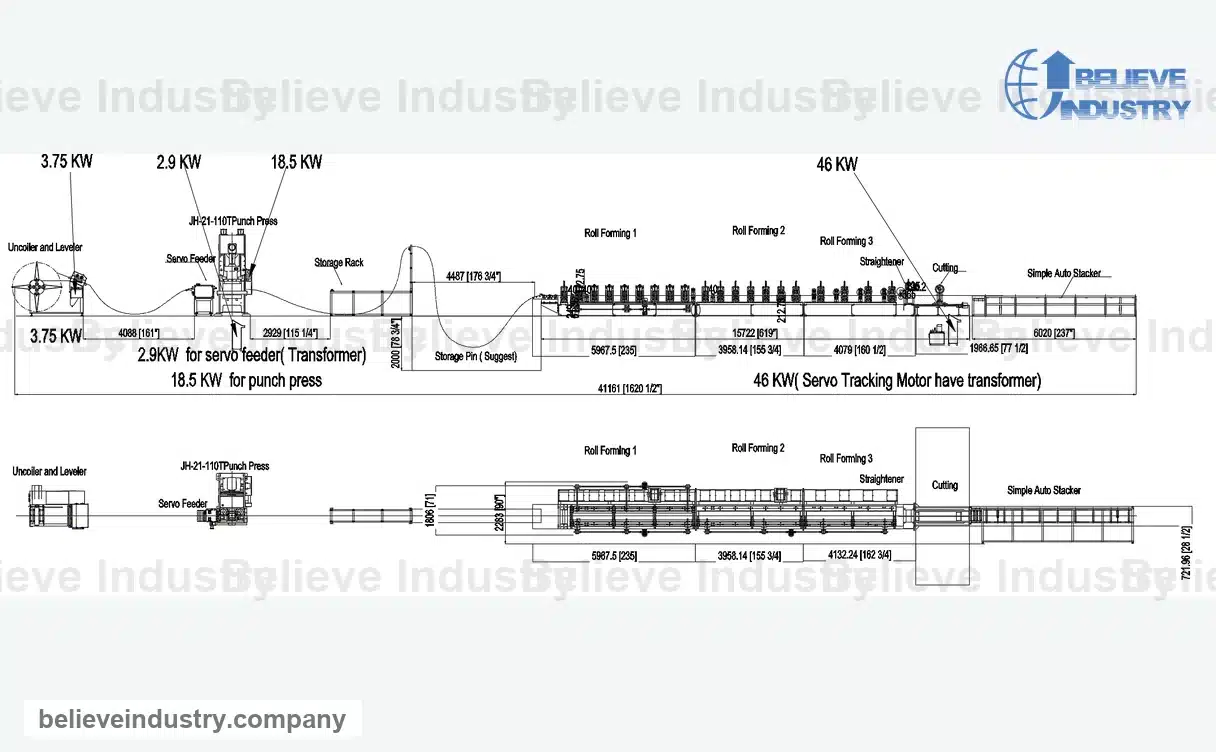
A shipment is a set of modules. The وحدة فك اللفائف والتقويم والتغذية is one, the punch press another, the forming mill another, then the cut unit and the المُكدِّس الآلي. Roll forming machine installation joins them into one line and proves that strip runs through all of them without a helper at every station.
The contract boundary of a roll forming machine installation matters. The supplier supplies the layout drawing, anchor bolt plan, machine setting and the commissioning engineer. The buyer supplies the slab, crane, power drop, air supply, coil stock and the crew. Put that split in writing before the container ships. MHI standards are a useful reference for the equipment side of it.
A roll forming machine installation excludes civil design, permits, the upstream feeder and the profile drawing, which belongs to the tooling order. The tooling has to be in the crate before step four.
| خطوة | العمل | Who leads | Sign off point |
|---|---|---|---|
| 1 | Floor survey and line layout | Buyer and supplier | Centre line marked on the slab |
| 2 | Concrete foundation and anchor bolts | Buyer civil crew | Bolt pattern measured against drawing |
| 3 | Positioning and leveling | Supplier fitter | Base level within tolerance |
| 4 | Pass line and roll alignment | Supplier fitter | Strip runs straight without drift |
| 5 | Hydraulic, air and electrical connections | Supplier electrician | Direction, pressure and E stop checks |
| 6 | Dry run without coil | Both | All stations cycle at set speed |
| 7 | First coil and first good profile | Both | Part measured against profile drawing |
Skipping step four is the expensive mistake. A level but unaligned line still makes bowed parts, and the crew blames the rolls. Roll forming machine installation has to prove the pass line before it proves the profile.
For roll forming machine installation, mark the centre line on the floor before anything is uncrated. The layout drawing gives the length of each module and the gaps between them. A 20 stand line with a punch press and a flying shear needs 18 to 24 m, plus coil loading space at the front and a clear run out at the back.
Check four things. Crane access over the uncoiler, 0.9 m of cabinet door swing, a hose route clear of the walkway, and a run out table longer than the longest part. Allow 3 to 4 m ahead of the uncoiler and 0.8 to 1.0 m of walkway along one side.
إنّ قاعدة الطاحونة drawing sizes the heaviest module. If the floor cannot carry that point load, shimming at step three will not hold the setting.
Most lines sit on a reinforced slab 200 to 300 mm thick, cast on compacted ground and isolated from columns that transmit vibration. That is a starting point, not a structural design. Thickness comes from machine mass, punch force and the soil report.
Anchor bolts go in before the machines arrive. Use the supplier bolt plan, not a guess based on the base plate you can see from outside. Check bolt centres after the concrete cures, because a 5 mm shift at the press feet is half a day of torch work later.
| Foundation item | Typical starting value | Owner |
|---|---|---|
| Slab thickness | 200 to 300 mm reinforced | Buyer civil engineer |
| Concrete strength | C25 to C30 or local equivalent | Buyer civil engineer |
| Anchor bolts | M16 to M24, per bolt plan | Supplier drawing, buyer installs |
| Vibration isolation | Pads under press and hydraulic station | Supplier specifies |
| Floor flatness | 2 to 3 mm over 3 m before shimming | Buyer |
Keep the cable trench and drainage channel out of the bolt grid. We have seen a trench cut through the anchor zone on delivery morning, which cost a new base plate and two weeks. Concrete detail belongs in its own guide; this step sets the acceptance point for roll forming machine installation.
During roll forming machine installation, set the heaviest module first, usually the forming mill, then work outwards. Set each base plate on steel shims, not on wood or grout bags. Level across the machine and along the pass line with a machinist level or a laser.
A working target for roll forming machine installation is 0.05 mm per metre across the stands and 0.10 mm per metre along the line. Those are setting targets, not a civil tolerance. Tighten anchor bolts in a cross pattern, then recheck the level. Torque always moves the reading on the first pass.
Grout only after the dry run, since grouting before alignment locks in the error. Isolate press feet from the mill base so press shock does not walk the mill out of level.
The pass line is the horizontal centre line that strip follows from the leveler to the shear. Set it with a taut wire or laser through the first and last stand, then bring every intermediate stand to that line. Roll gap comes next, set at the entry and checked at the exit with the same feeler gauge.
In roll forming machine installation, work on alignment only after the base is level. The دليل تركيب قوالب التثقيب covers die height and die centre, and the CZ purlin calibration guide gives a pass by pass sequence that transfers to other profiles. Both assume a flat base.
A short strip test tells you more than a dial gauge. Feed 2 to 3 m of the actual coil by hand through the first six stands. If the strip drifts to one side, the entry guides or one stand are out, not the coil. Fix that before powering the mill on any roll forming machine installation.
Connect the hydraulic station to the punch, shear and uncoiler, then bleed each circuit. Check motor rotation before coupling anything. A pump running backwards for ten minutes does damage that no site schedule can absorb.
Every roll forming machine installation starts electrical work at the buyer isolator. Confirm voltage, phase and frequency against the nameplate, then check every emergency stop, guard switch and photo eye before the first powered motion. NEMA publishes enclosure and wiring guidance that helps when site rules differ from the machine build standard. المُصنِّع has long running coverage of roll forming setup practice for the mechanical checks.
Fit the labelled quick disconnect plugs supplied with the line and record which cable went where. Label both ends. A roll forming machine installation that ships with unlabelled plugs costs a day at the next service visit.
For roll forming machine installation, run every station empty, one at a time, then all together. Cycle punch, shear and stacker for 30 minutes at low speed. Check oil temperature, hose movement and sensor lights. Confirm that emergency stops kill all motion, guards block startup, the encoder matches a measured stroke and pressure holds without drift.
Record the baseline numbers. They are the reference when a buyer calls six months later about a slow cut. The upright rack setup guide shows how those checks feed into the first good profile on a punched line.
On the last day of roll forming machine installation, thread the first coil at the lowest line speed. Our published speed bands are 3 to 4 m/min for hydraulic stop cutting, 10 to 15 m/min for press cutting, 20 to 35 m/min for a flying saw and 30 m/min or more for rotary cutting. Start below the band, then move up one step at a time.
Measure the first part against the profile drawing, not against the sample on the quotation. Check width, height, lip angle, hole position, cut length and straightness. A bowed part at this point is an alignment problem, not a tooling problem.
| Acceptance item | التسامح النموذجي | Where measured |
|---|---|---|
| طول القطع | plus or minus 1.0 to 1.5 mm | First 10 parts |
| موضع الثقب | زائد أو ناقص 0.5 mm | Punched part |
| عرض الملف | زائد أو ناقص 0.5 mm | Caliper at three points |
| Bow over 3 m | under 2 mm | Straightedge on run out table |
| Twist over 3 m | under 1 degree | Both ends on a flat table |
Sign off only after 20 consecutive parts pass. The quality control and certificate page lists the factory checks before shipping, so the site check is the second half of the same record. That closes roll forming machine installation and hands the line to production.
| Fault | Usual cause | Site fix |
|---|---|---|
| Strip drifts to one side | Entry guide or one stand off the pass line | Reset wire line, adjust entry guides |
| Bow along the part | Uneven roll gap top to bottom | Re set gap across all stands |
| Oval holes | Punch die centre misaligned | Re centre die, check strip flatness |
| Cut length wanders | Encoder wheel slipping | Clean wheel, check coupling |
| Oil temperature climbs | Pump running backwards or relief set high | Check rotation, reset relief |
Most of these trace back to steps two to four. That is why a roll forming machine installation crew should not be swapped mid job. The fitter who set the wire line should be the one who measures the first part.
Five items decide a roll forming machine installation plan and the quoted site days.
Ask for the bolt plan and layout drawing at order stage, not at shipping stage. The دليل أسعار ماكينات تشكيل اللفائف covers the cost side of these choices, including the items buyers forget until the crate arrives.
Believe Industry has built custom roll forming lines since 2005, with 80+ engineers and 500+ projects in 50+ countries under ISO 9001 and CE. We send the foundation drawing with the order confirmation, because roll forming machine installation starts on the buyer floor weeks before our fitter gets on a plane.
Q: How long does roll forming machine installation take?
Q: Can a roll forming line sit on an existing factory floor?
Q: Who supplies the anchor bolts and the foundation drawing?
Q: What level tolerance does the mill base need?
Q: Do we need the supplier engineer on site?
Q: What is checked before the first coil is threaded?
آخر تحديث: 2026-11-05
سجل تغييرات المقال
2026-11-05: Initial publication in the 2026-11-05 calendar slot, backfilled on 2026-11-14.
محفزات المراجعة التالية
Anchor bolt plan or base plate design changes on a shipped line; site wiring rules or enclosure ratings change; a buyer asks to install on a slab under 200 mm; first run tolerance targets move.
Steel Silo Roll Forming: 4 Profiles for Grain and Cement...
اقرأ المزيدTwo Cable Tray Roll Forming Machines Ready to Ship to...
اقرأ المزيدA roll forming machine price ranges from 20,000 for a basic stud and...
اقرأ المزيدCable Tray Roll Forming Machine: Ladder vs Perforated Tray Lines...
اقرأ المزيد