Адрес
№ 1, Yd Road, район Хуэйшань, город Уси, Цзянсу. 214183
Рабочие часы
С понедельника по пятницу: с 9:00 до 17:00
Суббота: 9:00 - 16:00
The PBR roof panel machine is not just another roll former on your factory floor. It produces one of the most specified exposed-fastener metal panels in North America. Manufacturers, contractors, and building suppliers who run PBR lines know the demand is real. Schools, warehouses, strip malls, agricultural buildings. All of them need PBR panels.
But buying the wrong PBR roof panel machine costs you more than money. It costs you production speed, panel quality, and repeat orders from fabricators who expect consistent profiles. I have seen shops buy cheap machines and spend six months fighting profile drift and cut-length variance.
This guide breaks down what a PBR panel is, how it stacks up against AG, R, and U panels, what the machine needs to deliver, and what separates a serious production line from a headache on skids.
PBR stands for Purlin Bearing R-Panel. The “PB” part matters. It means the panel has a purlin-bearing leg. That leg sits directly on the roof purlin or wall girt, transferring load straight down into the structure.
MBCI, one of the largest metal panel manufacturers in the US, specs the PBR panel at:
The 1.25-inch rib is what gives PBR its structural muscle. Compare that to AG panel at 0.75 inches and you already see why PBR spans further and handles more load. The purlin-bearing leg also improves sidelap alignment. Each panel nests into the next with less fiddling than standard R-panel laps.
Source: MBCI PBR Panel Product Page
PBR panels work as both roofing and siding. That dual-purpose flexibility makes a PBR panel roll former one of the most versatile machines in any профилегибочная машина shop. You run the same profile for a 30,000-square-foot warehouse roof and its walls.
If you are buying a PBR roof panel machine, you need to know exactly what separates PBR from the other exposed-fastener profiles. Some shops try to sell AG panel machines as “close enough” to PBR. They are not.
Here is the head-to-head spec comparison between the four main ribbed panel types.
| Спецификация | PBR Panel | Панель R | Панель AG | U Panel |
|---|---|---|---|---|
| Rib Height | 1.25″ | ~1.25″ | 0.75″ | Varies by mfr |
| Coverage Width | 36″ | 36″ | 36″ | Typically 36″ |
| Rib Spacing | 12″ OC | 12″ OC | ~9″ OC | Varies |
| Standard Gauge | 26 ga | 26 ga | 29 ga | 26 ga / 29 ga |
| Purlin Bearing Leg | Да | Нет | Нет | Нет |
| Min Roof Slope | 1/2:12 | ~1:12 | 3:12 | Varies |
| Cost (Relative) | Mid-High | Mid | Низкий | Low-Mid |
| Primary Use | Structural roof & wall | PEMB, commercial | Agricultural, light buildings | Light commercial, budget |
The purlin-bearing leg is the biggest differentiator. PBR has it. R panel and AG panel do not. That leg transfers load directly, improves sidelap alignment, and makes PBR the go-to for engineers specifying structural roof panels.
| Фактор | PBR Panel | Панель AG | Панель R |
|---|---|---|---|
| Material cost per sq ft | Higher (26 ga min) | Lower (29 ga available) | Mid (26 ga standard) |
| Span capability | Up to 5 ft on open purlins | 2-3 ft typical | Up to 5 ft on PEMB frames |
| Sidelap weather-tightness | Best (PBL design) | Стандарт | Стандарт |
| Roll former complexity | Средне-высокий | Середина | Середина |
| Market demand (US) | Very High | High (ag/residential) | High (Southwest/PEMB) |
Sources: Indiana Metal AG vs PBR Comparison, McElroy Metal R vs AG Comparison
If your customers build warehouses, commercial structures, or anything with open-frame purlins, buy a PBR panel machine. The Профилегибочная машина для панелей AG serves a different market. Farmers, shed builders, light residential. The two machines are not interchangeable. A PBR profile roll former costs more because it forms a taller rib, handles thicker material, and often runs at higher speeds for volume production.
The R panel is closer to PBR but misses the purlin-bearing leg. Some clients will accept R panel instead of PBR. Most engineers will not, especially on commercial jobs where sidelap performance matters.
PBN Panel Machine is a term some fabricators use interchangeably with PBR panel machines. PBN typically refers to the same 1.25-inch rib height panel with a purlin-bearing leg, just under a different manufacturer naming convention. When you see specifications for a PBN panel machine, you are looking at essentially the same machine a PBR panel roll former delivers.
Not all PBR panel roll formers are built equal. Here is what separates a machine that runs 8 hours a day for 10 years from one that loses profile tolerance after 18 months.
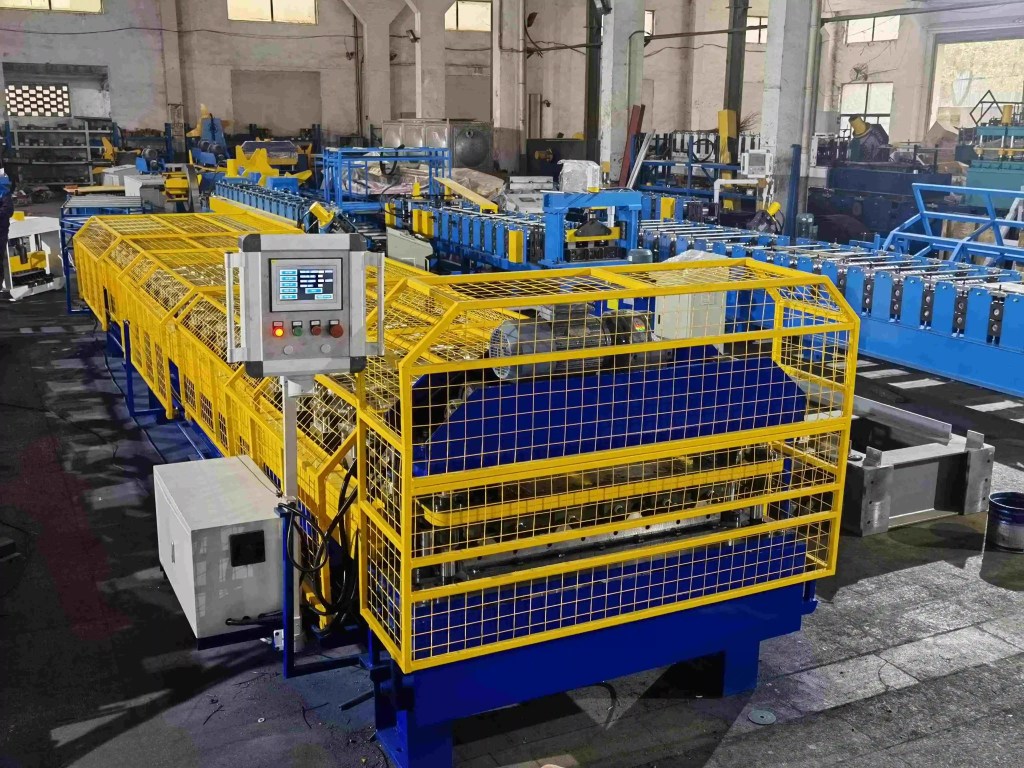
A PBR roof panel machine needs a rigid mill base. Forming 26-gauge steel into a 1.25-inch rib takes real force across 16 to 20 forming stations. Look for:
А консольная мельница design allows quick roll change for different profiles. Through-shaft mills offer better rigidity for high-volume PBR production. Both have their place.
Rollers make the profile. Cheap rollers make a cheap-looking panel. Proper PBR panel roll forming rollers need:
The roller design determines whether your panel comes out looking like MBCI spec or like a wavy approximation. Roll forming machine roller design is an engineering discipline, not guesswork.
PBR machines typically run 16-20 stations. Each station needs consistent torque. Two main drive options:
For a machine running a metal roof panel product line with daily production, gearbox drive pays for itself in uptime and profile consistency.
PBR panels get cut to length. The cut quality affects how panels install. A ragged cut means a bad first impression on the job site. Options:
Most serious PBR roof panel machine lines use flying hydraulic shears. When you are running 35 to 50 feet per minute, stopping and starting wastes hours every shift.
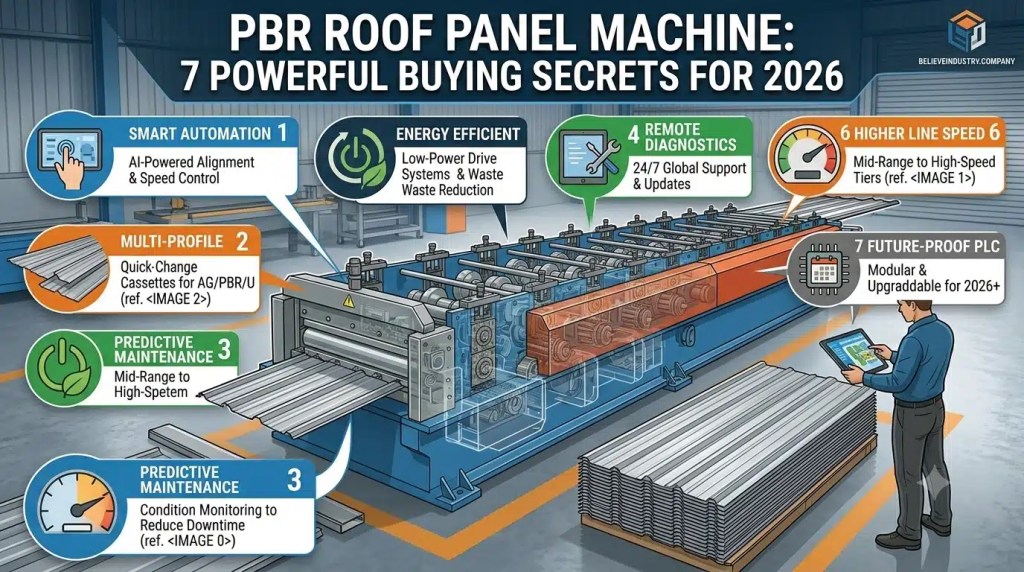
Modern PBR panel roll formers need modern controls. The bare minimum:
Better systems add remote monitoring. You or your China roll forming machine supplier can troubleshoot over the internet. That matters when your machine is in Texas and your support is in China.
complete PBR roof panel machine line is not just the roll former. It is a system. Here is the standard configuration.
| Station | Оборудование | Функция |
|---|---|---|
| 1 | Hydraulic decoiler (5-10 ton) | Holds and feeds coil stock |
| 2 | Coil car / loading system | Loads coils onto the decoiler |
| 3 | Entry guide & leveling | Aligns and flattens strip before forming |
| 4 | Pre-shear or pre-notch (optional) | Cuts notches if panel ends need them |
| 5 | Roll forming mill (16-20 stations) | Forms the PBR profile |
| 6 | Flying hydraulic shear | Cuts panels to length |
| 7 | Run-out table with auto stacker | Collects and stacks finished panels |
Some lines add a калькулятор металлических катушек integration that tracks coil usage and predicts when to reload. Others add embossing stations before the roll former for textured panel finishes.
Speed matters. A standard PBR panel roll former runs 15-25 meters per minute. High-speed lines hit 35-45 meters per minute. The difference in daily output is massive. A 25 m/min machine running 8 hours produces roughly 480 panels at 25-foot lengths. A 40 m/min machine at the same shift length hits 768 panels. That is a 60 percent output gain from speed alone.
| Speed Tier | Скорость линии | Panels/Day (25ft) | Лучше всего подходит для |
|---|---|---|---|
| Начальный уровень | 12-15 m/min | ~240-300 | Startup shops, low volume |
| Средний ценовой сегмент | 20-28 m/min | ~400-540 | Regional manufacturers |
| Высокоскоростной | 35-45 m/min | ~680-860 | National/export volume suppliers |
Most established профилегибочная машина для листового металла shops target the mid-range tier. It balances capital cost with output. High-speed lines make sense when you have consistent volume and qualified operators.
PBR panels are not popular by accident. The profile solves real problems that other exposed-fastener panels do not.
Low-slope capability. At 1/2:12 minimum slope, PBR handles roofs that AG panel (3:12 minimum) cannot touch. That opens up large-span commercial buildings where steep pitches are impractical or too expensive.
Structural strength. The 1.25-inch rib combined with the purlin-bearing leg lets PBR span up to 5 feet on open framing. Engineers spec PBR because the numbers work. Fewer purlins mean lower structural steel cost.
Dual purpose. One PBR roof panel machine produces both roof and wall panels. No tooling change. No profile switch. You stock one coil type and serve two applications. That simplifies профилегибочная машина для кровельных листов операции.
Code acceptance. PBR panels carry UL, FM, and ASTM ratings that building codes recognize. Architects can spec PBR without fighting permitting offices. That is not true for every imported panel profile. The Ассоциация производителей металлических зданий (MBMA) и Ассоциация металлоконструкций both maintain current technical resources for PBR panel specifications in commercial construction.
Installation speed. Exposed fasteners go in fast. A 4-man crew can install 3,000 to 5,000 square feet of PBR roofing per day. Standing seam takes longer and costs more in labor. For budget-driven commercial projects, PBR wins the math every time.
I have watched buyers make the same mistakes year after year. Here are seven things to verify before you sign anything.
1. Profile samples in your material. Do not accept a sample run on Chinese coil stock if you run US-made Galvalume. Material properties differ. Get samples formed on the exact substrate and gauge you will use in production.
2. Roller warranty and spare set pricing. Rollers wear. Ask for warranty terms and the cost of a replacement roller set. If the supplier will not quote spares up front, walk away.
3. Motor and electrical component brands. Siemens, Schneider, ABB. Do not accept unbranded or “equivalent” electricals. A PBR roof panel machine stops being profitable the day it stops running.
4. Hydraulic system components. Parker, Yuken, or Rexroth hydraulics. The flying shear depends on clean, consistent hydraulic pressure. Cheap hydraulics leak and drift.
5. Installation support. Does the supplier send a technician? For how many days? What about remote video support after commissioning? Roll forming machine installation done wrong costs months of downtime.
6. Total landed cost. Machine price plus ocean freight plus import duties plus inland trucking plus installation. Quote the full number. A 65,000FOBmachinecanlandat65,000ФОБмаcхинеканlанdat95,000 by the time it sits on your floor.
7. Reference customers. Ask for three customers who bought the same PBR panel roll forming machine and have been running it for at least 12 months. Call them. Ask about downtime, profile quality, and after-sales support.
A PBR panel roll former is not a set-and-forget machine. It takes consistent maintenance to hold profile tolerance and line speed.
Daily: Check roller alignment, hydraulic oil level, shear blade sharpness, and chain tension (if chain drive). Clean metal debris from rollers and guides. Ten minutes of daily inspection prevents hours of unplanned downtime.
Weekly: Lubricate all bearings and drive components. Check electrical connections for tightness. Inspect decoiler brake pads. Verify the PLC backup battery.
Monthly: Full roller inspection for wear or surface damage. Check gearbox oil levels. Calibrate the length measurement system. Run a full test panel and measure rib height, coverage width, and hole positions against the PBR spec sheet.
Annual: Replace hydraulic oil and filters. Full electrical system inspection. Replace worn rollers. Check frame bolts for torque.
Proper Техническое обслуживание профилировочных станков extends machine life from 5-7 years to 15-plus. The shops I know that run 15-year-old PBR lines did not buy the most expensive machine. They bought a decent machine and maintained it religiously.
Understanding how a PBR roof panel machine forms the profile helps you troubleshoot and optimize.
Coil loading. A coil car lifts the master coil onto the hydraulic decoiler. The decoiler feeds strip into the line under controlled tension. Too much tension stretches the strip. Too little causes feeding inconsistencies.
Leveling and guiding. Entry guides and leveling rollers flatten the strip and align it with the mill centerline. Even a 2mm misalignment at entry becomes a 10mm profile error by station 20.
Progressive forming. The flat strip moves through 16 to 20 roll forming stations. Each station incrementally bends the steel closer to the final PBR shape. The 1.25-inch ribs form gradually. Pushing too much deformation in one station creates stress and oil canning.
Flying cut. The hydraulic shear tracks the moving panel at line speed, clamps, cuts, and retracts. The cut triggers from the encoder counting length. Accuracy should be within +/- 1.5mm.
Stacking. Finished panels slide onto the run-out table and auto-stacker. Proper stacking prevents scratching and bending. Most damage to finished PBR panels happens in handling, not in forming.
The преимущества профилирования become clear when you compare this process to press braking. Roll forming produces consistent, long panels far faster than any brake press ever could.
A PBR roof panel machine is a roll forming line that produces PBR (Purlin Bearing R-Panel) metal roofing and siding panels. It forms 1.25-inch high ribs at 12-inch spacing across a 36-inch coverage width, typically from 26-gauge steel coil. The finished panels are used on commercial, industrial, and agricultural buildings as through-fastened roof and wall cladding.
The main difference is the purlin-bearing leg. PBR panels have a purlin-bearing leg that sits directly on structural supports, improving load transfer and sidelap alignment. R panels lack this feature and use a standard overlap sidelap. Both have roughly 1.25-inch rib height and 36-inch coverage, but the PBR profile offers better structural performance, especially on low-slope roofs.
No, not without a tooling change. PBR, AG, and R panels are different profiles with different rib heights, spacings, and edge details. A dedicated PBR panel roll former produces only PBR profiles. Some double-layer or quick-change machines can switch between two profiles, but the roller sets are different for each panel type.
The standard PBR roll former handles 26-gauge steel, the most common spec for commercial PBR panels. Heavy-duty machines also process 24-gauge and 22-gauge material for structural applications requiring thicker panels. Always verify the machine spec matches your target gauge before purchasing.
Standard PBR panel roll formers run at 20 to 28 meters per minute. High-speed models reach 35 to 45 meters per minute. Entry-level lines may run at 12 to 15 meters per minute. The speed you need depends on your daily volume target and whether you run single or multiple shifts.
A PBN panel machine is essentially the same as a PBR panel machine. Some manufacturers and fabricators use PBN as an alternative naming convention for panels with similar 1.25-inch rib height and purlin-bearing leg design. When comparing PBN panel machine specs, you are looking at equipment that produces the same structural exposed-fastener panel profile as a PBR roll former.
A complete PBR roof panel machine line from a China-based manufacturer like Believe Industry typically ranges from 45,000 to 120,000 FOB, depending on speed, automation level, and component quality. Landed cost with freight, duties, and installation adds 25 to 40 percent. US or European-built machines run significantly higher.
PBR panels can be installed on roofs with slopes as low as 1/2:12 when proper sealant is used at sidelaps and endlaps. This low-slope capability is one reason engineers prefer PBR over AG panels, which require a minimum 3:12 slope.
A PBR panel roll former typically needs 16 to 20 forming stations to progressively shape the 1.25-inch ribs without stressing the material. Fewer stations force more deformation per pass, increasing the risk of profile distortion and oil canning on the finished panel.
Daily roller cleaning and alignment checks. Weekly lubrication and electrical inspection. Monthly gearbox oil checks and calibration. Annual hydraulic oil replacement and full roller inspection. Following a consistent maintenance schedule extends machine life well beyond 10 years.
June 24, 2026
Станок для производства кровельных панелей PBR – это не просто очередной рулон...
Читать далееЕсли вы ищете станок для профилирования кабельных лотков...
Читать далееВыбор правильной серии профилей для стоек подвески — это не просто...
Читать далееВ этом руководстве по выбору станка для профилирования сельскохозяйственных панелей рассматриваются все аспекты...
Читать далееОформите подписку, чтобы продолжить чтение и получить доступ к полному архиву.