العنوان
رقم 1، طريق Yd، حي هويشان، مدينة ووكسي، مقاطعة جيانغسو. 214183
ساعات العمل
من الاثنين إلى الجمعة: 9 صباحا - 5 مساء
السبت: 9 صباحا - 4 مساء
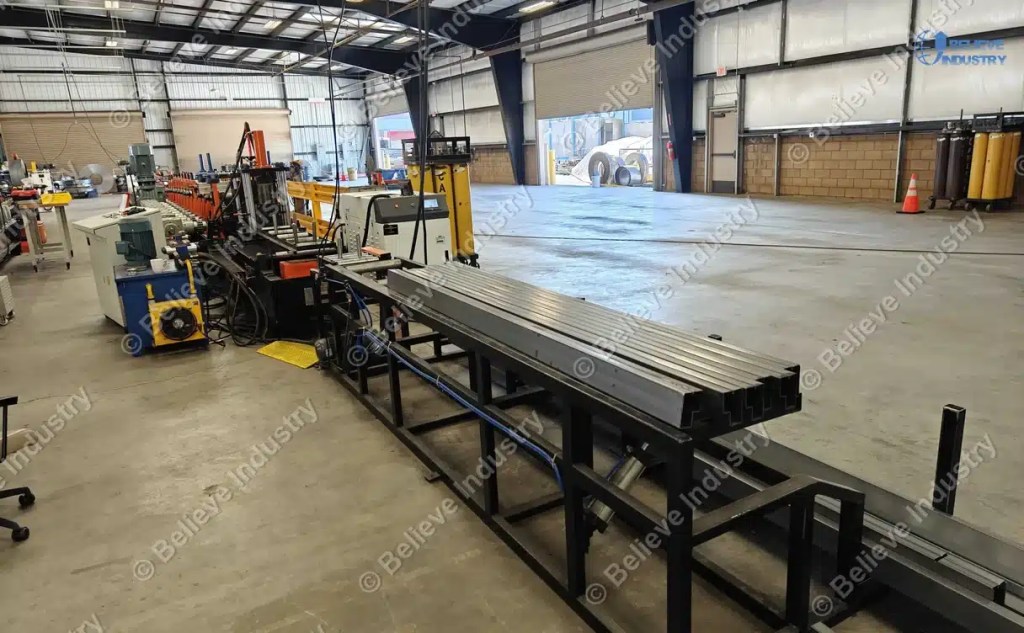
إجابة مختصرة: Step beam end processing is the punching, notching, cutting and welding work that turns a formed rack beam into a part that locks into an upright. Six rules decide the result. Freeze the connector drawing first, punch holes on flat strip, hold the datum to the cut end, size the notch to beam depth, pick the cut method by burr limit, and weld the end clips in a fixture. Most field complaints trace back to hole position rather than beam strength.
A rack beam carries the load in the middle. Step beam end processing decides what happens at the ends. The connector, the hook pattern and the cut face decide whether the beam drops into the upright or jams on site. Step beam end processing covers the last 150 to 250 mm of the part, and that short length drives most of the tooling cost.
This guide stays on step beam end processing. For the full route from coil to finished beam, see the عملية إنتاج العارضة المدرجة. For thick coil forming, see heavy duty step beam roll forming. Neither replaces the profile drawing that comes with the tooling order.
A finished beam end has four jobs. It has holes that take the connector hooks or bolts. It has a notch or relief that clears the upright face. It has a square cut face at the right length. It has an end clip welded in the right plane so the hooks engage together. Step beam end processing delivers all four in a repeatable order.
Step beam end processing sits on the same خط ماكينة التشكيل بالدرفلة as the forming mill, but it uses different stations. A pre punch unit sits before the first forming stand. A cut unit sits after the last stand. A weld fixture sits off line or at the run out table. The ماكينة تشكيل العوارض المدرجة is the whole chain; the end process is the tooling at both ends of it.
Step beam end processing does not include the upright hole pattern, the powder coat line or the rack design calculation. Those belong to the rack engineer. معايير MHI are a useful reference for the rack side of the boundary.
| Rule | What to fix | Typical shop target | Failure if ignored |
|---|---|---|---|
| 1 | Connector drawing and hook pattern | Frozen before die cutting | New clips do not fit old beams |
| 2 | Punch position on flat strip | Hole to end within 0.5 mm | Holes drift after forming |
| 3 | Datum at the cut face | Encoder referenced to cut, not coil edge | Cumulative feed error at long lengths |
| 4 | Notch size by beam depth | Root radius kept, no sharp corner | Cracks start at the notch root |
| 5 | Cut method by burr limit | Burr under 0.2 mm after deburr | Hooks hang up, hands get cut |
| 6 | End clip welded in a fixture | Clip square within 0.5 mm | One hook carries all the load |
These are shop targets for step beam end processing, not a rack code. Confirm them against the beam drawing and the connector supplier sheet before they go into a purchase order.
The connector decides the holes. A three hook clip, a four hook clip and a bolted end plate each need a different hole pattern, a different edge distance and a different safety lock position. Step beam end processing starts with that drawing, not with the coil.
Upright hole pitch matters to step beam end processing too. A 50 mm pitch and a 75 mm pitch call for different hook spacing. Ask the rack designer which upright the beam will meet, then pass the آلة تشكيل رف البالتات بالدرفلة profile drawing to the tooling shop at the same time. Changing the connector after the die is cut means buying a new die and a new weld fixture.
A step beam is a closed or near closed section. Once the two flanges are rolled together, a conventional die cannot reach the inside face. That is why step beam end processing puts the punch unit before the first stand, while the strip is still flat.
In step beam end processing, a hydraulic punch with servo feed stops the strip, fires the die and indexes to the next position. A rotary or travelling punch keeps the strip moving. Both need a clean die, correct clearance and a strip that is flat enough to sit on the die face. The دليل تركيب قوالب التثقيب covers clearance and alignment; upright rack punching faults covers the drift symptoms that appear later.
| المحطة | Placement | سرعة الخط المعتادة | ما تتحكم فيه |
|---|---|---|---|
| Decoiler and straightener | Line entry | 15 إلى 25 م/دقيقة | Strip flatness at the die |
| Hydraulic pre punch | Before stand 1 | 3 to 4 m/min stop and go | Hole pattern and hole to end distance |
| Servo travelling punch | Before stand 1 | 10 إلى 15 م/دقيقة | Hole pattern without stopping |
| وحدة التشكيل | 20 to 28 stands | 10 إلى 20 م/دقيقة | Section shape and step height |
| Flying saw or shear cut | After last stand | 20 إلى 35 م/دقيقة | Length, end squareness, burr |
| المُكدِّس الآلي | Run out | 15 إلى 25 م/دقيقة | Bundle order and surface damage |
The slowest station sets the line pace. A stop and go punch can halve the output of an otherwise fast mill.
Servo feed accumulates small errors over a long beam. If the hole pattern is measured from the coil edge, a 3 m beam and a 2.7 m beam from the same coil will show different hole to end distances. Step beam end processing should measure from the cut face.
In practice the encoder counts from the punch, the cut fires at a set count and the control compensates for blade position. Ask for a 30 piece sample with hole to end distance recorded on each piece. A drifting number means the datum is on the wrong end of the line.
The end notch clears the upright column and the adjacent beam. Cut too little and the beam will not seat. Cut too much and the hook zone loses material. Step beam end processing has to balance both against beam depth and strip thickness.
Common rack beams run 1.5 to 3.0 mm wall. A sharp notch root becomes a crack starter under cyclic pallet loading, so ask for a rounded root and keep the notch one hole diameter away from the hook holes. The fabricator reference library covers notch behaviour in formed sheet. Heavy duty beams need the relief checked against the actual connector.
Two cut methods dominate step beam end processing. A flying saw tracks the moving beam, clamps and cuts with a rotating blade. It suits closed sections and runs at 20 to 35 m/min. It leaves saw swarf and a burr that needs a deburr pass. A hydraulic shear or cut off die is faster per cut, gives a squarer face and can collapse a closed corner if the blade is worn.
Step beam end processing has to state the burr limit at the hook slots. A burr inside a slot stops the clip from seating. Blade life belongs in the spare parts list, and the quality control record should include the cut face check. NEMA guidance covers the electrical side of the cut drive.
| الخاصية | Shop target | طريقة القياس | لماذا يهم |
|---|---|---|---|
| Hole to end distance | Within 0.5 mm | Calliper from cut face | Clip engagement |
| Hole pitch across the end | Within 0.3 mm | Gauge or vision check | All hooks share the load |
| طول القطع | Within 1.0 mm | Tape against beam drawing | Rack bay fit |
| End squareness | Within 0.5 mm over section depth | Square on cut face | Beam sits flush to upright |
| Clip squareness | Within 0.5 mm | Fixture gauge after weld | No twist in the connection |
| Burr height after deburr | Under 0.2 mm | Run a fingernail or gauge | Safe handling, clean seating |
Step beam end processing welds the end clip after the beam is cut. A double station welder handles both ends of a beam in one cycle, but only if the beam is held square in a fixture. Free hand welding gives a clip that looks right and loads wrong. The line ends at that fixture, not at the cut unit.
Check three things on the first article: every hook enters the upright slot together, the safety lock hole lines up, and the clip face sits flat. Pull a sample from each shift for a load check. Weld spatter in a hook slot is a rejection.
| العرض | Likely cause | Fix |
|---|---|---|
| Clip will not enter upright | Hook pitch or hole drift | Recheck datum and punch die |
| Beam sits high on one end | Clip welded out of square | Rebuild weld fixture stop |
| Crack at notch root | Sharp corner or over cut | Add root radius, reduce relief |
| Burr inside hook slot | Worn blade, no deburr | Change blade, add deburr station |
| Hole pattern walks along a coil | Encoder slip or feed roll slip | Clean rolls, reset compensation |
| Corner collapsed at cut face | Shear blade worn on closed section | Switch to saw or renew blade |
Step beam end processing faults are cheap to fix at the line and expensive to fix on a rack with pallets on it. Ask for a first article report before the container is packed.
Line output in step beam end processing follows the punch. A stop and go hydraulic punch caps a line near 3 to 4 m/min regardless of how fast the mill can roll. A travelling punch lifts that band to 10 to 15 m/min and adds to the price. The دليل أسعار ماكينات تشكيل اللفائف breaks down where that money goes. An المُكدِّس الآلي matters more than it looks, since a dropped bundle damages the cut faces that were just measured.
For a step beam end processing quote, send the connector drawing, upright hole pitch, beam length list, wall thickness range, daily output and inspection sheet with the enquiry. Two beam depths can share a mill, but they rarely share a punch die and a weld fixture. Ask the supplier to quote those as separate line items.
An upright column is punched along its full length, so its line lives or dies by feed accuracy over metres of strip. A step beam is punched at both ends only, so step beam end processing lives or dies by cut referenced position. That is why a good upright line does not automatically make good beam ends.
ماكينة آلة شعاع الصندوق uses roughly 14 forming stands plus 5 seam stations and usually ends with a flat cut and an end plate. It has no hook pattern, and borrowing its end tooling is a costly shortcut.
Q: Can we punch holes after the beam is formed?
Q: Which cut is better for a closed section?
Q: How many hooks should an end clip have?
Q: What tolerance should we ask for on hole to end distance?
Q: Do we need a separate end clip welder?
Q: Can one line run two beam depths?
آخر تحديث: 2026-11-09
سجل تغييرات المقال
2026-11-09: Initial publication in the 2026-11-09 calendar slot, backfilled on 2026-11-15.
محفزات المراجعة التالية
Connector drawing or upright hole pitch changes; a buyer asks for a new beam depth; cut method changes from saw to shear; inspection targets move.
Steel Silo Roll Forming: 4 Profiles for Grain and Cement...
اقرأ المزيدTwo Cable Tray Roll Forming Machines Ready to Ship to...
اقرأ المزيدRoll Forming Machine Foundation: 5 Concrete Specs and Layout Rules...
اقرأ المزيدScaffolding Roll Forming: 5 Profiles for Construction Access Systems Short...
اقرأ المزيد
