Electrical Roll Forming Machines 4 Power Distribution Profiles 2026

Electrical & Power Industry Roll Forming: Cable Tray & Busway Profiles

Need a Roll Forming Machine for Your Project?
Get a free quote from Believe Industry — 15+ years of custom roll forming manufacturing.
طلب عرض أسعار Download Catalogue

An electrical roll forming machine turns steel coil into the cable trays, busway housings, conduit channels, and transformer panels that power distribution networks are built from. One line can supply a cable tray plant, a switchgear builder, and a transformer workshop from the same coil stock. Roll forming machine lines with cassette tooling make that spread possible.

Short answer: An electrical roll forming machine is a roll forming line configured to produce power distribution profiles: cable tray (ladder, trough, solid bottom, and wire mesh), busway enclosure housings, electrical conduit channels, and transformer tank panels. These machines run pre galvanized, hot dip galvanized, or stainless coil at 12 to 35 m/min and punch NEMA standard slots in line.

Why Power Projects Buy Roll Formed Profiles

Power infrastructure consumes steel at a steady rate. Cable trays carry low and medium voltage cable through substations, plants, and data centers. Busway housings route high amperage power between transformers and switchgear. Conduit channels protect branch circuits. Transformer tanks need corrugated panels that radiate heat.

Service centers sell these profiles cut to length. That works for a single substation job. It fails for a cable tray manufacturer shipping container loads every month. Margin lives in forming the coil yourself.

Three numbers explain the shift:

  1. Cost per meter. Forming from coil cuts profile cost 20 to 40 percent against purchased cut lengths.
  2. Length freedom. Cable tray straight sections ship in 3 meter lengths by standard, but EPC projects often ask for custom runs. In house forming answers without a supplier round trip.
  3. Slot control. NEMA and IEC slot patterns differ by market. A punching press wired to your own line adapts in an afternoon.

ال آلة تشكيل صينية الكابلات is the anchor product in this category, and demand keeps growing with data center and grid investment.

Four Power Distribution Profiles

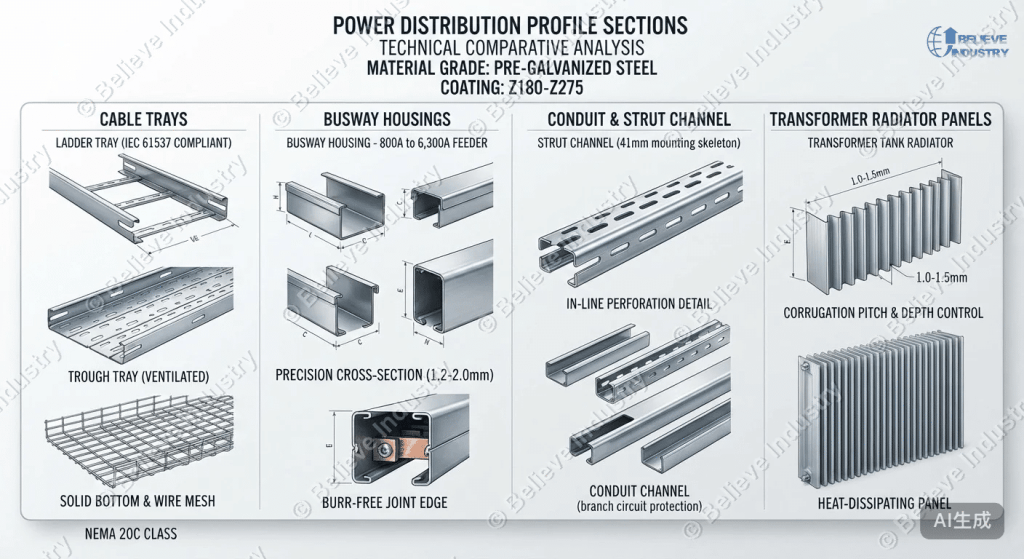
1. Cable Trays: Ladder, Trough, Solid Bottom, Wire Mesh

Cable tray is the volume product. Ladder type carries heavy cable runs on two side rails with rungs. Trough type adds a ventilated bottom. Solid bottom (also called conduit tray) encloses the cable fully. Wire mesh tray bends from cold drawn wire instead of coil and serves light duty installs.

Roll forming covers the first three. Side rails form from 1.5 to 2.5 mm coil with a return flange that adds stiffness without weight. The IEC 61537 standard defines how tray load capacity is tested, and most export tenders reference it directly.

NEMA classes matter for the US market. Class 20B tray handles light duty spans, Class 20C and 20D take heavier cable at longer support spacing. A آلة تشكيل صينية الكابلات set up for 20C sections covers the tender volume most EPC buyers need.

Regional slot patterns are the hidden spec. Middle East projects follow NEMA hole patterns with galvanized finish per project specs. Our cable tray machine Middle East buy guide breaks down those requirements market by market.

2. Busway Enclosure Housings

Busduct and busway systems route 800 to 6,300 ampere feeders between transformers and main switchgear. The housing is a roll formed channel that clamps around insulated bus bars and doubles as the ground path.

The profile needs a tight fold and consistent cross section, because bus bars stack inside with fixed clearance. Most housings form from 1.2 to 2.0 mm pre galvanized or aluminum zinc coil. Housing lengths join end to end, so cutoff cut quality matters: a burr at the joint scratch damages the bar insulation during assembly.

3. Conduit Channels and Strut Channel

Strut channel is the mounting skeleton of every electrical room. Cable tray hangers, conduit clamps, and panel supports all bolt to 41 mm strut. The آلة تشكيل قنوات الدعامات بالدرفلة producing it runs continuous in line perforation so fitters can position hardware anywhere along the channel.

Conduit channels for branch circuit protection form from thinner coil, 0.8 to 1.5 mm, often pre painted in indoor environments. Both profiles share tooling logic with cable tray rails, which is why multi profile cassette mills dominate this market.

4. Transformer Tank Panels and Radiator Elements

Distribution transformers shed heat through corrugated tank walls. The corrugation pattern is roll formed into 1.0 to 1.5 mm cold rolled steel, then welded into the tank and filled with oil on both sides. Fold depth and pitch control the radiator surface, so the profile tolerance is tighter than structural work: forming stands hold the fold depth within a fraction of a millimeter.

Panel shops that form their own radiator corrugation control transformer pricing directly. It is a smaller volume market than cable tray, but margins run higher and competition is thinner.

Profile and Machine Matching

حساب تعريفيسمك الملفسرعة الخط النموذجيةنوع الآلة
Cable tray side rails1.5 to 2.5 mmمن 15 إلى 25 متر/دقيقةTray rail mill with servo punching
Cable tray bottomsمن 0.8 إلى 1.5 ملم20 to 30 m/minTray bottom mill
Busway housing1.2 to 2.0 mm12 to 20 m/minCassette mill with tight tolerance stands
قناة دعامة1.5 to 2.5 mm20 to 35 m/minStrut mill with in line perforation
Conduit channelمن 0.8 إلى 1.5 ملم20 to 30 m/minLight gauge cassette mill
Transformer radiator panels1.0 to 1.5 mm10 to 18 m/minCorrugation mill with precision fold control

Steel and Coating Choices

Electrical environments attack steel differently than farm or construction sites. Indoor switch rooms stay dry for decades. Outdoor substations, petrochemical plants, and coastal generation sites chew through thin coatings.

EnvironmentRecommended CoatingService Life
Indoor switch rooms and panel shopsPre galvanized Z180 to Z275أكثر من 20 عامًا
Industrial plants (dust, moisture)Hot dip galvanized after fabrication, Z27520 to 25 years
Outdoor substationsZ275 to Z350, optional polyester top coat25+ years
Petrochemical and coastal sitesStainless 304 or hot dip plus duplex coatأكثر من 30 عامًا

Coating weight follows the ASTM A653 standard, which defines galvanized grades by coating mass per square meter. Put the coating weight in the purchase contract, not in an email thread.

Coil grade matters as much as coating. Return flanges on tray rails work harden the steel at the fold, and low grade coil cracks there. Our guide on how to select steel coil for roll forming covers yield strength and mill tolerance for exactly this reason.

Coil width errors waste material on every profile. Cable tray rails in particular need tight width control because the return fold consumes a fixed allowance. The coil width calculation guide shows how to set blank width before the first test run.

What an Electrical Roll Forming Line Includes

A complete line has five stations:

  1. Decoiler. A 3 to 5 ton capacity decoiler feeds the mill. Double arm models cut coil change downtime in half.
  2. Leveler. Valuable for 2 mm rail coil, where flatness drives slot alignment after forming.
  3. Roll forming mill. 14 to 24 stands depending on profile depth. Cassette tooling swaps tray rails for strut or busway housing without rethreading.
  4. Punching press. A servo press punches NEMA slots, cable tray knockouts, and strut perforations on the fly. Punch speed sets the real line speed on tray rails.
  5. Cutoff and stacking. Flying die or servo tracked cutoff gives clean, burr free ends. Busway housing tolerates no burrs at the joint face.

Buyers who run one mill across tray, strut, and conduit profiles ask how to keep changeover time down. The coil changeover guide covers setup routines that trim hours to minutes.

Data centers deserve a separate note. A hyperscale campus installs cable tray by the kilometer and upgrades it every few years. The آلة تشكيل لفائف مركز البيانات guide covers raised floor and containment profiles that pair with tray production on the same mill.

Production Planning for a Multi Profile Shop

A single cassette mill serving four profile families keeps a shop busy year round. One practical schedule:

QuarterMain ProductOutput Target
Q1Cable tray rails and bottoms60,000 m
Q2Strut channel for EPC orders45,000 m
Q3Busway housing for switchgear contracts30,000 m
Q4Transformer panels and export tray orders35,000 m

Grid investment peaks follow government budgets, not seasons. Trimming the mill between product families is cheaper than idling a second line, which is the core argument for cassette tooling in this category.

Common Buying Mistakes

Buying a tray machine that only forms tray. A dedicated tray mill is fast and inflexible. Cassette tooling costs more upfront and covers busway and strut demand when tray orders slow down.

Ignoring punching speed. NEMA slot patterns put a hole every 50 to 100 mm on tray rails. A hydraulic press that pulses too slow throttles the whole line no matter how fast the mill runs.

Skipping the load test. Tray that fails the IEC 61537 span test in the field costs a full shipment recall. Ask the machine builder for a load test video with certified weights before ordering.

Treating burrs as cosmetic. Cable insulation abrades against sharp tray edges for 25 years. Burr free cutoff is a product requirement, not a finish detail.

Ordering thin coating for outdoor work. A substation buyer who receives Z180 instead of Z275 sees rust within five years. Put coating weight in the contract.

Frequently Asked Questions of Electrical Roll Forming Machine

What profiles can an electrical roll forming machine produce?

Standard outputs include cable tray side rails and bottoms (ladder, trough, and solid bottom types), busway and busduct enclosure housings, strut channel, conduit channels, and transformer tank radiator panels. Cassette tooling lets one mill switch between families in 2 to 3 hours.

How fast does an electrical roll forming machine run?

Light profiles such as tray bottoms and conduit channels run 20 to 30 m/min. Tray rails and busway housing run 12 to 25 m/min. Actual output depends on punching density more than mill speed.

What steel does cable tray production need?

Pre galvanized or hot dip galvanized coil from 0.8 to 2.5 mm depending on the profile. Rail sections use 1.5 to 2.5 mm for NEMA Class 20C and above loads. Coastal and petrochemical projects call for 304 stainless. Coating weight should follow ASTM A653 and be written into the contract.

What is the difference between NEMA and IEC cable tray standards?

NEMA VE 1 defines tray classes by load and span for the North American market. IEC 61537 defines load testing for international tenders. Both reference the same physics, but the slot patterns and documentation differ, so confirm which standard the tender cites before setting up the punching pattern.

How much does an electrical roll forming machine cost?

A single profile tray line starts near 45,000 USD. A cassette based multi profile line covering tray, strut, and busway runs 90,000 to 160,000 USD. Fully automated lines with servo punching and stacking exceed 200,000 USD.

Can one machine serve a cable tray plant and a switchgear builder?

Yes. Cassette tooling swaps tray rail cassettes for busway housing cassettes in hours. Shared decoiler, punching press, and cutoff keep the investment low. Punch tooling changes faster than roll cassettes.

Why does busway housing need tighter tolerances than tray?

Insulated bus bars stack inside the housing with fixed clearance. A fold that drifts out of tolerance jams the bar assembly at the joint. Housing mills use more stands at smaller fold increments to hold the cross section.

What installation support do you provide?

Believe Industry ships lines with video guided installation, remote commissioning, and operator training. Most lines reach full production within two weeks of arrival. Export documentation covers destinations across the Middle East, Southeast Asia, Africa, and Latin America.

أهم النقاط

  • An electrical roll forming machine produces four core power distribution profile families: cable tray, busway housing, conduit and strut channel, and transformer radiator panels.
  • Cable tray is the volume product; transformer panels are the margin product. Cassette tooling lets one mill serve both.
  • NEMA slot patterns and IEC 61537 load testing decide export tender eligibility. Confirm the standard before ordering punch tooling.
  • Coating choice, not machine speed, decides profile life. Write ASTM A653 coating weights into the contract.
  • Punching speed sets real line output on tray rails. Size the servo press before the mill.

آخر تحديث: 2026-09-07

سجل تغييرات المقالة

  • 2026-09-07: First version. Covered four power distribution profiles, machine matching table, steel coating guide, standards comparison, and production planning.

محفزات المراجعة التالية

  • NEMA or IEC cable tray standard revision
  • New busway voltage class released by a major switchgear manufacturer
  • Stainless coil price shift above 15 percent

جدول المحتويات

تحديثات جديدة

اكتشاف المزيد من Believe Industry Company| Roll Forming Machine Manufacturer, Supplier & Exporter

اشترك الآن للاستمرار في القراءة والحصول على حق الوصول إلى الأرشيف الكامل.

تابع القراءة