DIRECCIÓN
No 1, Yd Road, distrito de Huishan, ciudad de Wuxi, Jiangsu. 214183
Horario laboral
De lunes a viernes: de 9:00 a 17:00
Sábado: 9:00 - 16:00
A Máquina perfiladora de techos residenciales shapes flat steel coil into finished roof panels for houses. Home construction demands specific profiles that differ from commercial or industrial roofing. The profiles need tighter tolerances, lighter gauges, and aesthetic finishes that homeowners actually want.
This guide covers seven home roof profiles a residential roofing roll former machine can produce. You will learn which profiles suit which markets, what material each requires, and how to configure the production line. Whether you supply residential contractors or run an in-house roofing shop, this information helps you pick the right machine setup.
Believe Industry Company has built roll forming machines for over 15 years. Machines shipped to 20+ countries. Every recommendation in this guide comes from real production lines, not catalog descriptions.
A residential roofing roll forming machine is a cold roll forming line that produces metal roof panels for residential buildings. It feeds galvanized or pre-painted steel coil through a series of roller stations. Each station bends the strip incrementally until the final profile emerges. A flying shear cuts the panel to length without stopping the line.
The process works at room temperature. No heat treatment, no welding, no material waste. You can learn more about the underlying process on our máquina formadora de rodillos en frío página.
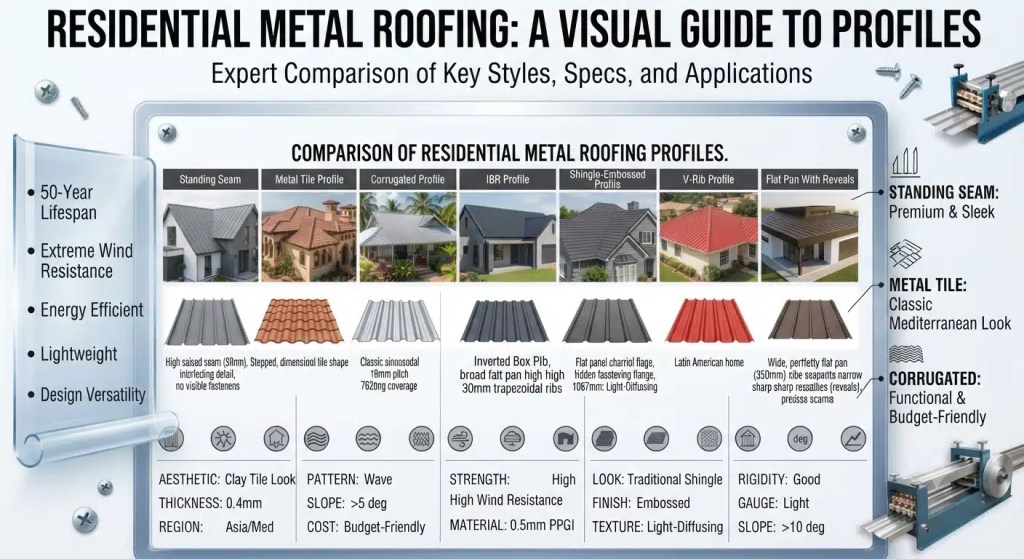
Residential roofing profiles differ from commercial profiles in three ways. First, they use lighter gauges, typically 0.3 to 0.6 mm. Second, they prioritize visual appeal with smooth finishes and consistent ribs. Third, they often include embossed patterns that mimic tile, shake, or shingle textures. A máquina formadora de rollos de láminas para techos built for commercial work cannot always produce these aesthetic profiles without modification.
A single residential roofing roll forming machine can produce multiple profiles if equipped with quick-change roller sets or a double-layer configuration. Here are the seven profiles most in demand for home construction.
| Perfil | Gauge Range | Ancho de cobertura | Altura de las costillas | Best Market | Aesthetic |
|---|---|---|---|---|---|
| Costura alzada | 0.4-0.6 mm | 300-500 mm | 25-40 mm | US, EU, AU | Clean, modern |
| Metal Tile | 0.3-0.5 mm | 830-1050 mm | 20-30 mm | Asia, Med | Tile-look |
| Acanalado | 0.3-0.5 mm | 762-1000 mm | 15-25 mm | Global | Classic wavy |
| IBR | 0.3-0.5 mm | 686-1000 mm | 30 mm | Africa, AU | Ribbed |
| Shingle-Embossed | 0.35-0.5 mm | 920-1150 mm | 10-15 mm | US, EU | Asphalt-look |
| V-Rib | 0.3-0.5 mm | 762-1000 mm | 18-25 mm | Latin America | Structured |
| Flat Pan | 0.4-0.6 mm | 300-400 mm | 20-30 mm | Custom homes | Minimalist |
Standing seam is the premium residential metal roof profile. The panels feature raised seams that interlock mechanically, hiding the fasteners from view. No exposed screws means no leak points and a cleaner appearance.
A máquina formadora de rollos de costura alzada for residential use typically forms panels at 300 to 500 mm coverage width. The seam height runs 25 to 40 mm. The machine includes a mechanical seaming unit that locks adjacent panels together at the job site or inline.
Homeowners choose standing seam for its 50-year lifespan and wind resistance. The profile handles slopes as low as 1:12, making it versatile for various roof designs. Material is usually 0.4 to 0.6 mm pre-painted Galvalume or PPGI steel.
Metal tile profiles mimic the look of traditional clay or ceramic tiles without the weight. Each panel covers a large area but shows a stepped tile pattern when installed. This profile is popular in Asia and Mediterranean markets where clay tile aesthetics dominate.
A máquina formadora de rollos de tejas metálicas uses an embossing station before or after the forming section. The embossing roller stamps the tile pattern into the steel surface. The forming stations then create the stepped profile that gives each panel its dimensional tile look.
Material thickness runs 0.3 to 0.5 mm. Coverage width ranges from 830 to 1050 mm depending on the tile pattern. The lighter gauge keeps the roof weight low, which matters for residential structures not engineered to carry clay tile loads.
Corrugated is the most widely recognized roofing profile worldwide. The wave pattern is simple, functional, and cost-effective. For residential use, corrugated panels typically use lighter gauges and pre-painted finishes that improve curb appeal.
A máquina formadora de rollos de láminas onduladas forms the wave profile through 12 to 16 roller stations. The pitch and depth of the waves vary by market. US residential corrugated often runs 3/4 inch pitch. Australian residential uses 762 mm coverage width with deeper waves for cyclone regions.
Corrugated residential roofing works on slopes above 5 degrees. The profile sheds water fast and handles high winds when properly fastened. It remains the go-to choice for budget-conscious home builders across Latin America, Africa, and Southeast Asia.
IBR (Inverted Box Rib) is a popular residential profile in South Africa and Australia. The profile features a broad flat pan between raised ribs. This design improves water carrying capacity and provides a clean, structured appearance.
Un Máquina formadora de rollos de chapa IBR forms the 30 mm rib height profile at 686 mm nominal coverage width. The machine runs 14 to 18 forming stations. Residential IBR typically uses 0.3 to 0.5 mm pre-painted galvanized steel.
Homeowners in cyclone-prone regions prefer IBR because the rib design resists wind uplift better than corrugated. The profile also provides better foot grip during installation and maintenance compared to flat pan profiles.
Shingle-embossed profiles replicate the look of asphalt shingles in metal form. The steel surface receives a textured embossing that breaks up light reflection and creates a dimensional appearance. This profile is gaining traction in US and European residential markets where homeowners want metal roof durability with a traditional look.
The residential roofing roll former machine for shingle profiles needs an embossing station with patterned rollers. Some lines use a secondary embossing unit that runs after the main forming section. The pattern depth is shallow, typically 0.2 to 0.5 mm, but the visual effect is significant.
Material runs 0.35 to 0.5 mm. Coverage width spans 920 to 1150 mm. The wider coverage reduces installation time, which contractors appreciate on large residential roofs.
V-rib profiles feature V-shaped ribs running along the panel length. The profile offers good structural rigidity at a lighter gauge. V-rib is common in Latin American residential construction where cost and performance need to balance.
The forming process uses 14 to 16 stations. Each station shapes the V ribs progressively to avoid material stress. The residential roofing roll forming machine for V-rib profiles typically runs at 15 to 25 meters per minute.
Coverage width ranges from 762 to 1000 mm depending on regional standards. The profile works on roof slopes above 10 degrees and handles moderate rainfall without ponding issues.
Flat pan profiles are the minimalist option in residential metal roofing. They feature wide flat sections broken by narrow raised reveals. This profile suits modern and contemporary home designs where clean lines matter more than texture.
Flat pan residential roofing requires precise roll forming. Any surface imperfection shows clearly on the flat sections. The residential roofing roll former machine needs polished roller surfaces and consistent material feed to avoid oil canning.
Material thickness runs 0.4 to 0.6 mm. The heavier gauge prevents the flat pan from flexing underfoot. Coverage width stays narrow at 300 to 400 mm because wider flat pans lack rigidity.
Residential metal roofing uses pre-painted galvanized steel (PPGI) or pre-painted Galvalume (PPGL) almost exclusively. The coating protects against corrosion while the paint provides color and UV resistance.
| Tipo de material | Revestimiento | Calibre típico | Lifespan | Common Markets |
|---|---|---|---|---|
| PPGI | Z60-Z120 zinc | 0.3-0.5 mm | 15-25 years | Asia, Latin America |
| PPGL | AZ50-AZ150 aluzinc | 0.4-0.6 mm | 30-50 years | US, EU, AU |
| Galvalume bare | AZ55-AZ150 | 0.4-0.6 mm | Más de 40 años | US, Canada |
| Aluminio | N / A | 0.5-0.7 mm | 50+ years | Coastal regions |
Galvalume offers better corrosion resistance than galvanized steel. The aluminum-zinc coating self-heals at cut edges. For residential roofs near coastlines, aluminum coil is the premium choice. The Asociación de Construcción Metálica provides detailed guidance on metal roofing material selection for residential applications.
Steel coil for residential roofing should meet ASTM A792 for Galvalume or ASTM A653 for galvanized steel. These standards define the minimum coating weight and yield strength that residential building codes require. Using non-standard coil risks premature corrosion and warranty claims.
Coil width matters. A residential roofing roll forming machine needs coil width matched to the profile coverage width plus edge trim allowance. A 1000 mm coverage profile needs 1020 to 1050 mm wide coil. Mismatched coil width causes edge waviness and profile distortion.
Residential roofing roll forming machines run at different speeds depending on profile complexity and automation level. Faster is not always better. Profiles with embossing or deep ribs need slower line speeds to maintain quality.
| Tipo de perfil | Velocidad de línea | Daily Output (8h) | Estaciones | Complejidad |
|---|---|---|---|---|
| Acanalado | 20-30 m/min | 9,600-14,400 m | 12-16 | Bajo |
| IBR | 18-25 m/min | 8,640-12,000 m | 14-18 | Low-Medium |
| Costura alzada | 15-20 m/min | 7,200-9,600 m | 18-24 | Medio-alto |
| Metal Tile | 12-18 m/min | 5,760-8,640 m | 16-20 + emboss | Alto |
| Shingle-Embossed | 12-15 m/min | 5,760-7,200 m | 14-18 + emboss | Alto |
Un estándar máquina para fabricar paneles de techo de metal running corrugated at 25 m/min produces over 10,000 meters of panel per shift. That is enough for 30 to 40 average-sized homes. A metal tile line running at 15 m/min produces 7,200 meters, covering 20 to 25 homes.
The output numbers assume continuous operation with minimal coil change time. A hydraulic double-uncoiler with coil car reduces coil swap time to under 5 minutes. Manual uncoilers add 20 to 30 minutes per change, which cuts daily output by 10 to 15 percent.
Selecting a residential roofing roll forming machine depends on your target market and profile mix. Three configurations cover most residential roofing needs.
A single-profile line produces one profile type. This setup is cost-effective and straightforward. It suits manufacturers serving a market where one profile dominates. For example, a South African manufacturer might run a dedicated IBR line. A US manufacturer might run a dedicated standing seam line.
Single-profile lines cost 35,000 to 80,000 FOB depending on speed and automation. They are easier to operate and maintain because the tooling never changes.
A máquina formadora de rodillos de doble capa stacks two profile sets on one frame. The operator selects which layer to run. This configuration suits manufacturers who need two profiles but have limited floor space or budget.
Double-layer lines cost 55,000 to 120,000 FOB. The trade-off is that you can only run one profile at a time. Profile change takes 30 to 60 minutes because the feeding guide and cutter need adjustment.
A quick-change line uses detachable roller cassettes. The operator swaps cassette sets to change profiles. Changeover takes 2 to 4 hours with a trained crew. This setup works for manufacturers serving multiple residential markets with varying profile demands.
Quick-change lines cost 70,000 to 150,000 FOB. The roller cassettes add 8,000 to 15,000 per additional profile. The investment pays off when you need three or more profiles on the same line.
Residential roofing needs more than just roof panels. A complete roof system includes ridge caps, flashings, and edge trims. Some residential roofing roll former machines can produce these accessories with different tooling.
A máquina perfiladora de cumbreras produces the peak covering that seals the roof ridge. Ridge caps are simple profiles but need precise angle bends to match the roof pitch. Some manufacturers run a separate small roll former for ridge caps rather than retooling the main line.
For homes in snow regions, snow guards are another accessory. These small brackets attach to standing seam panels and prevent snow from sliding off in sheets. Snow guard production uses a small press or roll former, not the main residential roofing roll forming machine.
Residential roof panels face stricter visual inspection than commercial panels. Homeowners see the roof every day. Any surface defect, oil canning, or color mismatch becomes a complaint.
Three quality checks matter most. First, profile dimension: rib height, coverage width, and edge bend angle must match the spec within plus or minus 0.5 mm. Second, surface finish: no roller marks, no scratches, no coating damage from the forming process. Third, cut quality: the flying shear must produce clean, burr-free cuts every time.
El National Roofing Contractors Association (NRCA) publishes installation guidelines that affect panel quality requirements. Panels that do not meet dimensional tolerances will not install correctly, leading to leaks and contractor callbacks.
Regular roller inspection is essential. Worn rollers produce panels with wavering ribs and inconsistent coverage width. A residential roofing roll former machine running 8 hours a day should undergo full roller inspection every 3 months. Roller reconditioning or replacement becomes necessary every 2 to 3 years depending on material volume.
A residential roofing roll forming machine is a cold roll forming line that produces metal roof panels for houses. It forms profiles like standing seam, metal tile, corrugated, and shingle-embossed from pre-painted steel coil. The machine typically handles 0.3 to 0.6 mm gauge material and runs at 12 to 30 meters per minute depending on the profile complexity.
A residential roofing roll former machine costs between 35,000 und 150,000 FOB from a China-based manufacturer like Believe Industry. Single-profile lines sit at the lower end. Double-layer and quick-change multicassette lines cost more. Total landed cost adds 25 to 40 percent for freight, duties, and installation.
Standing seam is the best profile for premium residential homes. It offers hidden fasteners, 50-year lifespan, and excellent wind resistance. For budget-conscious projects, corrugated and metal tile profiles provide good performance at lower cost. The right choice depends on the market, climate, and homeowner budget.
Yes, with the right configuration. A double-layer roll forming machine produces two profiles on one frame. A quick-change cassette line can switch between three or more profiles. However, each additional profile requires its own roller set, which adds to the total investment.
Residential metal roofing primarily uses pre-painted galvanized steel (PPGI) or pre-painted Galvalume (PPGL). PPGI is common in Asia and Latin America. PPGL dominates in the US, Europe, and Australia due to its superior corrosion resistance. Gauge typically ranges from 0.3 to 0.6 mm for residential applications.
Residential metal roofs made from PPGL steel last 30 to 50 years. PPGI steel roofs last 15 to 25 years depending on the zinc coating weight and environmental conditions. Aluminum roofs can exceed 50 years, especially in coastal areas. Proper installation and maintenance extend roof life significantly.
Minimum roof slope depends on the profile. Standing seam handles slopes as low as 1:12. Corrugated and IBR need at least 5 degrees (approximately 1:12). Metal tile profiles require 10 degrees or more. Always follow the profile manufacturer guidelines and local building codes for slope requirements.
Daily maintenance includes cleaning rollers, checking hydraulic oil levels, and verifying cut length accuracy. Weekly tasks involve lubricating bearings and inspecting electrical connections. Monthly work includes gearbox oil checks and full profile measurement against spec sheets. Annual maintenance covers hydraulic oil replacement and roller reconditioning.
A residential roofing roll forming machine gives manufacturers the ability to produce home roof panels in-house. Seven profiles cover the global residential market: standing seam, metal tile, corrugated, IBR, shingle-embossed, V-rib, and flat pan. Each profile serves a specific aesthetic and performance need.
Material selection, line speed, and machine configuration determine your production capability. Single-profile lines work for focused markets. Double-layer and quick-change lines handle diverse profile demands. Quality control protects your reputation with residential contractors who see every panel up close.
Believe Industry Company builds residential roofing roll former machines with over 15 years of tooling experience. Shipped to 20+ countries. Every machine comes with custom-designed rollers, PLC control systems, and full after-sales support. Contáctanos to discuss your residential roofing profile requirements.
Última actualización: July 9, 2026
Registro de cambios del artículo:
Siguientes desencadenantes de la revisión:
Una máquina perfiladora de techos residenciales da forma a la bobina de acero plano para convertirla en un producto acabado...
Leer másIntroducción Un altillo duplica el espacio útil sin necesidad de ampliar...
Leer másEl gasto mundial en construcción de centros de datos superó los 14.000 millones de dólares en 2025....
Leer másIntroducción Un sistema de estanterías para palets no es un solo producto. Es...
Leer másSuscríbete ahora para seguir leyendo y obtener acceso al archivo completo.