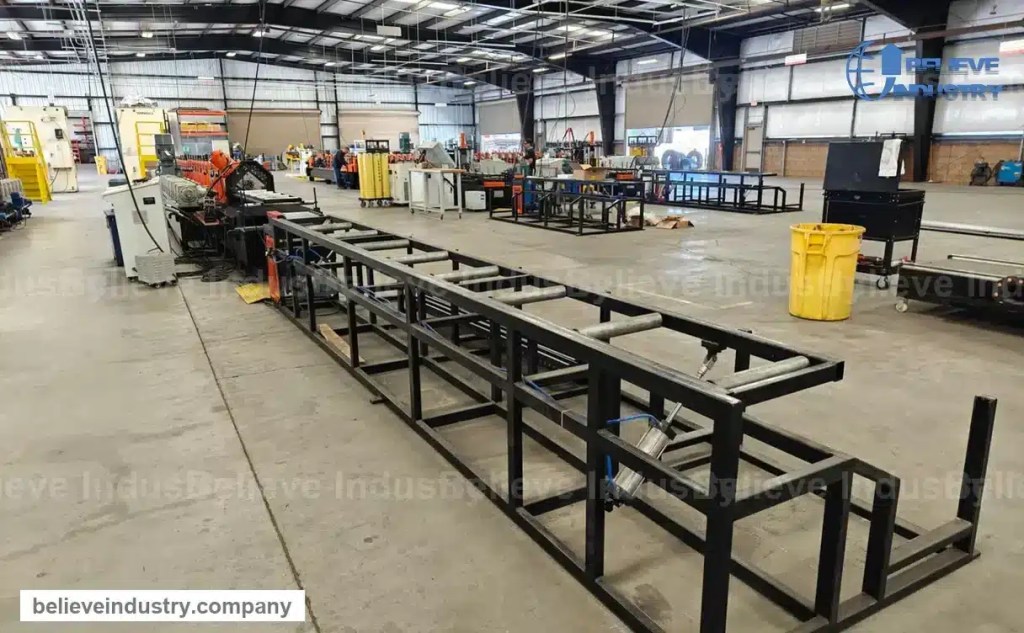
Fencing & Security Roll Forming Machine

Fencing & Security Roll Forming Machine: 5 Gate Profiles 2026

Need a Roll Forming Machine for Your Project?
Get a free quote from Believe Industry — 15+ years of custom roll forming manufacturing.
Request a Quote Download Catalogue

Fencing & Security Roll Forming Machine: 5 Gate and Barrier Profiles for 2026

Short answer: A fencing & security roll forming machine produces welded mesh rails, palisade fence stakes, gate frames, crash barrier beams, and perimeter guardrail posts from coil. Profile section, steel thickness, and coating choice decide which line you need.
A fencing & security roll forming machine serves construction sites, industrial plants, airports, and government facilities that need perimeter protection. Buyers often treat every fence product as the same profile. They are not. Welded mesh needs a different forming path than a palisade stake or a crash barrier beam. This guide covers five common security profiles, what each demands from the line, and the material specs that change the price. If you are new to the product, read what is a roll forming machine line first, then return to profiles.
A basic coil slitting setup upstream also reduces scrap before the line runs.

5 Profiles From a Fencing & Security Roll Forming Machine

The table below lists the five most common security profiles, their material, section size, and end uses.
ProfileMaterialSection / wire sizeTypical end use
Welded mesh tension railGalvanized steel strip1.5 to 3 mm thickIndustrial fencing, prison perimeter
Palisade fence stakeHRC steel plate2 to 3 mm thick, 50 to 100 mm heightHigh-security sites, schools, public buildings
Gate frameHollow section or angle40 to 80 mm sectionSwing and sliding gates, vehicle entries
Crash barrier beamHRC steel coil1.5 to 3 mm thick, 300 to 500 mm heightHighway and airport barrier, warehouse guardrail
Perimeter guardrail postHRC steel2 to 4 mm thick, C or U sectionFactory perimeter, site hoarding
These profiles share one trait. They run in long lengths, get cut to size, then go to galvanizing or powder coating. A fencing & security roll forming machine must therefore hold tolerance through high-tensile material and survive repeated punch impact without frame deflection. The line also has to handle coated coil without scuffing the surface, because a fence profile with a scratched coating fails inspection before it reaches the site. Review our roll forming machine punching die installation guide for tooling standards.
fencing roll forming machine production line

Welded Mesh Tension Rail: The Volume Profile

Welded wire mesh itself is not roll formed. The mesh is welded at wire intersections on a mesh welder, then cut into panels. The roll formed part is the tension rail or support channel that stiffens each panel.
fencing c bracing roll forming machine with cutter
That rail is where a fencing & security roll forming machine earns its place on a mesh line. Match the rail section to mesh spacing. A 50 mm mesh needs a stiffer rail than 100 mm mesh, because the panel flexes more between wires. Wire and mesh quality references sit in ASTM A185 for steel wire and ASTM F2453 for welded wire fence fabric.

Palisade Fence: Stake and Rail Forming

A palisade profile starts as HRC steel strip, formed into a shaped vertical stake with a serrated or rounded top. Horizontal rails are punched to take bolts or clips. Both parts come off the same line when the tooling is set up for it.
fencing roll forming section with integrated punching
The fencing & security roll forming machine has to form 2 to 3 mm HRC coil without marking the roll surface. The top angle is the critical dimension. A shallow angle is easy to climb. A sharp angle wears the forming tool faster and cracks the coating at the bend. Palisade lines commonly run 8 to 15 m/min with a flying cutoff synchronized to the punch pattern.

Gate Frame: Hollow Section or Angle

Gate frames take two routes. The hollow section route forms coiled strip through multiple bending stands, then closes the section with a seam welder. The angle route cuts pre-formed angle and welds the frame square.
fencing hydraulic punch and cutter on roll forming line
The difference matters more than buyers expect. A gate frame carries its own weight plus the impact of every open and close cycle. A fencing & security roll forming machine set up for gate hollow sections needs a seam welder and a straightener after the weld station, or the frame twists. Gate dimension and safety requirements are covered by EN 12604 for industrial and garage doors and gates.

Crash Barrier Beam: Energy Absorption

A crash barrier beam is formed from HRC steel into a W-beam or trough section with rolled edges. The section must absorb impact energy without tearing, so steel toughness and bend radius are controlled tightly. A fencing & security roll forming machine built for barrier work runs a heavy-duty gearbox frame and a servo flying shear.
Barrier sections are fixed by post spacing, usually 2 to 4 meters, so the cutoff must hold plus or minus 1 mm. Highway work in the United States references AASHTO M 180 for corrugated metal beam railings. A barrier line typically runs 10 to 20 m/min.

Perimeter Guardrail Post: C or U Section

Perimeter posts are C or U sections formed from 2 to 4 mm HRC steel, punched for bolt holes at fixed pitch, then cut to length. The fencing & security roll forming machine for this profile needs a high-tonnage punch and a rigid frame, because punch reaction is what deflects a light frame and throws the hole pattern out of line.
Posts either sit in concrete or bolt to a base plate. Hole position tolerance decides whether the post lines up with the rail on site. Plus or minus 0.5 mm is normal for this profile.

Material and Coating Choices

Security profiles face weather, vandalism, and impact. Material and coating are not optional extras.
MaterialCoatingTypical application
Mild steel stripHot-dip galvanizedGeneral perimeter, low corrosion
HRC steelHot-dip galvanizedCrash barrier, palisade, high impact
Galvanized sheetPolyester powder coatArchitectural fence, color match
Stainless steelMill finishCoastal, chemical, high-corrosion sites
HRC steel pushes the fencing & security roll forming machine cost up by about $8,000 to $18,000, because stands and shafts need upgrading to take the yield strength. Powder coating happens after forming and sits outside the line budget, but it still belongs in the project number.

How to Choose the Right Line

Start from the profile mix, not from a budget figure. If you only make welded mesh tension rails, an entry line with a wall-plate chain frame and hydraulic punch is enough. Add palisade stakes or crash barrier beams and you need a heavier frame, harder rolls, and a servo flying shear. Add gate hollow sections and the line needs a seam welder and a post-weld straightener.
The right fencing & security roll forming machine is the one matched to your product mix, not the cheapest quote on paper. A multi-profile line with quick-change tooling lets one line cover fence and guardrail products. Our USA market guide covers import and compliance for North American buyers. Believe Industry has built custom roll forming lines since 2005, with 80+ engineers and technicians and 500+ machines delivered to 50+ countries under ISO 9001 and CE. We size the frame, punch, and cutoff to your profile and volume, so the fencing & security roll forming machine price reflects production need rather than a catalog default.

Frequently Asked Questions of Fencing & Security Roll Forming Machine

Q: Can one fencing & security roll forming machine make all five profiles?

A single line handles several profiles when it uses quick-change or cassette tooling. Welded mesh tension rails and palisade stakes sit in similar thickness ranges, so a medium-duty line covers both. Crash barrier beams and gate hollow sections need a heavier frame or a seam welder, so most plants run them on a second line.

Q: What steel thickness is standard for palisade fence?

Palisade stakes are normally formed from 2 to 3 mm HRC steel. Below 2 mm the stake does not resist cutting. Above 3 mm the stands need upgrading, which adds $8,000 to $18,000 to the fencing & security roll forming machine cost.

Q: Does a fencing & security roll forming machine include a welding station?

Only if you add one. Welding is not part of roll forming itself. A gate hollow section line adds an inline seam welder to close the profile, and that module carries its own cost. Many plants form the rolls and weld on a separate station to keep the line simpler.

Q: How fast does a security fence line run?

Palisade and guardrail lines run 8 to 15 m/min. Crash barrier lines with a servo flying shear reach 20 to 25 m/min. Welded mesh tension rails run faster, up to 30 m/min, because the wire is drawn and welded before the strip reaches the roll former.

Q: Which coating suits an outdoor security fence?

Hot-dip galvanizing is the standard for palisade, guardrail, and crash barrier, and it matches the coating already on most HRC coil. Polyester powder coat goes on top when the project needs a color match or extra corrosion resistance, and it is applied after cutting and punching.

Q: Can a roll formed gate frame replace a welded tubular gate?

Yes, for most residential and industrial gates. A roll formed hollow section is lighter than welded tube and holds a consistent wall thickness. It has less torsional stiffness than a true tube, so keep it to gates up to 4 meters wide and add a diagonal brace above that.
*Last updated: 2026-10-28*
*Article Changelog: 2026-10-23: Initial publication.*
*Next Review Triggers: A buyer requests a mesh line above 30 m/min; palisade fence regulations change in Europe; crash barrier standards update.*

Table of Contents

New Updates