Адрес
№ 1, Yd Road, район Хуэйшань, город Уси, Цзянсу. 214183
Рабочие часы
С понедельника по пятницу: с 9:00 до 17:00
Суббота: 9:00 - 16:00
Every factory owner buying roll forming equipment hits the same wall. You need more than one profile. But do you buy two separate machines or one double layer unit? The gap between the right answer and the wrong one is $8,000 to $20,000. That is real money for most small to medium metal roofing factories.
А однослойный против двухслойного прокатного станка decision is not about which machine is “better.” It is about which one costs less over the life of your operation. And that math changes depending on your order mix, floor space, and labor situation.
В Вера в индустрию, we have supplied over 20 countries with roll forming equipment for over 15 years. We have seen factories save 35% on equipment spend by choosing a двухслойная профилегибочная машина over two singles. We have also seen factories waste money buying a double layer they did not need because 90% of their orders were one profile.
This article breaks down the real numbers so you can make that call with confidence.
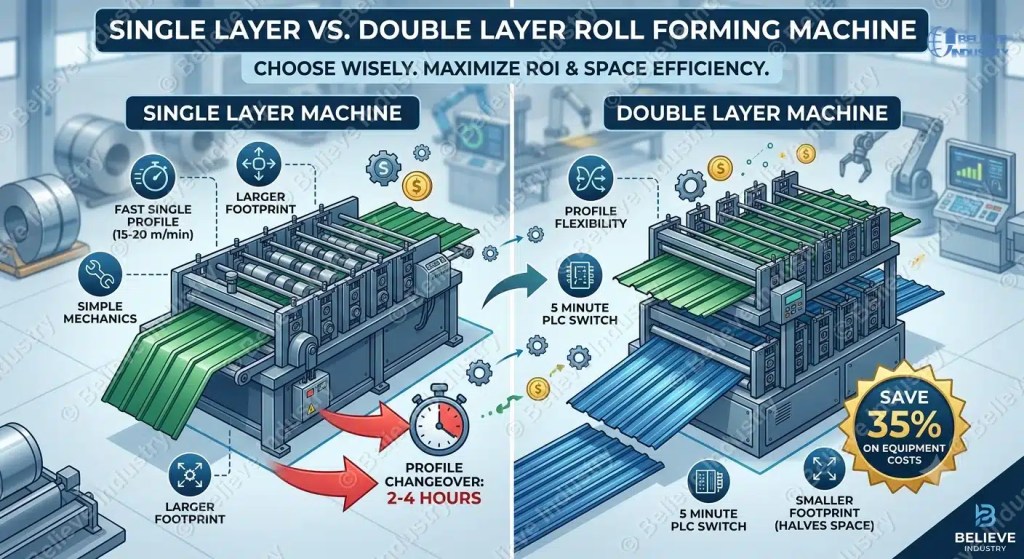
А single layer roll forming machine has one forming section with one set of rollers. Feed it a coil. It spits out one profile. Simple. If you need a different profile, you physically swap out the entire roller set. That takes 2 to 4 hours with skilled workers.
А двухслойная профилегибочная машина stacks two independent roller stations vertically on a shared base frame. The top deck runs one profile. The bottom deck runs another. Both share the same decoiler, hydraulic system, PLC control cabinet, and main motor. Switch between profiles in 5 minutes by toggling the clutch or switching the PLC preset. No roller changes needed.
The catch: you can only run one layer at a time. Both layers share one drive shaft. So a double layer machine does not double your output. It doubles your profile flexibility.
Here is the real equipment cost comparison based on a standard trapezoidal roof panel plus corrugated wall panel setup from mid-tier manufacturers.
| Фактор затрат | Two Single Layer Machines | One Double Layer Machine | Difference |
|---|---|---|---|
| Equipment purchase | $24,000 – $60,000 | $30,000 – $55,000 | 28% – 35% less |
| Площадь пола | 16 – 18 sq meters | 8 – 10 sq meters | ~50% less |
| Operators required | 2 (one per line) | 1 | 1 salary saved |
| Uncoiler units | 2 | 1 | Shared |
| Гидравлическая станция | 2 | 1 | Shared |
| Electrical cabinet | 2 | 1 | Shared |
| International freight (40HQ) | 2 slots | 1 slot | ~50% shipping saved |
The equipment purchase savings come from shared infrastructure. A double layer machine costs roughly 1.3 to 1.4 times a single single-layer machine. Two single machines cost 2.0 times. So you pocket the difference, typically $4,000 to $8,000 on equipment alone.
Add the secondary savings (one operator, one uncoiler, one hydraulic station, one shipping slot) and the total first-year advantage of a double layer machine can exceed $15,000.
For detailed specs on specific roofing profiles, check our профилегибочная машина для кровельных листов страница.
The double layer machine wins on purchase cost only if you genuinely need two profiles. If you do not, the single layer is the smarter buy. Here is when a single layer roll forming machine is the cheaper option long-term.
You run one profile at high volume. If your factory produces 50,000 square meters of ibr sheets every month and nothing else, a dedicated листогибочная машина ibr gives you faster production speed and lower mechanical complexity. A double layer would just add cost with no benefit.
Your material gauge range varies widely. A double layer machine works best when both profiles use similar material thickness (0.3 to 0.5mm, for example). If one profile needs 0.3mm wall panels and the other needs 0.8mm structural roof sheets, the shared drive system struggles to maintain precision across both. Two separate machines each tuned to their gauge range outperform one double layer.
You have a small maintenance team. A single layer machine has fewer synchronized moving parts. Fewer things break. Your general technician can handle routine maintenance. A double layer has shared hydraulics and intelligent controls. If a shared component fails, both production lines stop.
You need maximum production speed. A single layer dedicates 100% of motor power to one profile. Production speeds reach 15 to 20 meters per minute reliably. A double layer splits motor torque through a clutch or gear system, which can cap each layer at 10 to 15 meters per minute depending on profile complexity.
The real savings case for a double layer machine kicks in when your order book is mixed. If you routinely get contracts that need both roofing and wall panels from the same project developer, the math flips.
Small factory, two profiles, limited space. A double layer machine occupies about 50% less floor space than two separate lines. In industrial zones where rent runs $5 to $12 per square meter per month, reclaiming 6 to 8 square meters saves $360 to $1,152 per year in rent. That is not dramatic on its own, but combined with the other savings, it tips the scale.
Mixed daily orders with frequent changeovers. If you switch between wall panel and roof panel profiles multiple times per day, the 5-minute PLC-based switch on a double layer beats the 2-to-4-hour roller change on a single layer every time. A factory doing three changeovers per day saves 6 to 12 hours of downtime daily. That is a whole extra shift of production you did not have before.
Importing equipment internationally. Shipping one machine instead of two cuts ocean freight by roughly half. For a 20-foot container from China to the Middle East or Southeast Asia, that is $500 to $1,500 saved. Customs clearance and port handling fees also halve.
Startup operations with budget pressure. New factories can buy one double layer machine at roughly 60-65% of the cost of two single-layer units. That frees up cash for raw materials, factory lease deposits, or hiring skilled operators. The профилегибочная машина для производства гофрированного листа и trapezoidal roof panel machines are frequently paired in double layer configurations for this exact reason.
| Metric | Single Layer Machine | Двухслойная машина |
|---|---|---|
| Скорость производства | 15 – 20 m/min | 10 – 15 m/min per layer |
| Daily output (8hr, single profile) | 7,200 – 9,600 linear meters | 4,800 – 7,200 linear meters |
| Profile changeover time | 2 – 4 hours (roller swap) | ~5 minutes (PLC/clutch switch) |
| Simultaneous operation | N/A (one profile only) | No (shared drive shaft) |
| Material gauge range | 0.15 – 0.8mm (wider) | 0.3 – 0.5mm (narrower, both layers must match) |
According to data from the Ассоциация металлоконструкций, demand for mixed-profile metal roofing and wall panel solutions has grown steadily across both residential and commercial construction segments.
The key insight: a double layer machine does not increase your per-profile output. It compresses your profile diversity into one machine footprint. If raw throughput is your only metric, buy the single layer. If flexibility and space utilization matter more, the double layer wins.
For manufacturers focused on specific structural applications, our профилегибочная машина для стоек с С-образным профилем и станок для профилирования профилей солнечных опор pages provide profile-specific production data.
Maintenance costs eat into equipment savings over time. Here is how the two configurations compare after year one.
A single layer machine has one motor, one hydraulic station, one set of rollers, one cutting die, and one control system. When something breaks, you fix it and keep running. The other machine (if you have two) is unaffected.
A double layer machine consolidates maintenance into one set of shared components. Fewer parts to maintain overall, and lubricant, spare rollers, and electrical consumable costs drop. But when a shared component fails (the main motor, the hydraulic pump, or the PLC), both profile lines stop. No production until it is fixed.
Our after-sales data across over 15 years shows double layer machines have about 30% lower total maintenance events than operating two separate single-layer lines. But each event is higher stakes. The practical fix is choosing a профилегибочная машина supplier with reliable after-sales support and readily available spare parts.
Most factory buyers fixate on equipment purchase price and ignore space cost. Here is the real math for a typical 15-meter machine length:
| Макет | Single Layer (per machine) | Two Single Layers | Double Layer |
|---|---|---|---|
| Machine footprint | 15m x 1.6m (24 sqm) | 15m x 3.4m (51 sqm, with aisle) | 15m x 1.8m (27 sqm) |
| Operator work zone | 2m perimeter | 2m perimeter x2 | 2m perimeter |
| Total effective area | ~28 sqm | ~56 sqm | ~31 sqm |
| Annual rent at $8/sqm/month | $2,688 | $5,376 | $2,976 |
Renting 56 square meters for two single-layer machines costs $5,376 per year. Renting 31 square meters for a double layer costs $2,976. The difference is $2,400 per year. Over a 5-year machine lifespan, that is $12,000 in rent savings alone. This does not even count the utility savings (one electrical connection instead of two, one hydraulic station instead of two).
For factories importing from China to markets like Saudi Arabia, the UAE, India, or Southeast Asia, shipping cost tilts the decision further toward double layer. The World Freight Rates index shows container shipping remains a significant line item for industrial machinery buyers.
A single 40HQ container slot for one 15-meter machine costs roughly $800 to $1,800 depending on destination port. Two single-layer machines need two slots: $1,600 to $3,600. One double layer machine fits in one slot: $800 to $1,800. The savings are immediate and recurring if you expand later.
Import duties, port handling, and inland trucking also scale per shipment. One machine means one set of customs brokerage fees. Two machines means two.
Наш Станок для профилирования стеновых облицовочных материалов и профилегибочная машина со стоячим фальцем pages show configuration options that can be combined in double layer setups for export markets.
Go through these before making a purchase decision:
| Scenario | Two Single Layer Machines | One Double Layer Machine |
|---|---|---|
| Year 1 equipment cost | $40,000 | $32,000 |
| Floor rent (3 years) | $16,128 | $8,928 |
| Operator wages (3 years, 1 extra) | $21,600 | $0 (saved) |
| Shipping (one import) | $3,200 | $1,600 |
| Maintenance parts (3 years) | $3,600 | $2,520 |
| Total 3-year cost | $84,528 | $45,048 |
This is a simplified model for a factory producing two profiles with moderate output. Real costs vary by country, profile type, and machine spec. But the direction is clear: for a two-profile operation, a double layer machine can save roughly $39,000 over three years compared to running two single-layer units. That is nearly half the total cost.
No. Both layers share one main drive shaft and motor. You feed raw material into one layer at a time. The benefit is fast switching between profiles, not simultaneous production. If you need two profiles running simultaneously, you need two separate single-layer machines.
Both can produce identical panel quality when properly set up and maintained. The quality difference comes from roller precision, material consistency, and operator skill, not from the single versus double layer configuration. A well-built double layer machine from a reputable manufacturer produces panels with the same dimensional tolerance as a good single layer machine.
About 5 minutes on a well-designed machine with pre-installed roller cassettes and a PLC preset system. You toggle the transmission clutch to engage the target layer, load the saved PLC parameters for that profile, adjust the feeding guide, and start production. Some machines include a manual lever switch; others use fully automatic hydraulic clutch switching from the HMI touch screen.
Yes, moderately. The mechanical structure is more complex with synchronized clutch systems and shared hydraulics. Your maintenance team needs basic training on the multi-layer switching mechanism and PLC troubleshooting. However, since there are fewer total components to maintain versus two separate machines, the overall maintenance workload tends to be lower.
The most common pairings are trapezoidal roof sheet + corrugated wall sheet, ibr roof panel + glazed tile profile, and standing seam + corrugated. The key requirement is that both profiles work within a similar material thickness range (usually 0.3 to 0.5mm). Profiles with wildly different gauge requirements are better served by separate machines.
Generally no. A double layer machine has a fundamentally different frame design with a taller, heavier-duty base to support two stacked roller stations. The drive system is also designed from the start to distribute torque between two layers. Retrofitting a single layer frame for an extra deck is usually more expensive than buying a purpose-built double layer machine.
Only for very specific use cases. Triple layer machines stack three profiles on one frame and cost about 1.6 to 1.8 times a single layer machine. They make sense for retail building material depots that need to offer corrugated, trapezoidal, and tile profiles to walk-in customers with small batch orders. For most production factories, a double layer covers the practical need while keeping mechanical complexity manageable. If you need three or more profiles regularly, a multi-profile cassette roll forming machine may be a better fit than stacking layers.
Double layer machines tend to hold value better in the used equipment market because they appeal to a wider range of buyers. A factory looking for one specific profile can still buy a double layer and only use the relevant layer. A single layer machine only appeals to buyers who need that exact profile. The broader buyer pool supports higher resale prices for well-maintained double layer units.
For a factory producing only one profile at high volume, the single layer roll forming machine saves more. It costs less upfront, runs faster, breaks less often, and is easier to maintain.
For a factory producing two profiles in limited space with mixed daily orders, the двухслойная профилегибочная машина saves more. Equipment cost drops 28-35%. Floor space halves. One operator instead of two. One shipping slot instead of two. Over three years, the total cost of ownership can be nearly $40,000 lower.
The key question is not “which machine is better.” It is “how many profiles do you actually need, and how often do you switch between them?” Answer that honestly, and the math does the rest.
For deeper technical guidance on roll forming equipment selection, the Roll Forming Manufacturers Association publishes industry standards covering machine specifications, safety requirements, and performance benchmarks.
В Вера в индустрию, we build both single and double layer roll forming machines for factories across over 20 countries. With over 15 years of manufacturing experience, we help you spec the right configuration for your specific production reality, not just sell you the most expensive option.
Последнее обновление: August 4, 2026
Список изменений статьи:
– August 4, 2026: Initial publication. Single layer vs double layer cost comparison with 3-year ROI model.
Триггеры для следующего обзора:
1. Raw material price shifts affecting steel coil costs (update equipment ROI model)
2. New PLC switching technology reducing double layer changeover time below 3 minutes
3. Import tariff changes affecting China-to-destination shipping costs
4. New competitor pricing data for single and double layer machines
5. Customer feedback with real-world production data to refine ROI estimates
Каждый проект по профилированию начинается с рулона. Прежде чем...
Читать далееКаждый владелец завода, покупающий оборудование для профилирования металла, сталкивается с одной и той же проблемой...
Читать далееБольшинство линий профилирования используют один профиль. Это...
Читать далееВведение. Станок для профилирования облицовочных панелей обрабатывает плоские стальные листы...
Читать далееОформите подписку, чтобы продолжить чтение и получить доступ к полному архиву.