Адрес
No 1, улица Yd, район Хуэйшань, город Уси, провинция Цзянсу. 214183
Рабочие часы
С понедельника по пятницу: с 9:00 до 17:00
Суббота: 9:00 - 16:00
Адрес
No 1, улица Yd, район Хуэйшань, город Уси, провинция Цзянсу. 214183
Рабочие часы
С понедельника по пятницу: с 9:00 до 17:00
Суббота: 9:00 - 16:00

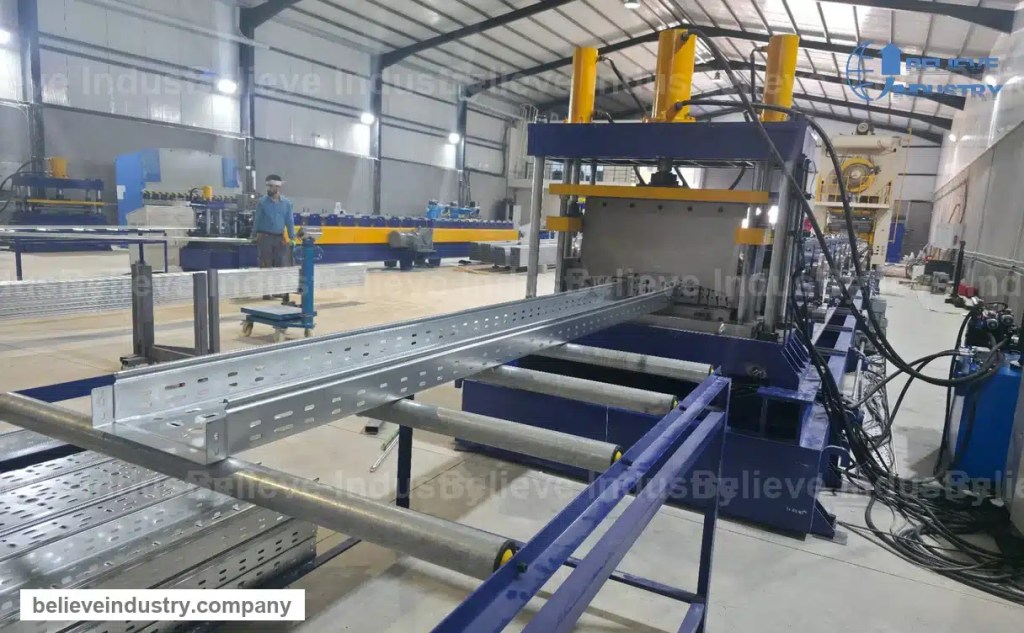
A Russian type cable tray production line has finished installation, commissioning, and trial production inside a customer factory in Russia. This cable tray production line forms both the perforated cable tray base and the solid cover in one chain, and it passed its trial run on both profiles. Below is what the line contains, what the trial run confirmed, and what a Russian buyer receives on a comparable cable tray production line build.
Коротко: The cable tray production line installed in Russia contains an uncoiler and leveler, a servo feeder with punch press, punch dies, roll forming sections for both cable tray and cover, a hydraulic cutting device with end expansion for easy-joint ends, plus the controller and hydraulic systems. The cable tray production line completed trial production and is now running serial product.
The sequence is fixed by how the sheet moves through the line. Coil at the inlet, finished tray sections leaving at the outlet.
| Этап | Unit on this line | Функция |
|---|---|---|
| 1 | Разматыватель и правильная машина | Holds the steel coil and removes coil stress before punching |
| 2 | Servo feeder | Feeds strip to an exact pitch matched to the punch die |
| 3 | Punch press | Drives the punch dies at the required stroke rate |
| 4 | Punch dies | Cuts the perforation pattern and end slots in one stroke |
| 5 | Roll forming section, tray | Forms the flat strip into the perforated tray profile |
| 6 | Roll forming section, cover | Forms the cover profile from the same line |
| 7 | Hydraulic cutting device with expansion | Cuts each section to length and expands the ends for easy joints |
| 8 | Controller and hydraulic systems | Runs the line sequence, length settings, and fault handling |
A cable tray roll forming machine spends most of its accuracy budget at the punching station, not at the rollers. The tray base carries rows of oblong perforations along the side flanges plus slot patterns at the connection ends, and the cover carries a different pattern. The punch press handles both, so the line does not need a separate drilling or laser station downstream.
Because the perforation is a fixed repeat, the servo feeder pitch and the punch die pitch are matched once during commissioning. Changing the tray length means changing the feeder setting and the cut length in the controller, not the punching tooling. That is why this cable tray production line uses a servo feeder instead of a mechanical roll feed.

The flat strip first enters the roll forming section for the tray. The base takes its U profile with the side flange return, then the flanges receive the perforation pattern already cut upstream. The same cable tray production line carries a second roll forming section for the cover, so tray and cover come off one production chain in matched lengths. For a Russian electrical contractor buying a complete system, that pairing removes the separate cover press that would otherwise sit in a second building.

The end of the line is a hydraulic cutting device that cuts each section to the ordered length. On this build it also carries an expansion function at the cut position, so the ends of the tray section spread open slightly after the cut. The male and female ends of two sections then slide together and seat without a separate connector part.
That detail matters more in a cold market than in a warm one. A Russian plant running a cable tray production line through winter sees steel contract, and a joint that relies on tight tolerance alone will not seat cleanly on a cold morning. Expanded ends take that tolerance out of the joint and keep the connection tight across the season. It is also faster on site, because the installer does not fit a separate splice bracket per joint.

Trial production on this cable tray production line was run on both the tray profile and the cover profile. The run confirmed perforation alignment against the flange, correct tray and cover length matching, and the expanded end geometry on finished sections. It also gave the buyer a measured output figure for shift planning rather than a catalogue number.
Two details came out of that trial run that buyers often raise in writing. First, the tray perforation has to land on the flange return, not on the flat of the base, or the slot pattern weakens the section. Second, the cover length must match the tray length in the controller, not by eye at the cut. Both were corrected during commissioning on this cable tray production line before serial production started.
Line speed here follows the punching method, not the roll forming section. A servo feeder driving a mechanical punch press on a dense perforation runs 10 to 15 m/min on this class of machine. The roll forming rolls can run faster, but the press sets the pace of the whole chain. We size the whole line against the punch rate from the first quotation.

The cable tray roll forming machine guide covers the profile families, perforation layouts, and coil widths used on cable management projects. Russian buyers often ask about sheet thickness range and coating options alongside the tray size, so send the tray drawing with the enquiry and we confirm width, thickness, perforation, and cover pairing together. The same cable tray production line then arrives as one chain rather than two machines that need matching on site.
We also built a Russian cable tray roll forming machine video page covering the machine family earlier. This installation is the field counterpart to that page: the same machine class now running product in a Russian factory.
Believe Industry has built custom roll forming lines since 2005. More than 80 engineers, 500+ projects shipped to 50+ countries, ISO 9001 and CE certified. Cable tray and electrical installation lines are part of that record.
Q: What is included in a Russian type cable tray production line?
A: The build we installed in Russia contains an uncoiler and leveler, a servo feeder, a punch press, punch dies, roll forming sections for both cable tray and cover, a hydraulic cutting device with end expansion, and the controller and hydraulic systems.
Q: What does the trial production run check?
A: The trial run checks perforation alignment against the tray flanges, matching length between tray and cover, the expanded end geometry on finished sections, and measured line output for shift planning.
Q: Why do the cable tray ends get expanded?
A: The expansion lets male and female ends slide together and seat without a separate connector, which keeps the joint tight in cold weather and speeds up on-site installation.
Q: Can one cable tray production line make both tray and cover?
A: Yes. This build carries a roll forming section for the tray and a second one for the cover, so both profiles come off the same production chain in matched lengths.
Q: What speed does the line run at?
A: Speed follows the punching method. With a servo feeder and a mechanical punch press on a dense perforation, 10 to 15 m/min is normal. The press sets the line speed, not the roll forming section.
Q: Is installation and commissioning included?
A: Yes. Our engineers set the punch die, adjust the leveler, match the feeder pitch to the die, set the tray and cover lengths, and run trial production with your operator present before handover.
Первоначально опубликовано: January 3, 2026
Последнее обновление: January 3, 2026
История изменений:
Next Review Triggers:** Serial production output figures from the Russian plant, a change to the standard Russian tray perforation layout, a GOST or TR CU update affecting cable tray dimensions, or a 20 percent change in search interest for “cable tray production line”.


Scaffold Sheet Machine Ready to Ship to a United States...
Читать далее
Marine Roll Forming Machines: 5 Shipbuilding Profiles A marine roll...
Читать далее
Профилегибочная машина для железных дорог: 5 профилей инфраструктуры. Рельсовый...
Читать далее
Настройка машины для стоек вертикальных: 12 шагов к первому идеальному результату...
Читать далее English English
  Español
 Português
 Русский
 العربية
 Bahasa Melayu
 Türkçe
 ไทย
ไทย
 Bahasa Indonesia