Máquina de perfilagem de canaletas da série P

Máquina de perfilagem de canaletas da série P [Guia do comprador 2026]

Selecting the right strut channel series is not just a dimensional choice. It determines what fittings you can use, what loads the system carries, and what thickness of steel the roll forming machine must handle. Specifying the wrong series costs money in overspecification or fails inspection when the channel does not match the project’s required standard.

Believe Industry Company has built the P series strut channel roll forming machine for every major Unistrut series over 15 years, supplying equipment to customers across 10+ countries. This guide defines each series from the original Unistrut specification and compares them on the dimensions that matter to buyers and machine specifiers.

máquina de perfilagem de canaletas uni-strut

What Is P Series Strut Channel?

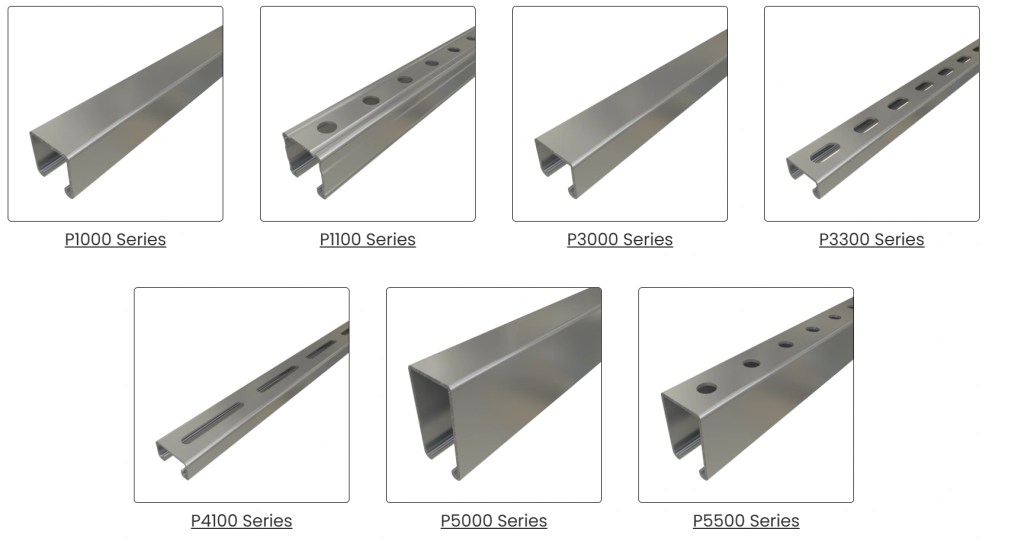
The “P series” refers to the family of metal channel profiles originally defined by the Unistrut system. Each series designation — P1000, P1100, P3000, P3300, P4100, P5000 — describes a specific combination of profile size, material thickness, and hole pattern. All series are roll-formed from steel or stainless coil into a continuous channel that accepts standardized fittings for framing, support, and racking applications.

P1000 is the baseline of the series: a 1-5/8″ x 1-5/8″ (41 mm x 41 mm) square channel in 12-gauge (2.7 mm) steel. The other series modify this baseline in one of three ways:

  • Thinner material — P1100 and P4100 use 14-gauge (1.9 mm) steel for lighter load requirements
  • Shallow depth — P3000 uses a 41 x 21 mm profile, half the depth of P1000
  • Different hole pattern — P3300 uses round holes; P5000 uses a combination of slots and round holes

P1000 itself covers a family of hole-pattern variants, all sharing the same 41 x 41 mm profile:

  • P1000 — solid channel, no pre-punched holes
  • P1000T — slotted pattern for adjustable fitting attachment
  • P1000WT — slotted pattern with additional holes for specific fittings
  • P1000SL — elongated slots for extended adjustment range
  • P1000DS — double-slot pattern for higher load transfer per attachment point
  • P1000H3 — round holes on three sides, used when fittings attach from multiple directions
  • P1000HS — round holes on one side only
  • P1000KO — knock-out holes that are removed by hand, avoiding on-site drilling

P1000 is the most widely produced strut channel profile in the world. A P series strut channel roll former built by Believe Industry typically runs 1.5–3.0 mm galvanized steel at 20–60 m/min, depending on the punching configuration. For lines that produce P1000 and compatible profiles, the pre-punching unit is the most critical subsystem: hole position accuracy determines whether standard fittings slide and lock correctly along the full channel length.

Side-by-Side Comparison

The fastest way to see the differences across all six series. Dimensions are given in both inches and millimeters.

SeriesProfile Size (in / mm)Thickness (Gauge / mm)Hole PatternAplicação típica
P10001-5/8 x 1-5/8 (41 x 41)12 ga / 2.7Slotted or solidGeneral framing, solar racking
P11001-5/8 x 1-5/8 (41 x 41)14 ga / 1.9Solid onlyLight-duty supports, cost-sensitive projects
P3001-5/8 x 13/16 (41 x 21)12 ga / 2.7SlottedWall-mounted cable runs, shallow mounting
P33001-5/8 x 1-5/8 (41 x 41)12 ga / 2.7Round holesBolt-through connections, fixed positioning
P41002-1/2 x 1-5/8 (64 x 41)14 ga / 1.9SlottedWide-span supports, higher vertical load
P50001-5/8 x 1-5/8 (41 x 41)12 ga / 2.7Combo slot + roundMixed fitting installations

P1000 and P3300 share the same profile size and thickness but use different hole patterns. P300 is the only series in this comparison with a shallow (13/16″) depth, which changes how fittings attach and what bending loads the channel can carry.

For machines that produce slotted variations, punching die design determines slot length tolerance and edge finish. The tooling approach for slot-only patterns applies directly to the P1000T, P1000SL, and P300 series, and is covered in detail on the Máquina de perfilagem de canaletas com ranhuras página.

Máquina de perfilagem de canaletas da série P

P1000 vs P1100: Thickness and Load Capacity

P1100 is the light-duty version of P1000. Both use the 41 x 41 mm profile, but P1100 is rolled from 14-gauge (1.9 mm) steel compared to P1000’s 12-gauge (2.7 mm).

That 0.8 mm thickness difference changes two things:

Load capacity. A P1000 channel carries roughly 40–50% more load than P1100 at the same span and mounting configuration. In most building codes for solar racking and seismic bracing, P1000 is the specified choice.

Machine sizing. UM P series strut channel machine that runs P1000 at 2.7 mm needs a heavier frame, larger shaft diameter, and more drive torque than a machine that only runs P1100 at 1.9 mm. If a buyer needs both, Believe Industry builds the machine to the thicker material specification and adjusts roll gaps for the thinner material.

P1100 is the right choice when the project calls for a 41 x 41 mm profile but the loads are light — cable tray supports, light fixture mounting, and non-structural framing. Specifying P1100 in those cases saves material cost without compromising performance.

P1000 P1100

P1000 vs P3000: Profile Depth and Application

The P3000 series uses a 41 x 21 mm (1-5/8″ x 13/16″) profile — half the depth of P1000. This changes the channel’s structural behavior and its fitting system.

P300 is used where full-depth channel is too bulky or too expensive:

  • Wall-mounted cable runs where the channel sits flush against the wall
  • Lighting tracks and signage supports where shallow depth is preferred for appearance
  • Low-load racking where the span direction does not require full 41 mm depth

P3000 has the same 12-gauge thickness as P1000, so the material strength is identical. The difference is geometric: the shallow depth reduces the section modulus, which reduces bending capacity by approximately 50% compared to P1000.

From a roll forming perspective, P300 is simpler to form because the bend depth is shallower. A production line for P300 typically needs 14–16 forming stations, compared to 18–22 stations for full-depth P1000. The same quick-change principles discussed on the máquina de perfilagem de rolos de dupla camada page apply when configuring a single line for both profiles. When buyers need a P series strut channel roll forming machine that covers shallow and full-depth profiles on the same line, Believe Industry sizes the roll forming section and drive system to the largest profile, with modular tooling sets that swap between P3000 and P1000 roll sets.

P1000 P3000

P1000 vs P3300: Hole Pattern Difference

P3300 uses the same 41 x 41 mm profile and 12-gauge thickness as P1000, but with round holes instead of slots.

This matters for two reasons:

Fitting compatibility. Slotted channels (P1000) accept all standard Unistrut fittings and allow position adjustment along the channel length. Round-hole channels (P3300) require fittings that bolt through a fixed hole and cannot be adjusted after installation.

Die complexity. A pre-punching unit for P1000 must hold tight tolerances on slot length and width because fitting adjustability depends on them. A punching die for P3300 is simpler because round holes have no orientation requirement.

In practice, P3300 is less common in new installations. Most specifiers default to P1000 or P1000T unless the project specifically calls for round-hole channel. The máquina de perfilagem de canaletas uni-strut can be configured for either hole pattern with a punching die change.

P1000 P3300

P1000 vs P4100: Profile Width

P4100 uses a 64 x 41 mm (2-1/2″ x 1-5/8″) profile — wider than P1000’s square section. The extra width increases the channel’s capacity for vertical loads and provides a larger surface for fitting attachment.

P4100 is used in:

  • Wide-span equipment supports where the channel must bridge a gap without intermediate fixing
  • Heavy cable tray systems with concentrated loads
  • Solar racking where rail width affects module clamping layout

P4100 is typically produced at 14-gauge (1.9 mm), which is thinner than P1000’s 12-gauge standard. The wider profile compensates for the thinner material in many applications, but load calculations must be checked for each case.

A roll forming machine for P4100 needs a wider roll forming section and a wider punching die compared to a P1000 machine. Believe Industry designs the machine width to match the strip width required by the profile — typically 180–220 mm for P4100 compared to 100–130 mm for P1000. Buyers who run both P4100 and P1000 on a single P series strut channel roll former get a machine sized for the wider strip, with interchangeable roll sets for each profile.

P1000 P4100

P1000 vs P5000: Combination Hole Pattern

P5000 returns to the 41 x 41 mm profile and 12-gauge thickness of P1000, but adds a combination hole pattern: both slots and round holes in the same channel length.

This allows the channel to accept both standard slotted fittings and round-hole fittings. It is used in mixed-fitting installations where some connections need adjustability and others need fixed positioning.

The punching die for P5000 is the most complex in this comparison. It must punch two different hole shapes at the correct spacing along the strip. Believe Industry builds these dies with replaceable insert systems so individual punches can be changed without replacing the entire die set.

For solar racking, the hole pattern is typically defined by the racking designer and built into the punching die. Believe Industry configures the máquina de perfilagem de canaletas para estrutura solar with servo-driven punch positioning so the hole pattern can be adjusted through the PLC without changing the die, which is useful when supplying rails to multiple racking system brands.

P1000 P5000

Material and Coating Options Across All Series

All six series are available in the same material and coating options. The production machine must be specified for the material thickness range and yield strength required.

MaterialFaixa de espessuraRevestimentoUso típico
Hot-dip galvanized (GI)1,5–3,0 mmZ80–Z275Outdoor, general
Aço pré-galvanizado1,5–2,5 mmZ60–Z180Indoor, dry environment
304 stainless steel1,5–2,5 mmNone (intrinsic)Corrosive environment
316 stainless steel1,5–2,5 mmNone (intrinsic)Marine, chemical
Liga de alumínio1,5–3,0 mmNone (intrinsic)Lightweight, corrosion-resistant

Stainless steel and aluminum require different roll surface treatment compared to galvanized steel. Believe Industry specifies hard-chrome-plated rolls or PU-coated contact surfaces when the machine runs stainless or aluminum to prevent surface marking. A P series strut channel roll forming machine configured for stainless or aluminum production also uses a different lubrication system because these materials gall more easily under forming pressure. The same roll surface principle applies to the máquina de painéis de telhado metálico when running color-coated steel.

How to Specify a P Series Strut Channel Roll Forming Machine

The specification process is the same for all series. The differences are in the profile drawing, the hole pattern drawing, and the material thickness range.

Confirm these before requesting a quote:

  1. Which series — P1000, P1100, P300, P3300, P4100, P5000, or multiple
  2. Desenho de perfil — CAD file with all dimensions and tolerances
  3. Hole pattern drawing — slot dimensions, round hole diameter, pitch spacing
  4. Faixa de espessura do material — affects roll station design and drive sizing
  5. Material yield strength — 235 MPa, 350 MPa, or 550 MPa
  6. Required line speed — 20, 30, 40, or 60 m/min
  7. Pre-punching or post-punching — pre-punching for fixed patterns; post-punching for variable lengths
  8. Faixa de comprimento de corte — minimum and maximum finished channel length
  9. Peso da bobina — determina a tonelagem do desenrolador
  10. Auto stacker or manual discharge

Believe Industry reviews all ten parameters and returns a line layout drawing with total floor space, utility requirements, and a production output estimate. For a machine that produces multiple series, the proposal includes changeover time estimates for switching between profiles. Quick-change tooling design follows the same principles used on the máquina de perfilagem de rolos de dupla camada page, adapted for strut channel profiles.

Production Output Reference by Series

Line speed and daily output depend on material thickness and punching configuration, not the series designation. Shallower profiles (P300) typically run at slightly higher speeds because forming load is lower.

SeriesProfundidade do perfilTypical Line SpeedPieces per 8-hr Shift (3 m length)
P100041 mm30–50 m/min4,800–7,200 pcs
P110041 mm40–60 m/min5,760–8,640 pcs
P30021 mm40–60 m/min5,760–8,640 pcs
P330041 mm30–50 m/min4,800–7,200 pcs
P410041 mm30–50 m/min4,800–7,200 pcs
P500041 mm20–40 m/min3,200–5,760 pcs

P5000 runs at the lower end of this range because the combination hole pattern requires more precise punching registration, which limits practical line speed. The máquina de perfilagem de rolos de cremalheira vertical faces a similar speed limitation when the profile includes pre-punched features that must align across multiple roll stations.

Perguntas frequentes

What is a P series strut channel?

The “P series” refers to the family of metal channel profiles originally defined by the Unistrut system. Each series designation — P1000, P1100, P300, P3300, P4100, P5000 — describes a specific combination of profile size, material thickness, and hole pattern. All series are roll-formed from steel or stainless coil into a continuous channel that accepts standardized fittings for framing, support, and racking applications.

Can a P series strut channel roll forming machine produce both P1000 and P1100?

Yes, if the machine is specified for the thicker material. P1000 at 2.7 mm needs a heavier machine than P1100 at 1.9 mm. If the machine is built for the P1000 thickness range, it can run P1100 material by adjusting the roll gaps. Running the machine only for P1100 allows a lighter frame and lower drive power, which reduces machine cost.

What is the difference between P1000 and P3000 strut channel?

P1000 uses a 41 x 41 mm square profile. P3000 uses a 41 x 21 mm shallow profile. Both are typically 12-gauge thickness. P3000 has roughly half the bending capacity of P1000 because the depth is half as large. P3000 is used for wall-mounted applications and light-duty supports where full-depth P1000 is not needed.

Which series is best for solar racking?

P1000 is the most common choice for solar racking rails. The 41 x 41 mm profile and 12-gauge thickness meet structural requirements for most ground-mount and rooftop solar projects. Some racking designs use P5000 when the rail must accept both adjustable clamps and fixed brackets. The hole pattern for solar applications is typically specified by the racking system designer and built into the roll forming machine’s punching die.

Can the same machine produce P1000 and P5000?

The profile size is the same (41 x 41 mm), so the roll forming section does not need to change. The difference is in the punching die. If the machine uses a pre-punching unit with replaceable die inserts, the punching die can be changed to switch between P1000 slotted pattern and P5000 combination pattern. Without replaceable dies, the punching unit must be changed completely, which takes 4–8 hours.

What is the delivery time for a P series strut channel machine that produces multiple profiles?

A machine for a single series takes 45–60 days. A machine designed to produce multiple series with quick-change tooling takes 60–75 days because the roll sets, punching dies, and shaft systems are more complex. Believe Industry supplies interchangeability drawings before production starts so the buyer can confirm that all required profiles fit the same machine platform.

Why Believe Industry for P-Series Strut Channel Roll Forming Machines?

Believe Industry Company has manufactured roll forming equipment over 15 years. The engineering team has built machines for all major strut channel series — P1000, P1100, P300, P3300, P4100, and P5000 — for customers across 30+ countries.

Every machine is tested at full speed with the buyer’s profile and hole pattern before shipment. The test report includes sample channels measured for twist, straightness, hole position accuracy, and cut length tolerance. Operator training materials and spare parts lists ship with each machine.

For strut channel machines configured for solar applications, the punching die is the most specification-critical subsystem. Believe Industry designs and machines all punching dies in-house, which means the hole pattern matches the buyer’s drawing exactly without relying on third-party tooling suppliers.

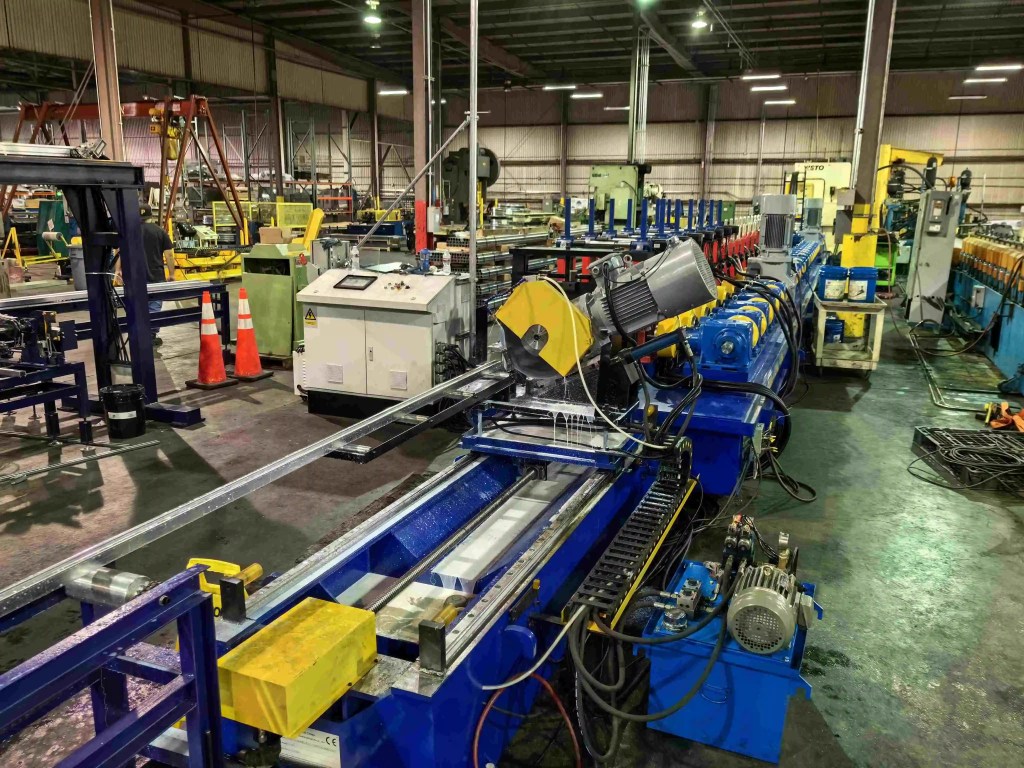
P Series Strut Channel Machine In Action

Referências externas

Índice

Novas atualizações

Descubra mais sobre Believe Industry Company| Roll Forming Machine Manufacturer, Supplier & Exporter

Assine agora para continuar lendo e ter acesso ao arquivo completo.

Continue lendo

ACREDITE NA INDÚSTRIA | SOLUÇÕES PERSONALIZADAS

SOLICITE SEU
PROPOSTA DE ENGENHARIA