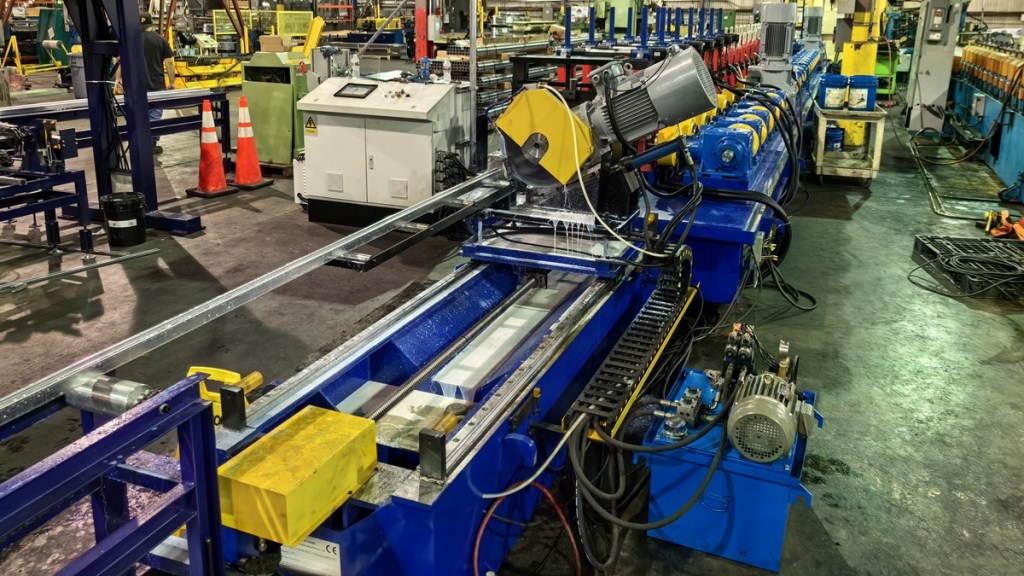
roll forming machine cost

​What Determines Roll Forming Machine Cost? Your 2025 Investment Guide

Need a Roll Forming Machine for Your Project?
Get a free quote from Believe Industry — 15+ years of custom roll forming manufacturing.
Request a Quote Download Catalogue

Industrial roll forming machines are transformative capital investments—driving efficiency for metal fabrication, construction, and automotive sectors. But with prices spanning ​​80,000 to over 800,000, manufacturers must dissect what truly impacts the bottom line. This guide demystifies 2024 pricing structures and reveals how to maximize ROI.

⚠️ ​Key Insight:
The “sticker price” is just 60% of your total investment. Tooling, automation, and lifecycle costs make up the rest.

​Core Factors Driving Roll Forming Machine Cost​

1. ​Machine Type & Complexity​

​Category​ ​Price Range​ ​Best For​
Entry-level manual 5,000-30,000 Low-volume, simple profiles
Semi-automated 30,000-200,000 Medium-volume batches
Fully automated 150,000-300,000 High-speed mass production

​Example: A fully automated line with servo-driven controls, integrated punching, and AI monitoring costs $200k+ but cuts labor by 70%.

2. ​Customization Level​

Off-the-shelf machines save 15–30% upfront but often underdeliver. Custom-engineered solutions address:

  • ​Profile complexity: Curved/wavy designs vs. straight channels
  • ​Material thickness: Handling 8mm steel vs. 0.3mm aluminum
  • ​Integration: Adding coining, embossing, or laser welding

💡 Believe Industry Insight:
Our clients save $110k on average with ​modular designs—upgrading automation later.

3. ​Production Volume & Speed​

High-output machines (40+ meters/minute) command premium pricing:

  • ​​< 10 m/min: 20K-100K
  • ​10–30 m/min: 100K-300K
  • ​30+ m/min: 300-500K

​Case Study: A California Strut Channel supplier invested $250k in a 30 m/min system—ROI achieved in 14 months via reduced scrap and 24/7 running.

4. ​Tooling & Dies​

Tooling costs often equal 20–40% of roll forming machine cost:

  • ​Standard dies:5,000-20,000
  • ​Custom carbide dies: 20,000-50,000+
  • ​Quick-change systems: +$25,000 (reduces changeover from 1 hour → 5 mins)

5. ​Hidden Operational Costs​

​Expense​ ​Annual Cost​ Mitigation Strategy
Maintenance 1000-3000 Predictive monitoring systems
Energy consumption 12,000-40,000 Servo-electric drives (saves 30%)
Operator training 3,000-10,000 Virtual reality simulations

​2024 Price Ranges by Industry Application​

​Industry​ ​Typical Machine Cost​ ​Common Configurations​
​Construction​ 60K-200K C/Z purlin lines with punching
​HVAC​ 150K-300K Spiral duct forming + seam locks
​Automotive​ 200K-500K High-precision reinforced beams

​How Believe Industry Delivers Cost Efficiency​

✅ ​Modular Design​
Start with core functionality ($20k), add automation later.

✅ ​Tooling Lifetime Guarantee​
Unlimited re-grinding on carbide dies—saves $100k+ over 10 years.

✅ ​AI-Driven Predictive Maintenance​
Cut unplanned downtime by 90% with IoT sensors (included for machines $300k+).

​FAQs: Roll Forming Machine Cost​

​Q: What’s the cheapest roll forming machine?​​
A: Very simple machine with few forming stages, manual forward and backward, cost less than 5K

​Q: Do used machines save money?​​
A: Sometimes (40–60% discount), but hidden repair costs average $70k. We offer certified refurbished units with warranty.

​Maximize Value: 3 Action Steps​

  1. ​Get a Tailored Quote: Request Custom Quote
    (Specify profiles, materials, and daily output)
  2. ​Download the Cost Checklist: Free PDF Guide
    (26-point TCO evaluation temlate)
  3. ​Book a Live Demo: See Machine in Action

​Why 50+ Manufacturers Chose Believe Industry:

  • 30% faster ROI than industry average
  • China-engineered & CE-certified
  • 5-year warranty on drive systems

​Ready to Invest Smart?​​
📞 Call our engineers: +86 17351680080
⏱️ Response time: < 4 hours

Table of Contents

New Updates

Discover more from Believe Industry Company| Roll Forming Machine Manufacturer, Supplier & Exporter

Subscribe now to keep reading and get access to the full archive.

Continue reading